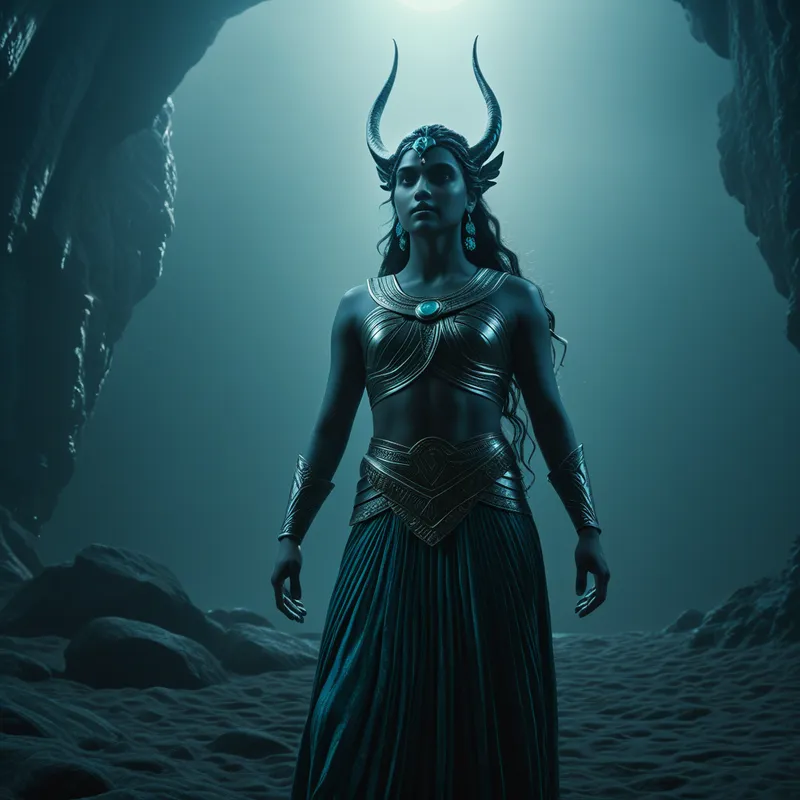
Raijin God of Thunder
A fearsome Shinto deity who commands thunder and storms, Raijin embodies nature's raw power and the dual forces of destruction and protection in Japanese mythology.
The Tale of Raijin God of Thunder
The birth of [Raijin](/myths/raijin “Myth from Japanese culture.”/) was a cataclysm. When the primordial goddess Izanami died giving birth to the fire god Kagutsuchi, her descent to [the land of Yomi](/myths/the-land-of-yomi “Myth from Shinto culture.”/), [the underworld](/myths/the-underworld “Myth from Greek culture.”/), fractured [the world](/myths/the-world “Myth from Tarot culture.”/). From her decaying form in that polluted realm, alongside other kami of [death](/myths/death “Myth from Tarot culture.”/) and disease, was born a child of furious, pent-up energy. His name was [Raijin](/myths/raijin “Myth from Japanese culture.”/), and he was a being of pure, untamed atmospheric rage. Cast out from the darkness that birthed him, he ascended into [the sky](/myths/the-sky “Myth from Persian culture.”/), claiming the tempest as his domain.
He is not a god of serene order, but of explosive becoming. His form is a testament to this: a demonic figure of red skin and wild, unkempt hair, often surrounded by a halo of drums. These are no ordinary instruments; they are taiko of the heavens, their hides stretched taut with the tension of the atmosphere itself. When Raijin’s restless energy peaks, he beats them with a furious, ecstatic rhythm. Each strike is a [thunderclap](/myths/thunderclap “Myth from Various culture.”/) that tears the fabric of the sky; the reverberations are the rolling growl of thunder that shakes [the earth](/myths/the-earth “Myth from Hindu culture.”/) to its roots. He does not play for an audience, but from a primal, insatiable need to express the power churning within him.
His brother, Fūjin, [the wind](/myths/the-wind “Myth from Various culture.”/) god, is his eternal companion and accomplice. Where Raijin provides the sound and fury, Fūjin unleashes the gales that [herald](/myths/herald “Myth from Greek culture.”/) the storm. Together, they are the chaotic heart of the typhoon, the sudden summer squall that uproots trees and floods plains. In one famous tale, their combined assault was so terrible it threatened the divine fleet of the Mongol invasions, giving rise to the concept of kamikaze—the “divine wind”—that protected Japan. Yet, Raijin is not merely an agent of foreign destruction. He is a domestic terror, a trickster of the skies. Folk belief holds he has a taste for the navels of children, prompting mothers to warn their sons and daughters to hide their bellies during a storm lest Raijin steal them away. This is not mere malice, but the mythic expression of nature’s indiscriminate, appetite-driven [chaos](/myths/chaos “Myth from Greek culture.”/), which can snatch the innocent as easily as it topples a tyrant.
Cultural Origins & Context
Raijin’s origins are deeply embedded in the animistic bedrock of Shinto, the “way of the kami.” In this worldview, every formidable force of nature is imbued with spiritual presence—a kami. The terrifying, life-giving, and destructive power of thunderstorms made them a prime subject for this personification. Raijin is not an abstract meteorological concept; he is the volatile spirit of the storm, a being with appetite, emotion, and will.
He represents a fundamental aspect of the Japanese relationship with nature: respectful fear. The archipelago’s geography makes it subject to violent seasonal typhoons, torrential rains, and lightning strikes that can cause both disaster and, through rainfall, fertility. Raijin embodies this critical duality. He is the necessary chaos that precedes renewal, the terrifying power that must be appeased. Worship and placation rituals were common, especially among farmers and fishermen whose lives depended on his capricious moods. Small household shrines and charms were dedicated to warding off his lightning, acknowledging that one does not command such a force, but negotiates with it.
Furthermore, his birth from [Izanami in Yomi](/myths/izanami-in-yomi “Myth from Shinto culture.”/) ties him to a profound spiritual pollution (kegare). He is, in a sense, a god born of death and defilement, which explains his wild, “demonic” (oni-like) appearance and his association with frightening, disruptive events. This connection does not make him evil, but rather places him outside the realm of pristine, celestial order. He is a necessary part of the cosmic whole, a reminder that creation and destruction, purity and pollution, are inextricably linked.
Symbolic Architecture
Raijin’s mythology constructs a symbolic [architecture](/symbols/architecture “Symbol: Architecture in dreams often signifies structure, stability, and the framing of personal identity or life’s journey.”/) where [chaos](/symbols/chaos “Symbol: In Arts & Music, chaos represents raw creative potential, uncontrolled expression, and the breakdown of order to forge new artistic forms.”/) is not the [enemy](/symbols/enemy “Symbol: An enemy in dreams often symbolizes an internal conflict, self-doubt, or an aspect of oneself that one struggles to accept.”/) of order, but its dynamic, terrifying [partner](/symbols/partner “Symbol: In dreams, the symbol of a ‘partner’ often represents intimacy, connection, and the dynamics of personal relationships, reflecting one’s desires and fears surrounding companionship.”/). He is the embodiment of [nature](/symbols/nature “Symbol: Nature symbolizes growth, connectivity, and the primal forces of existence.”/)’s ungovernable will, the sudden fracture in a quiet day that reminds humanity of its fragility and dependence.
His drums are the core of this symbolism. They represent the creative potential of chaos itself—the rhythmic pulse that can structure the formless into a powerful, albeit temporary, pattern. The thunder is not random noise, but the sound of creation happening, a violent music that reshapes the world.
His [appearance](/symbols/appearance “Symbol: Appearance in dreams relates to self-image, perception, and how you present yourself to the world.”/)—often depicted as a muscular, red-skinned figure with sharp claws and a fierce [expression](/symbols/expression “Symbol: Expression represents the act of conveying thoughts, emotions, and individuality, emphasizing personal communication and creativity.”/)—symbolizes raw, untamed libidinal [energy](/symbols/energy “Symbol: Energy symbolizes vitality, motivation, and the drive that fuels actions and ambitions.”/). This is the psychic force that breaks through repression, the explosive anger or creative surge that dismantles stagnant structures. He is the Rebel [archetype](/symbols/archetype “Symbol: A universal, primordial pattern or prototype in the collective unconscious that shapes human experience, behavior, and creative expression.”/) in its most elemental form, opposing not a specific tyrant, but the very [idea](/symbols/idea “Symbol: An ‘Idea’ represents a spark of creativity, innovation, or realization, often emerging as a solution to a problem or a new outlook on life.”/) of complacency and permanent calm. His partnership with Fūjin illustrates that such raw power ([thunder](/symbols/thunder “Symbol: A powerful natural sound symbolizing divine communication, sudden change, or emotional release in arts and music contexts.”/)) is always coupled with a moving force (wind); the outburst requires a medium to carry its transformative effect across the world.
The Dreamer’s Resonance
To encounter Raijin in a dream or in the depths of the [psyche](/myths/psyche “Myth from Greek culture.”/) is to meet the aspect of [the self](/myths/the-self “Myth from Jungian culture.”/) that refuses domestication. He is the thunderclap of repressed emotion—a long-simmering rage, a sudden bolt of insight, or a passionate desire that shatters the quiet facade of [the ego](/myths/the-ego “Myth from Jungian culture.”/). He represents those moments when the carefully maintained [persona](/myths/persona “Myth from Greek culture.”/) is split open by something more authentic and more terrifying.
Psychologically, Raijin resonates with [the shadow](/myths/the-shadow “Myth from Jungian culture.”/)’s explosive potential. He is not the quiet, hidden shame, but the shadow in active eruption—the tantrum, the fierce declaration, the creative mania that defies all polite convention. To integrate Raijin is not to become perpetually angry, but to acknowledge the legitimate, powerful force of one’s own intensity. It is to make room for the storm within, to give it its drums, so that its energy can be expressed and cycled, rather than suppressed until it causes irreparable internal or external damage. He calls the dreamer to respect their own power, to recognize that protection sometimes requires a show of formidable strength, and that true growth is often preceded by a necessary rupture.
Alchemical Translation
The alchemical process mirrored in Raijin’s myth is [solve et coagula](/myths/solve-et-coagula “Myth from Alchemical culture.”/)—dissolve and coagulate. He is the agent of the solve, the violent dissolution. His lightning is the fulgur of the alchemists, [the divine spark](/myths/the-divine-spark “Myth from Gnostic culture.”/) that in an instant breaks apart compounded matter, reducing it to its essential components. The old form—be it a dead tree, a stagnant belief, or a rigid social structure—is shattered by his strike.
This destruction is not an end, but the first, necessary step in renewal. The lightning flash illuminates the landscape with terrifying clarity, revealing what was hidden in the dark. The thunder that follows is the shockwave of this revelation, vibrating through the very bones of the world, shaking loose what is no longer needed.
The rain he brings completes the translation. It is the [aqua vitae](/myths/aqua-vitae “Myth from Alchemical culture.”/), the [water](/myths/water “Myth from Chinese culture.”/) of life that falls upon the scorched and broken ground, washing away the debris of the old and providing the moisture for new seeds to sprout. Raijin’s chaos is thus the precursor to fertility. The alchemical work is to hold the tension of this duality: to withstand the terrifying dissolution with the knowledge that it serves a future coagulation, a new and more resilient form born from the storm’s passage.
Associated Symbols
Explore related symbols from the CaleaDream lexicon:
- Thunder — The audible manifestation of rupturing force, a sound that vibrates through matter and psyche to announce a transformative event.
- Lightning — The instantaneous, illuminating strike that cleaves reality, representing sudden insight, divine inspiration, or destructive clarity.
- Chaos — The primal, unstructured state of potential from which all new forms emerge, embodied by Raijin’s storm.
- Drum — The instrument of rhythmic creation, translating chaotic energy into a powerful, structuring pulse that commands attention and incites action.
- Rebirth — The inevitable consequence of the storm’s passage, where the dissolution of the old makes way for the germination of the new.
- Shadow — The untamed, explosive aspect of the self that holds immense power and must be integrated rather than feared.
- Mountain — The earthly form that both attracts the storm’s fury and stands firm through it, symbolizing endurance amidst cataclysm.
- Rain — The cleansing and fertilizing gift that follows destruction, representing the nurturing potential released by chaotic events.
- Duality Mask — The visage that contains both the fearsome destroyer and the indirect life-giver, refusing a simple alignment with good or evil.
- Primal Chaos — The original, undifferentiated state of energy and matter that Raijin’s fury re-enacts and channels.
- Thunderclap — The singular, shocking moment of rupture that breaks silence and complacency, a call to immediate awareness.