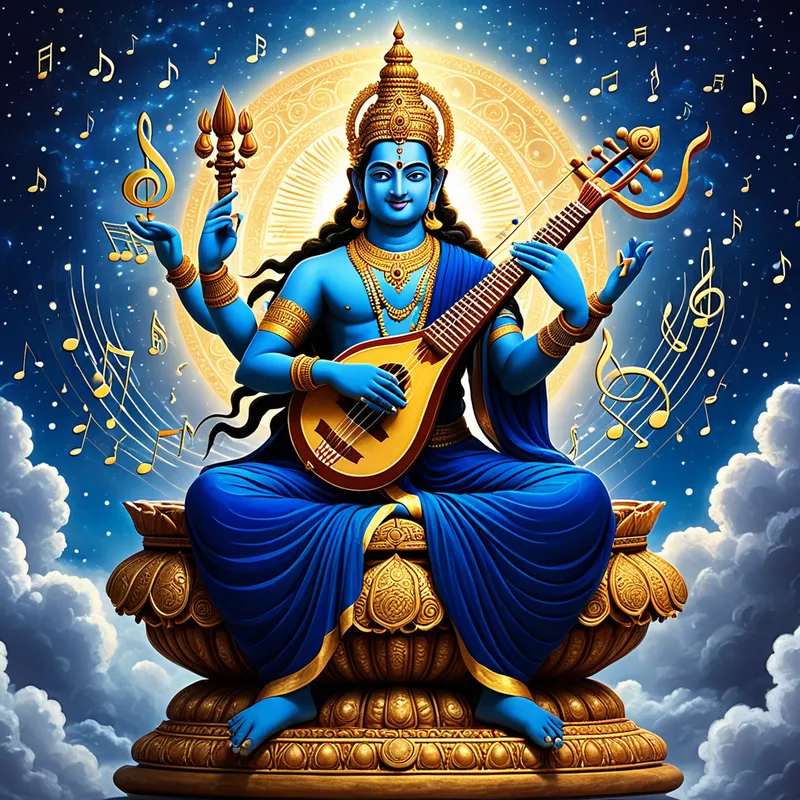
Ragas Myth Meaning & Symbolism
The myth of the Ragas, born from Shiva's cosmic dance, are divine melodies that govern time and emotion, guiding the soul's alchemical journey.
The Tale of Ragas
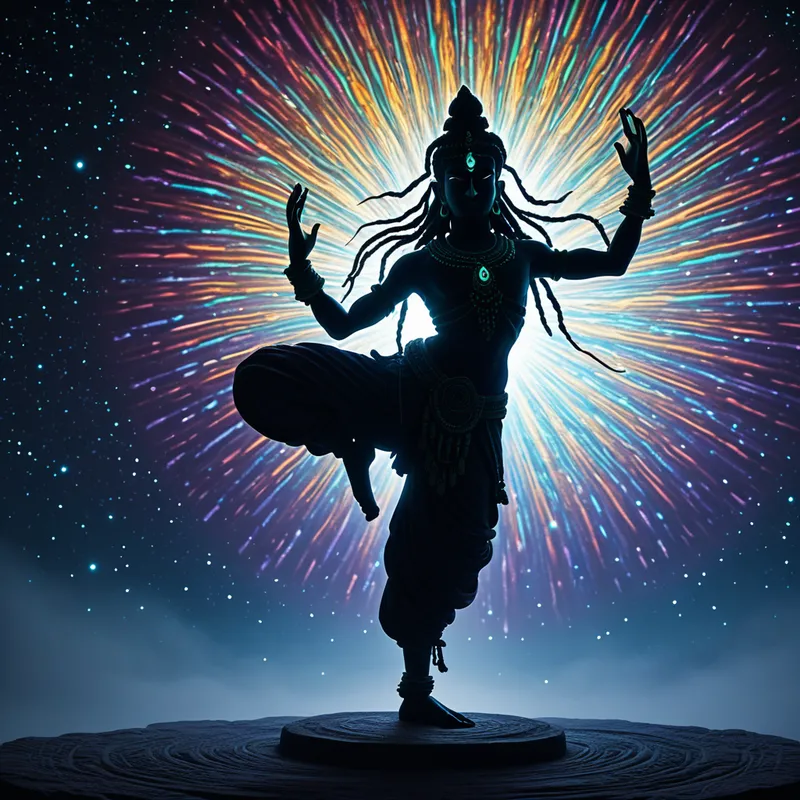
Listen. Before the first sunrise stained the sky, in the silence that is not silence but the hum of potential, Shiva danced.
This was not a dance upon the earth, but within the void of his own limitless consciousness, the Maya. His form was darkness absolute, yet etched with the fire of a billion stars. With each movement, universes flickered into being and were swept away in the tide of his flying locks. In one of his many hands, he held the damaru. It was a tiny thing against the cosmos, yet it contained the seed of all rhythm.
And he played it.
The first beat was a thunderclap that shattered eternity into time. The second was a heartbeat that gave pulse to the formless. From the furious, ecstatic shaking of the damaru—a rhythm so profound it was the very pattern of chaos becoming order—a cascade of notes spilled forth. They were not mere sounds. They were living entities, radiant and full-bodied, born from the intersection of divine movement and divine will.
They took shape in the air around the dancing god. Some were male, some female. Their complexions were the colors of the world yet to be: the deep blue of the midnight sky, the green of first growth, the crimson of passion's flame, the pale gold of dawn. They were the Ragas. Each one carried a distinct mood, a unique emotional climate. One radiated a serene, cooling peace like moonlight on a still lake. Another simmered with the restless, heroic energy of a noonday sun. A third wept with the poignant longing of the first monsoon rain.
Shiva assigned them their dominion: Time. Not just the hours, but the essence of moments. The heroic Raga Shri was given the afternoon, when the sun hangs heavy and resolve is tested. The deeply devotional Raga Bhairava was given the pre-dawn, the hour of profound solitude and yearning for the divine. The romantic Raga Hindola was given the season of blossoms. They became the unseen sovereigns of the emotional and temporal landscape, their silent music governing the rise and fall of feeling in every heart, the turning of seasons, the appropriate mood for every sacred and worldly act.
To hear a Raga performed at its appointed hour was not merely to listen to music. It was to step into a living myth, to be enveloped by a deity of emotion, to have one's own inner chaos momentarily ordered by the original pattern laid down in the cosmic dance. The myth tells us that the right Raga, at the right time, could summon rain, extinguish fires, or bring peace to a tormented soul. For the Raga was not invented; it was discovered—a fragment of the original, creative vibration of the universe, waiting to be channeled once more.
Cultural Origins & Context
The concept of the Ragas as divine beings is woven into the very fabric of Indian classical music and its sister arts. This mythology finds expression in texts like the Natyashastra and numerous medieval musicological treatises. It was not a mere allegory for artists but a foundational spiritual technology.
The myth was passed down through the guru-shishya parampara. A master would not just teach notes and scales; he would tell the story of the Raga—its birth from Shiva, its color, its personality, the season and time it governed, the deity it invoked. The student learned to become a vessel for this divine entity. The performance was a puja, a sacred offering. The musician, through immense discipline (sadhana), prepared themselves to be a clean conduit for this cosmic force.
Societally, this myth elevated music from entertainment to a direct means of moksha, a way to harmonize the individual soul (atman) with the universal rhythm (rita). It provided a sacred map of time, linking human emotion to the celestial clock, and offered a prescribed path to navigate the inner world through the outer discipline of art.
Symbolic Architecture
At its core, the myth of the Ragas is a profound map of the psyche's relationship with time and emotion. Shiva's dance represents the dynamic, often chaotic, ground of being—the unconscious Self in its raw, unmanifest state. The damaru is the instrument of differentiation, the point where unity becomes multiplicity.
The Raga is the archetypal form of an emotion, born when cosmic chaos is struck by the rhythm of conscious attention.
Each Raga symbolizes a specific, pure emotional complex. They are not the messy, personal feelings of daily life, but their distilled, eternal prototypes. Raga Deepak is the essence of fiery, transformative heat. Raga Malkauns is the essence of profound, introspective gravity. They represent the objective reality of our subjective states.
Their governance over time is the key psychological insight. The myth asserts that emotions are not random; they have seasons and cycles. There is a "right time" for grief, for joy, for passion, for serenity. To force a Raga out of its time is to create dissonance, both in music and in the soul. This mirrors the psychological need to honor the natural rhythm of our inner processes, rather than suppressing or forcing them.
The Dreamer's Resonance
When the archetype of the Raga stirs in the modern unconscious, it often manifests in dreams of powerful, non-verbal communication and atmospheric transformation. One might dream of a room that changes color with a sound, or of meeting a figure who communicates entirely through music that alters the dreamer's emotional state. These are visitations from the Raga-as-archetype.
Such dreams suggest the dreamer is undergoing a process of emotional differentiation. The chaotic soup of undifferentiated feeling (Shiva's formless dance) is beginning to be organized into distinct, nameable states (the individual Ragas). The somatic experience might be one of tension release or a sudden, clear understanding of a previously confusing emotion. It is the psyche's way of composing its own inner raga, of learning the specific "time" and quality of its own sorrow, its own joy. A dream of a forbidden or out-of-place Raga can signal a forced emotion—a grief ignored in its season, or a joy stifled by inappropriate circumstance.
Alchemical Translation
The journey of the musician mastering a Raga is a perfect allegory for the alchemical process of individuation. First, there is the base matter: the raw, undisciplined psychic energy and chaotic emotion (the prima materia). This is the student's initial, clumsy attempt to grasp the scale.
Then comes the disciplina, the years of rigorous practice (sadhana). This is the stage of separation and purification, burning away the ego's desire for personal expression to become an empty vessel. The musician's individual will is dissolved.
The ultimate goal is not to perform the Raga, but to allow the Raga to perform you—to let the archetype sing through the individual, transforming personal noise into universal music.
Finally, in the moment of true mastery, the coniunctio occurs. The musician's consciousness merges with the archetypal Raga. The personal self is not lost but is transcended, becoming the instrument for a transpersonal reality. The emotion expressed is no longer petty or personal; it is the pure, cosmic form of that emotion. This is psychic gold. The individual has successfully transmuted their subjective, temporal experience into a resonance with an objective, eternal pattern.
For the modern seeker, the myth instructs: Do not be afraid of your emotional chaos. Do not seek to silence the inner damaru. Instead, listen for its primordial rhythm. With conscious attention and disciplined inner work, you can differentiate the living "Ragas" within you—honor their appointed times, understand their unique colors and purposes, and ultimately, allow the supreme dancer within your own psyche to compose the unique, divine melody that is your authentic life.
Associated Symbols
Explore related symbols from the CaleaDream lexicon: