Rabia al-Adawiyya Myth Meaning & Symbolism
A slave girl's heart becomes a crucible for divine love, transforming chains into wings and illuminating the path of pure, unmediated devotion.
The Tale of Rabia al-Adawiyya
In the deep, velvet night of Basra, where the desert wind carried the scent of salt and sorrow, a story was born not of kings, but of a captive. Her name was Rabia al-Adawiyya. She entered the world not to a fanfare, but to a silence that would become her greatest teacher. Orphaned, sold, her childhood was a cup of bitterness. Her body knew the ache of the stone floor, her hands the roughness of labor, her neck the cold weight of a slave’s chain.
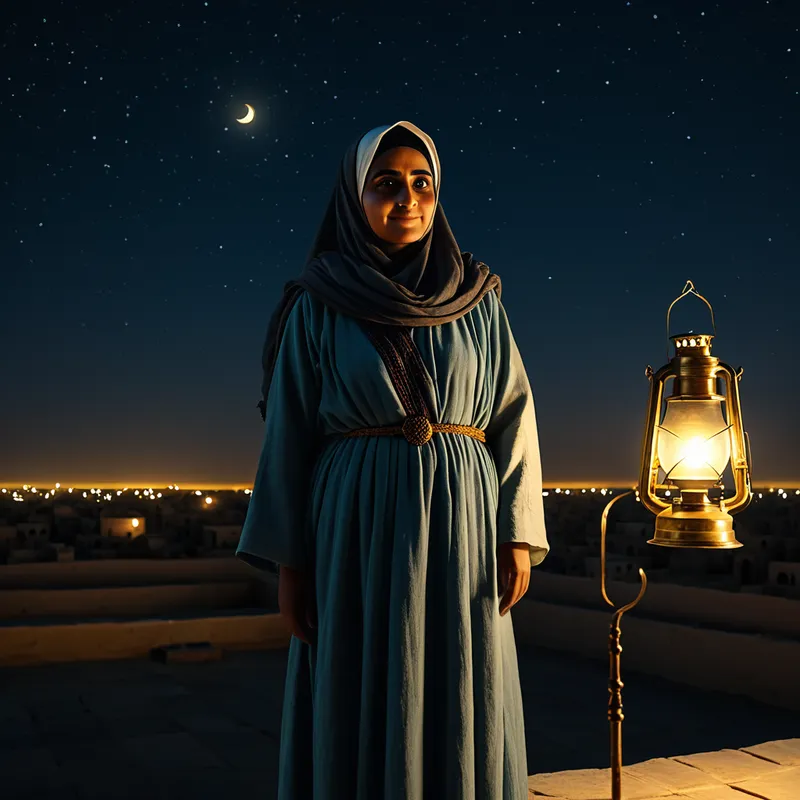
But within that prison of flesh and circumstance, a different fire was kindling. While her master’s house slept, Rabia would steal to the flat rooftop. There, under the vast, star-strewn dome of the Sky, she would prostrate. Not in plea for freedom from her master, but in a conversation so intimate it left no room for anyone else. The conflict was not against her captors, but against the very architecture of desire. One night, the legend says, her master was drawn by a strange light from his window. He saw Rabia in prayer, and above her, a great Lamp of light suspended from the heavens, casting her shadow long and holy upon the roof. In that moment, he saw not his property, but a sovereign of a different kingdom. He freed her the next dawn, but her true liberation had already occurred in that secret dialogue with the night.
Now unchained, her journey turned inward. She fled not to society, but to the desert’s austere embrace. The rising action of her life was a stripping away. She refused marriage, wealth, even the comfort of a permanent shelter. A seeker once found her sitting with her head bowed. “What are you doing?” he asked. “I am polishing the Mirror of my heart,” she replied, “so that when my Beloved looks, He sees only Himself.”
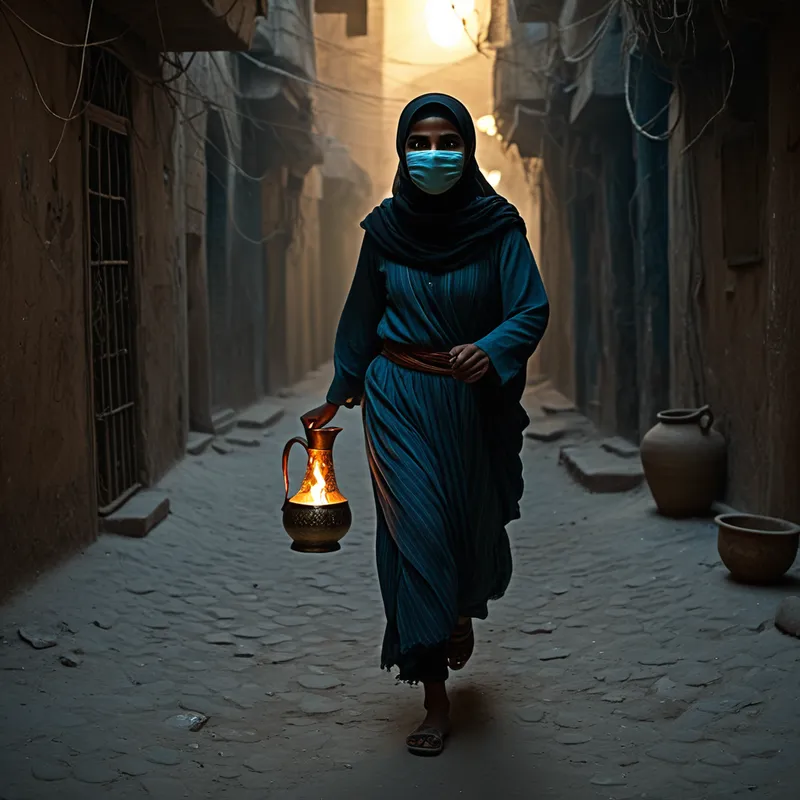
The tales swirl around her like desert sand. She was seen running through the streets with a Pitcher of water in one hand and a burning torch in the other. “I am going to quench the fires of Hell,” she declared, “and burn down the gardens of Paradise, so that people will love God for Himself alone, without fear of punishment or hope for reward.” Her conflict reached its zenith in this: the annihilation of all intermediaries between [the lover and the Beloved](/myths/the-lover-and-the-beloved “Myth from Sufi culture.”/).
Her resolution was not an event, but a state of being. She lived in a perpetual dawn of the heart. When asked if she hated Satan, she said, “My love for the Truth leaves no room for hate.” In her final hours, she asked those present to leave, that she might keep her last rendezvous in privacy. When they returned, they found her gone, having uttered her final testament: “O my Beloved… at last.”
Cultural Origins & Context
Rabia’s story emerges from the fertile, early soil of Sufism in 8th-century Iraq. Unlike the formalized theological and legal discourses of her time, her narrative was carried on the breath of oral tradition—whispered in khanaqahs, recounted by travelers, and later recorded in hagiographies like Attar’s “Memorial of the Saints.” She represents a pivotal, radical voice within Islamic spirituality, shifting the emphasis from obedience and law to the central, transformative power of ishq` (divine, passionate love).
Her societal function was profoundly disruptive. As a woman, a former slave, and an ascetic, she stood at the intersection of multiple marginalized identities, yet her authority was derived solely from her perceived intimacy with the Divine. Her myth served as a corrective and an inspiration, modeling a path of devotion that bypassed social hierarchy, gender norms, and transactional religion. She became a living symbol of the heart’s direct line to the ultimate reality, a proof that the deepest mystical realization was not the sole province of scholars or men, but accessible to any soul consumed by sincere love.
Symbolic Architecture
Rabia’s [life](/symbols/life “Symbol: The symbol of ‘Life’ represents a journey of growth, interconnectedness, and existential meaning, encompassing both the joys and challenges that define human experience.”/) is a map of the [soul](/symbols/soul “Symbol: The soul represents the essence of a person, encompassing their spirit, identity, and connection to the universe.”/)’s [alchemy](/symbols/alchemy “Symbol: A transformative process of purification and creation, often symbolizing personal or spiritual evolution through difficult stages.”/). Her physical slavery symbolizes the [human](/symbols/human “Symbol: The symbol of a human represents individuality, complexity of emotions, and social relationships.”/) [condition](/symbols/condition “Symbol: Condition reflects the state of being, often focusing on physical, emotional, or situational aspects of life.”/): bondage to ego, to societal expectations, to fear and desire. Her liberation is not merely social, but the awakening of an inner sovereignty that renders external conditions irrelevant.
The heart that loves God for Himself is a heart that has burned away the ledger of karma and the currency of reward.
The [pitcher](/symbols/pitcher “Symbol: A pitcher often embodies the themes of nourishment, attention, and the sharing of emotions or resources.”/) and [torch](/symbols/torch “Symbol: A portable light source symbolizing illumination, guidance, and the transfer of knowledge or life force.”/) are her ultimate symbolic act. They represent the [dissolution](/symbols/dissolution “Symbol: The process of breaking down, dispersing, or losing form, often representing transformation, release, or the end of a state of being.”/) of dualistic spiritual motivation—the Fear of hell and the Pride of heavenly reward. By seeking to annihilate these cosmic carrots and sticks, she aims to purify love itself, making it absolute and unconditional. The [lamp](/symbols/lamp “Symbol: A lamp symbolizes guidance, enlightenment, and the illumination of truth, often representing knowledge or clarity in dark times.”/) seen above her is the divine confirmation, the baraka that illuminates a soul who has become a transparent [vessel](/symbols/vessel “Symbol: A container or structure that holds, transports, or protects something essential, representing the self, emotions, or life journey.”/). Her entire life becomes a [Ritual](/symbols/ritual “Symbol: Rituals signify structured, meaningful actions carried out regularly, reflecting cultural beliefs and emotional needs.”/) of polishing the Mirror of the [heart](/symbols/heart “Symbol: The heart symbolizes love, emotion, and the core of one’s existence, representing deep connections with others and self.”/), removing the rust of selfhood until only the [reflection](/symbols/reflection “Symbol: Reflection signifies self-examination, awareness, and the search for truth within oneself.”/) of the Beloved remains.
The Dreamer’s Resonance
When the archetype of Rabia stirs in the modern Dream, it often signals a profound somatic and psychological shift. One may dream of being trapped in a menial job or a loveless relationship (the slavery), yet feeling a strange, inexplicable light growing within the chest. There may be dreams of holding contradictory elements—Fire and Water—not in conflict, but in a purposeful, urgent mission. This is the psyche initiating the purification of motive.
Somatically, this can feel like a burning in the heart center, a tightness releasing, or a profound longing (shawq) that has no earthly object. The dreamer is being called to distinguish between love that is transactional—love for security, approval, or personal gain—and love as an end in itself. The Shadow work here involves confronting the parts of oneself that seek spiritual experiences for egoic prestige (the Pride of the ascetic) or out of fear of existential emptiness. Rabia’s pattern in dreams guides the soul to burn these lesser motivations, however painful, to make room for the authentic.
Alchemical Translation
The individuation process modeled by Rabia is the alchemy of Love itself. The prima materia is the raw, selfish, needy human heart. The first stage (nigredo) is her slavery—the confrontation with one’s own limitations, dependencies, and conditioned responses. The liberation is the albedo, the washing clean, where one takes responsibility for one’s inner state regardless of outer circumstance.
The ultimate transmutation is not of lead into gold, but of desire into devotion, and of devotion into pure, subjectless presence.
The running with Fire and Water is the citrinitas, the active, conscious work of deconstructing the internal heavens and hells—the fantasy of perfect outcomes and the terror of failure that govern so much of our striving. Finally, the rubedo, the reddening, is the state of constant, luminous connection. The heart, once a chamber of personal want, becomes a Cup that simply contains the divine presence. The ego is not destroyed but repurposed; it becomes the servant of this love, not its negotiator. For the modern individual, this translates to doing one’s work not for accolades, engaging in relationships not for completion, and pursuing growth not to become “enlightened,” but simply because these actions are expressions of a fundamental, non-negotiable love for the texture of existence itself. The Destiny is not an achievement, but a state of perpetual, grateful rendezvous.
Associated Symbols
Explore related symbols from the CaleaDream lexicon:
- Fire — The transformative power of divine love that burns away all secondary motives, leaving only pure, luminous devotion.
- Water — The element of cleansing and grace, used not for personal comfort but to quench the punitive fires of fear-based religion.
- Mirror — The human heart, which Rabia sought to polish relentlessly so it could purely reflect the divine reality without the distortion of ego.
- Heart — The central organ of Rabia’s myth, representing not emotion but the spiritual core where the soul meets the Divine in unmediated love.
- Love — The absolute, non-transactional, and consuming force that is both the path and the destination in Rabia’s spiritual journey.
- Freedom — The inner liberation from all forms of bondage—social, psychological, and spiritual—achieved through total reliance on the Divine.
- Lamp — The divine light of confirmation and grace that illuminates the seeker who has become a true vessel of love.
- Journey — The inward odyssey from slavery of the ego to the sovereignty of the heart, which is the true pilgrimage.
- Shadow — The ego’s attachments to reward, recognition, and fear, which must be faced and dissolved on the path of pure devotion.
- Cup — The soul as a receptacle, made empty of self in order to be filled entirely with the presence of the Beloved.
- Destiny — The soul’s ultimate rendezvous with the Divine, understood not as a future event but as the ever-present reality of the loving relationship.