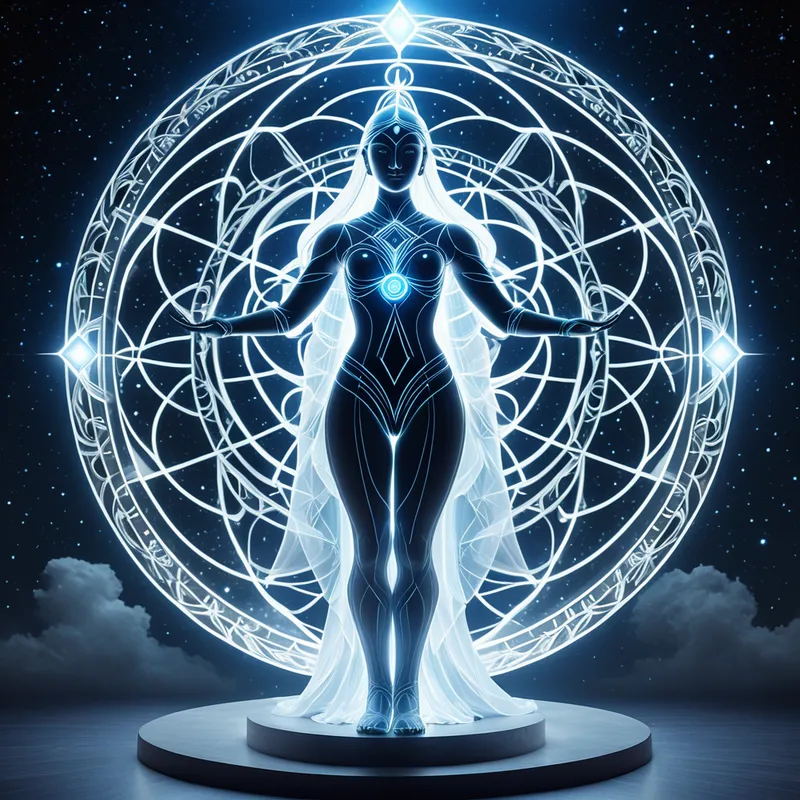
Quintessence Myth Meaning & Symbolism
The story of the fifth element, born from the sacred marriage of opposites, representing the perfected spirit and the ultimate goal of the alchemical opus.
The Tale of Quintessence
Listen, and I will tell you of the birth of the fifth. In the beginning, there was the Chaos, a seething, formless potential. From it, the Great Artificer separated the four: the heavy, dreaming Earth; the fluid, feeling [Water](/myths/water “Myth from Chinese culture.”/); the dancing, thinking Air; and the consuming, willing Fire. Each claimed dominion, and in their strife, [the world](/myths/the-world “Myth from Tarot culture.”/) was made, a beautiful, broken [thing](/myths/thing “Myth from Norse culture.”/) of seasons and strife, growth and decay.
But a profound loneliness settled upon the cosmos. The elements were perfect in their nature, yet incomplete. Earth yearned for [the sky](/myths/the-sky “Myth from Persian culture.”/), Water for the flame, Air for the stability of stone, and Fire for the quenching embrace of the deep. Their conflict was a dance of desire, a tragic love story written in eruptions and floods, in gentle breezes and crumbling mountains.
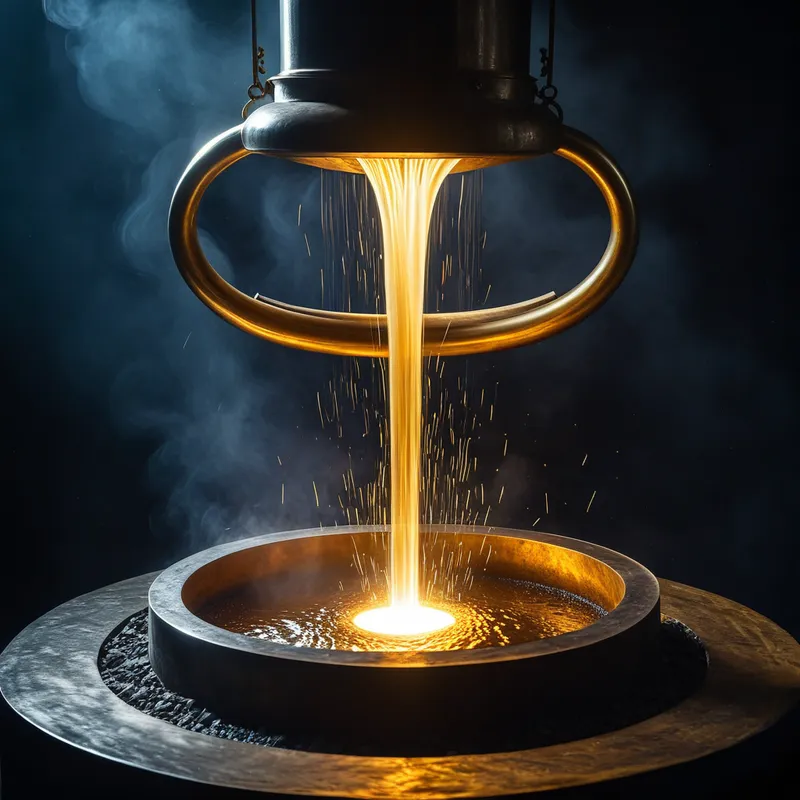
Deep within the secret heart of the world, in a chamber that was neither cavern nor cloud, the Athanor—the cosmic furnace—hummed with a patient, eternal heat. Here, the whispers of the elements gathered. It was said that if one could capture the pure, unadulterated spirit of each—the [prima materia](/myths/prima-materia “Myth from Alchemical culture.”/) of Earth, the aqua vitae of Water, the [pneuma](/myths/pneuma “Myth from Greek culture.”/) of Air, and the ignis innaturalis of Fire—and compel them to congress, a miracle would occur. But this was no mere mixing. It required a coniunctio oppositorum, a [sacred marriage](/myths/sacred-marriage “Myth from Alchemy culture.”/) of the deepest opposites: the King of Solar Gold and the Queen of Lunar Silver.
Many an adept tried and failed, producing only foul smoke and brittle slag. Their error was force. They sought to command, not to court. The true alchemist, [the vessel](/myths/the-vessel “Myth from Alchemical culture.”/) of the work, had to become the marriage bed itself. He had to hold the tension of the opposites within his own soul—his own solar will and lunar soul—until they bled and wept and longed for each other.
In the tale, the moment comes not with a roar, but with a sigh. The purified King and Queen, dissolved in the Mercurial Spirit, gaze upon one another in the glass. Their conflict ceases. In a flash of silent, unbearable recognition, they rush together. It is not a battle, but a consummation. A blinding, white-gold light erupts from the vessel, a light that sings a single, perfect note. From this luminous chaos, a new presence precipitates. It is not a fifth element added to the four, but the perfected essence of the four united. It is the Quintessence—The Philosophers’ Stone.
It has no weight, yet anchors the cosmos. It has no form, yet gives shape to possibility. It is the hidden harmony, [the music of the spheres](/myths/the-music-of-the-spheres “Myth from Greek culture.”/) made substance. Where it flows, division heals. Base metal glimpses its golden soul. The sick body remembers wholeness. The weary spirit touches eternity. The four elemental dragons lay down their strife, not out of defeat, but because they have finally seen their true mother, their original, unified face.
Cultural Origins & Context
The myth of Quintessence is not a folktale with a single origin, but the core narrative engine of the entire Western alchemical tradition, spanning from Hellenistic Egypt through the Islamic [Golden Age](/myths/golden-age “Myth from Universal culture.”/) to the Renaissance and early modern Europe. It was passed down not by bards to a crowd, but in encrypted texts, cryptic emblems, and oral teachings from master to apprentice in hidden laboratories and monastic scriptoria. Its tellers were figures like [Hermes Trismegistus](/myths/hermes-trismegistus “Myth from Greek culture.”/), Jabir ibn Hayyan, and later, adepts writing under pseudonyms like Basil Valentine.
Its societal function was profoundly dual. Exoterically, it was a framework for proto-chemistry, a guide for material transformation seeking medicinal elixirs and transmutation. Esoterically, and more importantly, it was a psycho-cosmology. It provided a symbolic language for the soul’s journey from a state of ignorant, conflicted fragmentation ([Nigredo](/myths/nigredo “Myth from Alchemical culture.”/)) to integrated, enlightened perfection ([Rubedo](/myths/rubedo “Myth from Alchemical culture.”/)). In a world where the Church dictated the path to salvation, alchemy offered a parallel, experiential path of inner transformation, where the divine was not just worshipped, but conceived and born within the human vessel.
Symbolic Architecture
At its [heart](/symbols/heart “Symbol: The heart symbolizes love, emotion, and the core of one’s existence, representing deep connections with others and self.”/), the myth is a [blueprint](/symbols/blueprint “Symbol: A blueprint represents the foundational plan or design for something, often symbolizing potential, structure, and the mapping of one’s inner self or future.”/) for wholeness. The four warring elements represent the fragmented [human](/symbols/human “Symbol: The symbol of a human represents individuality, complexity of emotions, and social relationships.”/) [psyche](/myths/psyche “Myth from Greek culture.”/): the [body](/symbols/body “Symbol: The body in dreams often symbolizes the dreamer’s self-identity, personal health, and the relationship they have with their physical existence.”/) ([Earth](/symbols/earth “Symbol: The symbol of Earth often represents grounding, stability, and the physical realm, embodying a connection to nature and the innate support it provides.”/)), the emotions ([Water](/symbols/water “Symbol: Water symbolizes the subconscious mind, emotions, and the flow of life, representing both cleansing and creation.”/)), the intellect (Air), and the will/drive (Fire). Our inner conflicts—between thought and feeling, [action](/symbols/action “Symbol: Action in dreams represents the drive for agency, motivation, and the ability to take control of situations in waking life.”/) and inertia, [passion](/symbols/passion “Symbol: Intense emotional or physical desire, often linked to love, creativity, or purpose. Represents life force and deep engagement.”/) and [stability](/symbols/stability “Symbol: A state of firmness, balance, and resistance to change, often represented by solid objects, foundations, or steady tools.”/)—are the elemental [drama](/symbols/drama “Symbol: Drama signifies narratives, emotional expression, and the exploration of human experiences.”/).
The crucible is the Self, and the heat is the suffering of consciousness held in tension.
The [King](/symbols/king “Symbol: A symbol of ultimate authority, leadership, and societal order, often representing the dreamer’s inner power or external control figures.”/) and [Queen](/symbols/queen “Symbol: A queen represents authority, power, nurturing, and femininity, often embodying leadership and responsibility.”/) are the ultimate psychic opposites, often framed as [Logos](/myths/logos “Myth from Christian culture.”/) and Eros, conscious and unconscious, [spirit](/symbols/spirit “Symbol: Spirit symbolizes the essence of life, vitality, and the spiritual journey of the individual.”/) and [soul](/symbols/soul “Symbol: The soul represents the essence of a person, encompassing their spirit, identity, and connection to the universe.”/), or the [animus](/symbols/animus “Symbol: In Jungian psychology, the masculine inner personality in a woman’s unconscious, representing logic, action, and spiritual guidance.”/) and [anima](/symbols/anima “Symbol: The feminine archetype within the male unconscious, representing soul, creativity, and connection to the inner world.”/). Their sacred [marriage](/symbols/marriage “Symbol: Marriage symbolizes commitment, partnership, and the merging of two identities, often reflecting one’s feelings about relationships and social obligations.”/) is not the annihilation of [difference](/symbols/difference “Symbol: Difference symbolizes diversity, change, and the contrast between ideas or people.”/), but its transcendence in a third, superior state. The [Quintessence](/symbols/quintessence “Symbol: The fifth element or pure essence beyond earth, air, fire, and water, representing perfection, the divine, and the fundamental nature of reality.”/) that results is the Self—the central, ordering principle of the [personality](/symbols/personality “Symbol: Personality in dreams often symbolizes the traits and characteristics of the dreamer, reflecting how they perceive themselves and how they believe they are perceived by others.”/) that was always there, but obscured by elemental strife. It is the experience of meaning, [purpose](/symbols/purpose “Symbol: Purpose signifies direction, meaning, and intention in life, often reflecting personal ambitions and core values.”/), and inner coherence.
The [Stone](/symbols/stone “Symbol: In dreams, a stone often symbolizes strength, stability, and permanence, but it may also represent emotional burdens or obstacles that need to be acknowledged and processed.”/) is not an external object to be found, but the [condition](/symbols/condition “Symbol: Condition reflects the state of being, often focusing on physical, emotional, or situational aspects of life.”/) of the psyche that has achieved this union. It is the [ability](/symbols/ability “Symbol: In dreams, ‘ability’ often denotes a recognition of skills or potential that one possesses, whether acknowledged or suppressed.”/) to “transmute” leaden experiences—suffering, conflict, base desires—into the gold of wisdom and [compassion](/symbols/compassion “Symbol: A deep feeling of empathy and concern for others’ suffering, often involving a desire to help or alleviate their pain.”/). The myth asserts that perfection (the [Stone](/symbols/stone “Symbol: In dreams, a stone often symbolizes strength, stability, and permanence, but it may also represent emotional burdens or obstacles that need to be acknowledged and processed.”/)) is not the [absence](/symbols/absence “Symbol: The state of something missing, void, or not present. Often signifies loss, potential, or existential questioning.”/) of the base, but its ultimate [redemption](/symbols/redemption “Symbol: A theme in arts and music representing transformation from failure or sin to salvation, often through creative expression or cathartic performance.”/).
The Dreamer’s Resonance
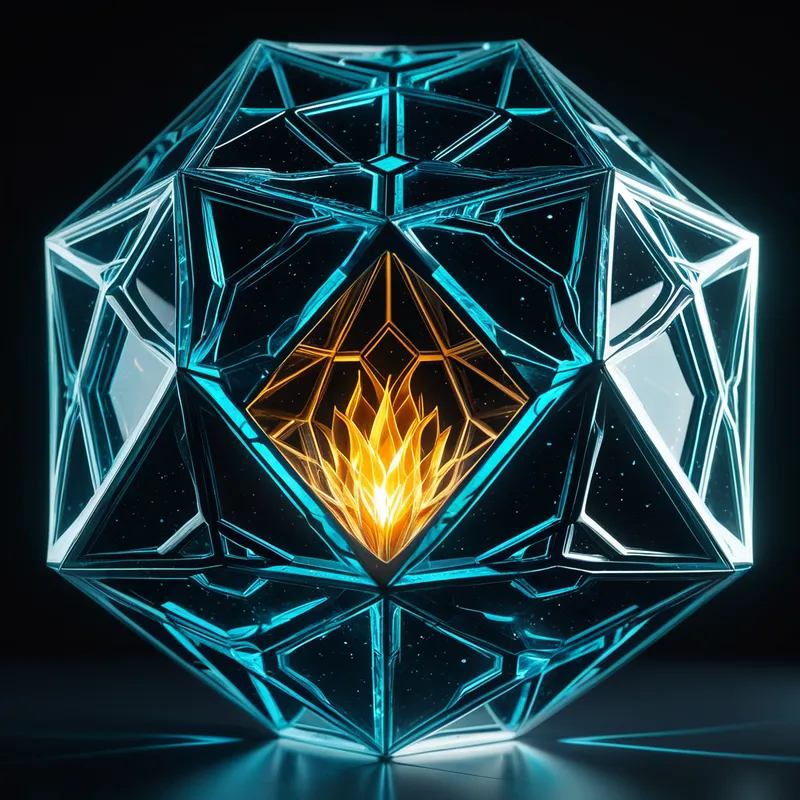
When this myth stirs in the modern unconscious, it often manifests in dreams of profound synthesis and resolution. A dreamer may find a mysterious, radiant jewel or crystal that emits a calming, unifying light, instantly resolving a chaotic dream scene. They may dream of two powerful, opposing figures (a raging giant and a serene queen, a sun and a moon) embracing or merging into a single androgynous being of light.
Somatically, this can correlate with a psychological process of integration following a period of intense inner conflict or “dark night of the soul” (Nigredo). The dreamer is moving from a state where opposing parts of themselves are at war (e.g., career ambition vs. family desire, rationality vs. deep emotion) toward a nascent, hard-won inner peace. The dream of Quintessence is the psyche’s announcement that a new, more resilient level of organization is being born from the ashes of the old contradictions. It is often accompanied upon waking by a sense of deep, quiet clarity, a somatic feeling of being “centered” or “grounded” in a new way.
Alchemical Translation
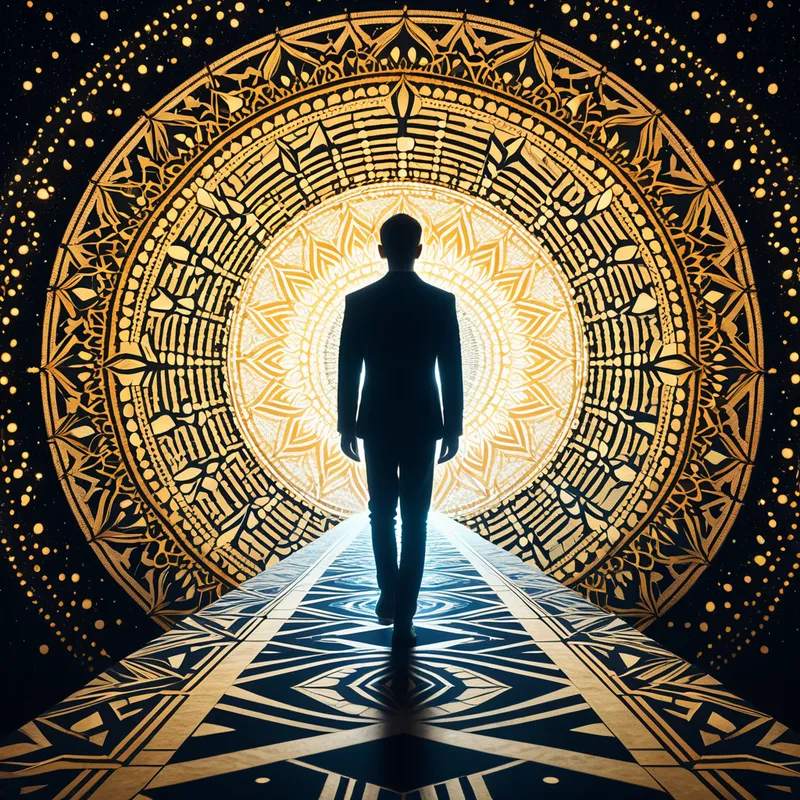
For the modern individual, [the opus](/myths/the-opus “Myth from Alchemical culture.”/) of Quintessence is the journey of Individuation. [The laboratory](/myths/the-laboratory “Myth from Alchemical culture.”/) is one’s own life. The first step is recognizing the base matter—owning one’s “lead,” one’s flaws, complexes, and unresolved conflicts (the chaotic [four elements](/myths/four-elements “Myth from Greek culture.”/)). The next is the arduous work of separation and purification (Albedo)—through introspection, therapy, or creative expression—distinguishing the authentic King and Queen (one’s true values and deep feelings) from the dross of [persona](/myths/persona “Myth from Greek culture.”/) and expectation.
The marriage cannot be willed; it can only be suffered into being, as the vessel holds the fire.
The central, transformative phase is holding the coniunctio—the tension of opposites—without resorting to one-sidedness. This is [the crucible](/myths/the-crucible “Myth from Alchemical culture.”/): to feel fully one’s desire for security and freedom, for tradition and innovation, without prematurely choosing one and repressing the other. This suffering-in-tension is [the athanor](/myths/the-athanor “Myth from Alchemy culture.”/)‘s heat. If one can endure it, a spontaneous, numinous union occurs (often experienced as a profound insight, a creative breakthrough, or a moment of unconditional self-acceptance). This is the birth of the inner Quintessence.
The result is not a perfect person, but a cohesive one. The individual gains the “Philosophers’ Stone” of perspective—the ability to find meaning and value in all experiences, to transmute suffering into growth. [The four elements](/myths/the-four-elements “Myth from Greek culture.”/) of the personality are not eliminated; they are harmonized. Earth provides groundedness, Water empathy, Air discernment, and Fire passionate action—all now in service to the centered, guiding light of [the Self](/myths/the-self “Myth from Jungian culture.”/). One becomes, in a humble, human way, an agent of Quintessence: a source of integration in a world of fragmentation.
Associated Symbols
Explore related symbols from the CaleaDream lexicon: