Qubba Myth Meaning & Symbolism
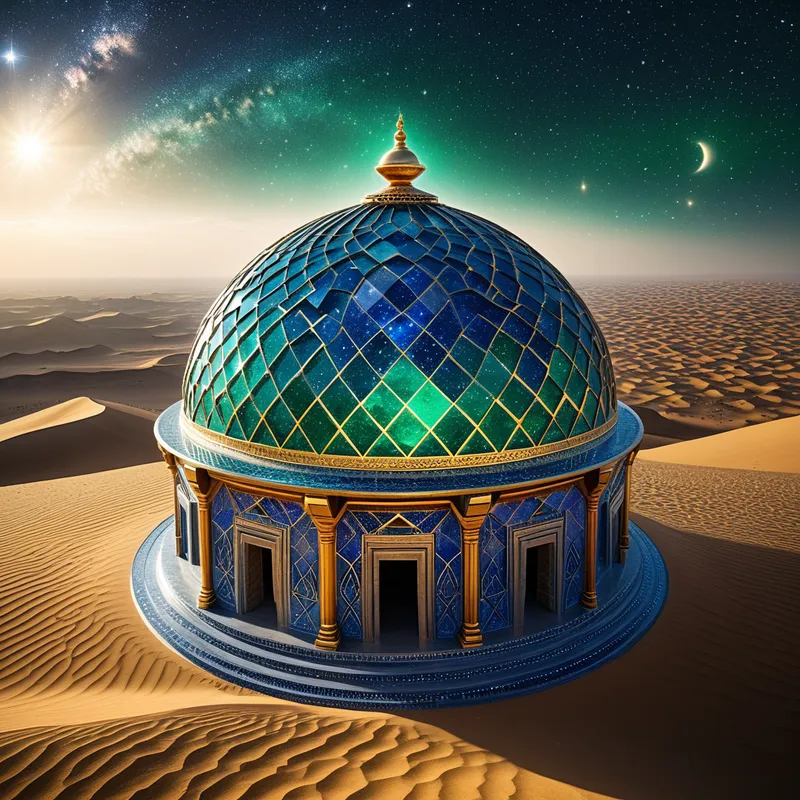
A myth of the celestial dome, Qubba, whose collapse sends humanity on a quest to rebuild the sacred center and restore cosmic harmony.
The Tale of Qubba
In the time before time was counted, when [the sky](/myths/the-sky “Myth from Persian culture.”/) was a seamless garment of indigo and [the earth](/myths/the-earth “Myth from Hindu culture.”/) a receptive silence, there stood in the heavens the Qubba. It was not a structure of stone, but of intention—a perfect, shimmering dome of celestial geometry, woven from the first command, Kun (Be!). Its curves held the constellations in their dance; its apex was the still point around which all creation turned. Beneath its sheltering arc, [the world](/myths/the-world “Myth from Tarot culture.”/) knew its place. The seasons flowed, the rains descended in their measure, and in the heart of the great desert, a point of perfect resonance hummed—the Markaz, the navel of [the world](/myths/the-world “Myth from Tarot culture.”/).
Humanity lived in [the shadow](/myths/the-shadow “Myth from Jungian culture.”/) of this grace, their lives a reflection of its order. But the human heart is a vessel of infinite capacity, and within it grew a whisper, then a murmur, then a clamor—a hunger not for more of the divine light, but for the source itself. They looked not at the beauty of the design, but coveted the hand of the Designer. They sought to build towers of ambition, not to praise, but to peer behind [the veil](/myths/the-veil “Myth from Various culture.”/). Their collective yearning, untempered by humility, became a needle of pride aimed at the firmament.
And the Qubba trembled.
It began as a sigh across the heavens, a single star winking out of its appointed place. Then a crack, silent and profound, appeared in the perfect curve—a line of deepest black against the lapis lazuli. With a sound like a mountain dissolving into sand, the dome shattered. Not into fragments of matter, but into shards of meaning. The fixed order of the stars scattered into chaos. The rains forgot their paths, the winds their names. The Markaz in [the desert](/myths/the-desert “Myth from Biblical culture.”/) was silenced, its resonant hum replaced by a hollow, keening wind.
A great desolation fell upon the people. They were not cast out of a garden, but from the very architecture of belonging. The sky was now a gaping wound, an open maw of terrifying freedom. In their despair, a voice arose, not from the heavens, but from the deepest well of memory within them. It was the voice of the first covenant, the Fitra, speaking through the lips of dreamers and those who kept the old ways.
“Seek the center,” it whispered on the night wind. “Gather the scattered light. Remember the shape of home.”
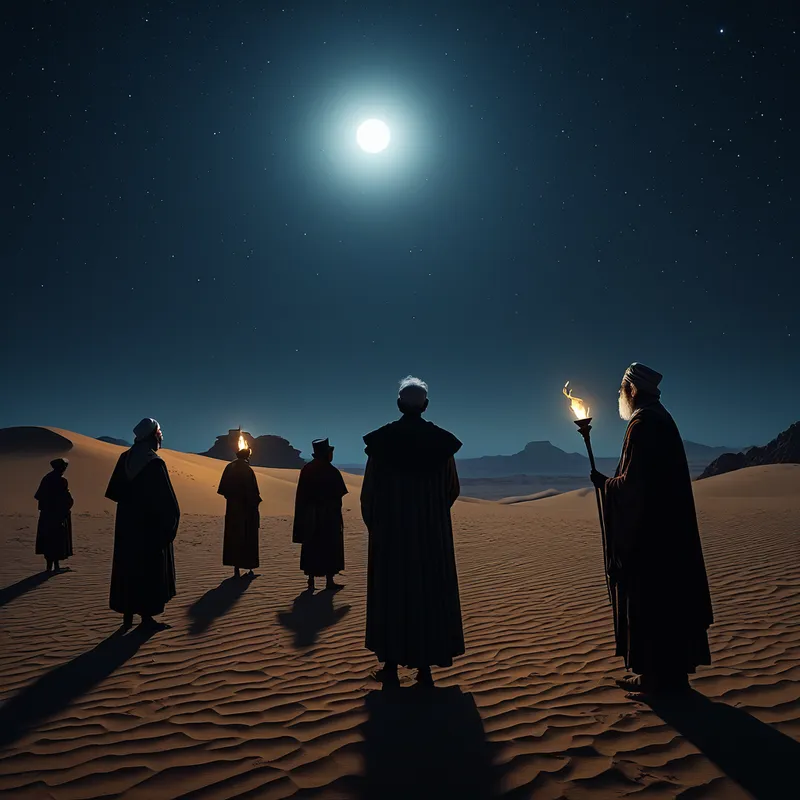
And so began the Long Return. Caravans of seekers, guided by the faint, lingering memory of the Markaz, trekked into the heart of the desert. They were not heroes with swords, but astronomers, poets, stone-masons, and [water](/myths/water “Myth from Chinese culture.”/)-finders. Their quest was not to conquer, but to recollect. They studied the erratic stars, searching for the ghost of the old pattern. They built small, perfect domes of mud-brick, not as replicas, but as prayers in form—each curve an act of remembrance, each alignment a syllable in a language they had half-forgotten.
Generations passed under the broken sky. The memory of the Qubba became the myth that guided them. Until, in a place where the dunes formed a natural basin and the silence was most complete, they found it. Not the physical dome, but the echo of its essence. Here, through collective aspiration, perfected geometry, and hearts purified by longing, they built. And as the final stone was set, not restoring the old dome to the sky, but creating a new qubba upon the earth, a miracle of a different order occurred. The chaos above did not suddenly reorder. Instead, within the shelter of that human-made dome, the perfect order was reflected. The cosmic harmony was not seized from the heavens, but grown from the earth upward, a testament to the covenant remembered. The center held once more, not because it was given, but because it was earned through the long night of seeking.
Cultural Origins & Context
The myth of the Qubba finds its roots not in a single canonical text, but in the rich loam of Islamic mystical thought, cosmology, and architectural symbolism. It is a narrative woven from threads of Tasawwuf (Sufism), philosophical inquiry, and the profound symbolic language of sacred geometry. Passed down through allegorical teachings of masters, poetic allusions in the works of thinkers like Ibn Arabi, and embodied in the very stones of mosques and shrines, it functions as a meta-myth about the human condition post-Revelation.
Its tellers were often the Murshid, the spiritual guides, who used it not as a historical account but as a teaching story. It served a critical societal and psychological function: to explain the experience of spiritual alienation (ghurba) and the imperative of the return journey (awda). In a culture deeply aware of divine transcendence (tanzih), the myth consoles by suggesting that immanence (tashbih)—the divine presence in the world—can be approached through sincere seeking and right action. The physical qubba, crowning sacred spaces from the Qubbat as-Sakhrah to local [saints](/myths/saints “Myth from Christian culture.”/)’ tombs, became a constant, architectural reminder of this myth, a solid echo of the celestial archetype in the human realm.
Symbolic Architecture
At its core, the Qubba myth is a profound map of the [psyche](/myths/psyche “Myth from Greek culture.”/). The primordial, intact [dome](/symbols/dome “Symbol: A dome symbolizes shelter, protection, and the boundaries we place around our personal lives, as well as aspirations toward the divine or higher consciousness.”/) represents the original, unconscious unity of the [soul](/symbols/soul “Symbol: The soul represents the essence of a person, encompassing their spirit, identity, and connection to the universe.”/) with the divine—a state of pre-conscious [paradise](/symbols/paradise “Symbol: A perfect, blissful place or state of being, often representing ultimate fulfillment, harmony, and transcendence beyond ordinary reality.”/) where order is inherent and unquestioned. Its shattering is the inevitable [crisis](/symbols/crisis “Symbol: A crisis symbolizes turmoil, urgent challenges, and the need for immediate resolution or change.”/) of [consciousness](/symbols/consciousness “Symbol: Consciousness represents the state of awareness and perception, encompassing thoughts, feelings, and experiences.”/). It is the [moment](/symbols/moment “Symbol: The symbol of a ‘moment’ embodies the significance of transient experiences that encapsulate emotional depth or pivotal transformations in life.”/) [the ego](/myths/the-ego “Myth from Jungian culture.”/) awakens, looks at the wholeness of [the Self](/myths/the-self “Myth from Jungian culture.”/), and, in its prideful desire for ownership rather than [relationship](/symbols/relationship “Symbol: A representation of connections we have with others in our lives, often reflecting our emotional state.”/), severs the [connection](/symbols/connection “Symbol: Connection symbolizes relationships, communication, and bonds among individuals.”/).
The broken dome is not a punishment, but the necessary condition for a conscious relationship with the sacred. One cannot seek a center one has never left.
The scattered stars symbolize the [fragmentation](/symbols/fragmentation “Symbol: The experience of breaking apart, losing cohesion, or being separated into pieces. Often represents disintegration of self, relationships, or reality.”/) of the psyche—our disparate drives, conflicting desires, and lost sense of [purpose](/symbols/purpose “Symbol: Purpose signifies direction, meaning, and intention in life, often reflecting personal ambitions and core values.”/). The Markaz, the silent center, is the archetypal Self, the God-[image](/symbols/image “Symbol: An image represents perception, memories, and the visual narratives we create in our minds.”/) within, which remains as a potential even when its voice is drowned out by the [noise](/symbols/noise “Symbol: Noise in dreams signifies distraction, confusion, and the need for clarity amidst chaos.”/) of [chaos](/symbols/chaos “Symbol: In Arts & Music, chaos represents raw creative potential, uncontrolled expression, and the breakdown of order to forge new artistic forms.”/). The long [journey](/symbols/journey “Symbol: A journey in dreams typically signifies adventure, growth, or a significant life transition.”/) through the desert is the arduous [path](/symbols/path “Symbol: The ‘path’ symbolizes a journey, choices, and the direction one’s life is taking, often representing individual growth and exploration.”/) of individuation, where one must confront the arid stretches of [the personal unconscious](/myths/the-personal-unconscious “Myth from Jungian Psychology culture.”/), the nafs (the egoic self), with only the faint inner compass of the Fitra to guide. The building of the earthly dome is the ultimate symbolic act: the conscious reconstruction of a personal cosmology, a weltanschauung, that can once again contain and reflect the divine order, not through passive [reception](/symbols/reception “Symbol: The symbol of ‘reception’ often signifies the act of welcoming or accepting new ideas, experiences, or people into one’s life.”/), but through active, creative [integration](/symbols/integration “Symbol: The process of unifying disparate parts of the self or experience into a cohesive whole, often representing psychological wholeness or resolution of internal conflict.”/).
The Dreamer’s Resonance
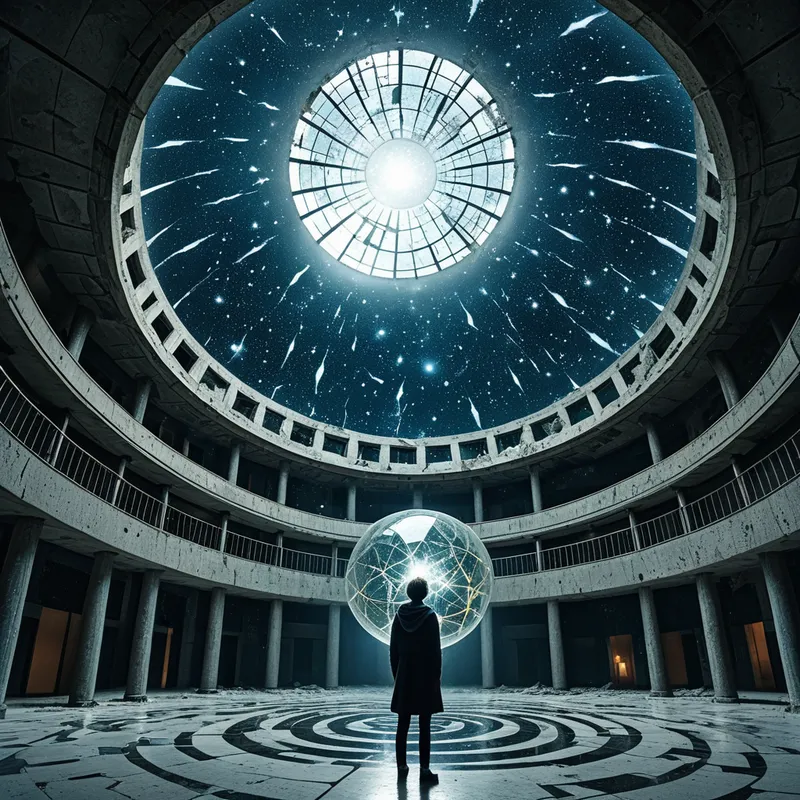
When this myth stirs in the modern unconscious, it often manifests in dreams of architectural crisis or celestial longing. The dreamer may find themselves in a familiar building—a home, a library, a train station—only to discover the roof is missing, exposing a chaotic, stormy, or awe-inspiring night sky. They may be tasked with collecting scattered, shining fragments on a vast plain. Or they may be standing before a simple, perfect dome, feeling an overwhelming somatic response of peace, completion, and “rightness.”
These dreams signal a psychological process at a critical juncture. The shattered dome dream often coincides with the collapse of a long-held belief system, identity, or life structure. The somatic feeling is one of exposure, vulnerability, but also terrifying potential. The dream of gathering fragments is the psyche’s work of recollection—integrating lost parts of the personality, reconciling with the past, and seeking unifying patterns in life’s chaos. The completed dome dream marks a moment of profound psychic synthesis, where the ego has successfully built a temporary, functional structure that aligns with the deeper Self. It is not a final state, but a testament to the process itself.
Alchemical Translation
The alchemical journey mirrored in the Qubba myth is the opus contra naturam—the work against nature—which here means against the fallen, fragmented state. It begins with the [nigredo](/myths/nigredo “Myth from Alchemical culture.”/), the blackening: the shattering of the dome, the descent into the chaos of meaninglessness. The desert journey is the albedo, the whitening, a purification through the harsh, clarifying light of introspection and the stripping away of egoic illusions.
The seeker in the desert does not find the dome; they become the site upon which it can be built. The material is the substance of their own lived experience, refined by longing.
The careful study of the stars—the search for pattern in chaos—is the mental citrinitas, the yellowing, where insight and intellectual understanding begin to coalesce. Finally, the act of building is the [rubedo](/myths/rubedo “Myth from Alchemical culture.”/), the reddening. This is the embodied, passionate, and creative act of giving form to the integrated Self. The earthly qubba is [the philosopher’s stone](/myths/the-philosophers-stone “Myth from Alchemical culture.”/) of this process: not a stone at all, but a living, psychic structure. It represents the achievement of a temporary, functional wholeness where the conscious mind (the builders, the community) has aligned itself with the transcendent order (the celestial blueprint). For the modern individual, this translates to the conscious creation of a life of meaning—forging a personal philosophy, ethical framework, or creative practice that is robust enough to shelter one’s soul and reflect, in its own small, perfect way, the cosmic harmony it diligently sought. The dome is rebuilt not in the sky, but in the human heart, and from there, it changes everything under its arch.
Associated Symbols
Explore related symbols from the CaleaDream lexicon: