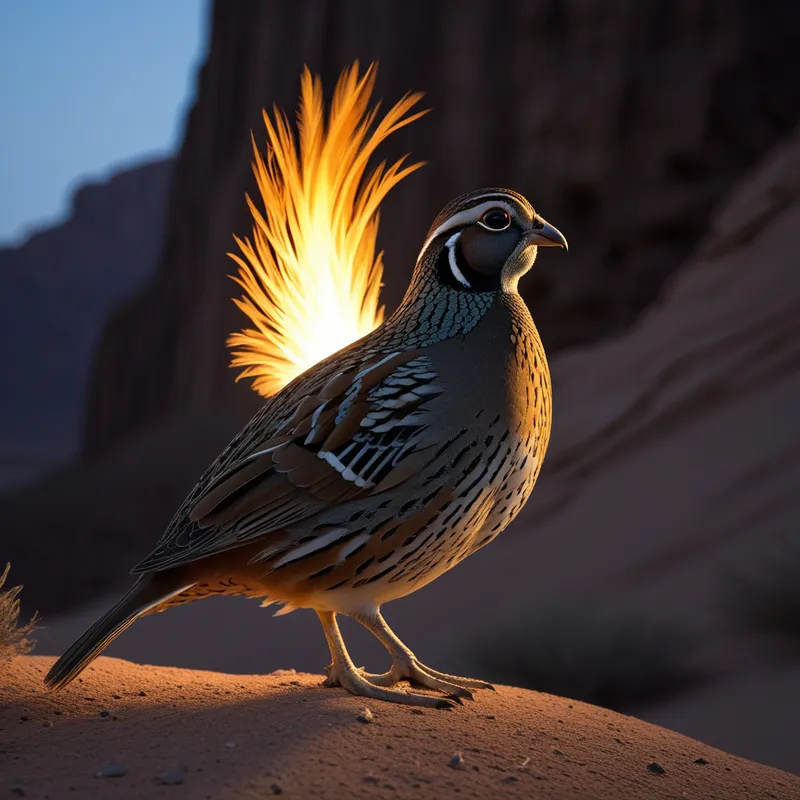
Quail in Folklore Myth Meaning & Symbolism
A myth where a small, humble bird's sacrifice brings fire to humanity, embodying transformation through vulnerability and collective survival.
The Tale of Quail in Folklore
In the time before time, when the world was new and shadows were long, the People shivered. The sun was a distant, cold eye. The nights were a blanket of teeth, and the wind sang a song of bone. There was no fire. Only the great, grey cold, and the fear that lived in it.
The People huddled in their shelters of brush and hide, their breath frosting the air. They ate their food raw and tasteless. Their children cried from the chill. They knew of a warmth that existed, a rumor whispered by the oldest stories: Fire. But it was guarded, hoarded far away in a high, forbidden place by beings who cared nothing for the trembling creatures below.
Many brave and strong animals had tried. The mighty Bear climbed the cliffs, but his roar of challenge only made the guardians laugh, and they hurled stones that sent him tumbling back. The cunning Coyote attempted to sneak and steal, but his cleverness was seen through, and he fled with his tail singed. The swift Hawk dove from the sky, but the heat drove him back, his feathers smoking. Despair settled over the land like a deeper frost.
Then, a small voice spoke from the edge of the gathering. It was Quail. She was round and brown, a creature of the dust and low brush, not the high cliffs. “I will go,” she said, her voice a soft whir.
The others were silent. Then came the snorts of disbelief. “You? Your wings are short. Your feet are for scratching dirt, not climbing mountains. You will be burned to ash before you take a single step.”
Quail did not argue. She simply turned her small, bright eye toward the distant, glowing peak. “I am not strong. I am not fast. I am not clever like Coyote. But I am determined. And I am small. Perhaps they will not see me.”
With no fanfare, she began her journey. It was not a heroic charge, but a patient, painful trudge. She hopped over cold streams, her feet numbing. She pushed through thorny brush that caught at her feathers. She climbed not with power, but with a relentless, tiny persistence, finding cracks and roots where the larger animals saw only sheer rock.
For days and nights she climbed, until the air grew thin and the heat from above began to prickle her skin. She reached the summit, a terrible place of roaring light and shifting, giant shadows—the guardians. They were vast, fiery beings, arguing amongst themselves, tossing great coals like playthings. Quail, dusty and small as a pebble, crept into the shadow of a great, discarded ember. She waited, her heart a frantic drum against her ribs.
Then, a miracle of inattention. A guardian, in a gesture of boredom, flicked a small, perfect coal from the edge of the pit. It rolled, glowing, and came to rest barely a wing’s length from Quail. It was a piece of the sun itself, offered by chance.
There was no time for thought. She opened her beak and took the coal. Agony, immediate and profound, seared through her. The smell of her own burning flesh filled her senses. But she did not drop it. She turned and, with a strength born of pure purpose, threw herself from the cliff’s edge.
She did not fly. She fell, a tiny, smoking comet plummeting through the darkness. The wind screamed past her. The heat in her mouth was a consuming star. She thought not of the pain, but of the People, of the children who cried in the cold. Down, down she tumbled, a sacrifice falling from the sky.
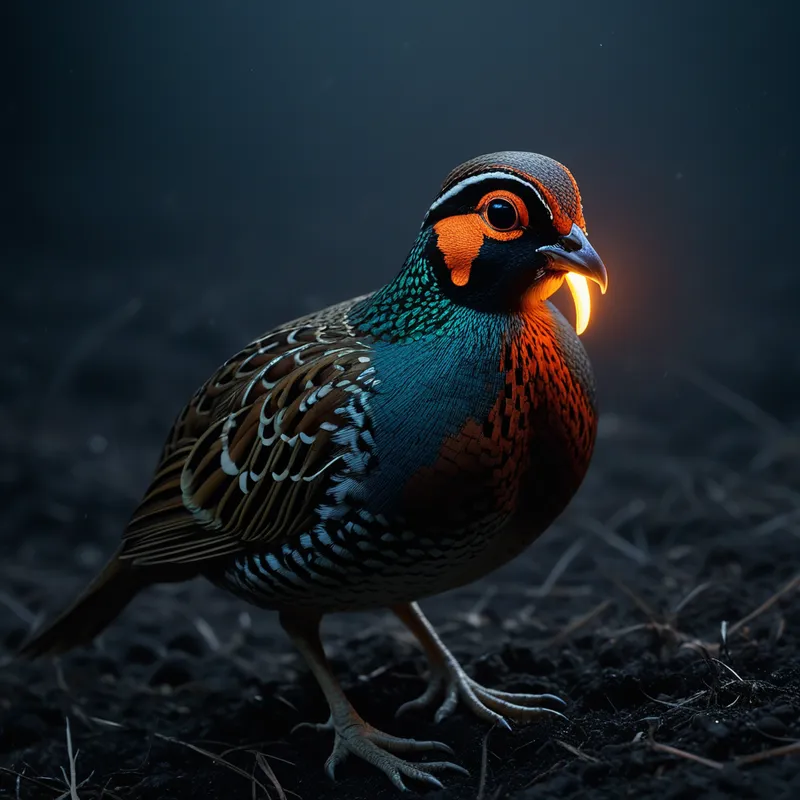
She struck the earth not far from the village, a soft, terrible thud. The People rushed to her. There she lay, her beak charred black forever, the skin around it burned and red. But in her beak, still held tight, was the coal, alive and pulsing with warmth.
Tender hands took the coal. They fed it with dry grass, with tiny twigs. A flame, hesitant then sure, leapt to life. For the first time, warmth that did not come from the distant sun filled the space between them. Light danced on their faces, driving back the long shadows.
They turned to thank Quail, but she was gone. Some say she gave the last of her life to bring the gift home. Others say she recovered, but forever bore the marks of her journey—the black beak and the red-tinged feathers—a living testament. From that day, fire belonged to the People. And they remembered that their salvation came not on the wings of an eagle, but from the courage of the smallest, humblest heart among them.
Cultural Origins & Context
This narrative exists in various forms among numerous Native American cultures, particularly among tribes of the Southwest, Great Basin, and California regions. It is a classic etiological myth, explaining the sacred origin of fire, the single most transformative technology in human history. Unlike Promethean tales from other traditions that emphasize theft and defiance, this story is often framed as a mission of compassion and a gift earned through sacrifice.
The myth was not written but lived, passed down orally through generations by elders and storytellers, often during the long winter nights by the very fire whose origin they recounted. Its function was multifaceted: it was a practical lesson in respecting fire, a moral lesson in valuing the seemingly insignificant, and a spiritual lesson about the nature of sacrifice for the greater good. It reinforced community values—survival depended not solely on the strongest hunter, but on the courage and willingness of any member to contribute, regardless of their stature.
Symbolic Architecture
At its core, the myth of Quail is an archetypal drama of the undervalued becoming essential. Quail symbolizes the unconscious resource. She is not the proud, solar consciousness of Hawk, nor the instinctual power of Bear, nor the clever ego of Coyote. She is the part of the self that is overlooked, the quiet persistence, the vulnerability that is often mistaken for weakness.
The greatest gifts are not seized by force of will, but are received by the courage to endure the necessary wound.
The Fire represents transformative energy—consciousness, passion, spirit, and the warmth of culture itself. It is initially held in the realm of the “gods” or powerful, indifferent forces (the unconscious in its raw, unintegrated state). The journey is the process of making this energy accessible to the conscious community (the ego and the wider psyche).
Quail’s burned beak and face are not a punishment, but the indelible mark of transformation. They are the stigmata of the initiate. She is physically altered by her encounter with the sacred, becoming a living symbol of the cost and the reward of bringing light into darkness.
The Dreamer’s Resonance
When this myth pattern stirs in the modern dreamer, it often manifests as dreams of being small in a vast, challenging landscape, or of carrying something precious but painfully hot. One might dream of a tiny, glowing object in one’s hands or mouth that must be protected at all costs, or of a humble, overlooked animal displaying unexpected bravery.
Somatically, this can correlate with a feeling of constriction in the chest or throat—the “carrying of the coal.” Psychologically, it signals a process where a long-ignored or undervalued aspect of the self (a quiet talent, a buried emotion, a humble need) is being activated to solve a collective problem in one’s life—be it in a family, a workplace, or one’s internal community of psyche. The dreamer is in the “climb,” enduring the friction and pain of developing this fragile, nascent resource, feeling profoundly inadequate yet driven by a deep, often compassionate necessity.
Alchemical Translation
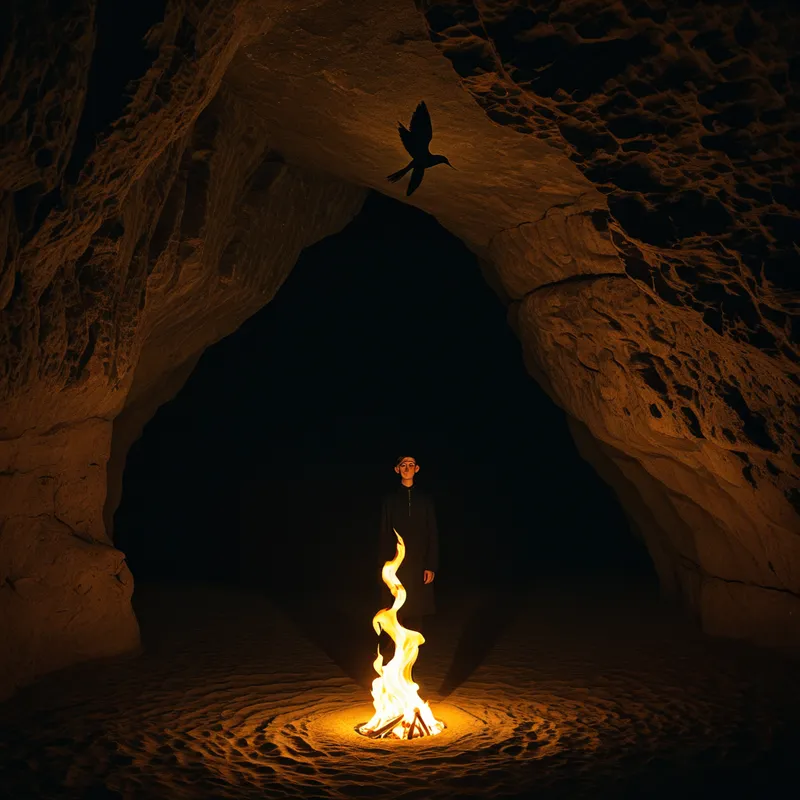
The alchemical process mirrored here is nigredo leading to illumination. The cold, grey world is the prima materia—the leaden, unconscious state. Quail’s decision is the first stirring of the work. Her arduous climb is the purification through ordeal (mortificatio). Taking the coal is the sacred, painful union with the transformative agent—the searing encounter with a truth or energy that cannot be held without being marked by it.
Individuation is not about becoming a giant, but about the humble, persistent bird within making its essential, scarring journey to bring warmth home.
The fall is the crucial stage of albedo—the descent of the spirit into matter, the integration of the gained insight into the fabric of one’s being, even at the risk of ego dissolution (“she did not fly, she fell”). The final act—the community nurturing the spark into a sustaining flame—is the rubedo. The treasure is not for Quail alone; it is for the whole psychic system. The transformed one (the quail with the marked face) may recede, but the transformative energy (fire) now sustains the entire inner community, bringing light, warmth, and the ability to “cook” raw experience into nourishing wisdom.
For the modern individual, this myth models that profound psychological shifts are rarely achieved through brute force of will or intellectual cleverness alone. True transformation, the kind that warms one’s entire life, often comes through the channel of humility, sacrificial endurance, and the courage to let a sacred, searing truth alter you forever, so that it may nourish all that you are.
Associated Symbols
Explore related symbols from the CaleaDream lexicon: