Qahtanite and Adnanite Origins Myth Meaning & Symbolism
An ancient myth dividing the Arab people into two primordial lineages, one rooted in the earth, the other descended from the stars.
The Tale of Qahtanite and Adnanite Origins
Listen, and let the wind carry you back to a time before time was counted in years, to the age when the land itself was a great, whispering memory. The sun was a hammer on the anvil of the sky, and the earth, our mother, was a vast and varied tapestry—not empty, but pregnant with potential.
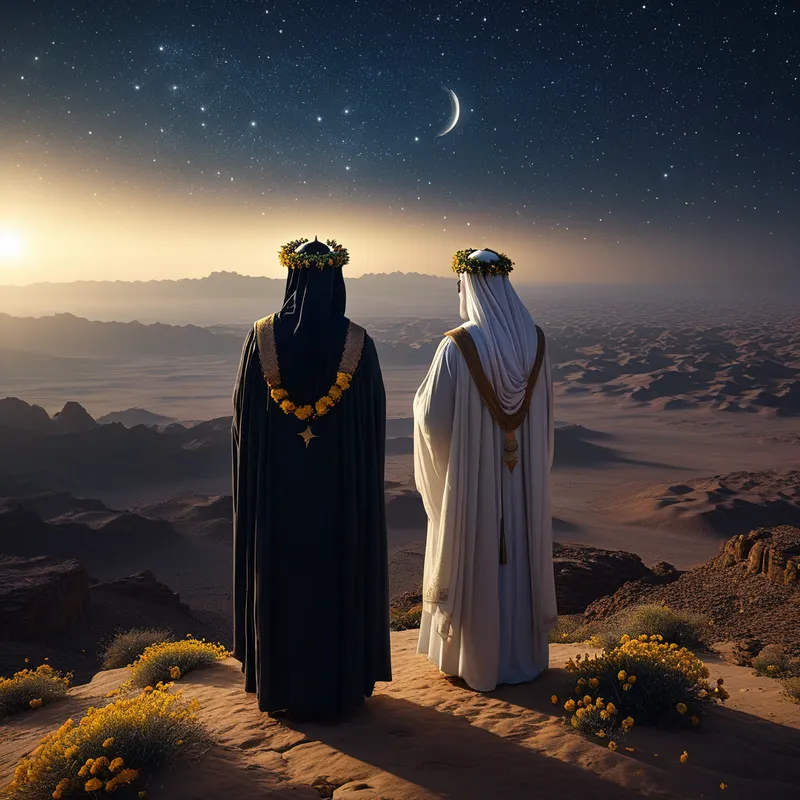
In the deep, verdant south, where the rains were generous and the mountains cradled life, there walked a man named Qahtan. He was not born of woman, the poets say, but was a son of the earth itself, sprung from the very rock and soil. His people were the builders of mighty Ma’rib, who taught the water to flow in channels and made the desert bloom. They knew the secrets of the frankincense tree and the paths of the monsoon. Their kingdom was one of roots, deep and settled, their identity as solid as the foundations of their towers. They were the Arabs of the earth, the al-‘Arab al-‘ariba.
Then, from the north, came a different wind. It carried stories of a man named Adnan. His lineage was not from the soil, but was traced back, star by star, to Ibrahim himself, and to his son Isma’il. Adnan’s children were children of the promise and the journey. They did not build cities of stone, but kingdoms of the tent and the camel. Their maps were written in the constellations they followed across the Rub’ al Khali. They were the masters of the word, the poets for whom a finely crafted verse was a weapon and a shield. They were the Arabs of the sky, the al-‘Arab al-musta‘riba—those who became Arab.
The tale is not of a battle, but of a great and silent divergence. Imagine a single, ancient well in a forgotten wadi. Two brothers drink from it. One looks down into the dark, cool water and sees the reflection of the fertile land around him. He stays. The other looks up from the water’s surface and catches the first evening star. He is called to follow it. They part with a clasp of hands, a look of deep, unspoken understanding. One turns south, to the mountains of Qahtan. The other turns north, to the caravan routes of Adnan. The desert, vast and indifferent, receives them both, but henceforth, it knows two songs: the settled hymn of the farmer and the rhythmic ode of the nomad.
Cultural Origins & Context
This myth of dual origin is not a single story from a single book, but a living, breathing framework that emerged from the oral traditions of the pre-Islamic Arabian Peninsula. It was carried on the breath of poets (sha‘ir) and genealogists (nassabah) around tribal campfires and in the shadow of bustling oases. Its primary function was sociological and political: to explain the complex web of relationships, alliances, and rivalries among the countless tribes.
The Qahtanite claim, centered in Yemen and the south, represented a claim of autochthony—original, indigenous ownership of the land and its ancient civilizations (Saba’, Himyar). The Adnanite claim, dominant in the Hejaz and the north, represented a claim of prophetic lineage and connection to a broader Near Eastern narrative. The myth provided a foundational identity, answering the profound human questions: Where do we come from? and, more importantly, Who are we in relation to others? It was a narrative compass in a social landscape as shifting as the dunes.
Symbolic Architecture
At its [heart](/symbols/heart “Symbol: The heart symbolizes love, emotion, and the core of one’s existence, representing deep connections with others and self.”/), this myth is not about historical fact, but about a fundamental psychic split in the concept of [identity](/symbols/identity “Symbol: Identity represents the sense of self, encompassing personal beliefs, cultural background, and social roles.”/). It is the archetypal [moment](/symbols/moment “Symbol: The symbol of a ‘moment’ embodies the significance of transient experiences that encapsulate emotional depth or pivotal transformations in life.”/) where a unified whole perceives itself as two.
The first division is not between self and other, but within the self—a primordial choice between rooting and rising.
Qahtan symbolizes the [Earth](/symbols/earth “Symbol: The symbol of Earth often represents grounding, stability, and the physical realm, embodying a connection to nature and the innate support it provides.”/) principle: the unconscious, the instinctual, the [body](/symbols/body “Symbol: The body in dreams often symbolizes the dreamer’s self-identity, personal health, and the relationship they have with their physical existence.”/) and its deep ties to a specific place. It is the psyche’s [connection](/symbols/connection “Symbol: Connection symbolizes relationships, communication, and bonds among individuals.”/) to the maternal, the fertile, the established patterns and cultural [memory](/symbols/memory “Symbol: Memory symbolizes the past, lessons learned, and the narratives we construct about our identities.”/) that feel innate. Adnan symbolizes the Sky principle: [consciousness](/symbols/consciousness “Symbol: Consciousness represents the state of awareness and perception, encompassing thoughts, feelings, and experiences.”/), the [spirit](/symbols/spirit “Symbol: Spirit symbolizes the essence of life, vitality, and the spiritual journey of the individual.”/), the fathering influence of law, [covenant](/symbols/covenant “Symbol: A binding agreement or sacred promise between parties, often carrying deep moral, spiritual, or social obligations and consequences.”/), and transcendent [purpose](/symbols/purpose “Symbol: Purpose signifies direction, meaning, and intention in life, often reflecting personal ambitions and core values.”/). It is the psyche’s drive toward [destiny](/symbols/destiny “Symbol: A predetermined course of events or ultimate purpose, often linked to spiritual forces or cosmic order, representing life’s inherent direction.”/), [language](/symbols/language “Symbol: Language symbolizes communication, understanding, and the complexities of expressing thoughts and emotions.”/), and a identity forged through [journey](/symbols/journey “Symbol: A journey in dreams typically signifies adventure, growth, or a significant life transition.”/) and adoption.
The Desert between them is the liminal [space](/symbols/space “Symbol: Dreaming of ‘Space’ often symbolizes the vastness of potential, personal freedom, or feelings of isolation and exploration in one’s life.”/) of the ego, the arid field of conscious [life](/symbols/life “Symbol: The symbol of ‘Life’ represents a journey of growth, interconnectedness, and existential meaning, encompassing both the joys and challenges that define human experience.”/) where these two powerful forces—the deep, rooted Self (Qahtan) and the aspirational, guiding Spirit (Adnan)—are felt as separate, often conflicting, loyalties.
The Dreamer’s Resonance
When this myth stirs in the modern soul, it rarely appears as a historical pageant. Instead, one may dream of being torn between two homes, two families, or two powerful callings. There is a profound somatic sense of being split at the core.
A dreamer might find themselves in a house with two foundations: one basement is a lush, overgrown garden, the other is an observatory filled with star charts. They feel they must choose which to live in, yet both are essential parts of the structure. Or they may dream of trying to speak two languages at once, their tongue tangled between a deep, guttural mother-tongue and a lofty, complex father-tongue. The body in the dream often feels heavy yet ungrounded, pulled between the weight of inheritance and the vertigo of possibility. This is the psyche working through its own “Qahtanite and Adnanite” conflict—the tension between the identity we are born with (culture, family, innate traits) and the identity we choose or are called toward (vocation, beliefs, adopted communities).

Alchemical Translation
The individuation process modeled here is not about choosing one lineage over the other, but about undertaking the sacred journey across the desert to recover their original unity within the Self.
The goal is not to become only Qahtan or only Adnan, but to become the well from which they both drank.
The first stage is recognizing the division (the Nigredo). One must feel the acute pain of the split: the shame of abandoning one’s roots, or the grief of feeling alienated from one’s destiny. The Desert of this stage is a necessary, if painful, confrontation with one’s own fragmented state.
The second stage is the journey of acknowledgment (the Albedo). This involves consciously honoring both lineages. It is the inner work of building a Bridge between the deep, often unconscious, earthy wisdom of the Qahtanite within (our instincts, bodily wisdom, cultural heritage) and the conscious, sky-oriented striving of the Adnanite within (our ideals, spiritual yearnings, chosen path). One must learn the poetry of the nomad and the engineering of the settled farmer.
The final stage is the symbolic marriage (the Rubedo). This is the realization that the Water in the well is the same. The one who looks down and the one who looks up are two faces of a single seeker. The integrated individual can draw from the fertile depth of Qahtan’s earth while navigating by the stars of Adnan’s sky. They become the living synthesis: grounded yet aspirational, traditional yet transformative, carrying the memory of the root while reaching for the fruit. They achieve a belonging that is not exclusive, but expansive—a homeland of the soul that contains both the mountain and the caravan route.
Associated Symbols
Explore related symbols from the CaleaDream lexicon:
- Earth — The principle of rootedness, the unconscious foundation, and inherited identity represented by the Qahtanite lineage and its connection to the land.
- Sky — The principle of destiny, consciousness, and aspirational identity represented by the Adnanite lineage and its connection to celestial prophecy and journey.
- Desert — The vast, liminal space of the ego and conscious life that separates and defines the two lineages, a place of testing, choice, and potential integration.
- Water — The source of life, the common unconscious origin from which both lineages drink, symbolizing the shared essence beneath apparent division.
- Journey — The core action of the Adnanite narrative and the psychological process required to move between or reconcile the two aspects of the self.
- Root — The deep, anchoring connection to place, ancestry, and the unconscious embodied by the Qahtanite archetype.
- Star — The guiding light of destiny, lineage, and transcendent purpose that navigates the Adnanite archetype.
- Mountain — The stable, fertile, and enduring homeland of the Qahtanite south, representing established order and deep memory.
- Tent — The mobile, adaptable dwelling of the Adnanite north, representing a identity based on journey, covenant, and relationship rather than fixed place.
- Origin — The central mystery the myth seeks to address, representing the human quest to understand the source of one’s being and identity.
- Bridge — The symbol of the potential reconciliation and necessary connection that must be built between the two opposing inner lineages.
- Division — The primary action and enduring state created by the myth, representing the fundamental psychic and social split in the concept of self and tribe.