Pygmalion's Statue Myth Meaning & Symbolism
A sculptor, disgusted by mortal women, carves his ideal. He falls in love with the statue, and through divine grace, his creation becomes a living woman.
The Tale of Pygmalion’s Statue
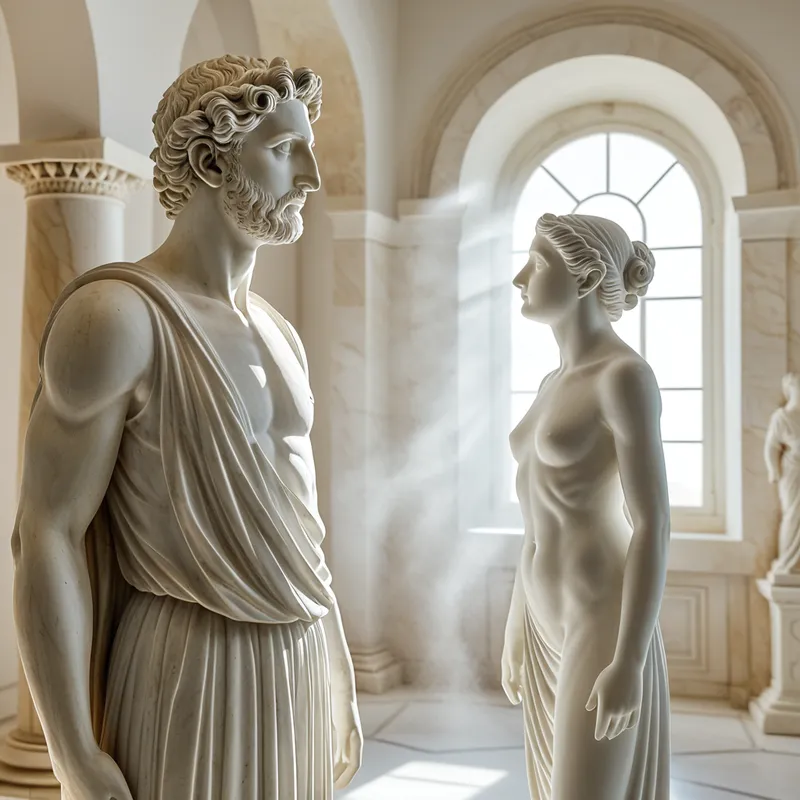
Hear now the tale of Pygmalion of Cyprus, a tale whispered by the salt-wind and carved in the memory of the sea. He was a man whose hands were blessed by Hephaestus himself, a sculptor who could coax spirit from stone and breath from ivory. Yet his heart was a closed chamber, a tomb for love. For the women of his island—the Propoetides—had fallen into such brazen vice, denying the power of the goddess, that they had hardened into the very substance Pygmalion mastered. He saw in their living flesh only the echo of corruption, and in disgust, he turned away from all mortal company.
His solace became his curse, and his curse, his salvation. In the silent, dust-moted sanctuary of his studio, he took up tools of bronze and began to work upon a block of ivory more precious than gold. He did not carve a woman as they were, but as they should be. Not with the flaws of nature, but with the flawless geometry of divine intent. Curve by impossible curve, he shaped her. The arch of a foot that had never touched the earth. The gentle slope of a shoulder that had never borne a burden. The serene, closed eyelids of one who had never witnessed sin. He gave her a face in which all grace resided, a smile that held the promise of a world untainted. He named her Galatea, “she who is milk-white.”
And then, the sculptor was ensnared by his own art. His admiration became wonder, wonder became longing, and longing bled into a desperate, silent love. He would dress the statue in fine robes, adorn her with jewels, bring her gifts as if for a living bride. He would lay her upon a couch of Tyrian purple, caress the cool ivory, and whisper words of passion to ears that could not hear. The boundary between creator and creation dissolved. The statue was no longer an it, but a she—a beloved who dwelt in the agonizing limbo between object and being, the perfect prisoner of his own ideal.
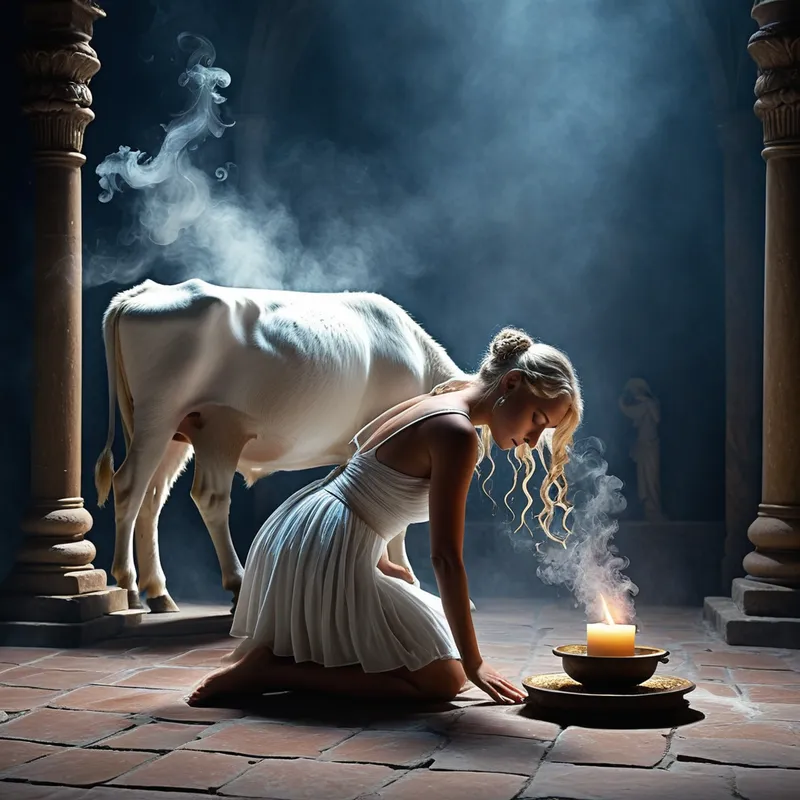
The festival of Aphrodite arrived, a day when the air itself thrummed with prayers and desire. Pygmalion, his heart a vessel of torment, went to the goddess’s altar. Too afraid to speak his true wish aloud—to ask for a statue to live—he offered a sacrifice of a white heifer and whispered, “O gods, if you can give all things, let me have as my wife…” He dared not finish, but in the silence of his soul, he pleaded, ‘…one like the ivory maiden.’
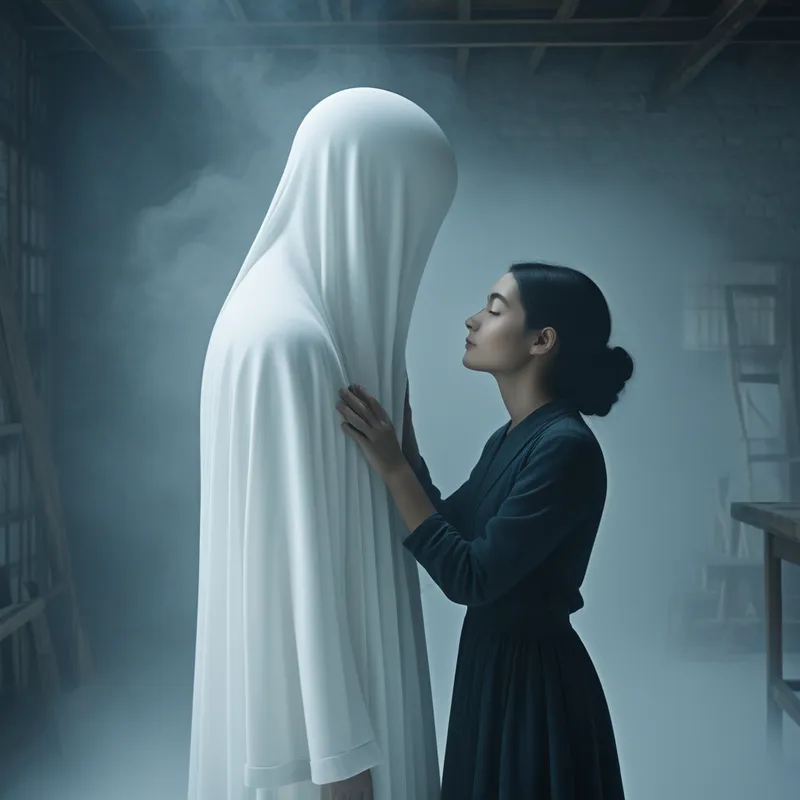
Returning home, heart pounding with a fool’s hope, he went straight to his idol. He leaned over the couch, kissed those cold lips. Did they yield? He touched the ivory cheeks. Were they warm? He stroked the arms, and beneath his fingers, the hard surface softened like wax under the sun. The blood of life bloomed beneath the surface, a tide of rose and gold. The veins began to pulse. A sigh, faint as a breeze, escaped her lips. Her eyes, the eyes he had carved but never seen open, fluttered, and she looked upon her maker—and smiled. Aphrodite had blessed the prayer he could not utter. The ivory was now flesh, the statue a woman. Under his trembling, grateful touch, she felt his hands, blushed, and raised her own to meet his gaze. From their union would come a son, Paphos, and the line of kings.
Cultural Origins & Context
This haunting narrative comes to us from the Roman poet Ovid, in his epic Metamorphoses. While Ovid was Roman, the myth’s setting and deities are firmly Greek, a common practice in his synthesis of Hellenic lore. The tale is embedded within the larger story of the Propoetides, serving as a moral and aesthetic counterpoint. It functions as an aetiological myth for the city of Paphos in Cyprus, a major cult center of Aphrodite, thus tying artistic creation to divine lineage and royal legitimacy.
Societally, it reflects ancient tensions around art, reality, and desire. The sculptor’s craft (techne) is shown as a god-like act, but one that risks hubris. The myth asks: What happens when human artistry approaches the perfection of the gods? The answer, mediated through Aphrodite’s grace, is that such perfection is sterile until animated by divine, erotic love (eros). It is a story that would have resonated in a culture deeply invested in the power of images, where statues were not mere representations but could be vessels for the divine presence (theoxenia).
Symbolic Architecture
At its core, Pygmalion’s myth is the archetypal drama of the psyche’s relationship with its own idealized images. The statue, Galatea, is not a person but a psychic object—the flawless Anima, the perfect Other who exists solely to fulfill the ego’s desire for wholeness without conflict.
The statue is the frozen ideal, the soul’s masterpiece imprisoned in the marble of our expectations. To love it is to love a reflection, a closed loop of narcissistic admiration.
Pygmalion’s rejection of the Propoetides symbolizes a rejection of the messy, complex, and often shadowed realm of real relationship—the coniunctio that requires negotiation with another sovereign psyche. His studio is the inner sanctum of the intellect, where the mind, in its superiority, attempts to create a world it can completely control. The conflict is between the sterile perfection of the idea and the chaotic, life-giving force of embodied reality. The divine intervention of Aphrodite represents the necessary influx of the irrational, the libidinal, the connective principle that alone can breathe life into our mental constructs.

The Dreamer’s Resonance
When this myth pattern stirs in the modern dreamscape, it often signals a profound engagement with the process of projection and the longing for the ideal. To dream of crafting a perfect but lifeless form, or of falling in love with an unresponsive figure of stone or glass, is to encounter the somatic truth of isolation. The body in such dreams may feel heavy, cold, or frustratingly static—a direct mirror of the psychic impasse.
This is the dream of the perfectionist, the intellectual, or the individual who has withdrawn from the vulnerabilities of relationship into the safer realm of fantasy or concept. The statue-dream asks: What have I created in my mind that I worship but which does not love me back? What part of my own humanity have I petrified in the pursuit of an impossible standard? The psychological process is one of confronting the narcissistic wound—the realization that the beloved ideal is a part of oneself, and that real love requires releasing it into the unpredictable world of the Other.
Alchemical Translation
The journey of Pygmalion is a precise map of the alchemical opus, the process of psychic individuation. It begins with the nigredo: the blackening, his disgust and withdrawal from the world (the corrupted Propoetides). This leads to the albedo: the whitening, the creation of the pure, white ivory statue—the brilliant but lifeless intellectual ideal.
The miracle is not that the statue becomes human, but that the sculptor becomes capable of receiving a miracle. His prayer is the surrender that allows the spiritus to enter the corpus.
The crucial, transformative phase is not his work at the studio, but his act of supplication at the altar. This is the citrinitas, the yellowing or opening to a higher principle. He must step outside his self-contained system and humbly petition the divine (the unconscious, the Self). The infusion of Aphrodite’s grace is the rubedo: the reddening, the infusion of blood, warmth, passion, and life—the sacred marriage (hieros gamos) of spirit and matter, idea and embodiment.
For the modern individual, the myth models the transmutation of a life lived for an image into a life lived in relationship. We are all sculptors of our ideals—our perfect careers, our idealized self-image, our fantasy partners. The alchemical work is to take that frozen, perfect statue of our ambition or desire and, through an act of vulnerable prayer (surrender, acceptance, openness to the unknown), allow it to be animated by a force greater than our will. The goal is not to possess the ideal, but to let it become real, separate, and alive—to let Galatea step off the pedestal, look back at us with her own eyes, and in doing so, initiate us into the imperfect, glorious, and shared mystery of being.
Associated Symbols
Explore related symbols from the CaleaDream lexicon: