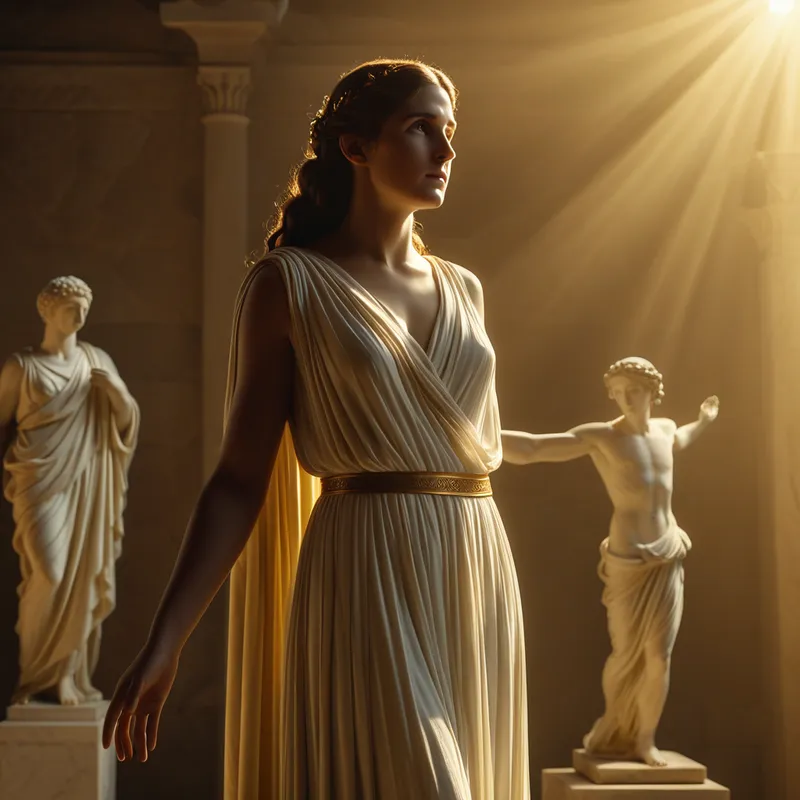
Pygmalion and Galatea - the sc Myth Meaning & Symbolism
A sculptor, disgusted by mortal women, carves his ideal from ivory. He falls in love with his statue, which is granted life by a goddess's grace.
The Tale of Pygmalion and Galatea
Hear now of [Pygmalion](/myths/pygmalion “Myth from Greek culture.”/), a king of Cyprus, whose hands were blessed by Athena but whose heart was sealed in stone. In his city, the Propoetides dared to deny the goddess’s power, and for their arrogance, they were cursed—their humanity stripped away until they became the first to trade their virtue for cold coin. Witnessing this descent, [Pygmalion](/myths/pygmalion “Myth from Greek culture.”/)’s soul recoiled. Disgusted by the failings of mortal flesh, he forswore all women, retreating into the silent, dust-moted sanctuary of his studio.
There, with tools of bronze and a heart full of a lonely ideal, he set to work. Not on common stone, but on a block of precious, snow-white ivory. He did not carve a woman as she was, but as she should be. Day after day, night after night, his chisel whispered secrets to the unfeeling tusk. He shaped not just limbs, but grace; not just a face, but a serenity untouched by time or flaw. He gave her a smile that promised a peace he had never known, a form so exquisite it seemed to hold its breath. He named her [Galatea](/myths/galatea “Myth from Greek culture.”/), “she who is milk-white.”
And then, the sculptor was ensnared by his own art. The very perfection he had crafted from his disdain became the object of his deepest longing. He would dress the statue in fine silks, adorn her with jewels, lay gifts at her feet as if at an altar. He would speak to her, cradle her cold hand, and at night, in the moonlight, he would press his lips to her ivory mouth, tasting only dust and despair. His creation, his perfect Galatea, was a prison of his own making. The festival of Aphrodite arrived, a city throbbing with life and passion. Pygmalion went to the goddess’s altar, but he could not ask for a living wife. Shamefully, quietly, he offered his sacrifice and whispered his true desire: “O goddess, if you can give all things, let me have as my wife… one like my ivory maiden.”
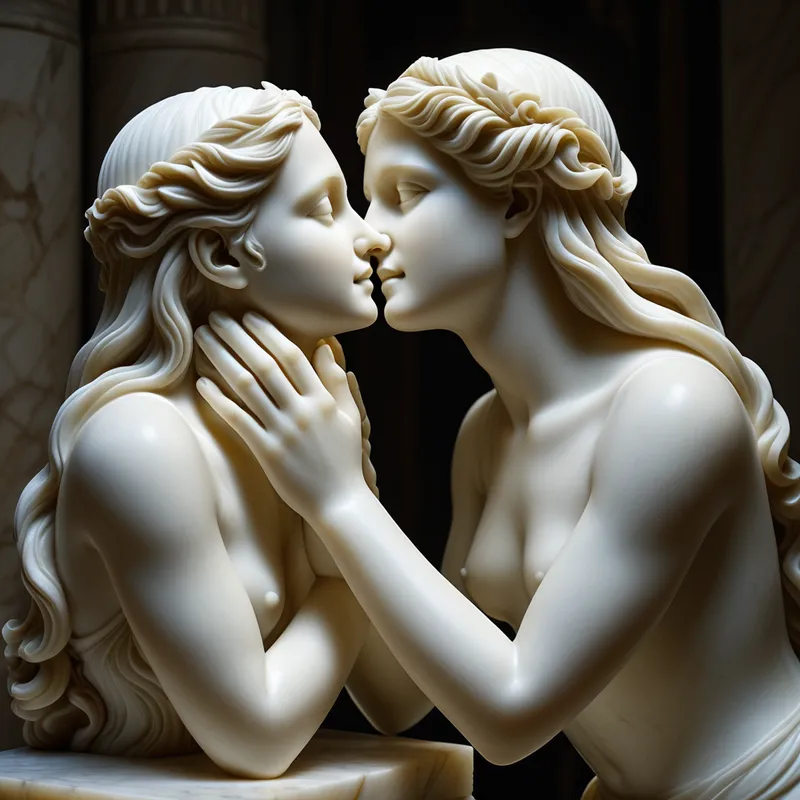
He returned home, his hope a fragile, trembling [thing](/myths/thing “Myth from Norse culture.”/). He approached his creation, his Galatea. As his fingers touched her arm, a shock ran through him—the ivory was no longer cold. It yielded. He kissed her lips, and they were warm. He held her, and he felt a heartbeat echo his own. The blood of life bloomed under her skin, the eyes he had carved opened, and they saw him. Aphrodite had not given him one like his statue. She had given the statue itself. Galatea stepped down from her pedestal, a woman born not of womb, but of worship, art, and divine grace. Their union was blessed, and from it came a child named Paphos, from whom the city took its name.
Cultural Origins & Context
This haunting narrative comes to us from the Roman poet Ovid, in his epic masterpiece, the [Metamorphoses](/myths/metamorphoses “Myth from Greek culture.”/). Written in the first century CE, Ovid’s work is a sprawling tapestry of transformation myths, and the tale of Pygmalion is nestled within it. While Ovid is our primary source, he was likely refining and poeticizing older, perhaps Cypriot, folklore. The myth functions on multiple levels in its ancient context. On one hand, it is a quintessential aetiological myth, explaining the lineage of the city-kingdom of Paphos, a major center for the worship of Aphrodite. On a deeper level, it served as a profound commentary on art, desire, and the relationship between the artist and his work. In a society where sculpture was the pinnacle of mimetic art, the story explored the ultimate fantasy of the creator: to have his vision not merely admired, but to have it live and love him in return. It was a tale told not just about a king, but about every artist who ever poured their soul into an inert medium and dreamed it awake.
Symbolic Architecture
At its core, the myth of [Pygmalion and Galatea](/myths/pygmalion-and-galatea “Myth from Greek culture.”/) is a profound map of the [psyche](/myths/psyche “Myth from Greek culture.”/)’s [movement](/symbols/movement “Symbol: Movement symbolizes change, progress, and the dynamics of personal growth, reflecting an individual’s desire or need to transform their circumstances.”/) from sterile idealism to enlivened [relationship](/symbols/relationship “Symbol: A representation of connections we have with others in our lives, often reflecting our emotional state.”/). Pygmalion begins in a state of profound alienation. His [rejection](/symbols/rejection “Symbol: The experience of being refused, excluded, or dismissed by others, often representing fears of inadequacy or social belonging.”/) of the Propoetides is not merely moral; it is a [rejection](/symbols/rejection “Symbol: The experience of being refused, excluded, or dismissed by others, often representing fears of inadequacy or social belonging.”/) of the messy, complex, and flawed [reality](/symbols/reality “Symbol: Reality signifies the state of existence and perception, often reflecting one’s understanding of truth and life experiences.”/) of the [anima](/symbols/anima “Symbol: The feminine archetype within the male unconscious, representing soul, creativity, and connection to the inner world.”/) (the inner feminine principle, in Jungian terms) as it exists in [the world](/myths/the-world “Myth from Tarot culture.”/) and within himself. He retreats into his own mind, his [studio](/symbols/studio “Symbol: A studio symbolizes creativity, self-expression, and the space where ideas come to life, often representing personal growth through artistic endeavors.”/) a [metaphor](/symbols/metaphor “Symbol: A figure of speech where one thing represents another, often revealing hidden connections and deeper truths through symbolic comparison.”/) for the isolated intellect.
The statue is not a woman, but an idea of woman—a perfect, frozen complex of all that the ego desires and fears to engage with in living form.
Galatea, the [ivory](/symbols/ivory “Symbol: A precious material from elephant tusks, symbolizing purity, luxury, and mortality due to its source and value.”/) maiden, symbolizes this psychic complex. She is the ultimate ideal, beautiful but lifeless, a [product](/symbols/product “Symbol: This symbol represents tangible outcomes of one’s efforts and creativity, often reflecting personal value and identity.”/) of [the ego](/myths/the-ego “Myth from Jungian culture.”/)’s will alone. Pygmalion’s subsequent “falling in love” with her marks a critical shift. The intellectual project becomes an emotional [obsession](/symbols/obsession “Symbol: An overwhelming fixation on a person, idea, or object that consumes mental energy and disrupts balance.”/). [The ego](/myths/the-ego “Myth from Jungian culture.”/) becomes enslaved to its own creation, a state of profound narcissistic entrapment. The [prayer](/symbols/prayer “Symbol: Prayer represents communication with the divine or a higher power, often reflecting inner desires and spiritual needs.”/) to Aphrodite is the crucial act of surrender. It represents [the ego](/myths/the-ego “Myth from Jungian culture.”/)’s admission that it cannot animate its own ideal; it requires the intervention of a greater, transpersonal power—the grace of the Eros principle. The animation of Galatea is not a reward, but a transformation. It is the [moment](/symbols/moment “Symbol: The symbol of a ‘moment’ embodies the significance of transient experiences that encapsulate emotional depth or pivotal transformations in life.”/) the psychic complex is integrated, moving from a [static](/symbols/static “Symbol: Static represents interference, disruption, and the breakdown of clear communication or signal, often evoking feelings of frustration and disconnection.”/), idealized object in the inner world to a living, breathing, and autonomous part of the [soul](/symbols/soul “Symbol: The soul represents the essence of a person, encompassing their spirit, identity, and connection to the universe.”/).
The Dreamer’s Resonance
When this mythic pattern stirs in the modern dreamscape, it signals a pivotal moment in the dreamer’s relationship to their own creations, ideals, or potential. To dream of lovingly crafting a perfect but lifeless object or person often points to a state where one’s creative energy or desire has become disconnected from the vital, instinctual flow of life. The dreamer may be in love with a plan, a fantasy of a partner, a self-image, or a career goal that is intellectually flawless but somatically dead—it has no heartbeat, no capacity for surprise or mutual relationship.
Conversely, dreaming of a statue coming to life—whether terrifying or joyous—indicates the sudden, often disruptive, infusion of soul into a long-held but static complex. This can feel like an awakening. A long-dormant talent (the “creation”) suddenly demands expression. A rigid self-concept cracks open to reveal a more fluid identity. It is a somatic process of thawing, where something that was held in perfect, safe stasis is flooded with the risky, warming blood of emotion and instinct. The dream may carry the anxiety of this new life: Can I handle what I have wished for?
Alchemical Translation
The alchemical journey of Pygmalion is a precise model for the stage of coagulatio, where spirit takes form, and its subsequent animation. The initial state is the [nigredo](/myths/nigredo “Myth from Alchemical culture.”/) of misanthropy and disillusionment. From this blackness, Pygmalion extracts his pure, white albedo: the ivory statue. This is the creation of the philosopher’s stone in its potential, perfect, but inert state.
The true transmutation occurs not in the carving, but in the surrender. The artist must release his masterpiece to a force beyond his craft.
Pygmalion’s prayer at the altar of Aphrodite is the citrinitas, the dawning recognition that the work is incomplete without the goddess’s touch—without the infusion of libido and relatedness. The animation of Galatea is the glorious [rubedo](/myths/rubedo “Myth from Alchemical culture.”/). The perfect, mineral form is penetrated by the quickening spirit, resulting in the hieros gamos of creator and creation. For the modern individual, this translates to any profound process where a long-cherished ideal—be it an artistic project, a psychological understanding, or a vision for one’s life—must cease to be a monument we worship from a distance. It must be risked, offered up to the unpredictable grace of life (Aphrodite), and allowed to become a living, breathing, and independent reality that can truly relate to us. We do not possess our creations; we enter into relationship with them, and in doing so, we are ourselves created anew. [The child](/myths/the-child “Myth from Alchemy culture.”/) Paphos is the new consciousness, the new city of the soul, born from this [sacred marriage](/myths/sacred-marriage “Myth from Alchemy culture.”/).
Associated Symbols
Explore related symbols from the CaleaDream lexicon: