Pygmalion and Galatea Myth Meaning & Symbolism
A sculptor, disillusioned with mortal women, falls in love with his perfect ivory statue, which is brought to life by the goddess Aphrodite.
The Tale of Pygmalion and Galatea
Hear now the tale of a man who loved a dream made solid, and of the goddess who breathed the world into his solitude. On the sun-baked island of Cyprus, where the salt air carries the scent of myrtle and the whispers of the sea, there lived a sculptor named Pygmalion. His hands were blessed by Hephaestus, but his heart was a fortress of stone. For he had seen the Propoetides, women whose souls had hardened into vice, and in his disgust, he turned away from all mortal flesh. He swore a silent oath to his art alone.
His workshop became his world, filled with the dust of marble and the scent of cedar oil. Then, from a block of pale, luminous ivory—bone of the earth, milk of the moon—he began to carve. Not a goddess, for that would be hubris, but the idea of one made manifest. Chisel and file became prayers; each stroke was an act of devotion. He shaped the curve of a calf, the slope of a shoulder, the serene arch of a neck. He gave her hair the suggestion of a breeze, her lips the ghost of a smile. When he was done, he stood back, and his breath caught. She was more than perfect form; she was a vessel for every unspoken ideal of grace, purity, and beauty his soul had ever conceived. He named her Galatea, “she who is milk-white.”
And here, the sculptor’s triumph became his torment. He would dress her in fine silks, place jewels in her ivory hair, lay gifts of fruit and flowers in her lifeless lap. He would speak to her of his day, his thoughts, his dreams, and in the silence of her reply, he heard his own longing echo. He would kiss her cold hand, and the warmth of his own lips was a cruel mockery. The statue was a masterpiece, but the man was now its prisoner, bound in a love that could never be returned, a dialogue with a perfect silence.
The festival of Aphrodite arrived, a riot of incense, song, and sacrifice. With a heart heavy as lead, Pygmalion approached the goddess’s altar. He could not ask for a living wife. He dared only to whisper, “O goddess, if you can give all things, give me one like my ivory maiden.” He feared to say the maiden, but the goddess, who sees the true desires burning beneath timid words, understood.
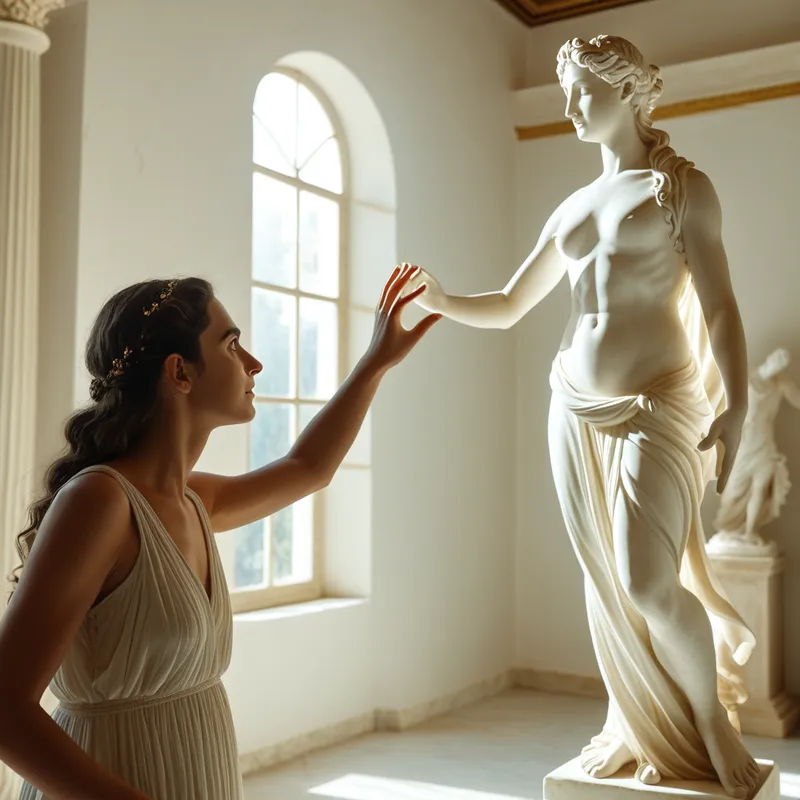
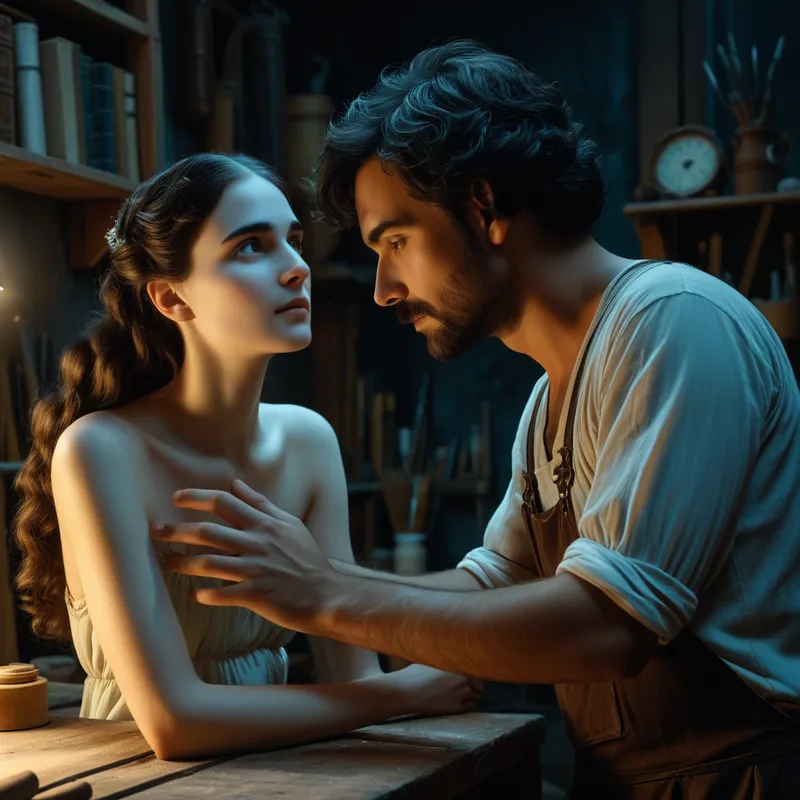
Returning home, heart thrumming with a hope he dared not name, he went to his creation. He reached out, as he had a thousand times before, to touch her cheek. But this time… the ivory yielded. A warmth, subtle as a sunrise, bloomed beneath his fingertips. The hard surface softened into living skin. A flush of rose spread across her face. Her chest rose with a first, shuddering breath. Her eyes, once blank orbs, opened and focused—on him. The veins in her wrists began to pulse with blue life. Aphrodite had not given him one like her; she had given Galatea herself. The statue stepped down from her pedestal, a woman born not of womb, but of ardent faith and divine grace. Their wedding was blessed by the goddess, and from their union came a son, Paphos, from whom the sacred city took its name.
Cultural Origins & Context
This haunting narrative comes to us from the Roman poet Ovid, in his epic compendium of transformations, the Metamorphoses. While Ovid is a Roman source, the myth’s themes are deeply rooted in Greek soil, particularly the cult of Aphrodite on Cyprus, her legendary birthplace from the sea foam. The story functions as a powerful aetiology, a founding myth for the city of Paphos and its famed sanctuary to the goddess of love.
In the Greek world, where the line between art and divinity was often blurred, the myth spoke to profound cultural anxieties and ideals. It explores the artist’s god-like power of creation and the dangerous, seductive potential of that power to replace reality with an ideal. It also serves as a moral and religious lesson on the proper relationship between mortal and divine: Pygmalion’s genuine, worshipful devotion—his pietas—is rewarded, contrasting sharply with the impiety of the Propoetides, who were punished. The myth was not just a fairy tale; it was a meditation on piety, artistic obsession, and the nature of reality itself, passed down not as history, but as a poetic truth about the human condition.
Symbolic Architecture
At its core, the myth of Pygmalion and Galatea is a profound allegory of the creative act and the psychology of idealization. Pygmalion represents the Ego in a state of profound disillusionment with the outer world. His rejection of the Propoetides symbolizes a rejection of the flawed, complex, and often disappointing realm of human relationship and instinct.
The statue is not merely an object of beauty; it is the crystallized Anima, the perfect inner image of the feminine that the conscious mind projects onto the world.
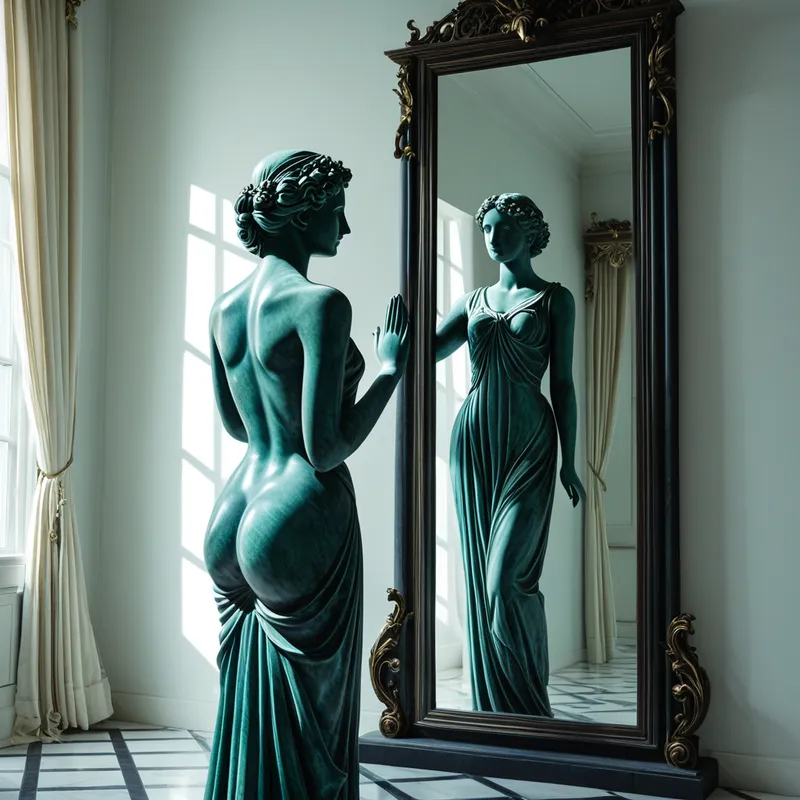
Galatea, the ivory maiden, is this projected ideal. She is flawless, passive, and entirely the product of his own mind and skill. She represents the ultimate fantasy: a reality perfectly conformed to one’s own will and aesthetics, a relationship without the risk of otherness, conflict, or independent desire. Pygmalion’s worship of her is, symbolically, a form of narcissism—a love for the reflection of his own soul’s deepest longing.
Aphrodite’s intervention is the crucial catalytic element. She represents the unpredictable, life-giving force of Eros—not just romantic love, but the fundamental connective principle of the universe. Her action transmutes the static, narcissistic fantasy into living, breathing reality. This is the moment when the idealized image is forced to encounter the autonomous, unpredictable world. The statue must become a separate being, with a will of her own, for true relationship—and true life—to begin.

The Dreamer’s Resonance
When this mythic pattern stirs in the modern dreamscape, it signals a pivotal moment in the psyche’s relationship between creation and relationship. To dream of crafting a perfect but lifeless form—be it a person, a project, or a life situation—speaks to a state of idealized control. The dreamer may be in a phase of intense creative focus or, conversely, emotional withdrawal, where relating to the messy reality of others feels too threatening.
Dreams of a statue coming to life, however, are somatic messages of profound psychic movement. They often precede or accompany a period where a long-held ideal, fantasy, or intellectual construct is suddenly infused with feeling, instinct, and autonomous energy. This can feel both miraculous and terrifying. The “Galatea moment” in a dream might manifest as a robot gaining sentience, a painting stepping out of its frame, or a doll opening its eyes. It is the psyche’s announcement that a previously inert complex is now alive and active, demanding to be related to not as a concept, but as a living part of the self or the world. There is a cracking open of perfection, making way for the fertile, unpredictable chaos of genuine life.
Alchemical Translation
The journey of Pygmalion is a precise map of the alchemical and Jungian process of Individuation. It begins in the nigredo, the blackening: his disillusionment and withdrawal from the flawed world. His studio is the alchemist’s sealed vessel, where he works solely on his prima materia—the raw ivory, symbolizing the cold, untransformed substance of his own soul.
The carving is the albedo, the whitening. He purifies and perfects his inner image, creating a sublime but sterile state of consciousness. This is a necessary but incomplete stage; the ego has refined its ideal but remains in a solipsistic loop.
The divine intervention of Aphrodite is the rubedo, the reddening—the infusion of the soul with the blood of life, passion, and relatedness. It is the transcendent function that breaks the deadlock.
For the modern individual, this translates to the painful but vital process of sacrificing perfectionism. It is the moment we allow our carefully crafted self-image, our ideal career, or our fantasy of a perfect partner to be touched by the unpredictable, often inconvenient, fire of real-world engagement. The statue must step off the pedestal. The creator must release control and meet his creation as an equal, separate other. This is the sacred marriage (hieros gamos) within the psyche: the integration of the conscious ideal (Pygmalion) with the now-animated soul-image (Galatea). The child Paphos born from this union symbolizes the new, fertile reality that emerges when we stop worshipping our fantasies and start living in a relationship with the dynamic, living truth of our own being and the world around us. The masterpiece is no longer an object to be admired, but a life to be lived.
Associated Symbols
Explore related symbols from the CaleaDream lexicon: