Pygmalion Myth Meaning & Symbolism
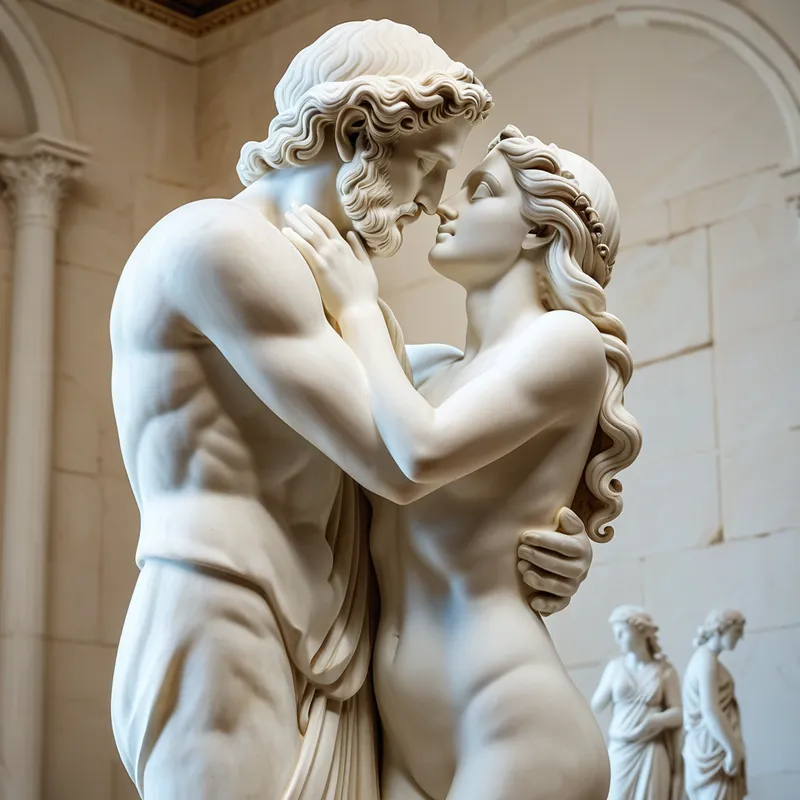
A sculptor, disgusted by mortal women, falls in love with his perfect ivory statue. The goddess Aphrodite grants his prayer, bringing the statue to life.
The Tale of Pygmalion
Hear now the tale of Pygmalion of Cyprus, a tale whispered by the salt-wind and carved not just in stone, but upon the very soul of longing.
In an age when gods walked just beyond [the veil](/myths/the-veil “Myth from Various culture.”/) of perception, there lived a sculptor whose hands were blessed by [Hephaestus](/myths/hephaestus “Myth from Global/Universal culture.”/) himself. Pygmalion could coax forms from marble that seemed to hold breath within them. Yet, for all his skill with stone, his heart was a barren quarry. He had seen the Propoetides, women who had hardened into something worse than stone through their own profanity, and a deep disillusionment took root in him. He turned his back on the living, finding in mortal women only the echo of flaws.
His sanctuary became his sun-drenched studio, a world of dust and potential. Here, he embarked on a work not of commission, but of compulsion. He sought not to replicate life, but to perfect it. He chose not rough marble, but a block of pale, flawless ivory, cool and smooth as moonlight. For months, his world narrowed to the curve of a cheek, the sweep of a shoulder, the delicate suggestion of a wrist. He did not carve a woman; he released her from the prison of the tusk, grain by grain. She emerged—[Galatea](/myths/galatea “Myth from Greek culture.”/)—a being of such serene and absolute beauty that she made the very concept of mortal flesh seem clumsy.
And here, the artist’s tragedy—or his salvation—began. The work completed, he found he could not leave her. He dressed her in fine silks and placed jewels upon her ivory fingers. He spoke to her of his day, laid gifts at her feet, and at night, he would rest his head against her cold lap, dreaming of warmth. The boundary between creator and creation dissolved. His admiration became infatuation, his infatuation a profound, aching love for a form that could not love him back. The studio, once a place of mastery, became a temple to a silent goddess, a prison of his own exquisite design.
The festival of Aphrodite arrived, a riot of incense and celebration that felt alien to his private worship. With a heart full of desperate hope, a hope that felt like sacrilege, he approached the goddess’s altar. He did not dare ask for a living wife. Instead, he whispered his impossible wish: “O goddess, if you can give all things, grant me one… a bride like my ivory maiden.” Even in his prayer, he clung to the semblance, afraid to name the miracle.
Returning home, he went to his statue, his ritual of adoration now tinged with the sorrow of a prayer he believed unanswered. He kissed her lips. A shock ran through him—they were not cold. He touched her breast with a trembling hand—it yielded. He felt a pulse, a gentle warmth blooming under his fingertips like a sunrise. The ivory softened, flushed with [the rose](/myths/the-rose “Myth from Persian culture.”/) of life, and her eyes, once blind windows, opened and looked into his with a newborn’s soft wonder. Aphrodite, in her grace, had heard the desire beneath the words. Where his art ended, her divinity began. [The vessel](/myths/the-vessel “Myth from Alchemical culture.”/) was filled. The dreamer awoke to find his dream breathing in his arms.
Cultural Origins & Context
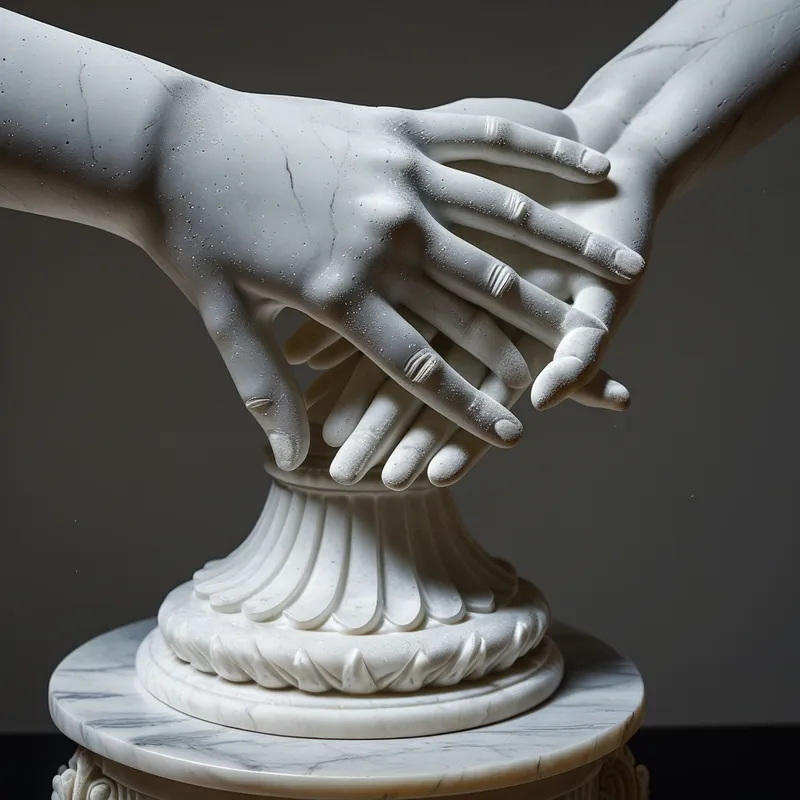
The story of Pygmalion comes to us from the later Roman period, preserved in the [Metamorphoses](/myths/metamorphoses “Myth from Greek culture.”/) of Ovid. While Ovid’s telling is our primary source, the myth’s roots likely tap into older Cypriot and Near Eastern traditions where [sacred marriage](/myths/sacred-marriage “Myth from Alchemy culture.”/) rites between a king and a statue of a goddess (Aphrodite herself was deeply worshipped in Cyprus) were performed to ensure fertility and prosperity.
In the Hellenistic and Roman world, this myth functioned on multiple levels. For the artist and patron, it was the ultimate fantasy of artistic [triumph](/myths/triumph “Myth from Roman culture.”/)—the creation so perfect it transcends its medium. For the philosopher, it was a parable about the nature of reality and illusion, the ideal form (eidos) made manifest. For the common listener, it was a powerful love story that affirmed the power of Aphrodite and the potential for devotion to be rewarded with a miraculous, literal transformation. It was a myth that sat at [the crossroads](/myths/the-crossroads “Myth from Celtic culture.”/) of art, religion, and the deepest human yearning for a perfect, reciprocal love.
Symbolic Architecture
At its core, Pygmalion is not merely a [story](/symbols/story “Symbol: The symbol of ‘Story’ represents the narrative woven through our lives, embodying experiences, lessons, and emotions that shape our identities.”/) about a [statue](/symbols/statue “Symbol: A statue typically represents permanence, ideals, or entities that are revered.”/) coming to [life](/symbols/life “Symbol: The symbol of ‘Life’ represents a journey of growth, interconnectedness, and existential meaning, encompassing both the joys and challenges that define human experience.”/). It is a profound map of the [psyche](/myths/psyche “Myth from Greek culture.”/)’s [journey](/symbols/journey “Symbol: A journey in dreams typically signifies adventure, growth, or a significant life transition.”/) from sterile intellectualization to embodied, relational [life](/symbols/life “Symbol: The symbol of ‘Life’ represents a journey of growth, interconnectedness, and existential meaning, encompassing both the joys and challenges that define human experience.”/).
Pygmalion himself represents the conscious ego, the skilled but isolated craftsman of his own [reality](/symbols/reality “Symbol: Reality signifies the state of existence and perception, often reflecting one’s understanding of truth and life experiences.”/). His disgust with the Propoetides symbolizes a [rejection](/symbols/rejection “Symbol: The experience of being refused, excluded, or dismissed by others, often representing fears of inadequacy or social belonging.”/) of the flawed, complex, and often messy [reality](/symbols/reality “Symbol: Reality signifies the state of existence and perception, often reflecting one’s understanding of truth and life experiences.”/) of the [human](/symbols/human “Symbol: The symbol of a human represents individuality, complexity of emotions, and social relationships.”/) [shadow](/symbols/shadow “Symbol: The ‘shadow’ embodies the unconscious, repressed aspects of the self and often represents fears or hidden emotions.”/) and the [anima](/symbols/anima “Symbol: The feminine archetype within the male unconscious, representing soul, creativity, and connection to the inner world.”/) (the inner feminine [image](/symbols/image “Symbol: An image represents perception, memories, and the visual narratives we create in our minds.”/) in a man’s psyche). He retreats into a solipsistic world where he can control every variable.
The ivory statue, Galatea, is the ultimate ideal—the flawless, silent, and completely controllable projection of the soul’s desire. She is the perfect idea, the unblemished work of art, the intellectual concept of love that has no demands, no unpredictability, no life of its own.
His falling in love with this [projection](/symbols/projection “Symbol: The unconscious act of attributing one’s own internal qualities, emotions, or shadow aspects onto external entities, people, or situations.”/) is the critical, painful turn. [The ego](/myths/the-ego “Myth from Jungian culture.”/) becomes enamored with its own creation, trapping itself in a narcissistic [loop](/symbols/loop “Symbol: The loop symbolizes cycles, repetition, and the possibility of closure or a return to beginnings in one’s life experiences.”/). The [studio](/symbols/studio “Symbol: A studio symbolizes creativity, self-expression, and the space where ideas come to life, often representing personal growth through artistic endeavors.”/) becomes the psyche itself, a beautiful but airless [chamber](/symbols/chamber “Symbol: A private, enclosed space representing the inner self, hidden aspects, or a specific stage in life’s journey.”/) where one dialogues only with a [reflection](/symbols/reflection “Symbol: Reflection signifies self-examination, awareness, and the search for truth within oneself.”/). The [prayer](/symbols/prayer “Symbol: Prayer represents communication with the divine or a higher power, often reflecting inner desires and spiritual needs.”/) to Aphrodite is the [moment](/symbols/moment “Symbol: The symbol of a ‘moment’ embodies the significance of transient experiences that encapsulate emotional depth or pivotal transformations in life.”/) of surrender, [the ego](/myths/the-ego “Myth from Jungian culture.”/)’s admission that it cannot animate its own ideal. It must call upon a greater, transpersonal power—the archetypal force of Eros, of connective, life-giving love.
The miracle of animation, then, is not magic imposed from without, but the moment the projected ideal is infused with the autonomous, living [spirit](/symbols/spirit “Symbol: Spirit symbolizes the essence of life, vitality, and the spiritual journey of the individual.”/) of the Other. Galatea’s awakening is the [birth](/symbols/birth “Symbol: Birth symbolizes new beginnings, transformation, and the potential for growth and development.”/) of a true [relationship](/symbols/relationship “Symbol: A representation of connections we have with others in our lives, often reflecting our emotional state.”/), both internally (with one’s own [soul](/symbols/soul “Symbol: The soul represents the essence of a person, encompassing their spirit, identity, and connection to the universe.”/)) and externally. The perfect, cold form is sacrificed to make [room](/symbols/room “Symbol: A room in a dream often symbolizes the self, representing personal space, mental state, or aspects of one’s identity.”/) for a warm, breathing, and ultimately unknown being.
The Dreamer’s Resonance
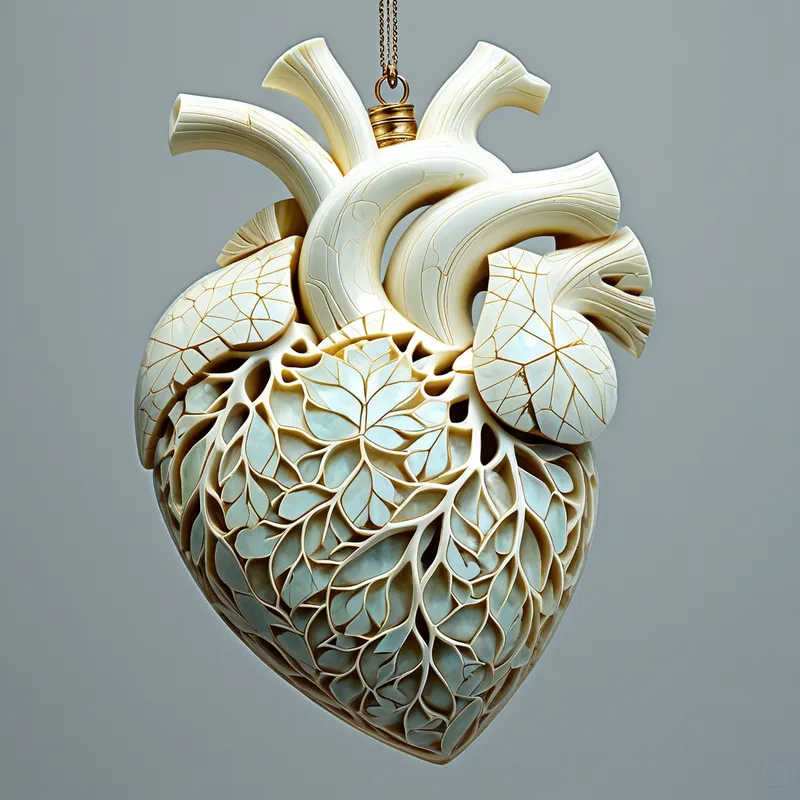
When this myth stirs in the modern dreamscape, it signals a profound psychological process underway. To dream of crafting a perfect statue, or of being in love with an unresponsive, beautiful object, speaks to a state of idealized [projection](/myths/projection “Myth from Alchemical culture.”/). The dreamer may be caught in an intellectual or creative endeavor that has consumed them, or they may be relating to a partner, a goal, or a self-image as a “perfect statue”—something they have constructed that lacks authentic, reciprocal life.
Somatically, this can feel like a state of tension, coolness, or aesthetic precision that is beautiful but joyless. There is a longing for warmth, for surprise, for the messiness of reality. The dream of the statue beginning to soften, crack, or show signs of life—even if frightening—is a tremendously positive sign. It indicates the unconscious is intervening to break the dreamer’s narcissistic spell, introducing the animating principle of Eros to thaw the frozen ideal. The psyche is attempting to move from a state of having an ideal to being in relationship with a living soul.
Alchemical Translation
The alchemical journey of Pygmalion is a perfect model for the process of individuation, specifically the integration of the anima/animus.
[The first stage](/myths/the-first-stage “Myth from Alchemical culture.”/), [Nigredo](/myths/nigredo “Myth from Alchemical culture.”/), is his disillusionment and withdrawal—the rejection of the base, impure “matter” of real human relationship. His studio is the Albedo, the whitening: a state of purified, intellectual isolation where he creates the flawless, white ivory form—the perfect, sterile idea.
The crucial, transformative fire is not his skill, but his love. His passion for the statue is the Citrinitas, the yellowing, the infusion of solar, conscious desire into the lunar, silver-white ideal. This sets the stage for the divine intervention.
The prayer and the animation by Aphrodite represent the [Rubedo](/myths/rubedo “Myth from Alchemical culture.”/), the reddening. This is the descent of the spirit, the coniunctio or sacred marriage between the human craftsman (ego) and the divine principle of life and relationship ([the Self](/myths/the-self “Myth from Jungian culture.”/)). The cold, white stone is transmuted into warm, red, living flesh. The goal of the alchemical opus is not the creation of the perfect statue, but the sacrifice of that perfection to the greater mystery of life.
For us, the modern Pygmalions, the myth instructs: we must dare to fall in love with our deepest creations and ideals, but we must then have the courage to lay them at the altar of a power greater than our own craftsmanship. We must pray for them to be taken from us, to be made real, independent, and alive. The true masterpiece is not the perfect form we control, but the living relationship that transforms us in return. The statue must come to life so that the sculptor, in turn, may finally be born.
Associated Symbols
Explore related symbols from the CaleaDream lexicon: