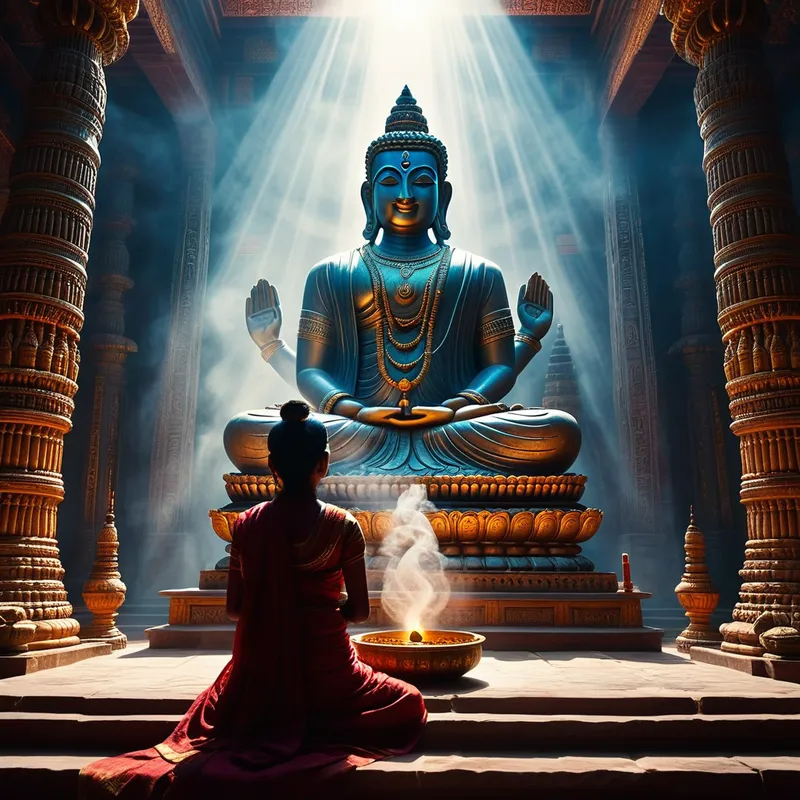
Puja Myth Meaning & Symbolism
The myth of Puja is the story of the sacred offering, a ritual act that transforms the mundane into the divine, bridging the human and the cosmic.
The Tale of Puja
Listen. Before the first word was spoken, there was an emptiness. A silence so profound it was a presence. In this stillness, the human heart first quickened with a question—a longing not for an answer, but for a connection. This is where our tale begins, not with a thunderous birth of a god, but with the quiet trembling of a human hand reaching out into the vast, echoing unknown.
Imagine a dawn, [the world](/myths/the-world “Myth from Tarot culture.”/) still veiled in grey mist. A figure, let us call her Anya, stands before a simple stone washed smooth by a river. It is not yet an idol; it is just a stone. But in her eyes, it holds the potential of the mountain from which it came. Her breath steadies. She gathers [water](/myths/water “Myth from Chinese culture.”/) from the stream, cupping it in her palms. This is the first gesture. The water, cool and clear, is poured over the stone. It is not a cleaning; it is an awakening. She anoints the stone, calling it to wakefulness, to presence.
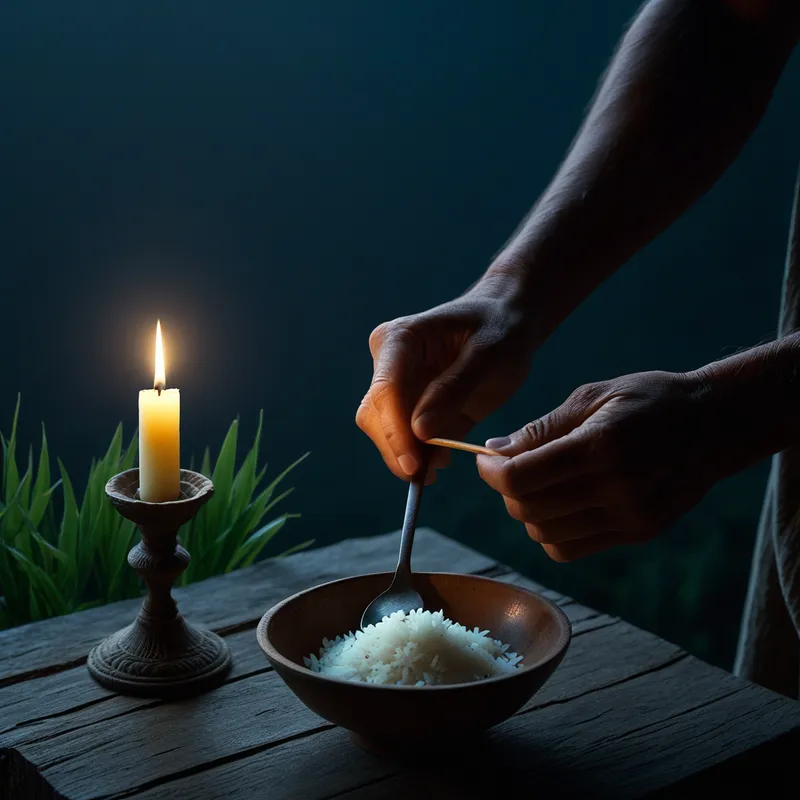
Next, a leaf, still damp with dew. She touches it to the stone. Then, a handful of wild rice, grains like tiny pearls of sunlight. Each offering is placed with a deliberate slowness, a somatic poetry. She lights a twist of dried herbs; smoke, fragrant and blue, rises in a slow, spiraling column, carrying her silent invocation upwards. A small flame from an earthen lamp flickers, casting dancing shadows, making the stone seem to breathe. Finally, she rings a tiny bell. The sound is sharp, clear—a vibration that cuts through the mundane air, creating a circle of sacred space around her, the stone, and the act.
There is no booming voice from the heavens. No miraculous transformation of the stone. The conflict is internal, the silent war between her doubt and her devotion, between seeing a mere rock and perceiving a vessel. The rising action is the rhythm of her own breath syncing with the rhythm of the gestures. The resolution is not in the stone, but in her. As she completes the final circumambulation, her hands folded in reverence, a subtle shift occurs. The world has not changed, yet everything is different. The stone now sits in a field of relationship. The air is charged. The ordinary space has become a [mandala](/myths/mandala “Myth from Buddhist culture.”/), and the simple act has woven a thread between her solitary heart and the immense, listening heart of the cosmos. The Puja is complete. The connection is made.
Cultural Origins & Context
The myth of Puja is not a single story with a fixed plot, but a living, breathing pattern of ritual that forms the very heartbeat of daily sadhana for millions. Its origins are as ancient as the human impulse to relate to the numinous. While grand Vedic yajnas required priests and elaborate communal resources, Puja represents the democratization of the sacred. It emerged as a personal, accessible dialogue with the divine, bringing ritual from the public arena into the inner chamber of the home and the heart.
Passed down not through epic recitations alone, but through the intimate mimicry of a child watching a parent, Puja is a myth performed by the body. Its primary storytellers are grandmothers lighting the evening lamp, fathers offering the first fruit of the season, and individuals in moments of quiet desperation or overflowing gratitude. Its societal function is profound: it structures time (daily, seasonal, life-cycle rituals), sanctifies space (transforming a corner of a room into a temple), and continuously re-weaves the individual into the cosmic and social fabric. It is a technology of remembrance, a daily realignment of the human [psyche](/myths/psyche “Myth from Greek culture.”/) with a reality greater than itself.
Symbolic Architecture
At its core, Puja is a myth of transformation through intentional [relationship](/symbols/relationship “Symbol: A representation of connections we have with others in our lives, often reflecting our emotional state.”/). Every element is a symbolic [node](/symbols/node “Symbol: A point of connection, intersection, or decision in a network, representing junctions in life paths, relationships, or systems.”/) in an [alchemical process](/symbols/alchemical-process “Symbol: A symbolic transformation of base materials into spiritual gold, representing inner purification, integration, and the journey toward wholeness.”/) where the profane becomes sacred, not by changing its substance, but by changing its context and meaning.
The deity, or ishta-devata, is not merely an external [statue](/symbols/statue “Symbol: A statue typically represents permanence, ideals, or entities that are revered.”/). It represents the archetypal wholeness, the ultimate “Other” with whom the psyche seeks union. The offerings—[water](/symbols/water “Symbol: Water symbolizes the subconscious mind, emotions, and the flow of life, representing both cleansing and creation.”/), flower, [food](/symbols/food “Symbol: Food in dreams often symbolizes nourishment, both physical and emotional, representing the fulfillment of basic needs as well as deeper desires for connection or growth.”/), light, [incense](/symbols/incense “Symbol: Incense represents spiritual communication, purification, and the transformation of the material into the ethereal through smoke.”/), sound—are the symbolic languages of the senses. They are the raw materials of [human](/symbols/human “Symbol: The symbol of a human represents individuality, complexity of emotions, and social relationships.”/) [life](/symbols/life “Symbol: The symbol of ‘Life’ represents a journey of growth, interconnectedness, and existential meaning, encompassing both the joys and challenges that define human experience.”/) and [perception](/symbols/perception “Symbol: The process of becoming aware of something through the senses. In dreams, it often represents how one interprets reality or internal states.”/), which are now “cooked” by the fire of devotion and offered up.
The ritual is not about feeding the god, but about transforming the one who offers. The devotee offers their own sensory experience—sight, touch, taste, smell, hearing—back to the source of perception.
The sequential steps—invocation, bathing, dressing, feeding, honoring—mirror the acts of hospitality shown to a most honored [guest](/symbols/guest “Symbol: A guest in a dream can symbolize new experiences, unexpected situations, or aspects of oneself that are being revealed.”/). This frames the divine not as a distant dictator, but as an intimate, beloved [presence](/symbols/presence “Symbol: Presence in dreams often signifies awareness or acknowledgment of something significant in one’s life.”/) entering one’s home. The final act of receiving the prasad (the offered food, now blessed) completes the circuit: a gift is given, transformed, and returned. The circle of giving and receiving becomes a model for a reciprocal [universe](/symbols/universe “Symbol: The universe symbolizes vastness, interconnectedness, and the mysteries of existence beyond the individual self.”/).
The Dreamer’s Resonance
When the pattern of Puja stirs in the modern unconscious, it rarely appears as a traditional ritual. The dreamer may find themselves in a stark, minimalist office, meticulously arranging pens and a coffee cup on their desk in a precise, reverent order. They might dream of tending to a dying houseplant with an intensity that feels like a sacrament, or of polishing a forgotten family heirloom until it shines with an [inner light](/myths/inner-light “Myth from Buddhist culture.”/).
These dreams signal a somatic and psychological process of re-sacralization. The psyche is attempting to bridge a felt disconnect. The “mundane” objects in the dream—the desk, the plant, the heirloom—are stand-ins for aspects of the dreamer’s own life or self that have become desiccated, functional, and devoid of meaning. The ritualistic behavior is the psyche’s innate impulse to re-establish relationship with these orphaned parts.
The somatic feeling is often one of focused calm amidst chaos, or a deep, quiet yearning. It is [the Self](/myths/the-self “Myth from Jungian culture.”/) (the inner Atman) prompting [the ego](/myths/the-ego “Myth from Jungian culture.”/) to stop, to attend, to offer care. The conflict in the dream might be an interruption of this ritual—a phone ringing, someone laughing—representing the modern world’s assault on depth, presence, and sacred attention.

Alchemical Translation
For the modern individual navigating a fragmented world, the alchemy of Puja models the complete process of psychic integration, or individuation. It is a blueprint for transforming the lead of our scattered, reactive daily existence into the gold of conscious, purposeful being.
First, we must choose our “deity”—not necessarily a religious figure, but the central, organizing value or archetype we wish to orient ourselves toward (Truth, Compassion, Creativity, Wholeness). This is the establishment of the altar in the inner sanctum. The daily “offerings” become our conscious actions: the focused attention we give to our work (the food), the beauty we seek or create (the flowers), the clarity we strive for (the water), the inspiration we follow (the light), the atmosphere we cultivate (the incense), and the boundaries we set against noise (the bell).
Individuation is the daily Puja of the soul. We gather the fragments of our experience—our thoughts, feelings, successes, and failures—and, through the fire of conscious reflection, offer them up to the greater pattern of our becoming.
The ritual sequence forces a slowing down, a movement from chaos to order. By physically (or mentally) performing these steps, we enact the psychological process of collecting our scattered psychic energy (the offerings), concentrating it (the focused ritual), and directing it toward our chosen center of value (the deity). The prasad we receive is the resulting state of grace: a sense of peace, integration, and renewed meaning that nourishes us for the day’s journey. We are not worshipping an external god; we are performing the sacred act of relating the small self to the great Self, thereby making our entire life an ongoing, lived Puja.
Associated Symbols
Explore related symbols from the CaleaDream lexicon: