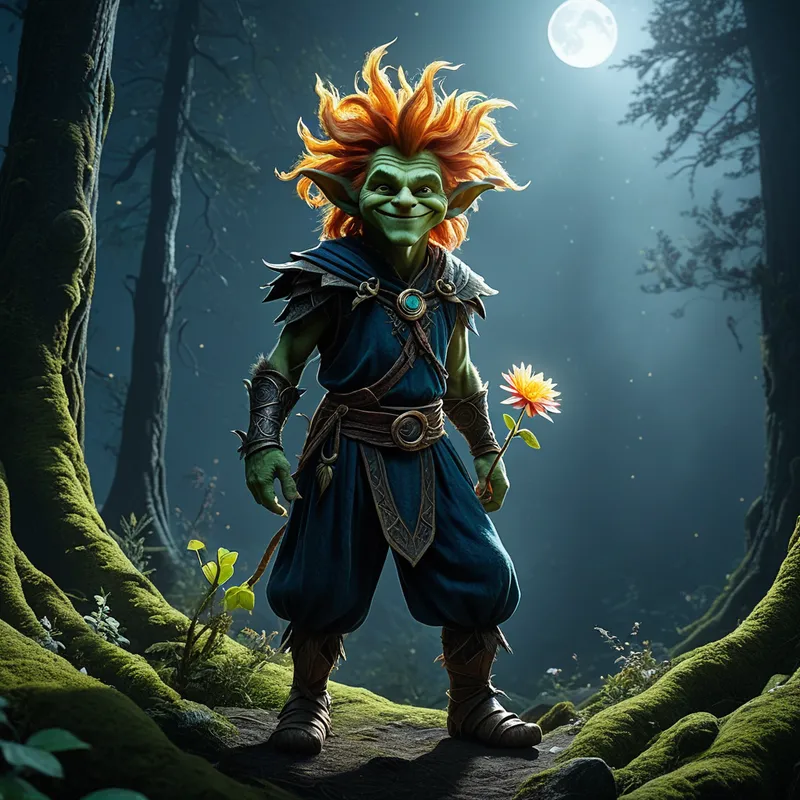
Puck Myth Meaning & Symbolism
A shape-shifting hobgoblin, servant to the Fairy King, whose chaotic magic in an Athenian forest reveals the fluid, transformative nature of reality and the self.
The Tale of Puck
Listen, and let the veil between your world and the other thin. The tale unfolds not in a kingdom of stone, but in a kingdom of green—the ancient, breathing woods outside Athens, on a night swollen with midsummer magic. Here, the moon is a sovereign, and her subjects are shadows and whispers.
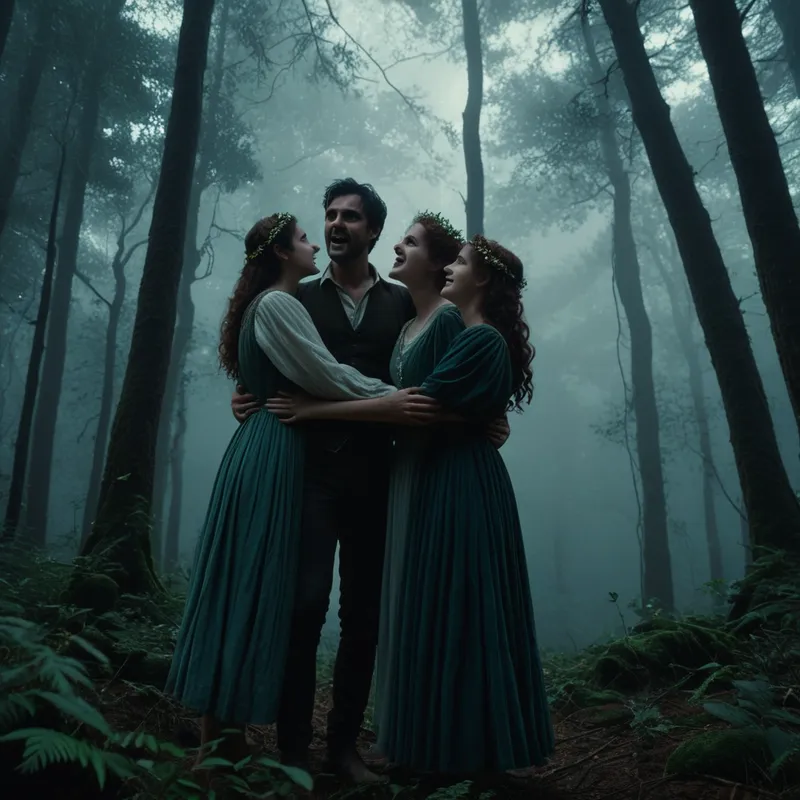
The forest is restless. Its true rulers, Oberon and Titania, are locked in a bitter quarrel over a changeling child, a tempest of pride that has twisted the very seasons. Into this charged gloaming stumble four mortals: the lovers Hermia and Lysander, fleeing Athenian law, pursued by the lovesick Demetrius and the heartbroken Helena. Their human passions—all sharp angles and desperate declarations—are clumsy noise in the fairy realm.
And there, at the crux of it all, is Puck. He is not a god, but a spirit of the threshold. He appears as a rough, knotted creature, part boy, part goat, with eyes that hold the glint of a thousand pranks. He is Oberon’s “shrewd and knavish sprite,” his will made manifest in the world. To correct the mortal lovers’ crossed stars, Oberon commands Puck to anoint the eyes of “the disdainful youth” with the juice of love-in-idleness, a flower struck by Cupid’s arrow.
But Puck is a creature of poetic literalism and wild humor. He finds a “Athenian youth” sleeping—but it is Lysander, not Demetrius. A drop of the purple essence, and the spell is cast. Upon waking, Lysander’s love for Hermia vanishes like mist, transferred wholly to Helena. The chaos multiplies when Puck, enjoying the sport, transforms the head of the boastful weaver Nick Bottom into that of an ass, and the enchanted Titania falls madly in love with this monstrous hybrid.
The forest becomes a theater of glorious confusion. Love turns on a dime, friendships shatter, and a queen dotes on a donkey. Puck weaves through it all, a delighted agent of anarchy, reporting to Oberon with the glee of a child who has set a complicated toy in motion. Only when the discord threatens to curdle into true harm does Oberon intervene. With a counter-charm and the careful application of the flower’s juice, he sets the world to rights. The lovers are paired correctly, their night’s turmoil remembered only as a “dream and fruitless vision.” Bottom is restored, clutching his strange memory. And Puck, his work done, sweeps through the house at dawn, mending the minor damages of the night, leaving the mortal world seemingly untouched, yet irrevocably altered beneath the surface.
Cultural Origins & Context
The figure of Puck is not Shakespeare’s invention, but his brilliant curation. He is a folkloric amalgam, a “hobgoblin” drawn from the deep well of English and Celtic rural belief. As Robin Goodfellow, he was a household spirit, known for both helpful chores and relentless teasing—churning butter or tangling horses’ manes. Shakespeare, writing for the cosmopolitan audiences of the Globe Theatre in London, plucked this rustic entity from village tales and placed him at the center of a sophisticated, courtly entertainment, A Midsummer Night’s Dream.
The play itself was likely written for an aristocratic wedding, functioning as a mythic mirror for the audience. In this context, Puck’s chaos is not merely slapstick; it is a necessary, ritualized disruption. The Elizabethan worldview held a deep anxiety about disorder—in the state, the family, and the self. The play allows this disorder to be enacted safely within the “green world” of the forest, a traditional literary space for transformation. Puck is the master of ceremonies for this temporary inversion. By orchestrating a crisis of identity and desire, he ultimately enables a more harmonious resolution, modeling the societal function of controlled carnival and comic release.
Symbolic Architecture
Puck is the living embodiment of the Trickster archetype. He is not evil, but amoral—a force of nature that operates beyond human concepts of right and wrong. His domain is the liminal space: the forest edge, the moment between sleep and waking, the threshold where one identity dissolves and another has not yet formed.
The Trickster does not destroy the world; he dissolves the glue that holds our perceived reality together, so that a truer, or at least a more fluid, configuration may emerge.
The love-in-idleness flower is his primary tool, a symbol of the intoxicating, irrational, and utterly transformative power of Eros—not just romantic love, but the fundamental life force that compels attraction and union. Puck’s “mistake” in applying it is psychologically profound: it reveals that our affections are not the stable, reasoned things we believe them to be, but are susceptible to unseen influences and can shift with a single drop of enchantment. His transformation of Bottom speaks to the animalistic, instinctual layer of the psyche (the Shadow) that civilization seeks to mask, and the bizarre, often humiliating, beauty that can arise when it is acknowledged.

The Dreamer’s Resonance
When the spirit of Puck visits a modern dream, the dreamscape often becomes a labyrinth of mistaken identities, shifting allegiances, and surreal transformations. You may dream of being passionately in love with the wrong person, or of your partner not recognizing you. You may find your own face changing in the mirror, or your voice sounding alien. These are not nightmares of external threat, but somatic dramas of internal disorientation.
Such dreams signal a psyche in flux. The conscious ego’s carefully constructed identity—its roles, preferences, and loves—is being gently (or not so gently) pranked by the unconscious. The somatic feeling is often one of vertigo, giddiness, or frustrating confusion. This is the psychological process of de-integration, where old structures must become fluid before a new synthesis can be achieved. The dream-Puck is the agent of this necessary dissolution, showing the dreamer that the self is not a fixed statue, but a flowing stream.
Alchemical Translation
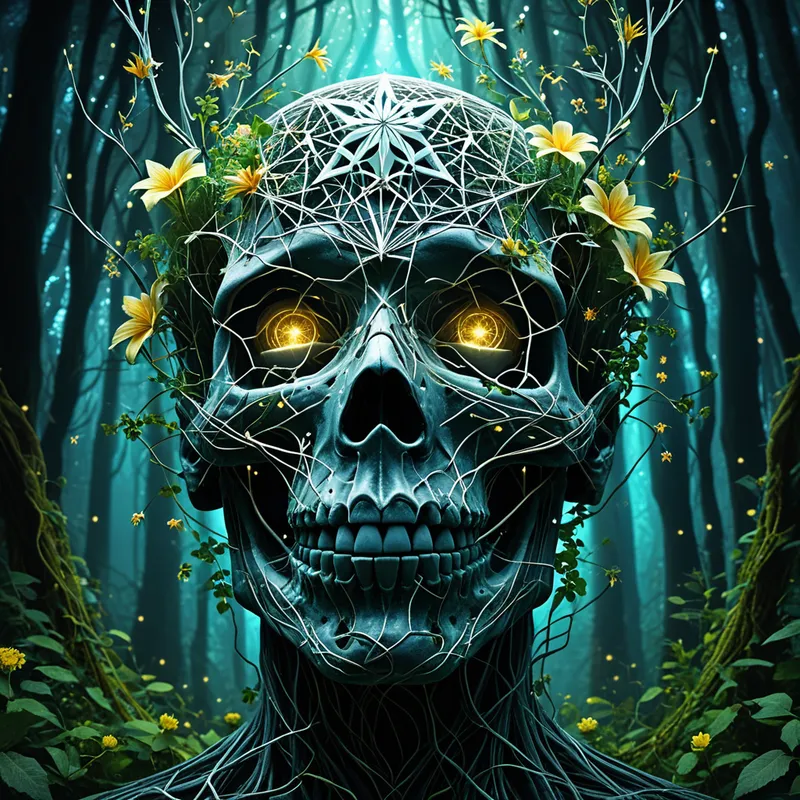
The alchemical journey mirrored in Puck’s myth is the stage of Solutio—dissolution. In the labor of individuation, the first task is often the breaking down of the hardened, leaden persona we present to the world. Puck’s chaos in the Athenian forest is a grand Solutio. He dissolves the rigid love triangles, the fixed social roles (queen, artisan, lover), and even the stable human form.
The psychic gold is not found in perfect order, but in the capacity to endure and integrate the chaos that precedes it.
For the modern individual, the “Puck moment” arrives when life itself seems to play a trick: a sudden job loss, an unexpected attraction, a crisis that scrambles our sense of self. The instinct is to panic, to grasp for the old order. The alchemical instruction is to instead, for a moment, adopt Puck’s own perspective: to see the chaos not as a disaster, but as a kind of wild, creative magic in progress. It is the forest doing its necessary work. The goal is not to become Puck—the eternal, amoral trickster—but to survive his realm, to allow the false certainties to be washed away, and to emerge, like the four lovers at dawn, with a humility born of having been profoundly lost. We integrate the Puck-energy by developing a sense of humor about our own rigidities and by acknowledging the wild, unpredictable, and transformative undercurrent that flows beneath our seemingly orderly lives.
Associated Symbols
Explore related symbols from the CaleaDream lexicon: