Psychopomp Myth Meaning & Symbolism
The myth of the Psychopomp, the soul-guide who shepherds the dead to the underworld, revealing the sacred art of navigating life's ultimate transitions.
The Tale of Psychopomp
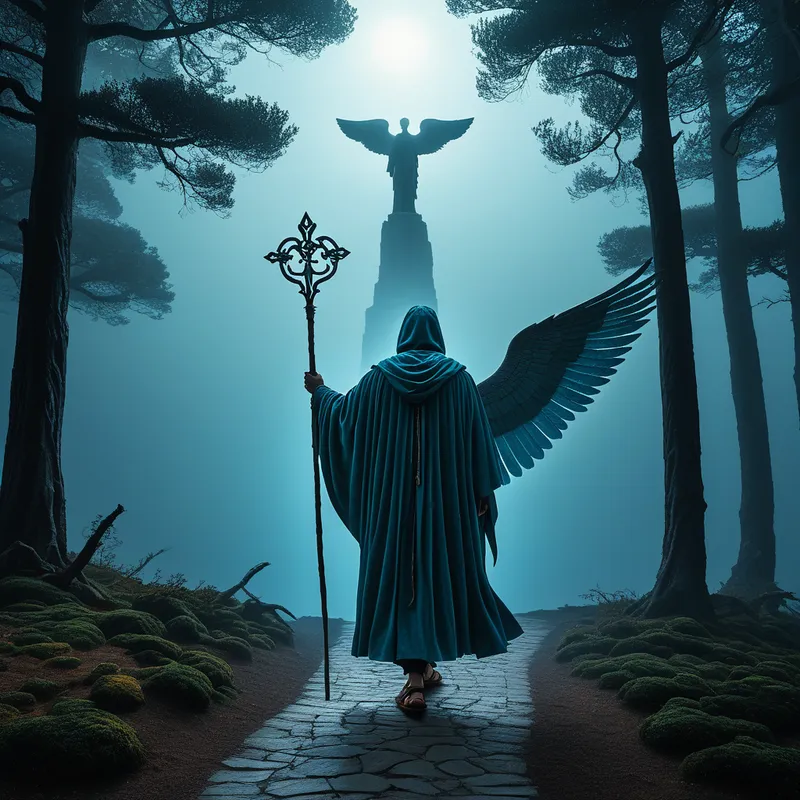
Listen, and let the veil between the worlds grow thin. The sun has fallen below the horizon, not into the sea, but into a deeper abyss—the realm of forgetting. In this hushed hour, when the last bird’s call has faded and the living have barred their doors, a different traveler takes to the roads. Not the dusty paths of men, but the silvered, moonlit track that only the newly loosened soul can see.
He is there, waiting at the crossroads. You know him by the whisper of wings on his sandals, by the staff of intertwined serpents held in his steady hand—the caduceus. He is Hermes, son of Zeus, but in this duty, he wears a different aspect. His usual mischief is tempered into a profound, unshakeable calm. His eyes hold the patience of the endless journey.
The soul, a wisp of memory and fear, clings to the fading warmth of its former hearth. It sees only the terrifying maw of the unknown, the black cypress grove, the soundless river. It is lost. Then, a presence. Not to seize, but to attend. Hermes does not speak with a mortal tongue, but with an assurance that settles in the soul’s core like a stone in a still pool. Come. The path is appointed, and I am its keeper.
Together, they move. Through landscapes that are and are not of this earth—fields of asphodel glowing grey in the twilight, past the silent ferryman Charon at the shore of the Styx, whose grim nod is granted only at the sight of the divine guide. The air grows thick with the sighs of a million shades, but the caduceus casts a circle of quietude. Hermes walks, a steady beacon, neither hastening the reluctant nor lagging for the sorrowful. His role is not to judge the life left behind, but to honor the truth of its ending.
The journey culminates at the throne of Hades himself, in the sunless hall. Here, in the presence of the stern king and his queen Persephone, the soul is presented. The guide’s task is complete. With a final, inscrutable glance that holds both a farewell and a recognition—for he will see countless more—Hermes turns. He retraces his steps, leaving the stillness of the dead for the noise of the living, ready to be called again when another thread of life is cut. He is the hinge on the door between all worlds, forever swinging.

Cultural Origins & Context
The figure of the Psychopomp—from the Greek psychē (soul) and pompos (guide or conductor)—is not the subject of a single, epic narrative like the labors of Heracles. Instead, it is a sacred function woven into the fabric of Greek religious understanding, appearing in Homer’s Odyssey, Hesiod’s Theogony, and countless vase paintings and funerary inscriptions. This was a practical mythology. In a culture where improper burial meant a soul doomed to wander, the presence of a divine escort guaranteed order in the cosmos’s most delicate transaction.
The role was most consistently embodied by Hermes, the quintessential boundary-crosser. As god of thresholds, trade, and communication, he was the natural choice to mediate the ultimate transition. This duty was not a lesser task but a foundational one, performed for every soul, from the greatest hero to the most common citizen. The myth was enacted in ritual: a coin placed in the mouth of the deceased for Charon was an echo of Hermes’s patronage of commerce, ensuring the soul could pay its fare under his auspices. The myth provided a psychic container for the terror of death, transforming a chaotic, personal ending into a structured, communal process with a divine chaperone.
Symbolic Architecture
At its core, the Psychopomp myth is a master symbol for the principle of guided transition. It addresses the universal human experience of being thrust into an unknown, terrifying state of being—whether death, a profound loss, a psychological crisis, or the end of an era of life.
The Psychopomp does not carry the soul; it walks beside it, illuminating the path the soul must ultimately take for itself.
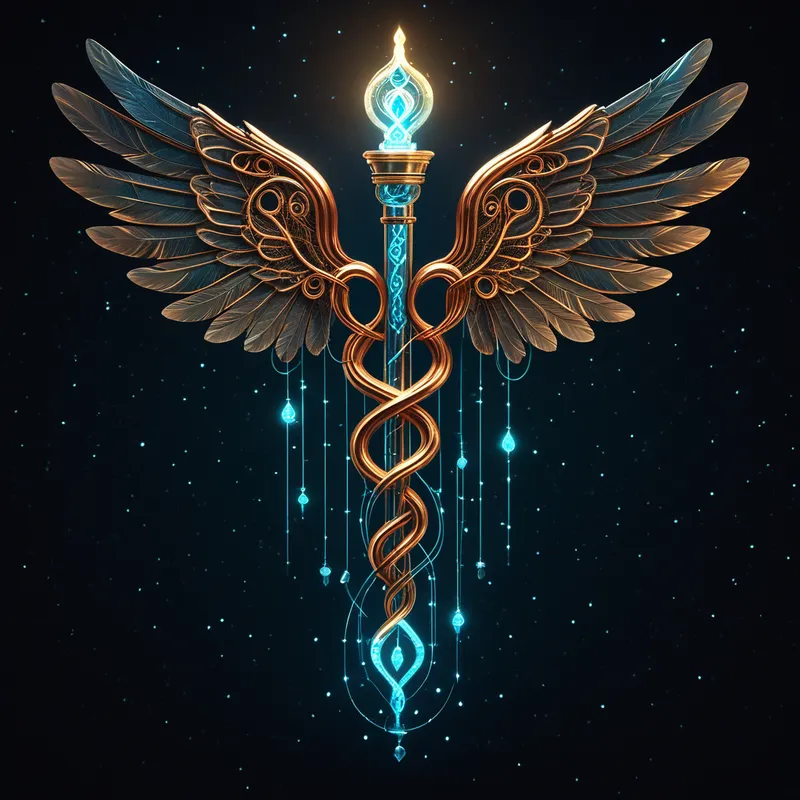
Hermes, with his caduceus, embodies the reconciliation of opposites necessary for such a journey. The twin serpents—often interpreted as symbols of life and death, or conscious and unconscious forces—are held in a dynamic, balanced embrace around the central staff. This represents the neutral, mediating consciousness required to navigate transformative chaos. He is not the destination (Hades), nor the judge (Minos), nor the raw material (the soul). He is the function of awareness that makes the journey conscious instead of a blind fall.
The path itself—the liminal space between worlds—is the critical symbolic stage. It is the bardo, the therapeutic process, the dark night of the soul. It is not life, and not yet the rest of death; it is the transformative in-between where identity is stripped bare and re-contextualized.
The Dreamer’s Resonance
When the archetype of the Psychopomp stirs in the modern psyche, it often manifests in dreams during periods of intense life transition or inner dying. The dreamer may not see a classical Hermes. The guide can appear as a unknown but trustworthy figure, a deceased loved one who feels comforting, a therapist, a specific animal that leads the way, or even a compelling, guiding light.
The somatic experience in such dreams is key: a profound feeling of being accompanied through a terrifying landscape. There is fear, but it is held within a larger container of safety. The dreamer might be walking through a decaying house (the old psyche), crossing a dark bridge, or navigating a labyrinthine bureaucracy (the impersonal afterlife). The presence of the guide reduces the paralyzing panic, allowing the dream ego to witness its own dissolution or change without being completely annihilated by anxiety. This is the psyche’s innate healing function, personified, assuring the conscious self that even in its most fragmented state, it is not abandoned. The process is about surrendering to a journey whose end is unknown, trusting the guidance of a deeper, inner authority.

Alchemical Translation
Psychologically, the myth of the Psychopomp models the essential process of individuation, specifically the phase of navigating the unconscious. The conscious ego (the soul) must “die” to its old, rigid self-conception to be reborn into a more expansive identity. This is a perilous descent.
The alchemical work is not in avoiding the underworld, but in finding the Hermes within—the observing, mediating intelligence that can converse with both the kingly ego and the shadowy contents of the deep.
In this translation, the journey to Hades represents the confrontation with the personal and collective shadow. The soul’s fear is the ego’s resistance. Hermes Psychopomp is the emerging symbol of the transcendent function—the psychic capacity that arises from holding the tension between conscious and unconscious, old and new, life and death. It creates a third, guiding perspective.
For the modern individual, to “become one’s own Psychopomp” is to cultivate this inner Hermes. It is to develop the capacity for self-observation and compassionate witnessing during depression, grief, or creative block. It is to take up the caduceus—the tool that negotiates between inner opposites—and guide oneself through the inevitable endings that precede all true beginnings. The myth ultimately teaches that every ending contains, within its very structure, the presence of the guide. The key is to recognize it, in the world or in the soul’s silent, moonlit depths.
Associated Symbols
Explore related symbols from the CaleaDream lexicon: