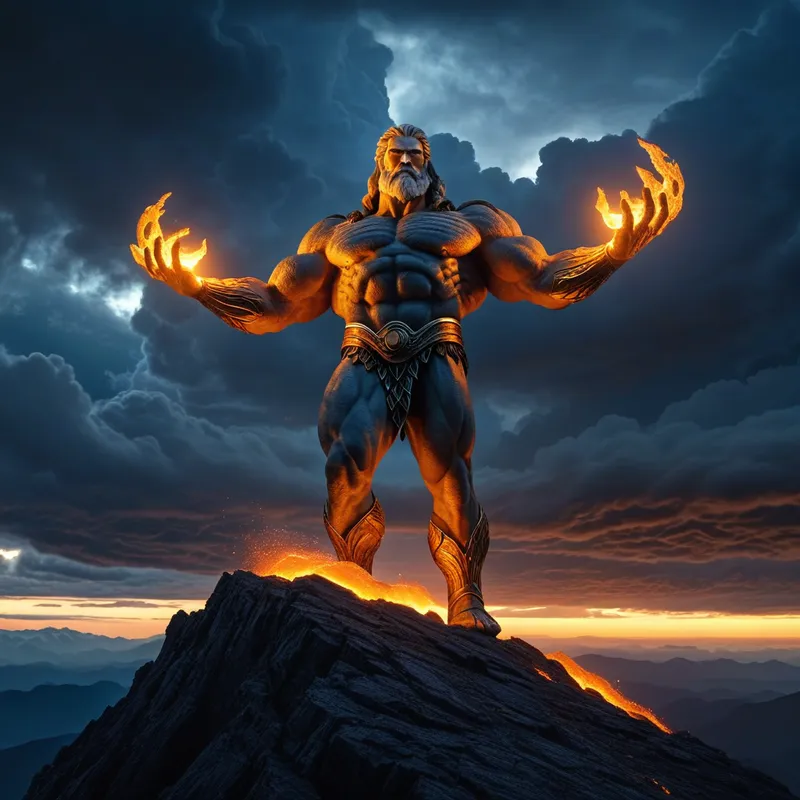
Prometheus and the stolen fire Myth Meaning & Symbolism
A Titan defies the gods to gift humanity with divine fire, sparking civilization and earning an eternity of torment for his transgression.
The Tale of Prometheus and the stolen fire
In the beginning, after the great war of the Titans had subsided and the new order of Zeus was established, the world was a place of shadows and cold. Humanity, molded from clay, huddled in caves. They were feeble, ephemeral creatures, destined to live brief, brutish lives in perpetual twilight, their meals raw and their spirits dim. They were playthings for the gods, their suffering a distant amusement.
But one being watched them with a different heart. Prometheus, whose name means “Forethought,” saw not mud and mortality, but potential. He felt a kinship with these fragile, shivering forms. While the other Olympians feasted on ambrosia and reveled in their eternal power, Prometheus descended to the misty valleys. He taught men to read the stars for seasons, to build simple shelters from the wind, and to find solace in stories. Yet still, they froze in the dark. Still, their world was one of instinct, not illumination.
The true secret, the divine spark that could change everything, was jealously guarded on Olympus. Fire. Not just the flame that cooks meat or wards off beasts, but the celestial fire of mind, of craft, of aspiration. Zeus had declared it forbidden, the sole property of the immortals. To give it to mortals was to make them like gods, to upset the ordained hierarchy. It was the ultimate taboo.
Prometheus’s resolve hardened like tempered steel. He journeyed to the sun-chariot of Helios. As the blazing vehicle crossed the vault of heaven, he took a stalk of giant fennel, hollow and dry. With cunning and unbearable courage, he touched it to the wheel’s fiery rim. A spark, a glow, then a flame leapt into the stalk’s heart. Hiding the stolen light within the humble plant, he descended back to earth, the smell of ozone and rebellion clinging to him.
He gathered the trembling humans. “See,” he said, his voice low with the weight of his crime. He blew upon the fennel stalk, and the divine fire burst forth. It did not just light the kindling at their feet; it lit their eyes from within. That night, for the first time, a communal fire roared. Shadows danced on cave walls, not as threats, but as the first tales. Hands, no longer numb, shaped tools in the heat. The smell of cooked food filled the air, a promise of community and future. Laughter, real laughter, was born in that circle of light.
On Olympus, the scent of burning wood and ambition reached the nostrils of Zeus. He looked down and saw the countless pinpricks of fire dotting the dark earth, a mirror of the stars he commanded. His rage was a thunderclap that shook the foundations of the world. The transgression was absolute. Prometheus had stolen the very currency of divinity and given it to clay.
The punishment was to be a masterpiece of cruelty. Hephaestus, the smith-god, was ordered to forge unbreakable chains. With a heavy heart, he bound the Titan to a desolate, wind-scoured cliff in the Caucasus Mountains. There, Prometheus was exposed, utterly helpless. But his torment was not mere exposure. Each day, a monstrous eagle, the emissary of Zeus, would descend. With talons like bronze sickles, it would tear open Prometheus’s side and feast upon his immortal liver. Each night, the organ would regrow, lush and vital, only to be ripped out again at dawn. His agony was to be eternal, an endless cycle of violation and renewal, a spectacle of suffering for his cosmic crime of compassion.

Cultural Origins & Context
This foundational myth originates from the rich tapestry of ancient Greek mythology, most comprehensively preserved in the epic poetry of Hesiod’s Theogony and Works and Days (8th-7th century BCE), and later dramatized in Aeschylus’s tragic play Prometheus Bound (5th century BCE). It was not merely a story for entertainment, but a sacred narrative that explained the human condition. Told by bards at symposia, performed in grand theaters during religious festivals, and contemplated by philosophers, it served a crucial societal function.
The myth provided an etiology—a story of origins—for humanity’s paradoxical state: our possession of god-like intellect and creative power (symbolized by fire and the arts Prometheus later bestowed) juxtaposed with our suffering, mortality, and toil. It explained why we must work for our food, why we are separate from the animals, and why our relationship with the divine is one of sacrifice and fraught tension. It positioned humanity in a cosmic order, born from an act of rebellion that defined our essence as beings who must strive, innovate, and endure punishment for our aspirations.
Symbolic Architecture
At its core, the myth of Prometheus is a profound allegory for the birth of consciousness and the inherent suffering of self-awareness. The stolen fire is not merely a tool; it is the spark of nous (mind), techne (art/craft), and culture. It represents the moment the human psyche awoke from the unconscious, instinctual dream of nature and perceived itself as separate.
The gift of fire is the theft of innocence. It is the knowledge of good and evil, the burden of choice, and the painful, glorious dawn of the individual will.
Prometheus himself is the archetype of the culture hero and the ultimate rebel. His “forethought” symbolizes the human capacity for foresight and planning, which sets us against the blind, immediate will of the gods (or the unconscious forces of nature/instinct). His defiance is not chaotic evil, but a principled rebellion against an unjust order. He represents the part of the psyche that challenges internalized tyranny—be it oppressive parental complexes, societal dogma, or the soul-crushing status quo.
Zeus embodies the established order, the ruling principle of law and hierarchy. His punishment is the inevitable backlash of the system when its foundational rules are broken. The eagle is a symbol of Zeus’s piercing, predatory authority, and the devoured liver—the seat of passion and life-force in ancient belief—represents the perpetual cost of such rebellion: the endless gnawing of guilt, anxiety, and the price of maintaining one’s hard-won consciousness.

The Dreamer's Resonance
When this myth stirs in the modern unconscious, it often manifests in dreams of illicit acquisition, defiant acts, or profound, isolating punishment. To dream of stealing a precious light or secret knowledge speaks to a psyche undergoing a critical awakening. The dreamer may be integrating a forbidden insight, embracing a talent or identity that feels transgressive to their internal “gods” (perhaps family expectations, cultural norms, or a former self-concept).
Dreams of being chained to a rock, or of a predatory bird attacking one’s torso, are somatic metaphors for the psychological consequence of this awakening. This is the “Promethean wound.” It is the feeling of being exposed and tortured for one’s authenticity, the chronic anxiety that accompanies breaking free, or the visceral guilt of surpassing one’s origins. The dream is not a warning to stop, but a mythic reflection of the process itself: enlightenment (fire) is inextricably linked to agony (the eagle). The dream confirms the enormity of the psychic shift underway.

Alchemical Translation
For the individual on the path of individuation, the Prometheus myth is a master narrative of psychic transmutation. The alchemical operation here is Separatio and Calcinatio—the separation from the collective (defying Zeus) and the burning purification in the fire of one’s own truth.
The first step is the “theft”: the conscious act of withdrawing one’s inner fire—one’s unique spirit, vocation, or creative genius—from the projected authority of the “gods.” These gods may be internalized parents, societal idols, or the collective persona. This is an act of supreme inner rebellion, necessary for sovereignty.
The alchemy of Prometheus teaches that one must be willing to be condemned by the old order to midwife the new self.
The binding to the rock is not a failure, but a crucial stage of mortificatio—a symbolic death. It represents the inevitable period of isolation, suffering, and stasis that follows a major psychological breakthrough. The ego, having seized its power, must now endure the consequences of its differentiation. The eagle’s daily visit is the painful, recurring confrontation with the shadow aspects of one’s rebellion: the pride, the isolation, the cost to old relationships.
The miracle—and the completion of the alchemy—lies in the liver’s regeneration. This immortal resilience symbolizes the indestructible core of the Self, which can endure endless cycles of suffering and renewal. The individuated being does not escape punishment, but develops the capacity to regenerate their life-force through meaning. The fire, once stolen, becomes an internal, unquenchable source. The myth thus maps the journey from unconscious servitude, through conscious rebellion and agonizing transformation, toward a hard-won, enduring authenticity. We are all, in some way, both the thief and the bound Titan, paying an eternal price for the divine spark that makes us human.
Associated Symbols
Explore related symbols from the CaleaDream lexicon: