Prince Rama Myth Meaning & Symbolism
The exiled prince Rama embarks on a perilous quest to reclaim his stolen wife and kingdom, embodying the archetypal struggle for dharma and inner integrity.
The Tale of Prince Rama
Listen. In the age when gods walked with kings, in the sun-drenched city of Ayodhya, there was a prince. His name was Rama, and his virtue was so pure it was a scent on the air, a light that made the stones of the palace seem to soften. He was the beloved eldest son of King Dasharatha, a warrior without peer, a husband devoted to his wife, the luminous Sita. The world bent towards his righteousness.
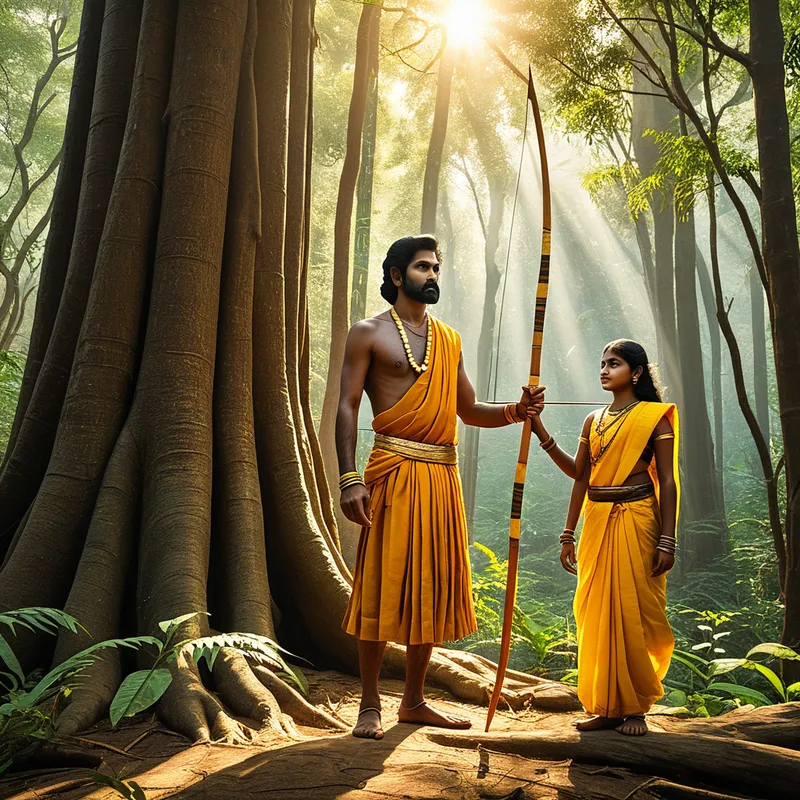
But shadows gather even in the brightest courts. A promise, whispered in a moment of debt, coiled in the king’s heart. Kaikeyi, the youngest queen, invoked it: her son, Bharata, must be crowned, and Rama must be exiled to the forest for fourteen years. The court held its breath. The city wept. And Rama, hearing the decree, smiled. Not a smile of joy, but of acceptance. “Dharma is my king,” he said. He laid aside his silks, took up the bark garments of an ascetic. Sita, whose name means “furrow,” the earth itself, would not be parted from him. His brother Lakshmana, the embodiment of loyalty, took up his bow to follow.
So they walked into the green maw of the Dandaka. The world changed. Sunlight became dappled and uncertain. The air hummed with the cries of strange birds and the whispers of rakshasas. Here, Rama was no longer a prince of palaces but a prince of roots and rivers, a protector of sages from the terrors of the deep wood. And it was here that the shadow found them. Ravana, the ten-headed lord of Lanka, whose form was majesty and whose heart was hunger, desired Sita. Through a cruel illusion—a golden deer, a cry for help—he drew the brothers away. The earth groaned as his chariot descended. He took her, a flash of gold against the dark, and flew south across the roaring sea.
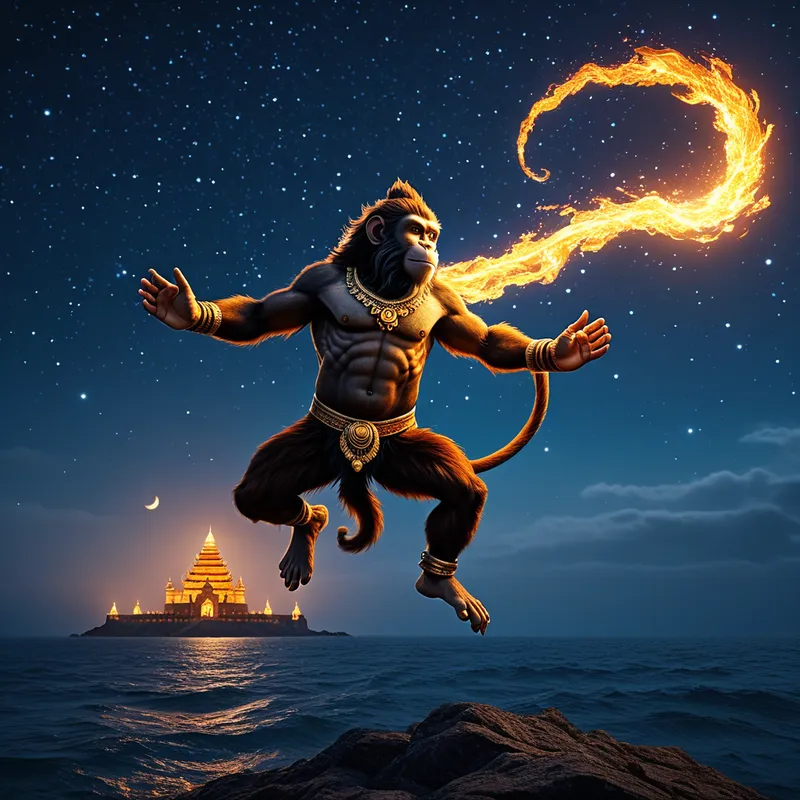
Rama’s grief was a silent tempest. It carved valleys in his soul. But grief turned to resolve, resolve to a fire that would cross oceans. In his exile, he forged an impossible alliance: with the monkey-king Sugriva, and his general, the mighty Hanuman. An army of monkeys and bears built a bridge of stones upon the sea, a line of defiance against the abyss. They crossed to Lanka, a city of gold and vice, and war shook the foundations of the world. Arrows blotted out the sun. Brothers fell—the noble Vibhishana who chose dharma, the mighty Indrajit who wielded serpent-arrows. Finally, Rama faced Ravana on the field. The demon’s heads regrew with each strike, his illusions multiplied. Then, guided by the sage Agastya, Rama invoked the Brahmastra. The arrow, humming with the primordial syllable, found its mark. The shadow-king fell.
Sita was recovered, but the world’s doubt remained. To prove her purity, she entered a pyre. The fire-god Agni himself returned her, unscathed. The fourteen years of exile ended like a long-held breath. Returning to Ayodhya, Rama was crowned, and his rule—Rama Rajya—began, an age where justice was as natural as rain, and sorrow was a forgotten language. The prince, tested in the crucible of exile and war, had become the king.
Cultural Origins & Context
The story of Rama is not merely a tale; it is the cultural bedrock of a civilization, primarily enshrined in the Sanskrit epic, the Ramayana, attributed to the sage Valmiki. Its origins are oral, likely coalescing between 500 BCE and 200 CE, though its roots delve into far older narrative traditions. For millennia, it has been performed, not just read—through dance-dramas like Kathakali, through village storytellers (Bhats), through nightly recitations during the festival of Dussehra and the culminating celebration of Diwali, where countless lamps symbolize the light of dharma returning from the darkness of exile.
Its societal function is multifaceted. Historically, it served as a smriti (remembered) text, a guide to dharma for every station in life: the king’s duty (Rama), the wife’s devotion (Sita), the brother’s loyalty (Lakshmana), the subject’s righteousness (Hanuman, Vibhishana). It maps the ideal social and cosmic order. Yet, its power lies in its accessibility; it is a mirror held up to every human conflict between desire and duty, loyalty and betrayal, justice and mercy. It is a story told to children, debated by scholars, and revered by devotees of Vishnu, for whom Rama is the seventh avatar, the divine made flesh to restore balance.
Symbolic Architecture
Beneath the epic battles and royal intrigues lies a profound map of the psyche. Rama is the archetypal ego in its highest potential—the conscious self striving to act in perfect alignment with the Self, the transcendent Atman. His exile is not a political accident but a necessary descent.
The forest of Dandaka is the unconscious itself—the untamed, shadow-filled realm one must enter to become whole. The palace of Ayodhya represents the ordered, conscious world; to be exiled is to be thrust into the raw material of one’s own soul.
Sita represents more than a spouse; she is sovereignty, the anima (the inner feminine principle) and the rightful connection to one’s own creative life and value (often symbolized as the kingdom). Her abduction by Ravana signifies the ego’s loss of connection to its own soul-value, stolen by the shadow-complex—the unintegrated, powerful, and often brilliant aspects of the psyche (Ravana is a great scholar, a devotee of Shiva). The quest to reclaim her is the central journey of individuation.
Lakshmana is the vigilant function of the psyche, the protective and loyal aspect of consciousness that guards the threshold while the work of integration occurs. Hanuman is the embodiment of bhakti (devotion) and the power of the instinctual, intuitive mind—the monkey-god who can leap directly to the heart of the problem (Lanka) and whose devotion gives him the strength to move mountains. The building of the bridge signifies the conscious effort to construct a connection between the conscious ego and the far-off, fortified island of the complex holding one’s value captive.

The Dreamer’s Resonance
When this myth stirs in the modern dreamer, it signals a profound process of disorientation and reorientation. To dream of being a capable, noble figure suddenly stripped of status and cast into a wilderness speaks to an experience of psychic exile. This could manifest after a job loss, the end of a relationship, a moral crisis, or any event that severs one from their familiar identity and “kingdom.”
Dreams of a cherished partner or a vital aspect of oneself (like creativity or purpose) being stolen by a powerful, shadowy figure point directly to the Ravana complex. This is not a cartoon villain, but an intelligent, compelling force within—perhaps an overbearing ambition, a consuming addiction, or a deep-seated resentment—that has “kidnapped” one’s vitality. The somatic experience is often one of hollow grief, frantic searching, and a feeling of being unmoored.
Conversely, dreaming of building a bridge with unlikely allies (animals, old friends, forgotten parts of oneself) or discovering a latent, loyal strength (a Hanuman-like energy) indicates the psyche mobilizing its resources for the journey back. The dream is mapping the path of reclamation.
Alchemical Translation
The alchemy of the Ramayana is the transmutation of the perfect prince into the integrated king. It models the process of individuation not through the avoidance of fate, but through its utter embrace.
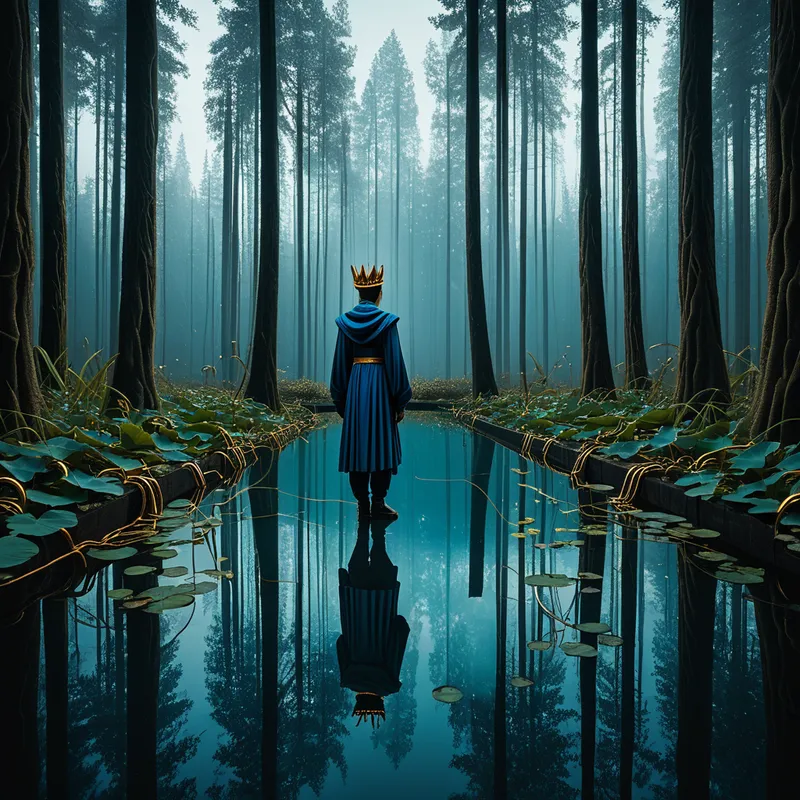
The exile is the nigredo, the blackening. It is the necessary dissolution of the persona—the “Prince of Ayodhya” mask—so that the raw, authentic self can be encountered in the forest of the unknown. One does not choose this fire; it is chosen by the logic of the soul.
The alliance with the monkey army is the albedo, the whitening. It represents the conscious ego (Rama) humbling itself to accept help from the instinctual, “lower” or non-rational parts of the psyche (Sugriva, Hanuman). True power is not solitary control, but integrated community within the self.
The battle in Lanka is the rubedo, the reddening. This is the confrontation with the shadow in its full, terrifying majesty. One does not defeat Ravana by becoming his opposite, but by integrating his power—his mastery, his intensity—into conscious service of the Self. The Brahmastra is the focused, transcendent insight that finally resolves the inner conflict.
The return and reign of Rama Rajya is the citrinitas, the yellowing or illumination. It is the state where the reclaimed sovereignty (Sita) rules alongside the conscious ego, not as a subordinate, but as its essential counterpart. The kingdom is no longer just an external place, but the inner landscape of a psyche where duty and desire, order and wilderness, consciousness and the unconscious, are in harmonious, dynamic balance. The exiled prince dies so the sovereign Self may live.
Associated Symbols
Explore related symbols from the CaleaDream lexicon: