Praying Mantis Kung Fu Myth Meaning & Symbolism
A defeated warrior learns a new way of fighting by observing the patient, precise, and deadly dance of a praying mantis in the forest.
The Tale of Praying Mantis Kung Fu
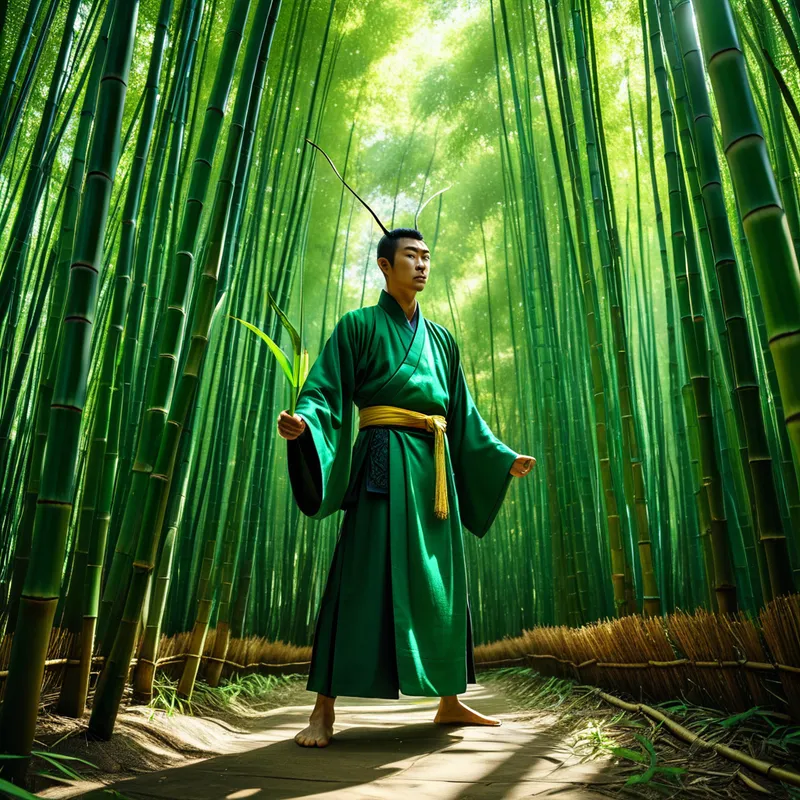
The air in the Mount Laoshan forest was thick with the scent of damp earth and pine. Wang Lang, a warrior whose spirit was as bruised as his body, moved through the shadows not with the stride of a fighter, but with the weary shuffle of a man defeated. The echoes of his last duel—the sting of a rival’s spear finding its mark, the hot shame of [the fall](/myths/the-fall “Myth from Biblical culture.”/)—clung to him like a second skin. He had sought the solitude of the mountains not for training, but for forgetting.
Exhaustion finally claimed him beside a clear stream. As he sat, [the world](/myths/the-world “Myth from Tarot culture.”/) narrowed to the rhythm of his own breath and the dance of light on [water](/myths/water “Myth from Chinese culture.”/). Then, a flicker of movement in the canopy above caught his eye. A cicada, fat and buzzing with summer life, clung to a branch. From the green veil of leaves emerged a hunter: a praying mantis. It was not large, but its presence was absolute. It did not charge. It became.
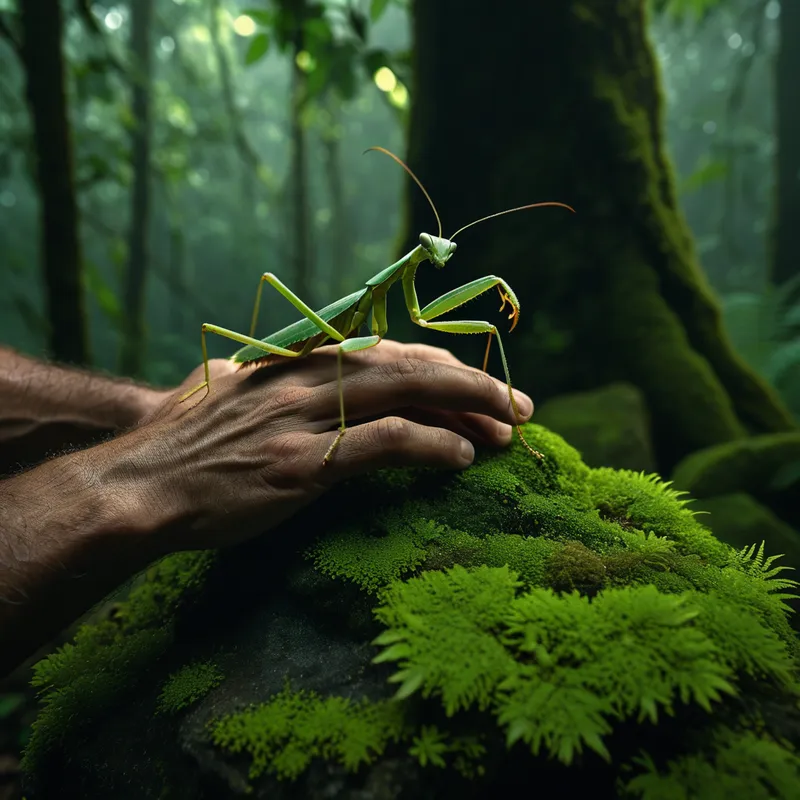
It was a statue of living jade, its triangular head turning with an unnerving, mechanical precision, tracking [the cicada](/myths/the-cicada “Myth from Greek culture.”/)’s every tremor. Wang Lang, the master of a hundred forms, held his breath. This was a different kind of mastery. [The mantis](/myths/the-mantis “Myth from Chinese culture.”/) advanced with steps so slow they were almost imperceptible, a stalker composed of pure patience. Its forearms, those hooked and spined blades, were held not in a crude guard, but in a poised, elegant arc—a gateway of death.
The cicada buzzed. In a burst of motion that was both shockingly sudden and eerily smooth, the mantis struck. There was no wasted effort, no dramatic flourish. One moment the cicada was there; the next, it was pinned, ensnared in a cage of green limbs. The mantis did not celebrate. It simply began to consume, its movements efficient, deliberate, final.
Wang Lang felt a tremor that was not of [the earth](/myths/the-earth “Myth from Hindu culture.”/), but of the soul. He saw not an insect killing its prey, but a principle made flesh. He saw the economy of motion, the interception of force, the turning of an opponent’s energy against itself. He saw patience as a weapon, stillness as a prelude to absolute action. For days, then weeks, he forgot his own forms. He became a student of the green sage. He observed the mantis duel with wasps, its deflections like poetry. He mimicked its stances, its footwork, the unique hooking, seizing, and piercing methods of its arms.
In the quiet of the forest, a new art was born not from human pride, but from humble, rapt attention. Wang Lang did not conquer the mantis; he invited its spirit into his own body. When he finally descended from Laoshan, he carried not just a healed body, but a transformed mind—and a new, devastatingly effective style that flowed like nature itself.
Cultural Origins & Context
The story of Wang Lang and the praying mantis is a foundational chuánshuō (legend) within the rich tapestry of Chinese martial folklore. It is situated in the Ming Dynasty, a period of great cultural consolidation and martial development. Unlike myths of gods descending from heaven, this is a distinctly human, almost Daoist tale of revelation through nature.
It was passed down orally within kung fu families and schools, not as a dry historical record, but as a shenfa—a sacred method or principle story. Its function was multifaceted: to explain the unique, biomimetic techniques of the style; to instill the core values of patience, observation, and adaptability in students; and to root the school’s authority in a moment of authentic, natural wisdom. It served as a living bridge between the martial artist and the natural world, teaching that the greatest master was not in a temple, but in the grass.
Symbolic Architecture
At its [heart](/symbols/heart “Symbol: The heart symbolizes love, emotion, and the core of one’s existence, representing deep connections with others and self.”/), the myth is an [allegory](/symbols/allegory “Symbol: A narrative device where characters, events, or settings represent abstract ideas or moral qualities, conveying deeper meanings through symbolic storytelling.”/) for the transformation of [consciousness](/symbols/consciousness “Symbol: Consciousness represents the state of awareness and perception, encompassing thoughts, feelings, and experiences.”/) through defeat and humble observation. Wang Lang represents the egoic self, identified with his learned skills and social standing as a [warrior](/symbols/warrior “Symbol: A spiritual archetype representing inner strength, discipline, and the struggle for higher purpose or self-mastery.”/). His defeat is the necessary shattering of this rigid [identity](/symbols/identity “Symbol: Identity represents the sense of self, encompassing personal beliefs, cultural background, and social roles.”/), creating the “empty cup” required for true learning.
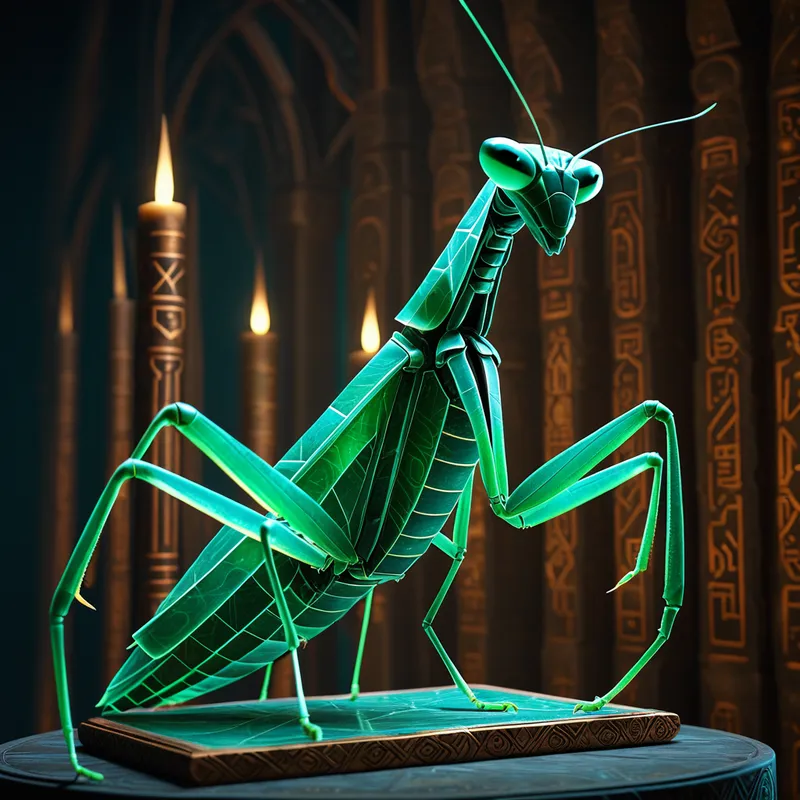
The [praying mantis](/symbols/praying-mantis “Symbol: The praying mantis symbolizes patience, stillness, and intuition, often reflecting feelings of contemplation and focus.”/) is the emissary of the unconscious, instinctual intelligence of [nature](/symbols/nature “Symbol: Nature symbolizes growth, connectivity, and the primal forces of existence.”/)—what the Yijing ([I Ching](/myths/i-ching “Myth from Chinese culture.”/)) might call the wisdom of the “earthly principle.” It does not think; it is [strategy](/symbols/strategy “Symbol: A plan of action designed to achieve a long-term or overall aim, often involving competition, resource management, and foresight.”/). Its symbolic power lies in its paradoxical [nature](/symbols/nature “Symbol: Nature symbolizes growth, connectivity, and the primal forces of existence.”/): it is both a patient monk in [prayer](/symbols/prayer “Symbol: Prayer represents communication with the divine or a higher power, often reflecting inner desires and spiritual needs.”/) and a ruthless, efficient [killer](/symbols/killer “Symbol: A representation of fear, internal conflict, or repressed aggression, often reflecting aspects of the dreamer’s darker self or unresolved issues.”/). It embodies the unification of opposites—[stillness](/symbols/stillness “Symbol: A profound absence of motion or sound, often representing inner peace, creative potential, or existential pause in artistic contexts.”/) and [action](/symbols/action “Symbol: Action in dreams represents the drive for agency, motivation, and the ability to take control of situations in waking life.”/), [defense](/symbols/defense “Symbol: A protective mechanism or barrier against perceived threats, representing boundaries, security, and resistance to external or internal challenges.”/) and offense, softness and hardness.
The mantis does not meet force with force; it accepts the force, hooks it, and redirects its essence. This is the alchemy of the non-opposing will.
The [forest](/symbols/forest “Symbol: The forest symbolizes a complex domain of the unconscious mind, representing both mystery and potential for personal growth.”/) stream where Wang Lang rests is the liminal [space](/symbols/space “Symbol: Dreaming of ‘Space’ often symbolizes the vastness of potential, personal freedom, or feelings of isolation and exploration in one’s life.”/), the [temenos](/myths/temenos “Myth from Greek culture.”/) or sacred [enclosure](/symbols/enclosure “Symbol: A bounded space representing psychological containment, social boundaries, or existential limitations. It can symbolize both safety and restriction.”/) where this [transmission](/symbols/transmission “Symbol: A symbol of communication, transfer, or passage of energy, information, or influence between entities or states.”/) can occur. His act of watching is not passive; it is an active, devotional receptivity. He does not impose his will on the [mantis](/symbols/mantis “Symbol: Represents stillness, contemplation, and the balance between action and patience.”/); he allows the mantis’s essence to impose a new [pattern](/symbols/pattern “Symbol: A ‘Pattern’ in dreams often signifies the underlying structure of experiences and thoughts, representing both order and the repetitiveness of life’s situations.”/) upon him. The resulting kung fu is therefore a technology of [integration](/symbols/integration “Symbol: The process of unifying disparate parts of the self or experience into a cohesive whole, often representing psychological wholeness or resolution of internal conflict.”/)—the [human](/symbols/human “Symbol: The symbol of a human represents individuality, complexity of emotions, and social relationships.”/) [body](/symbols/body “Symbol: The body in dreams often symbolizes the dreamer’s self-identity, personal health, and the relationship they have with their physical existence.”/) and mind integrating the archetypal patterns of a natural [predator](/symbols/predator “Symbol: Represents primal fears, survival instincts, and internal threats. Often symbolizes aggressive impulses or external pressures.”/).
The Dreamer’s Resonance
When this myth pattern stirs in the modern [psyche](/myths/psyche “Myth from Greek culture.”/), it often manifests in dreams of observation and latent power. One might dream of watching an insect or small animal with intense, unwavering focus, feeling a strange kinship. Or, one might dream of their own arms feeling strangely articulated, powerful, yet precise—tools waiting for the correct moment to be used.
Somatically, this signals a process where the conscious mind (the defeated warrior) has exhausted its known resources. The psyche is now turning towards instinctual, pre-verbal intelligence—the “body’s knowing.” It is a dream of preparation. The individual is not yet acting in their waking life, but they are in a profound state of psychosomatic recalibration, learning a new “posture” towards a challenge. The conflict in the dream is often internal: a struggle between the old, bruised ego wanting to rush back into the fray, and the new, observing self that understands the power of timing. The resolution is the felt sense of a new, innate strategy crystallizing, not from books, but from the deep well of embodied pattern recognition.

Alchemical Translation
The journey of Wang Lang is a perfect map for the individuation process. It begins with the confrontation with [the shadow](/myths/the-shadow “Myth from Jungian culture.”/)—his defeat, which is a brutal encounter with his own limitations and inadequacies (the inferior function, the unlived life). This forces a retreat from the collective arena of competition (the [persona](/myths/persona “Myth from Greek culture.”/)) into the solitude of [the Self](/myths/the-self “Myth from Jungian culture.”/) (the forest).
The mantis represents the archetypal symbol emerging from the unconscious to guide the transformation. It is a numinous object, possessing an awe-inspiring, foreign intelligence. The core alchemical operation is observation (observatio), which here is an act of religious submission to a wisdom greater than [the ego](/myths/the-ego “Myth from Jungian culture.”/).
The old martial form (the leaden ego) is dissolved in the waters of defeat. Through patient observation of the natural archetype (the mantis), a new, golden form is coagulated—a self that acts with the precision of instinct and the awareness of consciousness.
The final stage is return and integration. Wang Lang does not stay in the forest as a hermit. He returns to the world, but he is fundamentally changed. His new art is the embodied symbol of his transformed psyche. He has integrated the “mantis principle”: the ability to remain calm and centered ([the praying posture](/myths/the-praying-posture “Myth from Christian culture.”/)) while being perfectly prepared to engage with life’s challenges with decisive, appropriate action (the striking arms). For the modern individual, this translates to developing a consciousness that can patiently endure periods of uncertainty or attack, not with anxiety, but with focused attention, waiting for the precise psychological moment to “hook” the opportunity and redirect the energy of the situation towards growth and resolution. The myth teaches that true power is not forged in the fire of aggression, but in the quiet crucible of perceptive surrender.
Associated Symbols
Explore related symbols from the CaleaDream lexicon: