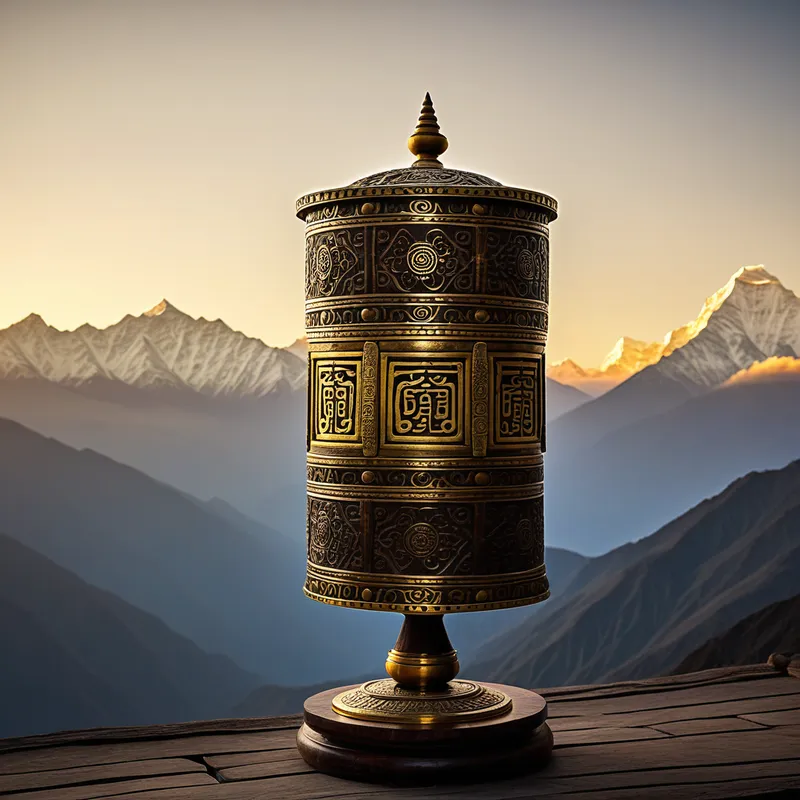
Prayer Wheel Myth Meaning & Symbolism
A mythic tale of a bodhisattva's vow, manifesting as a sacred wheel that turns prayer into wind, sound, and the liberation of all beings.
The Tale of the Prayer Wheel
Listen. In the high, thin air where the world meets the sky, where stone wears the face of wind and silence has a voice of its own, a story was born. It is not a story of a single hero, but of a vow—a promise so vast it needed a body, a vessel to hold its boundless intent.
In an age when the teachings of the Buddha were new and bright upon the earth, a being of profound compassion walked the mountain passes. This was a bodhisattva, whose heart was an open wound for the suffering of the world. He saw the people of the high plateaus: their lives harsh, their time scarce, their minds clouded by the endless toil of survival. They longed to accumulate merit, to recite the sacred syllables, to turn their minds toward liberation. But how could the shepherd, whose eyes must never leave the flock, recite ten thousand mantras? How could the farmer, whose hands are bound to the earth, hold a rosary?
The bodhisattva sat in meditation upon a crag of obsidian, his compassion a physical weight. He gazed upon a valley where a great river, born of glacial melt, turned a simple water mill. Round and round the wheel went, powered by the relentless flow, grinding barley into sustenance. A spark ignited in the depths of his contemplation. What if the wheel could grind not grain, but ignorance? What if the river was not water, but intention?
He withdrew into a cave, the realm of symbols and dreams. There, he did not sleep, but visioned. He took the form of the sacred mantra, Om Mani Padme Hum, the essence of compassion itself. He saw it not as sound alone, but as a living, spinning wheel of light. He saw it written, a million times over, on a scroll. He saw that scroll placed within a cylinder, and the cylinder placed upon an axle. He saw a hand—any hand, young or old, strong or frail—reaching out to turn it.
And so, from the marriage of limitless compassion and pragmatic wisdom, the first prayer wheel was born. It was a humble thing, of wood and hide. But when the first turn was made, the mountains themselves trembled—not with quake, but with resonance. The turning was not an empty motion. With each revolution, the wind that passed over the carved mantras became a whispered prayer. The sound of the cylinder spinning became a chorus of benevolent speech. The very act of turning became a walking meditation, a physical echo of the wheel of Samsara itself, now harnessed for its own undoing. The vow had found its body. The shepherd could tend his flock and turn the wheel of liberation. The farmer could sow seeds and sow the seeds of enlightenment. The prayer was no longer bound to the lips, but freed into the world, multiplied with every step, every breath, every turn.
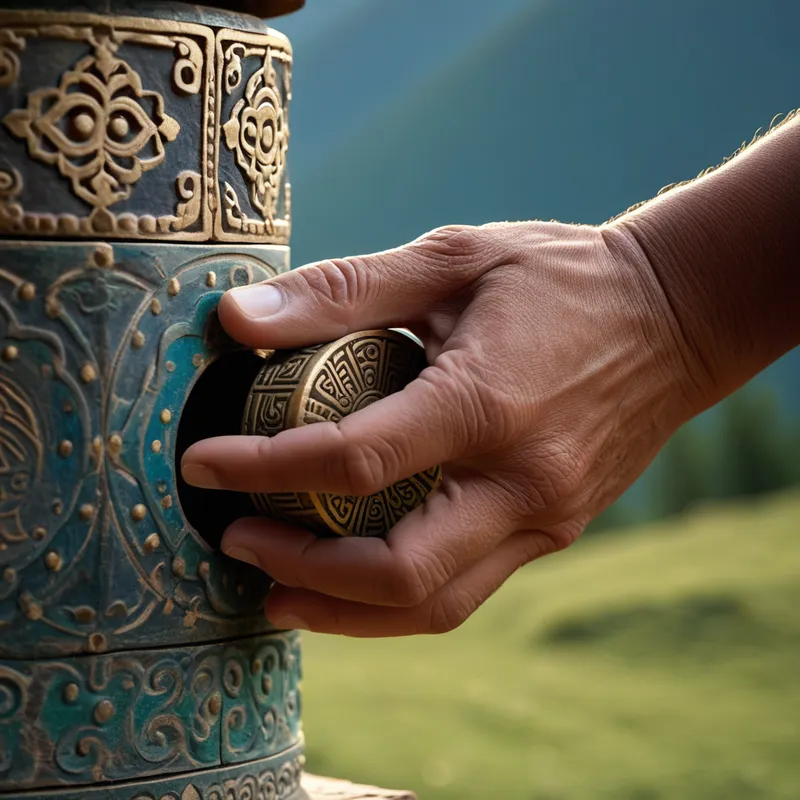
Cultural Origins & Context
The prayer wheel, or mani korlo in Tibetan, is not the product of a single, lost myth recorded in an ancient text. Its “myth” is living, embedded in ritual practice and oral tradition across the Himalayan Buddhist world—Tibet, Nepal, Bhutan, and Mongolia. Its origin story is less a fixed narrative and more a theological and practical consensus that emerged from the Mahayana Buddhist imperative to make the path to enlightenment accessible to all.
This mythic rationale was passed down by lamas and teachers as a dharma teaching. It served a critical societal function: democratizing spiritual practice. In cultures where literacy was not universal and life was arduous, the prayer wheel became a profound equalizer. It allowed the accumulation of merit (punya) and the dissemination of blessings to be continuous, communal, and integrated into daily labor. The myth justifies the technology: it is the compassionate engineering of the dharmakaya, made manifest for the benefit of every being, even the insects stirred by the wind of its turning.
Symbolic Architecture
The prayer wheel is a perfect mandala of symbolic meaning, a machine for the soul. Its architecture is a map of the Buddhist cosmos and the human psyche.
At its core is the cylinder, containing the rolled mantra scroll. This is the stored potential of enlightened mind, the Buddha-nature, hidden within the apparent solidity of form. The act of turning is the application of intention—the karmic wind that sets the potential in motion.
The wheel turns not to change the world, but to change the turner. The motion outside mirrors the revolution required within.
The axle upon which it spins represents the central channel of subtle body in yoga, the unwavering axis of reality (dharmata). The handle is the means, the upaya, by which we engage with the truth. Most profoundly, the wheel itself is the Samsara. Yet here, Samsara is not fled from; it is grasped, turned, and through the alchemy of compassionate intention, transformed into its own antidote. Every revolution is a microcosm of the path: recognizing the cyclic nature of suffering and consciously redirecting its energy toward liberation.
The Dreamer’s Resonance
When the image of a prayer wheel surfaces in a modern dream, it rarely appears in its traditional religious context. It emerges as a profound symbol of psychic process. To dream of a prayer wheel is to dream of one’s own mechanism of transformation.
A dreamer might find themselves in a sterile, modern office, turning a small, ornate prayer wheel on their desk while deadlines loom. This is the psyche signaling the desperate need to integrate repetitive, perhaps mind-numbing, daily actions (Samsara) with a deeper, intentional meaning. The somatic sensation is often one of a latent, rhythmic energy—a longing for the repetitive motion to matter, to accumulate into something greater than the sum of its parts.
Conversely, dreaming of a giant, immovable prayer wheel signifies a blockage. The dreamer may intellectually understand the need for change or the patterns of their life, but they cannot initiate the “turn”—the application of will and intention. The dream points to a conflict between insight and action. The prayer wheel in the dreamscape becomes an object of shadow-work, asking: What mantra, what core intention, have I inscribed on the scroll of my own being? And what is preventing me from setting it in motion?
Alchemical Translation
The myth of the prayer wheel models the individuation process as one of compassionate engineering. We are not asked to escape the wheel of our neuroses, our habits, our repetitive life patterns. We are instructed to take hold of it.
First, we must inscribe our own “mantra”—our central, guiding intention or value. This is the hard work of self-knowledge: what is the core truth we wish to realize? Then, we must build the container—the structure of our daily life, our practices, our relationships—that can hold that intention securely.
Individuation is the process of becoming the axle and the turner simultaneously: the still point of awareness that can consciously rotate the matter of one’s existence.
The alchemical fire is the friction of turning. It is the commitment to move, again and again, through our patterns, but now with awareness and purpose. Each conscious engagement with a habitual thought, each patient return to a practice after failure, is a turn of the wheel. The promise of the myth is that this motion is not futile. It generates its own energy, its own “wind of blessing.” It transmutes the leaden repetition of compulsion into the golden repetition of ritual. The ego, initially the sole turner seeking merit, gradually dissolves into the motion itself, realizing it is also the mantra being recited, the wind being blessed, and the space through which the wheel turns. The wheel turns until the turner disappears, and only the turning—the effortless, compassionate activity of the liberated mind—remains.
Associated Symbols
Explore related symbols from the CaleaDream lexicon: