Prajnaparamita Myth Meaning & Symbolism
The myth of the Perfection of Wisdom, a primordial mother of Buddhas, emerging from the depths of cosmic silence to reveal the heart of reality.
The Tale of Prajnaparamita
Listen. Before the first prayer was uttered, before the first monastery was built, there was a silence so profound it was a womb. From this womb, in a realm beyond realms, the Buddhas of the past, present, and future gathered. They were not seated on thrones of power, but in a circle of profound inquiry. A question hung in the luminous air, heavier than any mountain: What is the true nature of reality? What is the ultimate wisdom that births liberation itself?
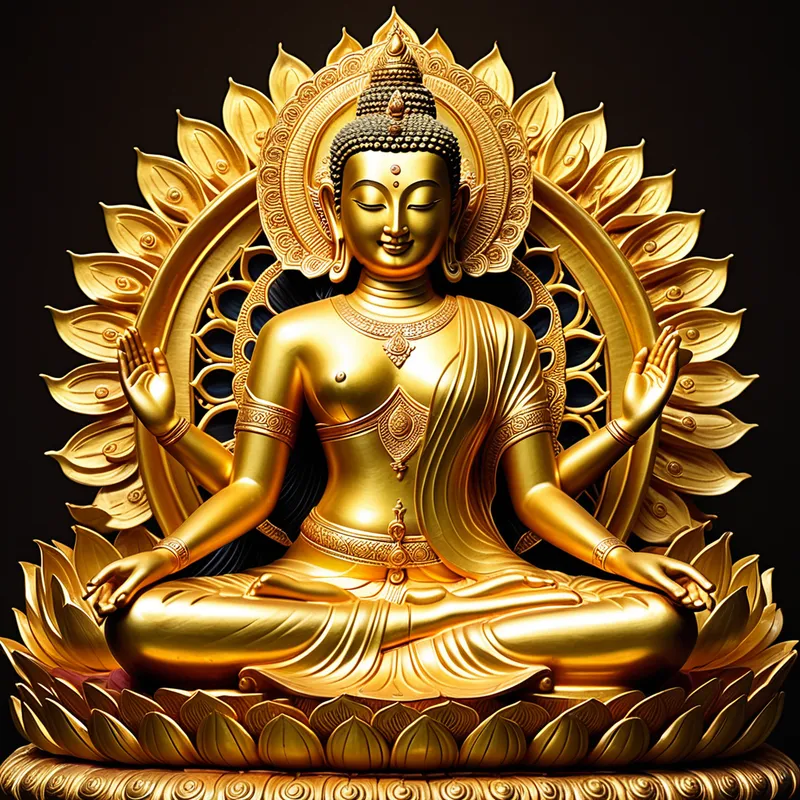
For eons that cannot be counted, they meditated. Their collective concentration was a force that bent the fabric of the cosmos. And from the very heart of their shared silence, she emerged. Not with a crash of thunder, but with the subtlety of dawn light piercing a perfect diamond. She was Prajnaparamita, the Perfection of Wisdom. Her form was that of a radiant, golden goddess, serene and immeasurably ancient. In her hands, she did not hold weapons of destruction, but the tools of ultimate insight: a sacred text, the very scripture of her being, and a flaming sword, sharp enough to cut through illusion itself.
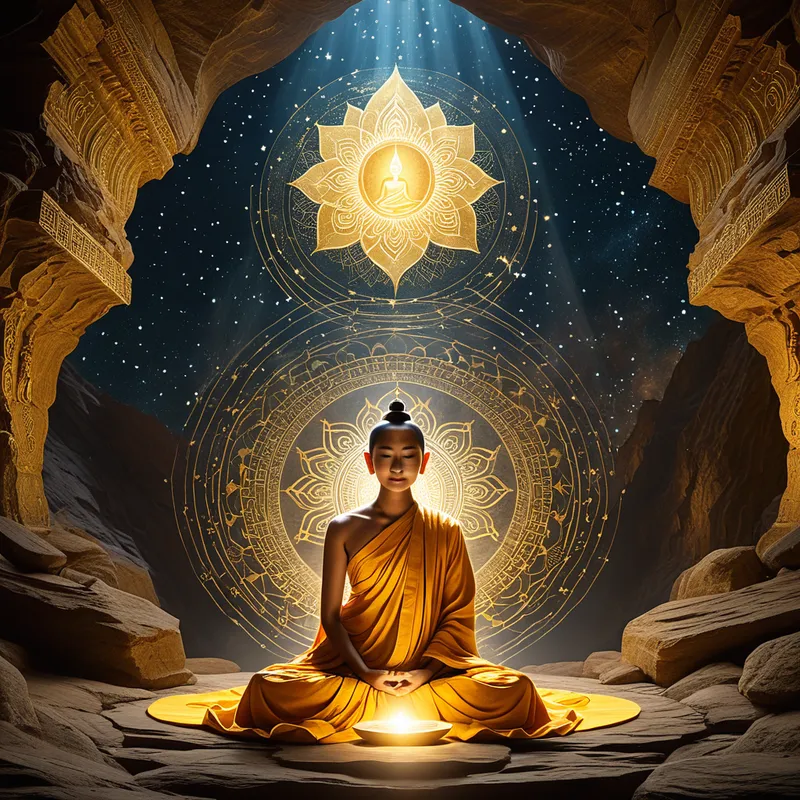
She did not speak to them. Instead, she descended from that celestial assembly, down through layers of reality, to the world of humans. She chose not a palace, but the Grdhrakuta, the Vulture’s Peak. There, in a humble cave that hummed with the memory of the Shakyamuni Buddha’s own voice, she took her seat. The cave was not dark; it was filled with a cool, blue-white light that had no source. The air tasted of ozone and sandalwood.
The Buddha, knowing the moment had ripened, turned to his disciple Subhuti. “Subhuti,” the Buddha said, his voice both gentle and vast, “prepare your heart. The Mother of All Buddhas is here to teach.” Subhuti, his mind clear as a mountain lake, felt a tremor of awe. He turned his gaze inward, to the cave of his own heart.
And then, the teaching began. It did not come as a lecture. It poured forth from Prajnaparamita’s silent presence like a river of liquid crystal. The very words of the Prajnaparamita-hrdaya, the Heart Sutra, materialized in the air—not as sound, but as shimmering, three-dimensional script. “Form is emptiness, emptiness is form,” the luminous characters declared. Subhuti listened not with his ears, but with his entire being. He felt the solid ground of his concepts—of self, of other, of attainment—dissolve beneath him. It was terrifying, a freefall into an infinite sky. Yet, within that terror was a profound, unshakable peace. The goddess’s flaming sword was not cutting down enemies; it was severing the very roots of his suffering: ignorance and clinging. When the last luminous syllable faded, Subhuti was not the same man. He was awake. The myth tells us that in that moment, countless beings across countless worlds attained a glimpse of the same unborn, undying wisdom.
Cultural Origins & Context
The myth of Prajnaparamita is not a folktale with a single origin, but the narrative embodiment of a revolutionary philosophical movement within <abbr title="The "Great Vehicle," a major branch of Buddhism emphasizing the bodhisattva path">Mahayana Buddhism, emerging around the 1st century BCE to the 1st century CE in the Indian subcontinent. It was born from the minds of monastic scholars and visionary practitioners who sought to articulate the ineffable experience of nirvana. They did not write dry treatises alone; they composed vast, poetic scriptures—the Prajnaparamita Sutras—and personified their central concept, Wisdom, as a divine, maternal figure.
This myth was passed down through two primary streams: the elite, scholarly transmission in monastic universities like Nalanda, where logic and debate refined its philosophy, and the devotional, artistic transmission through temple rituals, sculpture, and painting across Asia, from the caves of Ajanta to the monasteries of Tibet and Nepal. Its societal function was dual: for the philosopher, it was a metaphysical map to reality’s core; for the lay devotee, Prajnaparamita was a compassionate, all-knowing mother who could grant the wisdom necessary for liberation, making the profound accessible through the heart.
Symbolic Architecture
Prajnaparamita is not a goddess in the polytheistic sense, but the archetypal form of a fundamental principle. She symbolizes Sunyata, or Emptiness—the startling, liberating truth that all things are interdependent, devoid of a permanent, separate self.
She is the womb and the tomb: the source from which all apparent forms arise and the space into which they all return.
Her golden color represents the incorruptible, timeless value of this wisdom. Her multiple arms signify her boundless activity in the world, wielding both scripture (the conceptual guide) and the flaming sword (the direct, experiential insight that destroys delusion). Most profoundly, she is called the “Mother of All Buddhas.” This reveals the myth’s core psychological insight: wisdom is not something an enlightened being possesses; it is the very substance from which enlightened consciousness is born. The myth dismantles the hero’s journey of conquest, replacing it with a receptive, feminine-coded process of gestation and revelation.
The Dreamer's Resonance
When the energy of the Prajnaparamita myth stirs in the modern psyche, it may manifest in dreams not of golden goddesses, but of profound shifts in the dreamer’s relationship to knowledge and identity. One might dream of a library where all the books are blank, yet contain all knowledge—a somatic experience of knowing beyond words. Another might dream of a cherished, solid object (a house, a piece of jewelry, one’s own body) becoming transparent, weightless, or dissolving into light, triggering both anxiety and eerie peace upon waking.
These dreams signal a psychological process of deconstruction. The ego’s carefully constructed identity—its stories of who it is, what it owns, and what it knows—is being gently or forcefully unraveled by the deeper Self. It is the psyche’s innate wisdom performing its own “perfection of wisdom” surgery, cutting away rigid identifications. The somatic feeling can be one of freefall, dizziness, or profound relief, as if a heavy, invisible armor has been removed.

Alchemical Translation
The myth models the alchemical opus of individuation not as a quest to acquire a golden treasure, but as the courage to let all treasures—especially the treasure of a fixed self—be seen as empty. The modern seeker often begins like the assembled Buddhas, striving with great effort toward a goal called “enlightenment” or “wholeness.” The Prajnaparamita process interrupts this striving.
The alchemical fire is not for forging a stronger ego, but for incinerating the illusion that the ego was ever the true metal.
The first stage is the descent of the goddess—the eruption of a disruptive insight from the unconscious that challenges everything we think we know. This is the “flaming sword” moment: a breakup, a failure, a loss, or a sudden glimpse of life’s impermanence that cuts through our comfortable narrative. The second stage is the reception, like Subhuti in the cave. This requires not fighting or fleeing, but a radical, terrified openness—sitting in the cave of the heart and allowing the ground to dissolve. The final transmutation is the realization that this emptiness is not a void of meaning, but a space of infinite, compassionate connection. The seeker discovers they are not a separate self journeying toward wisdom, but a momentary expression of that wisdom itself. The Mother of All Buddhas is not out there; she is the very nature of the mind that seeks. The triumph is the end of seeking, and the beginning of a boundless, embodied knowing.
Associated Symbols
Explore related symbols from the CaleaDream lexicon: