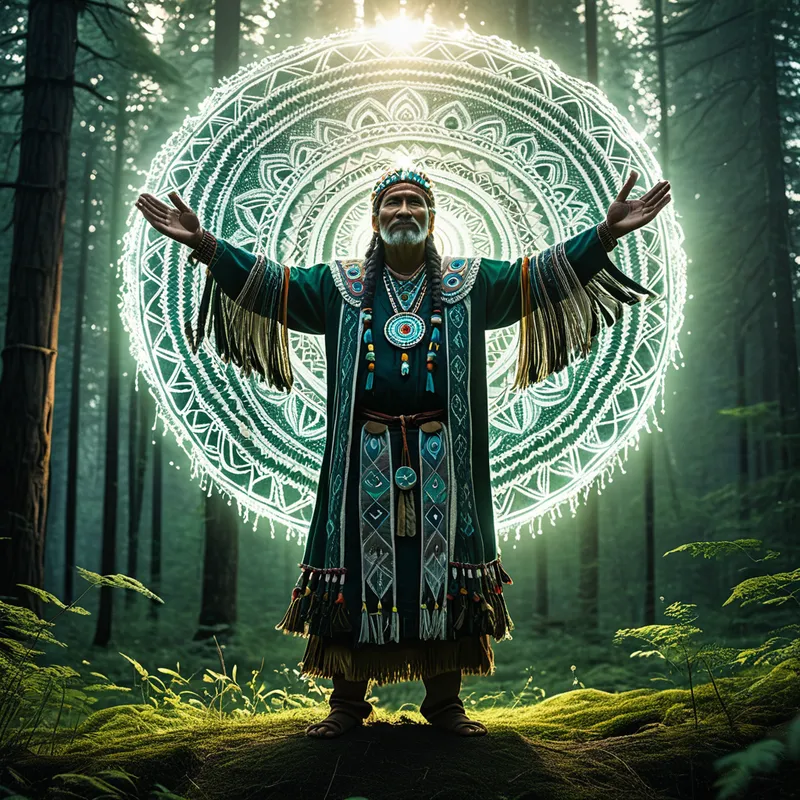
Powwow Myth Meaning & Symbolism
A mythic narrative of a healer's journey, where spiritual power is earned through sacrifice to restore balance and harmony to a fractured world.
The Tale of Powwow
Listen. The wind carries a story from a time when the world was out of balance. The people were sick, their bodies wracked with a wasting fever no herb could touch. The game had fled the forests, and the rivers ran thin and bitter. Despair, a cold, heavy stone, sat in every heart. The elders chanted until their voices were hoarse, but the Great Spirit seemed silent, the connection frayed like an old rope.
In this shadowed time, there was a young man. He was not a chief, nor the son of a great warrior. He was quiet, his eyes always watching the way the light fell through the leaves, listening to the secret language of the creek. When the sickness took his own family, a fire was lit in him—not of anger, but of a desperate, aching need to understand. He left the village one grey dawn, taking only a hollow gourd for water and a heart full of questions.
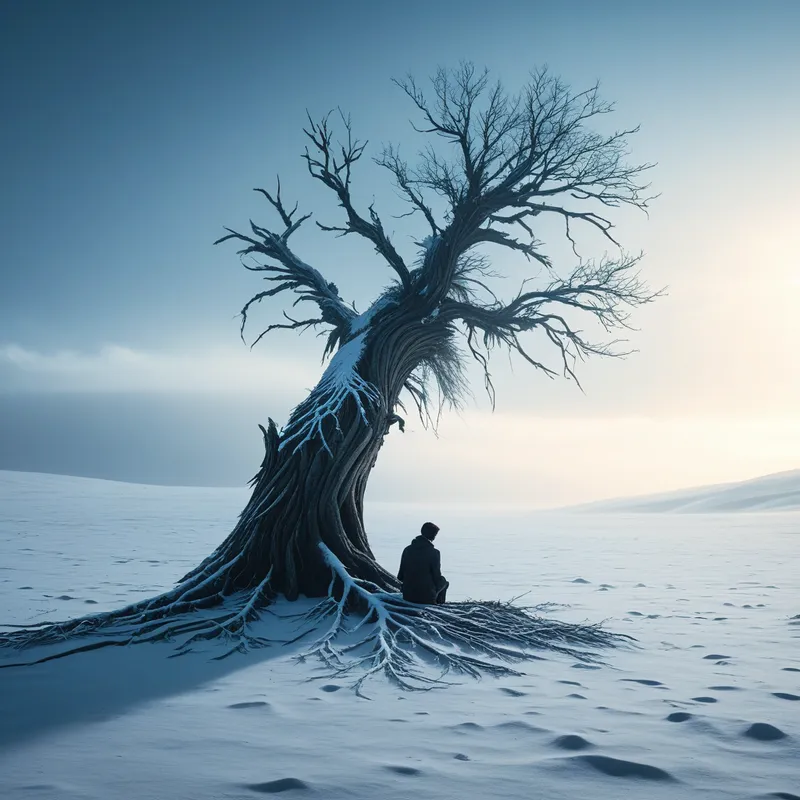
His journey was a stripping away. He walked until his feet bled, climbed until his muscles screamed. He fasted until the world shimmered and the line between earth and sky dissolved. In the heart of the highest mountain, in a cave that breathed with the cold breath of the stone, he finally collapsed. Here, at the edge of his strength, the visions came.
They were not gentle. A mighty Bear appeared, its roar shaking the cave dust loose. It did not attack, but stared into him, and in its dark eyes, he saw the sickness of the people mirrored—a corruption of spirit, a forgetting of the sacred web. The Bear showed him plants whose roots dug deep into the dark earth, herbs that burned with cleansing fire. Next came the Eagle, who carried him on its wings over the blighted land. From above, he saw the broken patterns, the places where the life threads were severed. The Eagle gifted him the feather, a quill to write the new song of health upon the wind.
For seven days and nights, the spirits schooled him. They taught him the songs that vibrated at the frequency of healing, the dances that traced the patterns of restoration back into the soil and the soul. They showed him how to weave the Sacred Hoop whole again. When he awoke, he was not the same man. A quiet power hummed in his bones. He was Powwow.
He returned to his people, who were shadows of their former selves. Without a word, he built a great fire in the center of the village. He began to move, his feet drumming the heartbeat of the earth back into the village square. He sang the songs the spirits had given, his voice a conduit for a power that was not his own. He used the herbs, the water, the smoke. One by one, the people rose. The fever broke like a storm cloud passing. Light returned to their eyes. The game, sensing the restored balance, ventured closer. The rivers ran clear.
He did not stay as a ruler. He taught them the songs, the dances, the ways of the plants. He showed them that the power to heal the hoop was not in one man, but in the circle, in the community remembering its sacred duty to all its relations. And so, the gathering, the ceremony of healing and renewal, was born from his ordeal and his gift. It was named for him, a living memory of the one who walked into the void and returned with the fire of restoration.
Cultural Origins & Context
The term “Powwow” originates from the Algonquian-speaking peoples of the Northeastern Woodlands, rooted in the word pauwau or powwaw, meaning “spiritual leader” or “one who dreams.” The mythic narrative of Powwow is not a single, codified story but a profound archetypal pattern woven into the ceremonial fabric of many Nations. It was passed down not as mere entertainment, but as a sacred charter—a story that explained the origin and necessity of the communal healing ceremonies that bear its name.
These stories were the province of elders and medicine people, told during times of gathering to reinforce identity, transmit ethical values, and enact the very restoration they described. The societal function was multifaceted: it was a teaching tool for aspiring healers, a collective ritual of remembrance that strengthened community bonds, and a performative act of medicine itself. By telling and re-enacting the story of Powwow, the community participated in a continuous cycle of diagnosis and healing, addressing not just physical illness but spiritual and social discord, reaffirming their place within the Sacred Hoop of life.
Symbolic Architecture
At its core, the myth of Powwow is a masterclass in the symbolism of holistic restoration. The hero’s journey is not to slay a monster, but to understand a sickness that is systemic. The wasting illness represents a rupture in the psychic and ecological order—a state of collective dissociation from the animating spirit of the world.
The true wound is never in the body alone; it is in the broken song between the people and the world.
The Bear and the Eagle are not mere helpers; they are emissaries of the deeper Self. The Bear, creature of the earth and the unconscious, forces the confrontation with the shadow—the ignored corruption, the deep-seated imbalance. The Eagle, sovereign of the sky and consciousness, grants the transcendent perspective, the vision of the whole pattern. Powwow’s transformation occurs in the integration of these two realms: the earthy, medicinal wisdom and the lofty, unifying vision.
The ceremony he establishes is the symbolic architecture made manifest. The circle of the gathering mirrors the Sacred Hoop. The drum is the recovered heartbeat. The dance is the rewiring of the pattern. The shared song is the reknitted connection. Power, in this myth, is never possessive; it is circulatory, moving from the spirit world, through the healer, and into the community, where it must be shared to be sustained.
The Dreamer’s Resonance
When this mythic pattern stirs in the modern dreamer, it often signals a profound somatic and psychological process of diagnosis and re-integration. To dream of a pervasive, unnamed sickness in one’s community or environment reflects a deep, often unconscious, awareness of a systemic “dis-ease” in one’s own life—be it in a family system, a workplace, or one’s own fragmented psyche.
Dreaming of a solitary journey into a barren landscape mirrors the necessary, often lonely, descent into the personal unconscious (the cave) that must precede healing. Encounters with powerful, instructing animals (like Bear or Eagle) in dreams can be visitations from the instinctual, archetypal Self, offering the specific “medicine” or perspective needed. The climax in the dream—the healing ceremony—may appear as finding oneself in a vibrant, unexpected gathering, leading a ritual, or simply feeling a powerful, harmonious energy flowing through a group. This is the psyche’s blueprint for how to reassemble the scattered parts of the self and one’s relationships. It is a dream of becoming a conduit for restorative power, not for glory, but for the mending of the whole.

Alchemical Translation
For the modern individual navigating the “wasting fevers” of alienation, anxiety, and fragmentation, the myth of Powwow models the complete alchemical process of psychic transmutation, or individuation. The first stage, nigredo, is the acknowledged illness—the depression, the burnout, the sense of meaninglessness. This is the village in despair.
The hero’s journey into the wilderness is the conscious undertaking of the opus, the hard work of introspection and shadow-work (confronting the Bear). The visions and ordeals represent the albedo, the whitening, where confusing but illuminating insights are gained. The gifts from the spirits are the acquisition of the lost “tools”—perhaps a new psychological framework, a creative practice, or a reclaimed intuition.
Individuation is not about becoming a solitary perfected self, but about becoming a healed node within a greater network. The goal is not sovereignty, but functional relatedness.
The return and the healing ceremony are the stages of rubedo and citrinitas—the reddening and yellowing—where the gained insight is integrated and applied in the community of the psyche and the world. The final, often overlooked, teaching of Powwow is the most alchemical: the philosopher’s stone is not kept. True gold is the process of healing that is taught, shared, and ritualized. The individuated Self, like Powwow, is not an end point but a functioning, healing center that exists to facilitate connection, restore balance, and keep the sacred hoop of the personality—and by extension, its world—spinning in harmony. The power is in the circulation, not the possession.
Associated Symbols
Explore related symbols from the CaleaDream lexicon: