Potter's Clay Myth Meaning & Symbolism
A prophet watches a potter reshape flawed clay, revealing a divine metaphor for human destiny, brokenness, and the possibility of remaking.
The Tale of Potter’s Clay
Hear now a word that came not with thunder, but with the quiet, turning hum of the wheel.
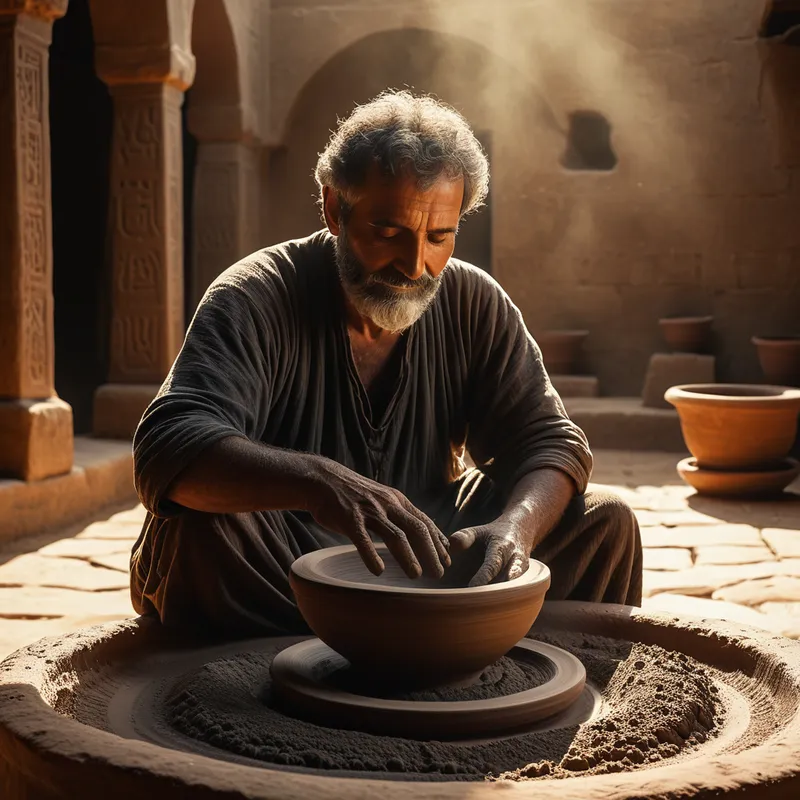
In the days when kings plotted and nations trembled, a man was sent down. Not to the palace, nor to [the temple](/myths/the-temple “Myth from Jewish culture.”/) mount, but to [the potter’s house](/myths/the-potters-house “Myth from Biblical culture.”/)—a place of earth and [water](/myths/water “Myth from Chinese culture.”/), of patient, spinning labor. The air was thick with the scent of damp clay and ancient dust. In the shaded courtyard, lit by slants of fierce sun, [the potter](/myths/the-potter “Myth from Abrahamic culture.”/) worked. His hands, etched with the lines of his craft, were upon the clay.
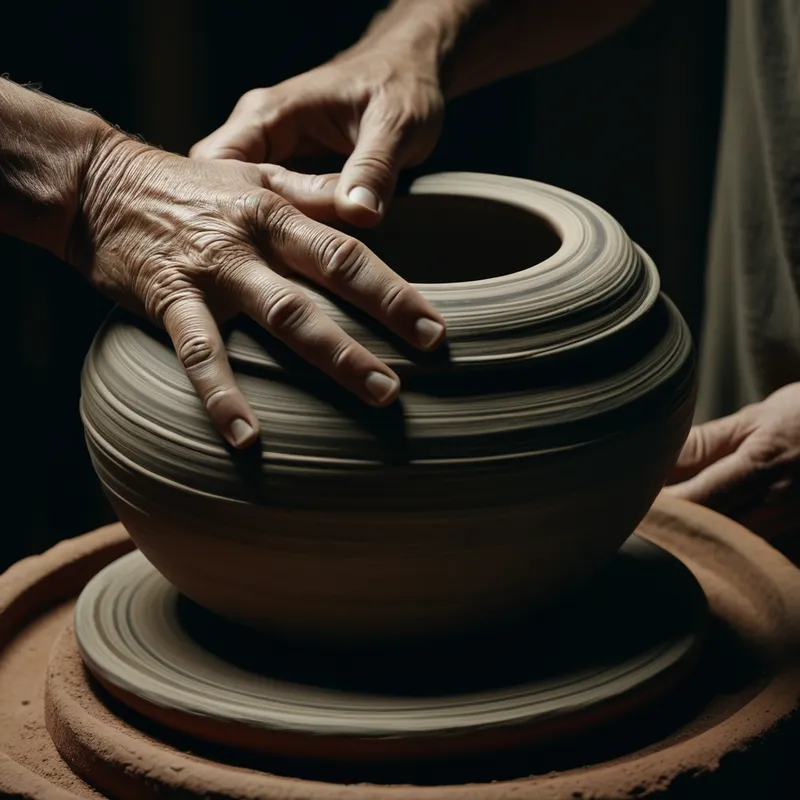
See it there, upon the wheel—a dark, yielding mound. Beneath the pressure of his palms, a miracle of form began to rise. A neck stretched upward, shoulders swelled, a belly curved with promise. It was becoming a vessel, a [thing](/myths/thing “Myth from Norse culture.”/) of use and beauty, shaped by a will not its own. The wheel sang its low song; the potter’s fingers danced a silent liturgy of creation.
But then—a flaw. A hidden pebble, a stubborn hardness in the heart of the clay. The symmetry shuddered. The smooth curve buckled. [The vessel](/myths/the-vessel “Myth from Alchemical culture.”/) marred itself in the making.
The prophet watched, breath held. Would the potter cast it aside? Would he scorn the flawed work? No. The potter did not hesitate. His hands, which had coaxed form from chaos, now closed with equal purpose. Without anger, without haste, he pressed the beautiful, broken thing down. He collapsed the proud neck, folded the graceful shoulders, until all that remained was the original, spinning lump—formless, yielding, and utterly in his hands once more.
And then, from that same clay, he began again. The wheel turned. The hands moved. A new vessel rose from the old material, shaped now as seemed good to the potter to make it.
[The word](/myths/the-word “Myth from Biblical culture.”/) that followed was a whisper that shook kingdoms: “Cannot I do with you as this potter has done?”
Cultural Origins & Context
This narrative is not a myth of the distant, primordial past, but a prophetic oracle, recorded in the book of Jeremiah (chapter 18). It emerges from a specific historical crucible: the late 7th century BCE, as the kingdom of Judah teetered on the brink of catastrophic political and spiritual collapse. The prophet Jeremiah delivered this message not as a comforting fable, but as a stark, performative metaphor to a people facing existential crisis.
The potter’s workshop was a universally familiar sight in the ancient Near East, a microcosm of human industry and divine analogy. By directing Jeremiah to this common scene, the narrative grounds transcendent truth in tangible, everyday reality. It was an oral proclamation, a “word from the Lord” delivered in public or in the court, designed to bypass intellectual argument and strike directly at the intuitive understanding. Its societal function was dual: it was a warning of impending judgment (the breaking of the vessel) and a startling revelation of conditional grace (the possibility of reformation). It presented sovereignty not as arbitrary tyranny, but as the inherent right and capacity of the Creator toward his creation, especially when the creation has become flawed in its purpose.
Symbolic Architecture
At its core, the myth presents a radical ontology: humanity is not a fixed, autonomous entity, but a dynamic substance in [relationship](/symbols/relationship “Symbol: A representation of connections we have with others in our lives, often reflecting our emotional state.”/) with a shaping will. The [clay](/symbols/clay “Symbol: Clay symbolizes malleability, creativity, and the potential for transformation, representing the foundational aspect of life and the ability to shape one’s destiny.”/) symbolizes the fundamental substance of [human](/symbols/human “Symbol: The symbol of a human represents individuality, complexity of emotions, and social relationships.”/) [life](/symbols/life “Symbol: The symbol of ‘Life’ represents a journey of growth, interconnectedness, and existential meaning, encompassing both the joys and challenges that define human experience.”/)—our potential, our inherent [nature](/symbols/nature “Symbol: Nature symbolizes growth, connectivity, and the primal forces of existence.”/), our [destiny](/symbols/destiny “Symbol: A predetermined course of events or ultimate purpose, often linked to spiritual forces or cosmic order, representing life’s inherent direction.”/). It is not inert; it is malleable. The potter represents the transcendent, creative principle—whether named as God, [the Self](/myths/the-self “Myth from Jungian culture.”/), or the ordering intelligence of the [cosmos](/symbols/cosmos “Symbol: The entire universe as an ordered, harmonious system, often representing the totality of existence, spiritual connection, and the unknown.”/). The wheel is the turning of circumstances, time, and [fate](/symbols/fate “Symbol: Fate represents the belief in predetermined outcomes, suggesting that some aspects of life are beyond human control.”/)—the context in which shaping occurs.
The flaw is not the end of the story; it is the catalyst for the story’s most profound chapter.
The [vessel](/symbols/vessel “Symbol: A container or structure that holds, transports, or protects something essential, representing the self, emotions, or life journey.”/)’s marring is the central [crisis](/symbols/crisis “Symbol: A crisis symbolizes turmoil, urgent challenges, and the need for immediate resolution or change.”/). It represents sin, yes, in the theological sense, but more broadly, it is any inherent contradiction, any hardened complex, any destiny-resisting flaw that prevents the individual or the collective from fulfilling their intended form. The critical symbolic [action](/symbols/action “Symbol: Action in dreams represents the drive for agency, motivation, and the ability to take control of situations in waking life.”/) is not the initial creation, but the re-creation. The potter does not discard the clay. He returns it to a state of potential. This is the myth’s devastating and hopeful [heart](/symbols/heart “Symbol: The heart symbolizes love, emotion, and the core of one’s existence, representing deep connections with others and self.”/): deconstruction is not destruction, but a prelude to a new making. The sovereignty of the potter is revealed most fully not in his power to make, but in his prerogative to remake.
The Dreamer’s Resonance
When this myth stirs in the modern unconscious, it often manifests in dreams of profound personal disintegration and reformation. One might dream of their house—the symbol of the [psyche](/myths/psyche “Myth from Greek culture.”/)—collapsing, only to find the bricks are soft clay, waiting to be rebuilt into a new structure. Another might dream of their own body melting or dissolving, not in terror, but in a strange, passive surrender, feeling themselves being reshaped by unseen hands.
Somatically, this can correlate to periods of intense life transition, illness, or psychological breakdown, where the old “vessel” of one’s identity, career, or relationships can no longer hold. The psyche is processing the death of a former shape. The dreamer is not merely “falling apart”; they are, at a depth level, being returned to the wheel. The emotional tone is key: Is there resistance, terror at the loss of form? Or is there a nascent, bewildered trust in the process? The latter suggests [the ego](/myths/the-ego “Myth from Jungian culture.”/) is beginning to relinquish its claim to ultimate authorship, aligning with the deeper, shaping movement of the Self.
Alchemical Translation
In the alchemy of the soul, the myth of the Potter’s Clay maps directly onto the stage of [nigredo](/myths/nigredo “Myth from Alchemical culture.”/)—the blackening, the dissolution. This is not a failure of the individuation process; it is its necessary, painful heart. The ego, having fashioned itself into a particular vessel, discovers its foundational flaw. The alchemical vessel cracks. All that was solid softens.
The goal is not to avoid being broken, but to consent to being the clay.
The modern individual, in their quest for wholeness, must undergo this same “potter’s house” experience. We must confront the hardened pebbles of our pride, our trauma, our fixed narratives. The therapeutic or transformative journey often involves this conscious, often reluctant, submission to a process that feels like undoing. We are pressed back into our own raw material—our memories, our wounds, our unlived life. The “potter” in this translation is the integrative, teleological pull of the Self. It works through life events, through insights that shatter our previous understandings, through the humble act of sitting with what is, yielding to a wisdom greater than our own conscious planning.
The [triumph](/myths/triumph “Myth from Roman culture.”/) of the myth, and of the individuation process it models, is the emergence of the “vessel as seems good to the potter.” This is the albedo, the new form. It is a vessel that is both utterly new and made of the same essential “you.” It is a life lived not from the ego’s brittle blueprint, but from a deeper, more authentic, and more resilient form—one that can finally hold the purpose for which it was always intended.
Associated Symbols
Explore related symbols from the CaleaDream lexicon: