Potlatch Ceremonies Myth Meaning & Symbolism
A sacred ceremony where giving away all one possesses, even destroying wealth, becomes the ultimate act of creation, weaving community and cosmic order.
The Tale of Potlatch Ceremonies
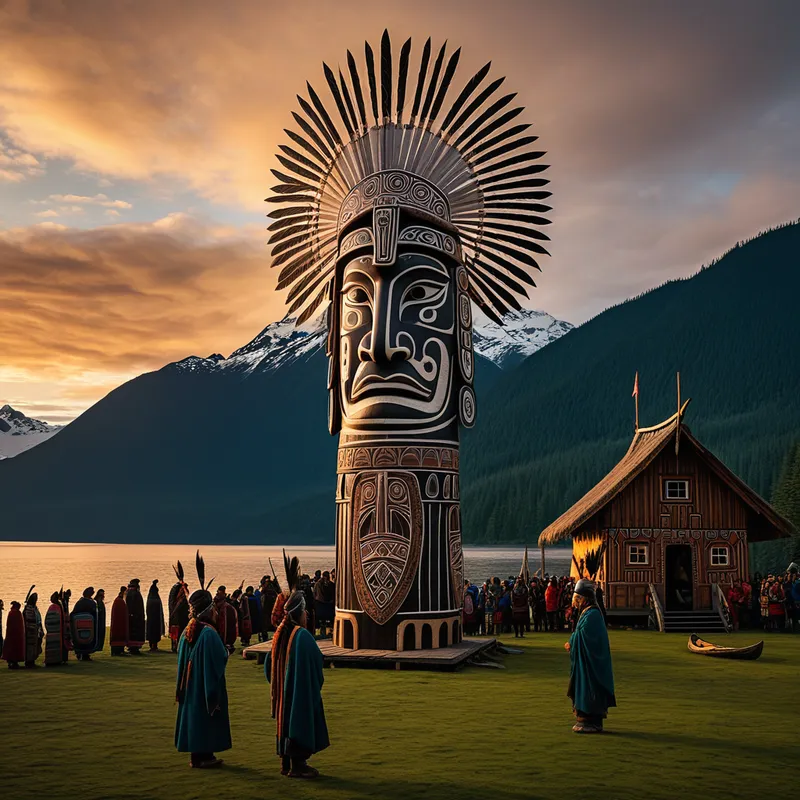
Listen. The air is thick with the scent of wet cedar and smoked salmon. The great plank houses of the Coast face the churning grey sea, their painted eyes watching. Inside, the fire-pit is a sun contained, its heat a living presence against the perpetual damp. The people are gathered, a tapestry of woven blankets and expectant silence. This is not a day for taking. This is the day for the great giving, the Potlatch.
At the heart stands the Chief. He is not merely a man today; he is a vessel for a force as old as the rivers. His regalia is a mountain worn: a robe of mountain goat wool, dyed with ochre and etched with the forms of Killer Whale and Raven, stories made tangible. On his head rests a crown of carved wood inlaid with sea-lion whiskers and abalone shell, catching the firelight like captured stars. He does not speak of what he has. He begins to enact what he is.
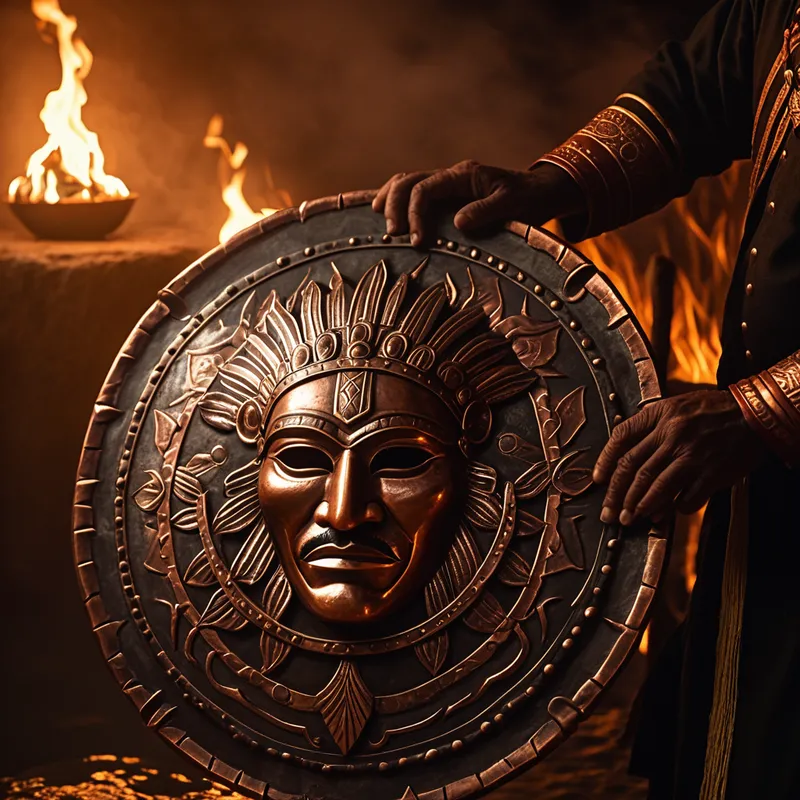
Attendants move like currents. They bring forth wealth not hoarded, but summoned for this moment. Piles of thick, woolen blankets grow into hills. Carved cedar boxes, filled with precious oolichan oil, are stacked high. There are canoes, sleek and new, pulled up on the beach as offerings. And then, the copper. A great, shield-shaped plaque, beaten until it sings a dull, red-gold song. It is called a Copper, and its value is not in metal, but in name, in history, in the deeds it represents.
The Chief takes the first blanket. He calls the name of a rival, a man from a distant village whose own pride is a well-known song. He does not hand the blanket to him. He places it at his feet, a challenge woven in wool. Another blanket follows, and another, until the rival stands knee-deep in generosity. The Chief’s voice rises, recounting his lineage, the myths that live in his blood, the territories his ancestors’ feet have hallowed. With each claim, more wealth flows: boxes of oil, bundles of food, tools of iron.
The tension is a drumbeat felt in the chest. This is war, but its weapon is abundance. Its violence is hospitality. The rival must receive, must accept this avalanche of honor. To refuse is to be erased. The Chief’s family now brings forth the great Copper. He holds it aloft, and its name is sung—“The-Maker-of-Houses,” “The-Sky-Faller.” He declares its history, each chief who broke a piece from it, raising its worth through ritual destruction.
Then, the climax. He may take the Copper to the edge of the sea and cast it into the deep, a wealth-sacrifice to the unseen powers. Or he may take an adze and, with a crack that echoes in the soul of every witness, break a corner from it, gifting the fragment to his greatest rival. In that act of calculated ruin, something is born. The broken Copper is now more valuable than the whole. The Chief who has nothing left—who has given away his food, his blankets, his most prized metal—now possesses everything. His name is a mountain. His status is unassailable. He has woven his people and his rivals into a net of obligation and awe. The feast begins, a roaring affirmation of the new order created from glorious, deliberate loss.
Cultural Origins & Context
The Potlatch was the central nervous system of social, economic, and spiritual life for many Coastal Nations, including the Kwakwaka’wakw, Haida, Tlingit, and Tsimshian. It was not a single myth told in the night, but a living, enacted mythology—a ritual theater where cosmology became social reality. These ceremonies marked pivotal transitions: the raising of a totem pole, the succession of a chief, a marriage, or the assumption of a sacred name and mask.
The stories were not merely recited; they were performed through dance, song, and the display of hereditary crests and privileges. The right to tell a specific story of the Raven stealing the sun, or to embody the Hamatsa (the cannibal spirit) in dance, was itself a form of wealth distributed and validated at a Potlatch. The ceremony was the engine of a non-capitalist economy where value flowed through prestige and reciprocal obligation, not through hoarding. It was a complex legal system, a historical record, and a cosmic drama ensuring the continued flow of life and balance between human and spirit worlds.
Symbolic Architecture
At its core, the Potlatch inverts the modern psyche’s foundational myth of acquisition. Its central tenet is that true authority, true “wealth,” is not consolidated by what you keep, but is generated by what you give away—and ultimately, destroy.
The ultimate act of creation is not accumulation, but a sacred, spectacular surrender. The ego must be broken like the Copper to be made whole.
The Copper is the perfect symbol for this alchemy. Its material value is secondary; its primary substance is narrative. Each break, each ritual diminishment, adds to its story and thus its worth. It represents the ego itself: a shiny, defended identity. In the Potlatch, this ego-shield must be fractured publicly. The act transforms shame (loss, diminishment) into honor (a more complex, storied self). The mountains of gifts are not just property, but extensions of the soul—energy, labor, and spirit made manifest. To distribute them is to distribute one’s own substance, weaving the community from the threads of your being.
The ceremony is also a profound dramatization of the cycle of life and death. The “death” of wealth (its destruction or giveaway) is not an end, but the necessary precondition for a social and spiritual “rebirth” of status and relational order. It forces a cosmic reciprocity, acknowledging that all gain comes from a source—the land, the sea, the ancestors—and must be returned to the communal flow to avoid stagnation and spiritual poverty.

The Dreamer’s Resonance
When this myth stirs in the modern dreamer, it often manifests as dreams of radical, compulsive giving or scenes of deliberate loss. You may dream of emptying your bank account to strangers, throwing your most cherished belongings into a river, or hosting a feast for people you barely know until your home is bare. There is a potent mix of anxiety and liberation in these dreams.
Somatically, this can feel like a pressure in the chest—the “hoarded” self—suddenly finding a release valve. Psychologically, it signals a profound crisis or opportunity in the dreamer’s relationship with their social persona, their resources (both internal and external), and their need for authentic recognition. The psyche is staging a Potlatch. It is insisting that the current “economy” of the self—where worth is tied to what one has, knows, or controls—is bankrupt. The dream is the unconscious Chief, initiating the terrifying, necessary ritual of de-possession to forge a new, more legitimate form of authority rooted in vulnerability and genuine connection, not in fortified isolation.

Alchemical Translation
For the modern individual navigating the path of individuation, the Potlatch offers a radical model of psychic transmutation. Our culture teaches us to build the Copper—to polish our resumes, curate our identities, and fortress our assets. Individuation, however, requires the ritual break.
The alchemical solve et coagula (dissolve and coagulate) is lived as the breaking of the Copper and the subsequent rise of unassailable presence.
The “giving away” is the dissolution of psychic complexes—the rigid patterns, the inflated self-images, the treasured grievances we mistake for wealth. We must call our inner “rivals” (our shadow, our neglected talents, our perceived inadequacies) and gift them with recognition. We must sacrifice our “blankets” of comfort and our “canoes” of old ways of moving through the world. This feels like ruin. It feels like impoverishment.
Yet, in this conscious, voluntary sacrifice lies the transmutation. The ego, broken from its monolithic form, is reassembled not as a solitary shield, but as a node within a wider web of meaning and relationship. Your authority no longer comes from what you hold apart, but from what you facilitate between yourself and others. Your true “wealth” becomes the quality of your connections, the authenticity of your story, and your capacity to generate life and meaning for your community. You become a true ruler, not by dominion, but by the sovereign act of generous, creative surrender. The feast that follows is the joy of a self that is finally, fully, in flow.
Associated Symbols
Explore related symbols from the CaleaDream lexicon: