Poseidon's Trident Myth Meaning & Symbolism
The story of the three-pronged scepter forged by the Cyclopes, granting Poseidon dominion over the chthonic seas and the human soul's turbulent depths.
The Tale of Poseidon's Trident
Before the world knew order, there was a war that shook the foundations of creation. The air was thick with the smoke of divine ichor and the screams of Titans. In the deep, lightless pit of Tartarus, the young gods, led by the thunder-wielding Zeus, fought a desperate, decade-long war against their tyrannical forebears. The earth groaned, the mountains trembled, and the very seas boiled with uncertainty.
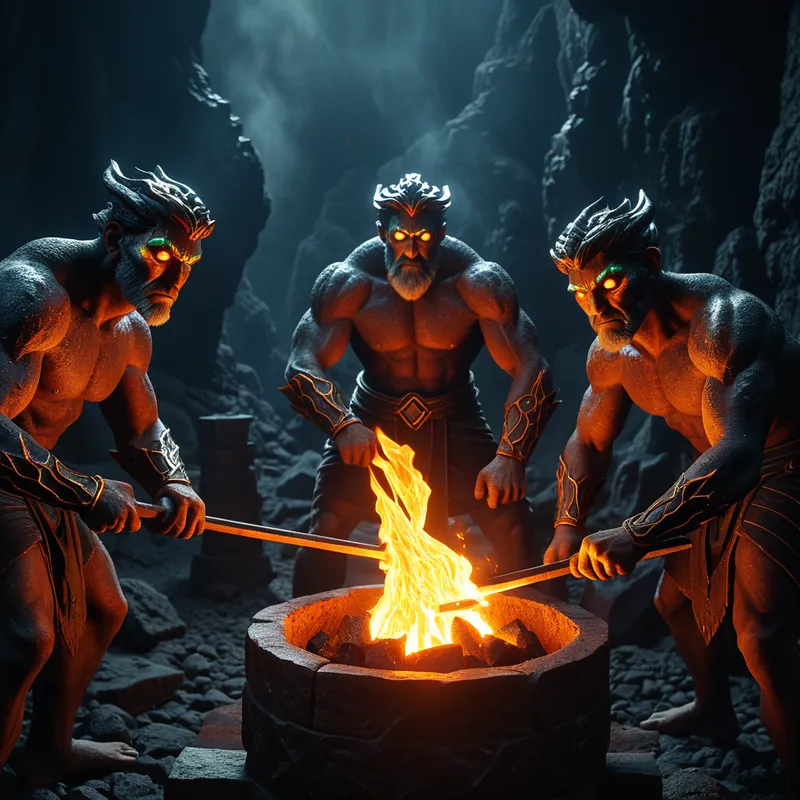
From this cosmic strife, a gift was forged. The Cyclopes, beings of immense primal craft, were freed from their chains. In gratitude, and seeing the need for weapons to match the cataclysm, they set to work in a cavern lit only by the heart of a volcano. With hammers that struck sparks like newborn stars, they worked a metal not of earth—adamantine, indestructible and singing with potential. For Zeus, they crafted the lightning bolt, a spear of cleaving light. For Hades, a helmet of utter darkness.
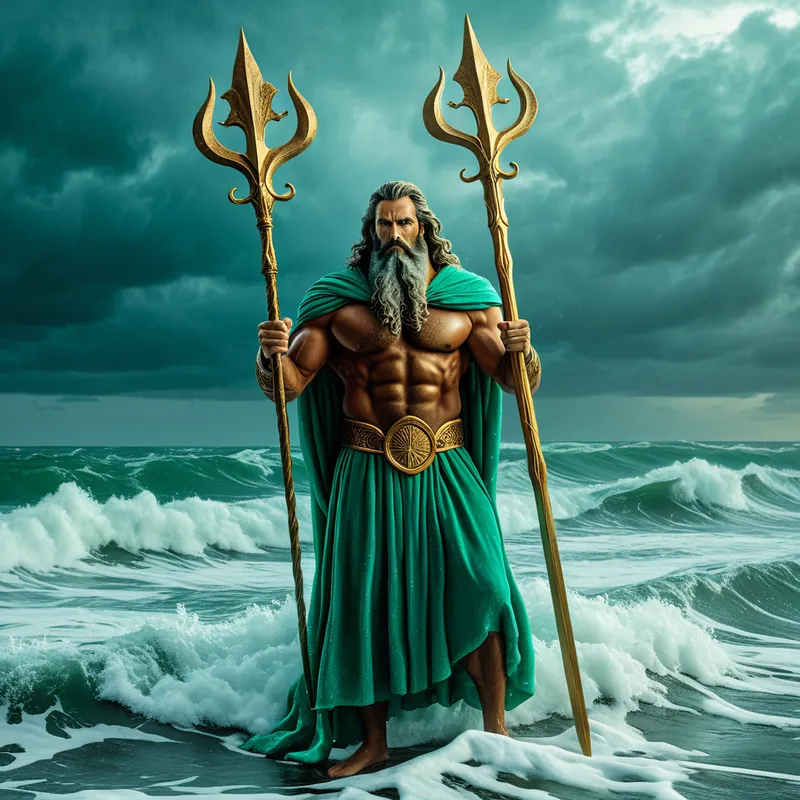
And for the brooding, tempestuous Poseidon, they forged the Trident.
It emerged from the cooling waters of their quenching trough not as a mere tool, but as a declaration. Three prongs, fused into one haft of power. When Poseidon’s calloused hand first wrapped around its grip, the world felt it. He did not merely lift it; he connected with it. He strode from the forge to the edge of the world, where the land frayed into chaos. With a roar that rivaled the Titans, he raised the Trident high and brought it down upon a barren, wave-lashed rock.
The strike was not an impact, but a genesis. The rock did not shatter—it transformed. From the points of the prongs, three immense fissures tore open, not of emptiness, but of source. From one, a geyser of pure, fresh water erupted, a life-giving spring in the salt waste. From the second, a crackle of energy summoned the first sea-storm, clouds bruising the sky. From the third, the very earth shuddered and buckled, announcing his dominion over the land’s hidden bones. The sea, which had churned in formless agitation, suddenly had a master. The waves now rose and fell at his whim, the creatures of the deep knew his name, and the hidden currents flowed by his command. The Trident was no longer a weapon. It was a scepter. It was the key to the world’s blue, beating heart.
Cultural Origins & Context
This foundational myth was not a singular story penned by an author, but a living, breathing truth woven into the very identity of a people surrounded by the Aigaîon Pélagos. It was told by bards at feasts, enacted in rituals at coastal shrines, and whispered by sailors making offerings for safe passage. The Trident’s tale was embedded within the larger narrative of the Titanomachy, a cultural memory of establishing cosmic and social order from primal chaos.
Its primary societal function was one of explanation and propitiation. The volatile, life-giving, and terrifying nature of the sea was given a face and a will—Poseidon’s. The Trident explained why storms arose (a strike of his weapon), why earthquakes occurred (his anger shaking the land), and why a hidden spring might be found (his beneficent creation). It served as a psychological contract: the sea’s chaos was not random, but the expression of a powerful, moody consciousness that could be appealed to, respected, and feared. Temples like the magnificent Sounion were built as monumental bargaining points with this power, their columns like stone tridents holding back the sky from the sea.
Symbolic Architecture
The Trident is a master symbol of triune power asserting itself over undifferentiated unity. It is an instrument of discrimination, piercing the formless whole to create distinct, potent realities.
The one shaft divides the world; the three points define its new nature. It is the archetypal act of consciousness emerging from the unconscious.
The three prongs are rarely arbitrary in myth. Here, they map the tripartite dominion of Poseidon: the seas (the watery unconscious), earthquakes (the chthonic, foundational psyche), and horses (the tamed, powerful instinctual energy). Psychologically, the Trident represents the ego’s necessary, often violent, tool for carving out a domain of identity from the vast, unconscious sea of the Self. It is will, focus, and authority. Yet, this power is ambiguous. It can create springs of life or summon annihilating storms; it can calm waves or shatter continents. It symbolizes the tremendous creative and destructive potential that comes with seizing one’s own authority, a power that is forged in conflict (the Titanomachy) and must be wielded with immense responsibility.
The Dreamer's Resonance
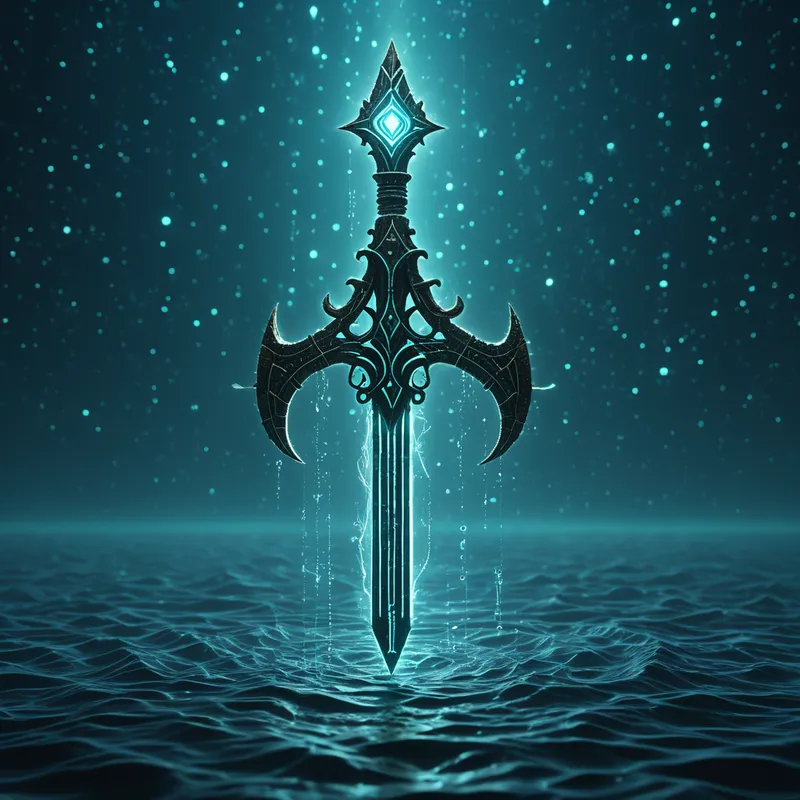
When the Trident appears in a modern dream, it is seldom held by a god-like figure. It may be found buried in sand, seen glowing on the ocean floor, or felt as a terrifying pressure in the chest. The dreamer is encountering the archetype of the Ruler in its raw, nascent state within their own psyche.
Somatically, this can manifest as a feeling of immense pressure—a need to make a defining choice, to take a stand, or to channel chaotic emotional energy into a specific direction. The dream often occurs during life transitions where one feels adrift in a "sea" of possibilities, responsibilities, or turbulent feelings. The Trident’s appearance signals that the unconscious is presenting the tool for sovereignty. The anxiety in the dream is the ego’s rightful fear of wielding such a potent, ambiguous instrument. To dream of breaking a trident speaks to a fear of one’s own authority or a collapse of hard-won structure. To dream of successfully wielding it, even to stir the waters, indicates a readiness to engage consciously with deep, formative powers.

Alchemical Translation
The myth of the Trident models the alchemical stage of Separatio, a crucial and often violent phase in the process of individuation. The prima materia—the chaotic, undifferentiated sea of the unconscious, teeming with latent potentials and monstrous complexes—must be pierced and defined.
The forging in the Cyclopes' cave is the incubation of the ego in the fires of conflict and necessity. The strike upon the rock is the moment of application, where theoretical power becomes world-changing act.
For the modern individual, the "Titanomachy" is the internal struggle against outmoded, tyrannical structures: parental complexes, societal expectations, or addictive patterns that rule from the shadows. The "Cyclopes" are the one-eyed, focused insights of the deep Self that emerge when we engage this struggle. They forge the Trident—our unique capacity for discernment, will, and focused action. The "alchemical translation" is the realization that mastering one’s inner chaos is not about suppression, but about channeling. One does not calm the entire ocean; one learns to command the wave, to find the spring in the salt, to ride the seismic shift rather than be broken by it. To claim one’s Trident is to move from being a subject of the inner tides to becoming the conscious, responsible ruler of a vast and potent inner kingdom. The goal is not to dry up the sea, but to sail upon it with purpose, respecting its depths while steering a chosen course.
Associated Symbols
Explore related symbols from the CaleaDream lexicon: