Poseidon's Palace Myth Meaning & Symbolism
A journey to the heart of the sea, where the god of earthquakes reigns over a palace of coral and chaos, embodying the untamed power of the deep.
The Tale of Poseidon’s Palace
Hear now of the realm where the sun’s fire is quenched, and [the world](/myths/the-world “Myth from Tarot culture.”/) is held in a vast, breathing darkness. Far from the bright Olympus, where the air is thin and reason reigns, lies a kingdom of another order. Its borders are the crashing shore and the edge of the continental shelf, a precipice into the unknown. This is the domain of [Poseidon](/myths/poseidon “Myth from Greek culture.”/), [the Earth](/myths/the-earth “Myth from Hindu culture.”/)-Shaker, and his home is not built upon rock, but within the very heart of [the sea](/myths/the-sea “Myth from Greek culture.”/)’s mystery.
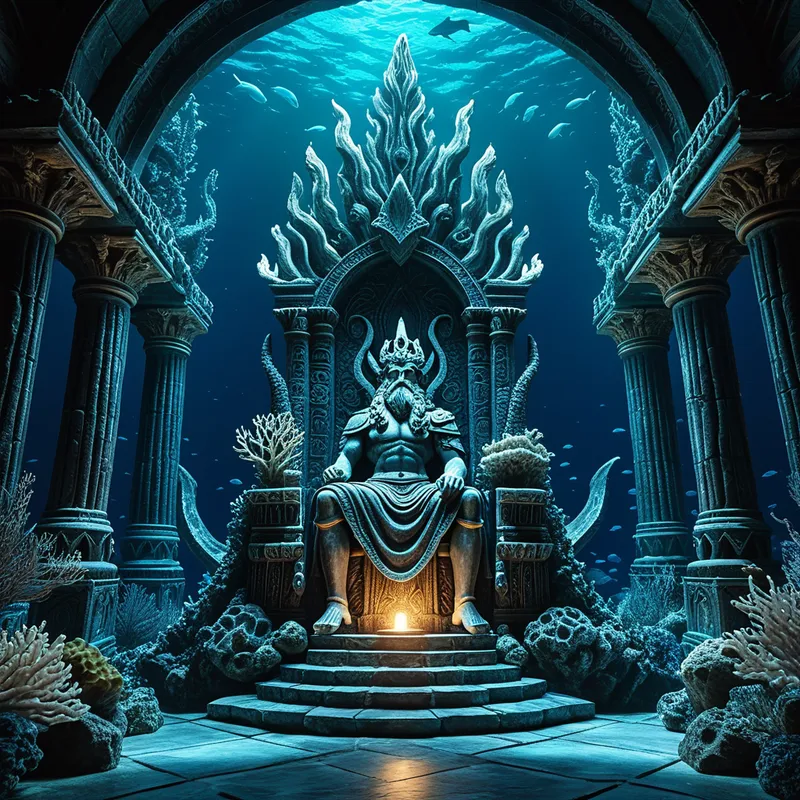
His palace lies in the sunless deeps, near Atlantis some say, or in the black trenches where even light fears to travel. Its walls are not hewn by mortal hands, but grown—great colonnades of living coral that pulse with a soft, internal radiance. Towers of abyssal stone are encrusted with pearls the size of a man’s head, and the gates are forged from the ribs of ancient, forgotten beasts. The sea itself is the palace’s breath; currents flow through its halls like sighs, carrying the songs of whales and the whispers of drowned things.
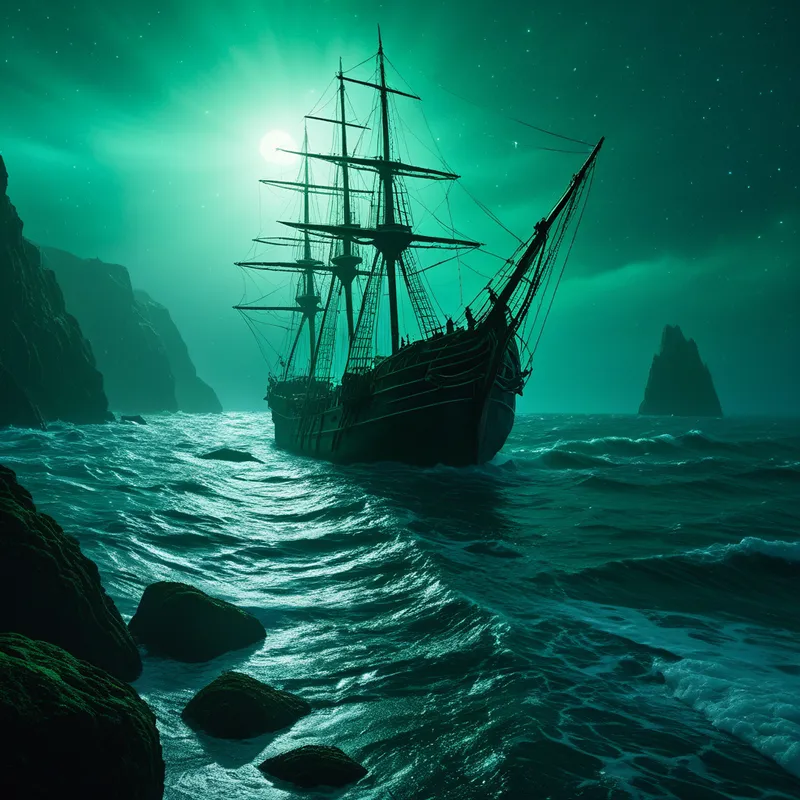
Here, Poseidon holds court. He sits upon a throne of polished obsidian and whalebone, his famed trident resting beside him. To this hall are summoned the denizens of the deep: [Nereids](/myths/nereids “Myth from Greek culture.”/) with hair of floating kelp, grim Tritons blowing on conch shells, and horses—magnificent, storm-maned steeds that were born from the sea foam. The mood within is as changeable as the surface above. One moment, the halls may ring with the boisterous laughter of the god, the [water](/myths/water “Myth from Chinese culture.”/) warm and clear. The next, a dark thought may cross his brow, and the very foundations of the world tremble. The palace groans, the water grows cold and turbulent, and far above, ships are shattered by waves he has summoned with a flick of his wrist.
This is not a place for mortals. To glimpse it is often a prelude to doom—a sailor dragged down in the wreckage of his ship, catching a final, terrifying glimpse of glowing spires before the breath leaves his lungs. It is a realm of absolute, untamed sovereignty, where the civilized order of the land holds no sway. It answers only to the tempestuous will of its king, a will as deep, as unpredictable, and as ancient as the ocean itself.
Cultural Origins & Context
The myth of Poseidon’s Palace is not a single, codified story from one text, but a pervasive idea woven through the fabric of [Homer](/myths/homer “Myth from Greek culture.”/)’s epics, the Bibliotheca, and countless hymns and local traditions. For the Greeks, a people whose lives were intimately tied to the wine-dark sea, the ocean was the ultimate source of bounty and the most immediate face of chaos. It was the highway for trade and colonization, and the grave for the unprepared.
Poseidon’s underwater abode served a crucial psychological and theological function. It localized and personified the sea’s terrifying power. The god wasn’t just in the sea; his palace was the sea’s spiritual and political center. This narrative was passed down by bards and poets, often in contexts emphasizing the peril of sea voyages (as in the Odyssey) or the cosmic division of the world between Zeus (sky), [Hades](/myths/hades “Myth from Greek culture.”/) ([underworld](/myths/underworld “Myth from Greek culture.”/)), and Poseidon (sea). The palace myth gave a shape and a ruler to the formless abyss, making it somewhat comprehensible. It told people that the storm had an origin point, a throne room, and that the god’s displeasure—perhaps over a missed sacrifice or a broken oath—could be the direct cause of their misfortune. It was a story that explained the unexplainable fury of nature by framing it as the emotional state of a conscious being.
Symbolic Architecture
The [Palace](/symbols/palace “Symbol: A palace symbolizes grandeur, authority, and the pursuit of one’s ambitions or dreams, often embodying a desire for stability and wealth.”/) of Poseidon is not merely a fantastical setting; it is a profound map of the unconscious [psyche](/myths/psyche “Myth from Greek culture.”/). If [Olympus](/symbols/olympus “Symbol: In Greek mythology, Mount Olympus is the divine home of the gods, representing ultimate power, perfection, and spiritual transcendence.”/) represents the [heights](/symbols/heights “Symbol: Represents ambition, fear, or spiritual elevation. Often symbolizes life challenges or a desire for perspective.”/) of [consciousness](/symbols/consciousness “Symbol: Consciousness represents the state of awareness and perception, encompassing thoughts, feelings, and experiences.”/), ego, and celestial order, then the sunless [palace](/symbols/palace “Symbol: A palace symbolizes grandeur, authority, and the pursuit of one’s ambitions or dreams, often embodying a desire for stability and wealth.”/) represents the [depths](/symbols/depths “Symbol: Represents the subconscious, hidden emotions, or foundational aspects of the self, often linked to primal fears or profound truths.”/) of the personal and [collective unconscious](/symbols/collective-unconscious “Symbol: The Collective Unconscious refers to the part of the unconscious mind shared among beings of the same species, embodying universal experiences and archetypes.”/)—a [realm](/symbols/realm “Symbol: The symbol of ‘Realm’ often signifies the boundaries of one’s consciousness, experiences, or emotional states, suggesting aspects of reality that are either explored or ignored.”/) of primal [emotion](/symbols/emotion “Symbol: Emotion symbolizes our inner feelings and responses to experiences, often guiding our actions and choices.”/), instinct, and creative potential that exists before and beyond the light of reason.
The palace is built where light fails, in the territory of the unformed and the unseen. To approach it is to approach the source of one’s own emotional tides.
Poseidon himself symbolizes the archetypal force of this [depth](/symbols/depth “Symbol: Represents profound layers of consciousness, hidden truths, or the unknown aspects of existence, often symbolizing introspection and existential exploration.”/). His trident is a key [symbol](/symbols/symbol “Symbol: A symbol can represent an idea, concept, or belief, serving as a powerful tool for communication and understanding.”/): it is a tool of both destruction (stirring storms, breaking the [earth](/symbols/earth “Symbol: The symbol of Earth often represents grounding, stability, and the physical realm, embodying a connection to nature and the innate support it provides.”/)) and creation (calling forth springs from rocks). This duality mirrors the unconscious, which can erupt in devastating, chaotic emotions (earthquakes of the [soul](/symbols/soul “Symbol: The soul represents the essence of a person, encompassing their spirit, identity, and connection to the universe.”/)) or provide the deep, [life-giving waters](/symbols/life-giving-waters “Symbol: Life-giving waters symbolize sustenance, nurturing, and the cyclical nature of life and death, serving as a vital resource for survival.”/) of inspiration and [intuition](/symbols/intuition “Symbol: The immediate, non-rational understanding of truth or insight, often described as a ‘gut feeling’ or inner knowing that bypasses conscious reasoning.”/). The palace’s [architecture](/symbols/architecture “Symbol: Architecture in dreams often signifies structure, stability, and the framing of personal identity or life’s journey.”/)—grown, not built—speaks to the organic, autonomous [nature](/symbols/nature “Symbol: Nature symbolizes growth, connectivity, and the primal forces of existence.”/) of the psyche’s deep structures. We do not consciously construct our deepest complexes; they grow there, shaped by ancestral and personal experience, forming a labyrinthine inner world we seldom visit.
The Dreamer’s Resonance
When the imagery of Poseidon’s Palace surfaces in modern dreams, it signals a profound engagement with the depths of the psyche. The dreamer is not skimming the surface of daily concerns but is being drawn into the foundational, often turbulent, layers of [the self](/myths/the-self “Myth from Jungian culture.”/).
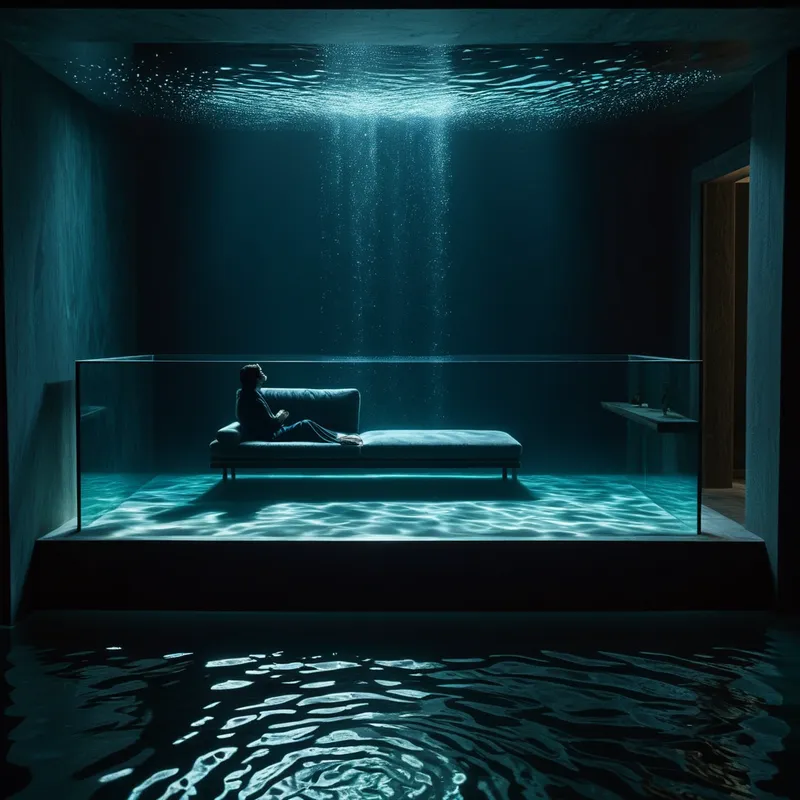
Common motifs include: finding oneself in a beautiful but terrifying underwater structure; being a guest or prisoner in a sumptuous yet oppressive hall where the rules are unknown; witnessing a powerful, mercurial figure (who may not look like Poseidon) whose mood shifts alter the entire environment; or simply being submerged in deep, dark water with a distant, glowing palace visible below. Somatically, this can correlate with feelings of pressure, of being in over one’s head, or of profound emotional flux. Psychologically, it indicates a process of confronting what has been submerged—repressed emotions, ancestral patterns, or a raw, untamed aspect of one’s own power and creativity that feels too vast or chaotic to integrate. The dream is an invitation, or a demand, to acknowledge this inner sovereignty, however frightening its court may be.
Alchemical Translation
The journey to and from Poseidon’s Palace models the alchemical process of individuation—the psychic work of integrating the unconscious into consciousness to become a more whole, self-governed individual. The first step is the descent: [the ego](/myths/the-ego “Myth from Jungian culture.”/)’s shipwreck, the crisis that forces us below the surface of our conscious identity into the chaotic depths (the [nigredo](/myths/nigredo “Myth from Alchemical culture.”/) or blackening).
The trident’s strike that shatters the ship is also the first crack in the shell of the old self, allowing the waters of the unconscious to flood in.
Arriving at the palace is the stage of confrontation. Here, one must face the Poseidon-within—the deep, often angry or neglected, source of one’s instinctual power and emotional truth. This is not about overthrowing this inner ruler, but about paying homage, listening to its demands, and recognizing its legitimate sovereignty over its own domain. The transformation (albedo or whitening) occurs when one learns to hold the tension between the palace’s chaos and the need for surface-level order. It is the process of bringing a single [pearl](/myths/pearl “Myth from Chinese culture.”/) of insight, a fragment of that deep, organic wisdom, back to the waking world.
The ultimate alchemical translation is the building of a conscious relationship with this inner palace. One learns to navigate its halls without drowning, to respect its king without being enslaved by his tempers. The individual who completes this work does not become Poseidon, but becomes a true ruler of their own life, one whose authority is now informed by both the light of reason and the profound, life-giving depths of the unconscious sea. They carry the trident’s power—to disrupt and to create—with conscious intent, having visited the throne room at the bottom of everything.
Associated Symbols
Explore related symbols from the CaleaDream lexicon: