Poseidon's Horses Myth Meaning & Symbolism
The story of the divine horses born from Poseidon's rage, embodying the untamed sea and the human struggle to harness primal, unconscious power.
The Tale of Poseidon’s Horses
Listen, and hear the crash of the deep. Before the age of heroes, when [the world](/myths/the-world “Myth from Tarot culture.”/) was raw and the gods still carved their domains from the carcass of the old cosmos, the [Poseidon](/myths/poseidon “Myth from Greek culture.”/) claimed his watery throne. His heart was a trench, his moods the tempest. Yet his dominion was vast and restless, and he desired a symbol of its power, a creature born not of earth or sky, but of [the sea](/myths/the-sea “Myth from Greek culture.”/)’s own furious soul.
He went to the [Tethys](/myths/tethys “Myth from Greek culture.”/), ancient mother of all waters, and in the lightless grottos where the first currents stirred, he poured forth his essence—not his love, but his rage, his ungovernable might, his lust for the untamed deep. From this divine fury, mingling with the primal salt, life was sparked. Not a gentle birth, but a violent eruption.
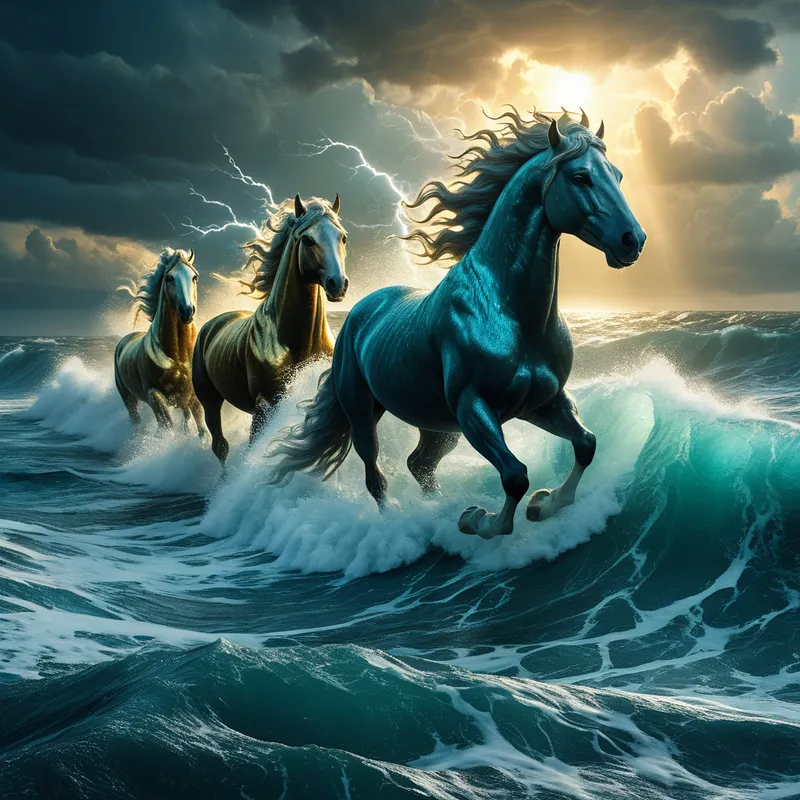
They burst forth from a wave that froze in mid-crest: the Horses of Poseidon. Their names were Brontes, Steropes, and Arges. They were not beasts of pasture. Their coats were the color of a storm at midnight, flecked with the white of shattered caps. Their manes and tails were living seafoam, hissing and dissolving into mist. Their hooves struck not earth, but the very skin of the sea, and where they stamped, whirlpools spun and new waves were born. Their eyes held the cold, green fire of [the abyss](/myths/the-abyss “Myth from Kabbalistic culture.”/). They were beautiful, and they were terrible.
Poseidon harnessed them to a chariot of coral and whalebone, and when he took the reins, the ocean itself obeyed his whim. To calm them was to calm the seas; to let them run wild was to summon hurricanes. They were the embodiment of his raw, untranslated power. For a time, this was enough. The god rode the chaos, and the chaos was him.
But [the Fates](/myths/the-fates “Myth from Greek culture.”/) weave threads for gods as for men. A challenge arose, not from a rival god, but from a mortal with a heart too bold. A king, some say, or a hero of the old blood, needed to cross a sea that Poseidon had sealed with his wrath. The only path was to master what the god himself had mastered: to steal, or to borrow, one of these elemental steeds.
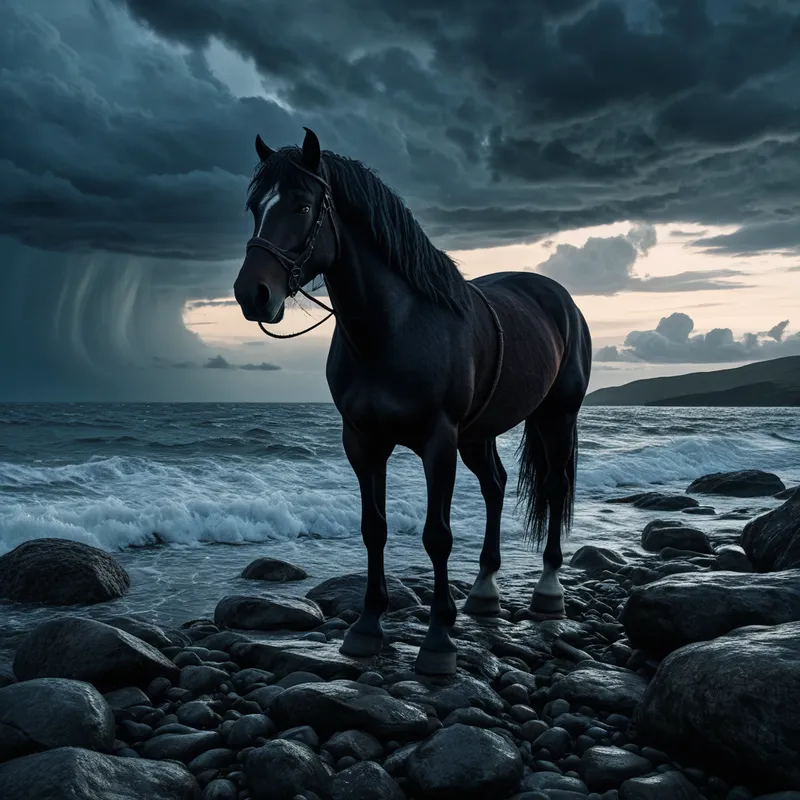
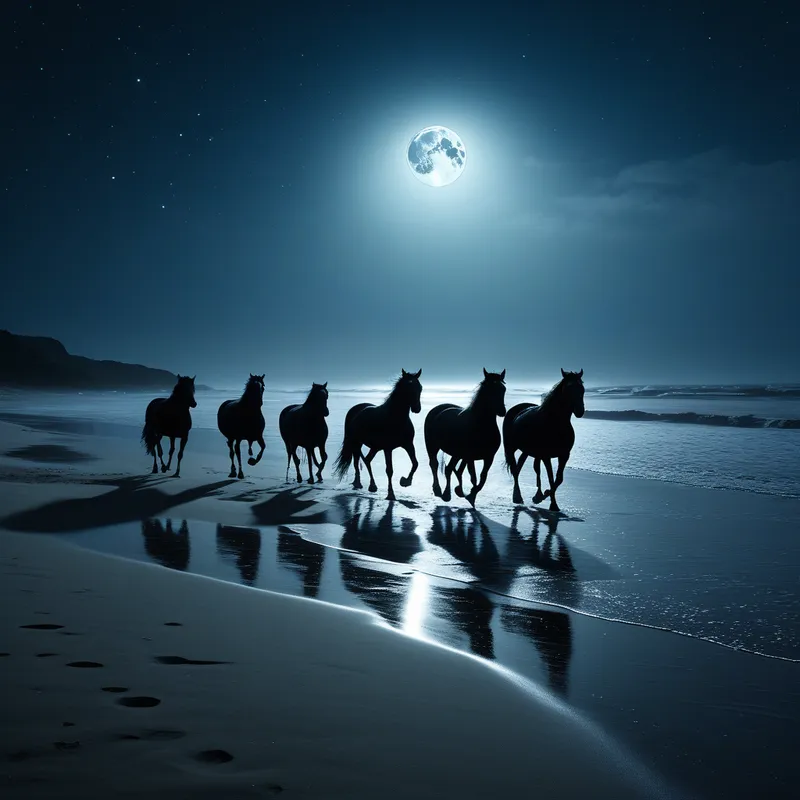
The tale whispers of a night when [the moon](/myths/the-moon “Myth from Tarot culture.”/) hid behind clouds of its own making. The hero descended to a shore where the cliffs wept salt, armed with nothing but a bridle forged in a god’s smithy and a will tempered by desperation. He did not fight the horse he found—a great, storm-grey stallion drinking starlight from a tidal pool. He spoke to it. He spoke not of conquest, but of partnership; not of breaking, but of channeling. He offered a direction for its boundless, chaotic energy.
The horse, creature of pure instinct and divine rage, hesitated. It felt the pull of the deep, the call of its sire’s anger. But it also felt the strange, focused fire of the mortal’s purpose. In that moment, a choice was made not in the heavens, but in the liminal space between sea and land. The horse lowered its head. The hero placed the bridle. And for one impossible journey, a force of nature was guided by a human hand, carrying its rider across the impossible strait before returning, with a final, echoing whinny, to the fathomless embrace of its father.
Cultural Origins & Context
The myth of Poseidon’s horses is not a single, codified story from a text like the Iliad, but a resonant motif woven through the fabric of Greek mythos. It finds echoes in Hesiod’s catalogues of divine beings, in fragments of lost epic cycles, and in the local cults and lore that dotted the Greek coastline. This was an oral tradition, told by sailors to explain the sudden, terrifying fury of a squall, or by farmers inland to speak of the distant, mysterious power of the sea they feared and relied upon.
Poseidon’s dual patronage—of the sea and of horses—is one of the oldest and most psychologically telling associations in the Greek [pantheon](/myths/pantheon “Myth from Roman culture.”/). The horse, the ultimate symbol of tamed terrestrial power and aristocratic warfare, finds its wild, primordial counterpart in the sea-horse. The myth served a societal function as a foundational metaphor for the Hellenic relationship with the Mediterranean. The sea was not just a resource or a barrier; it was a living, breathing, temperamental deity. To sail upon it was to temporarily harness a fraction of Poseidon’s own chaotic power, a profoundly dangerous act of hubris that required immense skill, respect, and ritual propitiation. The myth gave a face and a story to the very real, life-or-death struggle for mastery over an uncontrollable element.
Symbolic Architecture
At its core, the myth presents a powerful duality: the chaotic, generative [source](/symbols/source “Symbol: The origin point of something, often representing beginnings, nourishment, or the fundamental cause behind phenomena.”/) and the conscious will that seeks to direct it. Poseidon’s horses are not mere animals; they are psychoid entities—psychic forces so fundamental they appear as natural phenomena.
The horses are the embodied tumult of the unconscious, born not from gentle reflection but from the raw, creative rage of the divine Self.
Poseidon represents the archetypal ruler who possesses a power he did not create from nothing, but which erupted from the [depths](/symbols/depths “Symbol: Represents the subconscious, hidden emotions, or foundational aspects of the self, often linked to primal fears or profound truths.”/) of his own being. The horses are that power externalized—his unintegrated affect, his tempestuous emotions, his seismic will. To ride them is to be in command, but it is a command perpetually on the brink of being overthrown. The mortal [hero](/symbols/hero “Symbol: A hero embodies strength, courage, and the ability to overcome significant challenges.”/)’s act is the critical [human](/symbols/human “Symbol: The symbol of a human represents individuality, complexity of emotions, and social relationships.”/) intervention. He represents the emerging ego-[consciousness](/symbols/consciousness “Symbol: Consciousness represents the state of awareness and perception, encompassing thoughts, feelings, and experiences.”/) that dares to engage with an autonomous complex of immense power. He does not slay the horse; he bridles it. This is the key symbolic act: the [application](/symbols/application “Symbol: An application symbolizes engagement, integration of knowledge, or the pursuit of goals, often representing self-improvement and personal development.”/) of [structure](/symbols/structure “Symbol: Structure in dreams often symbolizes stability, organization, and the framework of one’s life, reflecting how one perceives their environment and personal life.”/) (the bridle) and [relationship](/symbols/relationship “Symbol: A representation of connections we have with others in our lives, often reflecting our emotional state.”/) (the offered partnership) to raw, instinctual [energy](/symbols/energy “Symbol: Energy symbolizes vitality, motivation, and the drive that fuels actions and ambitions.”/).
The successful crossing of the sea symbolizes the transcendent function—the [psyche](/myths/psyche “Myth from Greek culture.”/)’s [ability](/symbols/ability “Symbol: In dreams, ‘ability’ often denotes a recognition of skills or potential that one possesses, whether acknowledged or suppressed.”/) to navigate a previously impassable conflict (the sealed sea of a [problem](/symbols/problem “Symbol: Dreams featuring a ‘problem’ often symbolize internal conflicts or challenging situations that require resolution and self-reflection.”/)) by integrating a powerful, unconscious content (the horse) into a conscious endeavor.
The Dreamer’s Resonance
When this myth stirs in the modern dreamer, it rarely appears as a classical tableau. Instead, one might dream of trying to control a car with a mind of its own, of riding a wave that is also a living creature, or of being on a shore as enormous, shadowy animals emerge from a turbulent body of [water](/myths/water “Myth from Chinese culture.”/). The somatic experience is often one of exhilarating terror—a mix of awe at the power present and sheer anxiety about being overwhelmed.
Psychologically, this dream pattern signals a confrontation with what Carl Jung called a complex of great potency, often related to anger, passion, or a surge of creative or destructive energy that feels bigger than [the self](/myths/the-self “Myth from Jungian culture.”/). The dreamer is in the role of the hero on the shore. The chaotic force (the horse) is not an external enemy, but a part of their own psyche that has become autonomous and threatening. The dream asks: Can you engage with this? Can you find the “bridle”—the right attitude, the conscious container—for this storm within you? The process is one of acknowledging the power without being identified with it or destroyed by it.
Alchemical Translation
The alchemical journey mirrored in this myth is the [nigredo](/myths/nigredo “Myth from Alchemical culture.”/) and albedo. The blackness is Poseidon’s rage in the lightless grotto, the chaotic, undifferentiated state of a powerful emotion or drive. The horses are born from this [prima materia](/myths/prima-materia “Myth from Alchemical culture.”/)—the first, raw manifestation of this psychic content.
The hero’s act is the albedo: the washing, the purification. It is not the elimination of the base material, but its transformation through conscious engagement.
The mortal does not deny the horse’s oceanic nature; he uses it to cross the sea. In the individuation process, this translates to the difficult work of taking a disruptive, seemingly negative complex—a torrent of anger, a flood of grief, a seismic shift in identity—and not repressing it or letting it run rampant, but learning its nature and finding a direction for its energy. The bridle is the discipline of consciousness: therapy, artistic expression, ritual, or deep reflection. [The chariot](/myths/the-chariot “Myth from Tarot culture.”/) it connects to is the structure of one’s life and purpose.
To integrate Poseidon’s horse is to achieve a degree of sovereignty over one’s inner ocean. One becomes more like the god in his mastery, not by being the source of the chaos, but by being the conscious rider who can, at times, guide it. The sea remains vast and dangerous, the horse remains a creature of the deep, but a partnership has been forged. The individual is no longer at the mercy of every internal tempest. They have learned, however imperfectly, to navigate. They have, for a moment, made the unconscious conscious, and ridden the wave of the Self toward a farther shore.
Associated Symbols
Explore related symbols from the CaleaDream lexicon: