Poseidon's Chariot Myth Meaning & Symbolism
The myth of the sea god's chariot symbolizes the raw, untamed power of the unconscious and the heroic task of harnessing it for creation, not destruction.
The Tale of Poseidon’s Chariot
Hear now the tale of the foundation-shaker, the lord of the salt depths. Before the first ship dared his domain, before mortals learned to fear his tempers and beg for his calm, the god [Poseidon](/myths/poseidon “Myth from Greek culture.”/) claimed his kingdom.
[The world](/myths/the-world “Myth from Tarot culture.”/) was new-divided, the brothers having cast their lots. Zeus took the shimmering vault of heaven. [Hades](/myths/hades “Myth from Greek culture.”/) the silent realm of shades. And to Poseidon fell the endless, sighing, roaring sea—a realm of fathomless mystery and ungoverned power. But a king must have a throne, and a sovereign must have a steed. The wild, churning waters answered to his will, yet they lacked form, lacked the terrible majesty that would announce his passage to the very pillars of [the earth](/myths/the-earth “Myth from Hindu culture.”/).
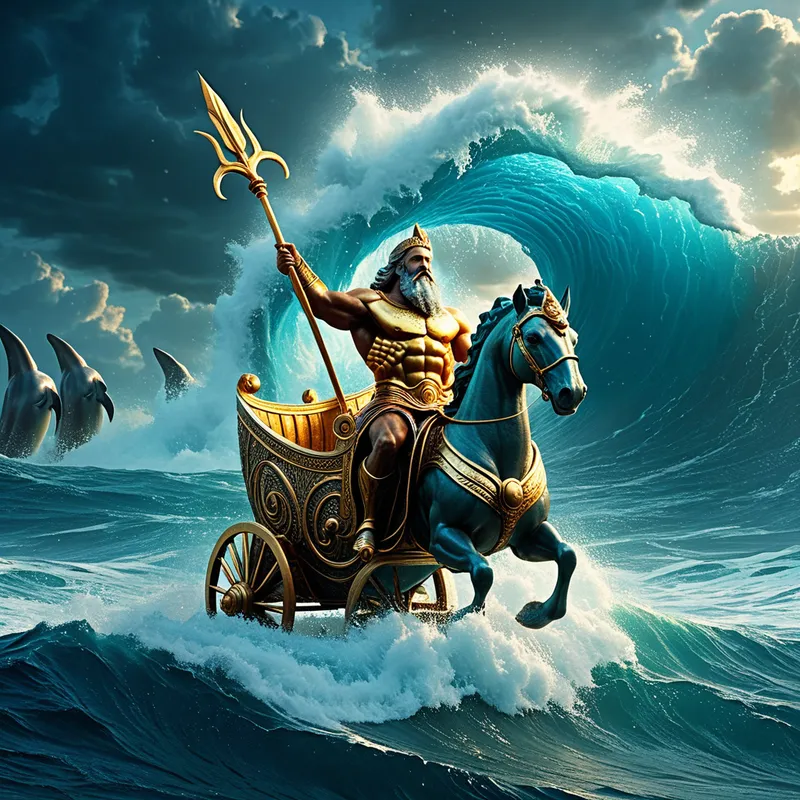
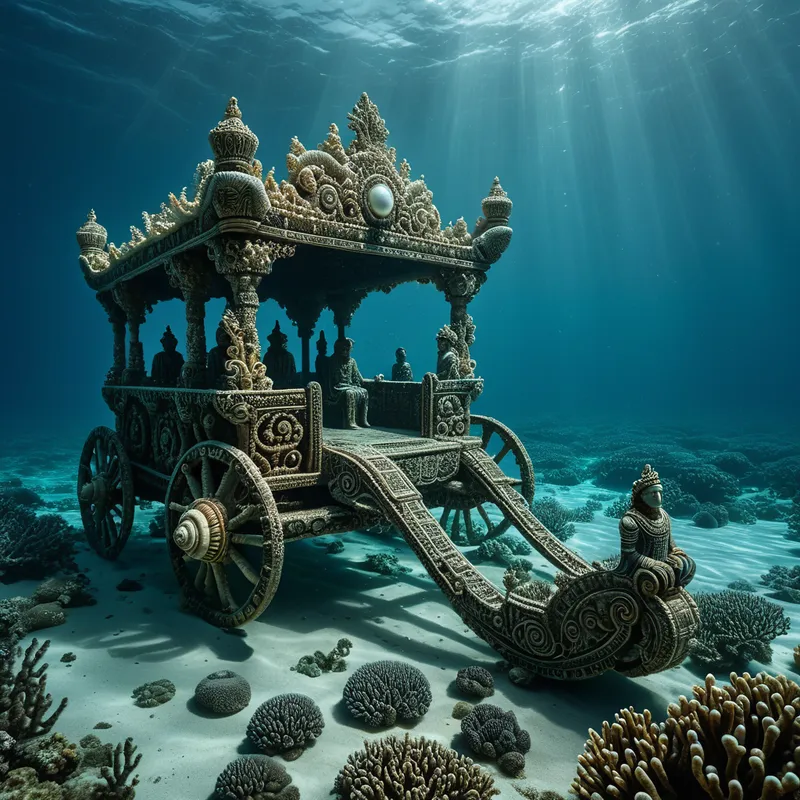
So from the forges of the Cyclopes, who had fashioned the thunderbolt for Zeus, came a chariot of beaten gold and bronze, impervious to the crushing deep, adorned with shells that sang of ancient tides. But this was merely a vessel. Its soul, its terrifying life, was yet to be born.
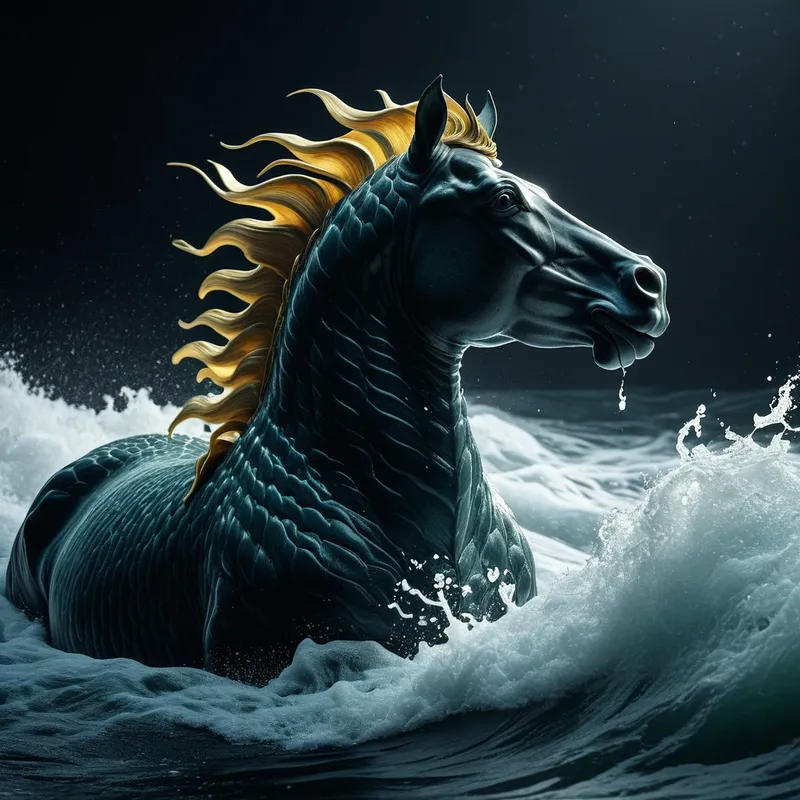
Poseidon descended to the darkest trenches, where light had never ventured. There, in the primordial ooze where life first stirred, he summoned the essence of the untamed. From the raw power of the storm-tossed wave, he took its relentless charge. From the mystery of [the abyss](/myths/the-abyss “Myth from Kabbalistic culture.”/), he took its coiling, hidden depth. From the freedom of the open sea, he took its boundless spirit. He fused these essences, and from the foaming seam where sea meets shore, they erupted—not as horses, not as fish, but as something wholly other: the hippocampi.
Four of them, vast and muscular, their forequarters mighty steeds with hooves that churned the [water](/myths/water “Myth from Chinese culture.”/) into thunder, their hindquarters great serpents or fish of gleaming scale, powerful tails driving them through the resistant deep. They were creatures of pure potential, of bridled chaos. They snorted streams of brine, and their eyes held the cold fire of the ocean floor.
The god grasped the reins, not of leather, but of living kelp and woven sea-foam. The moment he mounted [the chariot](/myths/the-chariot “Myth from Tarot culture.”/), [the sea](/myths/the-sea “Myth from Greek culture.”/) itself drew a breath. Then, he shook the reins.
What followed was not a ride, but an eruption. The chariot exploded from the depths, and the world witnessed its first true storm. The hippocampi plunged and reared, their charge creating whirlpools that could swallow islands. Waves rose like mountains at their flanks. The very seabed trembled, and earthquakes rumbled through the land—a reminder that the earth, too, was his to command. This was no mere travel; it was a declaration. Where the chariot of Poseidon passed, the sea was not empty. It was occupied, mastered, and made manifestly divine. He was not merely in the sea; he was the sea in motion, its sovereign will given terrifying form.
Cultural Origins & Context
The image of Poseidon in his chariot is not the subject of a single, canonical Homeric hymn but a pervasive iconographic and literary motif woven into the fabric of Greek understanding. We see it on the surfaces of painted vases, etched into temple metopes, and described in the poetic epithets of the god. It was a shared cultural shorthand, passed down through artisans, poets, and storytellers who shaped the communal imagination.
Its function was multifaceted. On one level, it explained the natural world: the sudden, terrifying storms at sea were visualized as the passing of the god’s chariot; earthquakes (Ennosigaios) were the reverberations of its wheels across the ocean floor onto the land. It gave a face and a narrative to the capricious, overwhelming power of the marine element that was both a source of livelihood and a cause of death for the Greeks.
Societally, it reinforced the concept of kosmos over chaos. Poseidon, one of the great ruling Olympians, did not merely rage like a primal force. He harnessed it. The chariot, a human invention for control and direction, symbolized this civilizing, ordering principle imposed upon the wild, unconscious realm of the sea. It told the people that even the most terrifying natural forces were under a form of sovereignty, however temperamental.
Symbolic Architecture
At its core, the myth of Poseidon’s [Chariot](/symbols/chariot “Symbol: The chariot signifies control, direction, and power in one’s journey through life.”/) is a profound [symbol](/symbols/symbol “Symbol: A symbol can represent an idea, concept, or belief, serving as a powerful tool for communication and understanding.”/) of the [relationship](/symbols/relationship “Symbol: A representation of connections we have with others in our lives, often reflecting our emotional state.”/) between [consciousness](/symbols/consciousness “Symbol: Consciousness represents the state of awareness and perception, encompassing thoughts, feelings, and experiences.”/) and the unconscious, between [the ego](/myths/the-ego “Myth from Jungian culture.”/) and the vast, autonomous psychic [depths](/symbols/depths “Symbol: Represents the subconscious, hidden emotions, or foundational aspects of the self, often linked to primal fears or profound truths.”/).
The sea is the classic symbol of the unconscious—deep, unknown, teeming with [life](/symbols/life “Symbol: The symbol of ‘Life’ represents a journey of growth, interconnectedness, and existential meaning, encompassing both the joys and challenges that define human experience.”/) and monsters, the [source](/symbols/source “Symbol: The origin point of something, often representing beginnings, nourishment, or the fundamental cause behind phenomena.”/) of all [fertility](/symbols/fertility “Symbol: Symbolizes creation, growth, and abundance, often representing new beginnings, potential, and life force.”/) and all [terror](/symbols/terror “Symbol: An overwhelming, primal fear that paralyzes and signals extreme threat, often linked to survival instincts or deep psychological trauma.”/). Poseidon represents the archetypal power that presides over this [realm](/symbols/realm “Symbol: The symbol of ‘Realm’ often signifies the boundaries of one’s consciousness, experiences, or emotional states, suggesting aspects of reality that are either explored or ignored.”/). He is not the unconscious itself, but its ruling principle, its potential for both creative nurture and annihilating [fury](/symbols/fury “Symbol: An intense, overwhelming rage that consumes the dreamer, often representing suppressed anger or a primal emotional eruption.”/).
The chariot is the vehicle of will, the structured ego-consciousness that attempts to navigate and direct the primal forces of the psyche.
The golden, crafted chariot symbolizes the conscious mind, the “I,” with its [intention](/symbols/intention “Symbol: Intention represents the clarity of purpose and direction in one’s life and can symbolize motivation and commitment within a dream context.”/), [structure](/symbols/structure “Symbol: Structure in dreams often symbolizes stability, organization, and the framework of one’s life, reflecting how one perceives their environment and personal life.”/), and desire for [direction](/symbols/direction “Symbol: Direction in dreams often relates to life choices, guidance, and the path one is following, emphasizing the importance of navigation in personal journeys.”/). The hippocampi are the brilliant, terrifying [image](/symbols/image “Symbol: An image represents perception, memories, and the visual narratives we create in our minds.”/) of the instinctual energies of the unconscious. They are hybrid, belonging to two worlds: the equine front symbolizing power, [passion](/symbols/passion “Symbol: Intense emotional or physical desire, often linked to love, creativity, or purpose. Represents life force and deep engagement.”/), and nobility (the “higher” or more recognizable instincts); the serpentine/fish [tail](/symbols/tail “Symbol: A tail in dreams can symbolize instincts, connection to one’s roots, or the hidden aspects of personality.”/) symbolizing the deep, ancient, slippery, and profoundly non-[human](/symbols/human “Symbol: The symbol of a human represents individuality, complexity of emotions, and social relationships.”/) wisdom of the [abyss](/symbols/abyss “Symbol: A profound void representing the unconscious, the unknown, or a spiritual threshold between existence and non-existence.”/).
The reins are the critical, fragile link. They represent the function of the ego to relate to, guide, and negotiate with these instinctual forces. To drop the reins is to be devoured by a psychosis, a flood of undifferentiated unconscious content. To pull them too tightly is to sever the vital [connection](/symbols/connection “Symbol: Connection symbolizes relationships, communication, and bonds among individuals.”/) to the instinctual wellspring of life and creativity, resulting in arid rigidity. The myth presents the ideal: a dynamic, tense, and masterful relationship.
The Dreamer’s Resonance
When this mythic pattern stirs in the modern dreamer, it signals a profound engagement with the foundational powers of the [psyche](/myths/psyche “Myth from Greek culture.”/). To dream of driving or witnessing a chariot pulled by hybrid sea-creatures is to experience the somatic reality of grappling with immense, newly mobilized inner forces.
The dreamer may feel the terrifying exhilaration of speed and power, the nausea of plunging into deep emotional waters, or the anxiety of holding reins that seem too slight for the beasts they control. This is the psyche’s theatre for processing a surge of raw affect—perhaps a long-suppressed rage that now demands recognition, a tidal wave of grief, or a creative impulse of overwhelming potency. The hippocampi are these feelings in their pure, archaic form, not yet rationalized or sanitized.
The condition of the chariot is telling. Is it sturdy or crumbling? Is the dreamer confidently standing or clinging on in terror? The dream presents a snapshot of the ego’s current capacity to “hold” and relate to this upwelling from the depths. To dream of losing control of the chariot, of being thrown into the chaotic sea, often parallels a feeling of being emotionally overwhelmed in waking life. Conversely, a dream of a graceful, powerful drive across calm, sun-dappled waters may reflect a hard-won period of emotional sovereignty and integrated power.
Alchemical Translation
The journey of Poseidon mounting his chariot is a perfect allegory for the alchemical process of psychic transmutation, what Jung termed individuation. It models the transformation of raw, unconscious content into a directed, life-serving force of personality.
[The first stage](/myths/the-first-stage “Myth from Alchemical culture.”/) is [nigredo](/myths/nigredo “Myth from Alchemical culture.”/), the descent into the dark sea-trench. This is the confrontation with [the shadow](/myths/the-shadow “Myth from Jungian culture.”/), the repressed, the chaotic emotional material we prefer to ignore. Poseidon does not fear this descent; it is his domain. The modern equivalent is the courageous act of turning inward to face one’s depths.
The forging of the chariot and the creation of the hippocampi represent albedo and citrinitas. Here, conscious understanding (the chariot) is constructed, and the instinctual energies (the hippocampi) are “named” and brought into a form that can be related to. In therapy or deep reflection, this is the process of articulating one’s complexes, understanding the nature of one’s passions and fears.
The ultimate goal is not to eliminate the chaotic sea, but to learn to drive across it, to become the conscious ruler of one’s own inner kingdom.
Finally, the triumphant drive is [rubedo](/myths/rubedo “Myth from Alchemical culture.”/), the achievement of a cohesive Self. The ego (the charioteer) is no longer a petty tyrant pretending the sea does not exist, nor is it a helpless victim of the waves. It has formed a working alliance with the archetypal power of the depths. The sovereign “I” can now harness the tremendous energy of the instincts for creation, for motion, for shaping one’s world, rather than being perpetually shaped—or shattered—by them. The earthquakes that accompany the ride remind us that this mastery is never static or gentle; true sovereignty transforms both the inner and the outer landscape.
Associated Symbols
Explore related symbols from the CaleaDream lexicon: