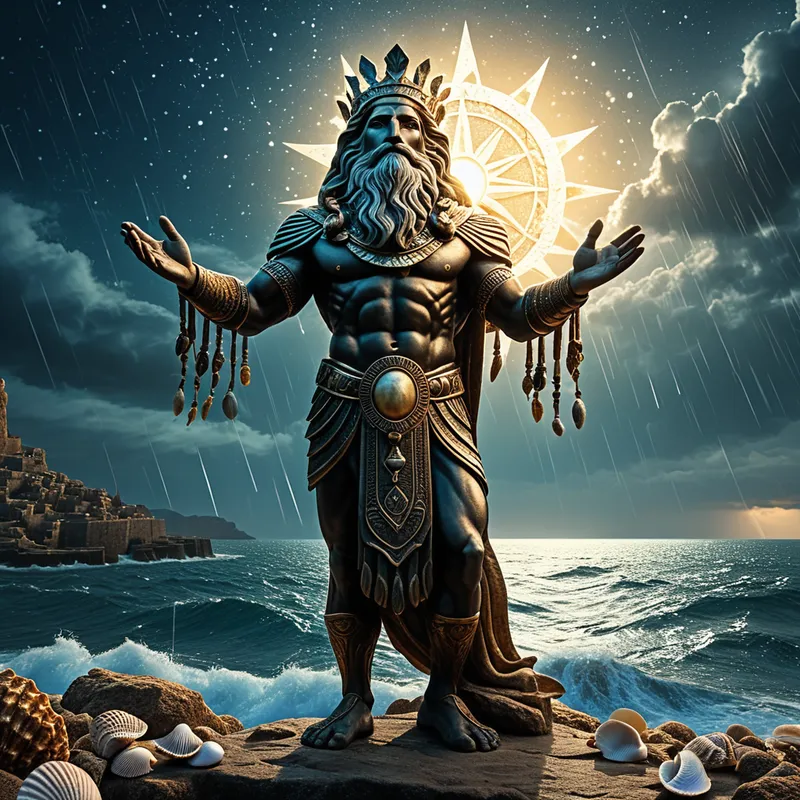
Port of Tyre Myth Meaning & Symbolism
A myth of Melqart's sacrifice, where the god's journey to the world's edge creates the sacred port, a threshold between chaos and order.
The Tale of Port of Tyre
Hear now the tale of the first harbor, born not from the hands of men, but from the sacrifice of a god. In the time before time, when the world was a younger, wilder place, the coast was a jagged, treacherous maw. The sea, Yam, roared against the land with a fury that shattered ships and swallowed hopes. There was no safe return, no haven for the vessels that dared the deep. The people of the coast, the ancestors of the purple-dyers, lived in fear of the horizon.
Then came Melqart, the Lord of Tyre, the King of the City. He was a god of foundation and far journeys, his brow crowned with the shells of the deep, his strength that of the mountain and the tidal wave. He saw his people’s terror and heard the weeping of widows on the wind. His heart, a furnace of royal will, could not abide this chaos. A king must provide safe passage; a god must impose order on the abyss.
He did not summon armies of spirits or command the rocks to part. Instead, he took the form of a mighty mariner, his skin the color of weathered cedar, his eyes holding the depth of the midnight sea. He boarded a galley of pure cedar, its sail dyed with the first purple, and he steered it not toward the known trade routes, but directly into the heart of the tempest, toward the very edge of the world where Yam’s rage was born.
For forty days and forty nights, the struggle shook the pillars of the earth. Melqart wrestled not a beast, but the very principle of formlessness. He fought the waves that had no memory and the rocks that knew no loyalty. He navigated by a single, steadfast star—the star of the evening, Astarte’s lamp—which pierced the storm clouds like a promise. The conflict was not of clashing swords, but of imposing direction upon the directionless, of carving intent into the heart of chaos.
At the climax, as his ship was about to be dashed upon the teeth of the final, primordial reef, Melqart made the sacrifice. He did not offer a lamb or a libation. He offered a piece of his own sovereign power. He took the celestial chart from his soul, the map of orderly navigation, and he cast it—not away—but down, into the raging waters at the specific point where the star’s light touched the foam.
Where the divine chart met the chaos, a great calming began. The furious waves drew back like a curtain. The jagged rocks submerged, grinding themselves smooth into protective arms. The wild, untamed water stilled, becoming a mirror that perfectly reflected the star above. And from the depths, a perfect, deep-water harbor arose, its entrance aligned with the celestial beacon. Exhausted, Melqart guided his battered galley into this first, sacred haven. Where his anchor fell, the city of Tyre would later rise. The port was not built; it was consecrated—a divine wound in the side of chaos, from which all safe returns would flow.

Cultural Origins & Context
This foundational myth was the spiritual and practical bedrock of the Phoenician civilization, a culture of master navigators and traders whose identity was inseparable from the sea. It was not merely a story of a god’s feat; it was the sacred charter for their entire way of life. The tale was likely recited during the annual egersis festival, a ritual of resurrection where the god’s journey and return were re-enacted to ensure the renewal of the city’s fortune and safe passage for its fleets.
Told by priests of Melqart and by ship captains to their crews on long voyages, the myth served multiple crucial functions. Societally, it sanctified Tyre’s status as a preeminent maritime power—their port was literally a divine creation, making their navigation a participation in sacred order. Psychologically, it transformed the terrifying, unknown sea from a realm of pure chaos (Yam) into a structured space that could be negotiated through skill, courage, and celestial observation. The myth provided a cosmic template: every successful voyage was a small re-enactment of Melqart’s primordial victory.
Symbolic Architecture
At its core, the Port of Tyre myth is a profound allegory for the creation of consciousness from the unconscious, and of culture from nature. The untamed, predatory coast represents the formless, potentially overwhelming psyche—the unconscious in its raw, chaotic state. Yam is the eternal, churning sea of potential and dissolution that precedes and surrounds individual existence.
The harbor is not the absence of the sea, but a sacred agreement with it—a conscious structure built at the very interface of chaos and order.
Melqart represents the archetypal principle of the ego or the sovereign self, tasked with the heroic burden of establishing a safe, functional space for life and commerce. His journey to the edge is the ego’s necessary confrontation with the deepest, most anarchic layers of the psyche. The sacrifice of his “celestial chart” is the critical moment: it symbolizes the surrender of a purely personal, controlling will in favor of a higher, ordering principle—the star, the transcendent function. The resulting harbor is the individuated self: a stable, receptive consciousness (the calm water) capable of receiving the contents of the unconscious (ships/trade) without being destroyed by them.

The Dreamer's Resonance
When this myth stirs in the modern dreamer, it often manifests as dreams of perilous journeys toward a safe haven that is just out of reach. You may dream of trying to guide a fragile boat through a storm, of searching for a specific dock in a maze of harbors, or of watching a lighthouse beam that you cannot seem to reach. Somaticly, this can feel like a deep, existential anxiety—a churning in the gut that mirrors the chaotic sea.
Psychologically, this dream pattern signals a critical phase in what James Hillman called “soul-making.” The psyche is engaged in the arduous work of creating an inner structure, a “port,” amidst a feeling of life’s chaos or a flood of unprocessed emotion. The dreamer is in the midst of their own forty-day navigation, wrestling with the formless aspects of a life transition, a creative block, or an emotional upheaval. The longing for the harbor in the dream is the soul’s intuition that a new, more resilient structure of consciousness is being formed through the struggle itself. The ego is being challenged to stop fighting the chaos directly and to instead find its guiding “star”—a core value, a truth, or a symbolic image—around which to organize the turmoil.

Alchemical Translation
The alchemical process mirrored in Melqart’s ordeal is the nigredo, the blackening, followed by the albedo, the whitening. The voyage into the storm is the nigredo: the ego’s necessary dissolution and confrontation with the shadowy, chaotic contents of the personal and collective unconscious. This is not a failure, but the essential first matter of transformation.
The god does not destroy the sea; he enters into a sacred dialogue with it, and from that conversation, a third thing—the harbor—is born.
The sacrifice of the chart is the pivotal moment of separatio. The old map of the world, the ego’s previous understanding of how life “should” work, must be given up. It is cast into the chaos to be broken down and reconstituted. The aligning of the harbor with the star of Astarte represents the albedo—the illumination, the emergence of a new ordering principle from the union of conscious effort (Melqart) and transcendent guidance (the star). For the modern individual, this translates to the process of individuation. We must venture into our own inner chaos (fears, unresolved traumas, creative blocks) not to conquer it, but to find the specific point where our deepest, most authentic longing (our star) can touch that chaos and transform it. The safe harbor that results is not a life free of storms, but a fortified, resilient center within the self—a soul-port from which we can engage the world’s depths without losing ourselves. We become, like Tyre, a city whose wealth and identity flow from its sacred capacity to navigate the great deep.
Associated Symbols
Explore related symbols from the CaleaDream lexicon: