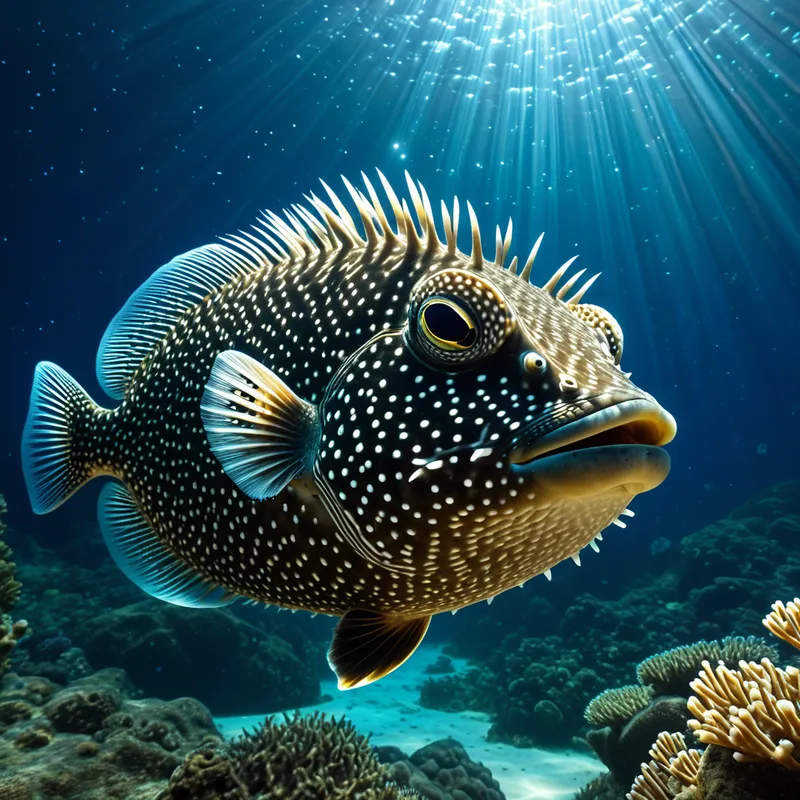
Porcupinefish Myth Meaning & Symbolism
A tale of a shape-shifting god who swallows the ocean's fire, sacrificing his form to become the spiny, protective Porcupinefish.
The Tale of Porcupinefish
In the time before time, when [the world](/myths/the-world “Myth from Tarot culture.”/) was soft and the ocean breathed with the heat of [the earth](/myths/the-earth “Myth from Hindu culture.”/)’s core, there lived a being of changeable form. He was Kupua, a god who walked as a man but whose essence was the fluid sea itself. His name is lost to the waves, but his nature was known: he was a guardian of the Po, the generative darkness.
The people of the great canoe lived in harmony with [the sea](/myths/the-sea “Myth from Greek culture.”/), but beneath the coral kingdoms, a great unrest stirred. Pele, in her restless journey, had left a fragment of her heart-fire smoldering on the ocean floor. This fire did not burn with clean flame, but with a poisonous, boiling rage. It seeped into the currents, turning the life-giving [water](/myths/water “Myth from Chinese culture.”/) acrid. Fish fled. Coral bleached to bone. The very Mana of [the sea](/myths/the-sea “Myth from Greek culture.”/) began to sicken.
The Kupua felt the distress of his realm as a physical pain. Diving deep, beyond where light could reach, he found the source: a fissure pulsing with a malevolent, greenish glow. The heat was not of creation, but of consumption. He knew the laws. This fire could not be quenched by water, nor commanded by chant. It could only be contained.
So, the Kupua made a choice that would unmake him. He opened his mouth, not to speak, but to swallow. He drew in the searing, toxic heat, pulling the venomous fire from the rock and into [the vessel](/myths/the-vessel “Myth from Alchemical culture.”/) of his own divine body. The pain was beyond telling. His smooth skin blistered and tightened. His form, once fluid, began to harden and swell under the immense, internal pressure. He felt his bones soften and reshape.
As he absorbed the last of the corrosive fire, his transformation locked into its final state. He had become round, a living container. Where once was skin, now were a hundred spears—sharp spines erected in a permanent crown of vigilance. The beautiful, terrible fire was now sealed inside him, a contained blaze that would forever glow as a warning. He had sacrificed his grace to become the Porcupinefish, the ‘aumakua who swallows danger so the reef may live. He drifted upward, a strange and potent new creature, a fortress of flesh, forever holding the line between the community of life and the chaos of [the abyss](/myths/the-abyss “Myth from Kabbalistic culture.”/).

Cultural Origins & Context
This myth finds its roots in the vast oceanic world of Polynesia, a culture navigated by stars and sustained by an intimate, reciprocal relationship with the sea. Stories like that of the Porcupinefish were not mere fables but vital Moʻolelo, carried across generations by storytellers and priests. They were shared during long voyages, at community gatherings, and as teaching tools for young navigators and fishers.
Its primary function was ecological and psychological pedagogy. It explained the unique, dramatic physiology of the porcupinefish—its ability to inflate and its sharp spines—not as random biological facts, but as evidence of a sacred, sacrificial history. The myth encoded a core societal value: the supreme duty of protection. It reinforced the idea that certain beings, whether chiefly ancestors or designated guardians, must sometimes take on a burdensome, even ugly form to ensure the survival of the whole. The Porcupinefish became a symbol of this self-sacrificial Mana, transforming a potentially frightening creature into a respected ‘aumakua.
Symbolic Architecture
At its [heart](/symbols/heart “Symbol: The heart symbolizes love, emotion, and the core of one’s existence, representing deep connections with others and self.”/), this is a myth of radical containment. The Porcupinefish is the archetypal [vessel](/symbols/vessel “Symbol: A container or structure that holds, transports, or protects something essential, representing the self, emotions, or life journey.”/). It symbolizes the psychological necessity of taking in that which is toxic, overwhelming, or disintegrating—not to become poisoned, but to neutralize it through a transformative act of [the self](/myths/the-self “Myth from Jungian culture.”/).
The true fortress is not made of stone, but of a willingness to let the threat inside and be changed by it.
The poisonous fire represents unintegrated rage, [trauma](/symbols/trauma “Symbol: A deeply distressing or disturbing experience that overwhelms the psyche, often manifesting in dreams as unresolved emotional wounds or psychological injury.”/), or any “hot” psychic content that threatens to scorch the ecosystem of the [psyche](/myths/psyche “Myth from Greek culture.”/). The Kupua’s initial fluid form is the adaptable, unformed ego. The act of swallowing is the conscious [decision](/symbols/decision “Symbol: A decision in a dream reflects the choices one faces in waking life and can symbolize the pursuit of clarity and resolution.”/) to engage with this [shadow](/symbols/shadow “Symbol: The ‘shadow’ embodies the unconscious, repressed aspects of the self and often represents fears or hidden emotions.”/) [material](/symbols/material “Symbol: Material signifies the tangible aspects of life, often representing physical resources, desires, and the physical world’s influence on our existence.”/), to “eat” one’s own anger or pain rather than project it [outward](/symbols/outward “Symbol: Movement or orientation away from the self or center; expansion, expression, or externalization of inner states into the world.”/). The resulting transformation—becoming spiny, round, and guarded—is not a failure but a successful [adaptation](/symbols/adaptation “Symbol: The process of adjusting to new conditions, often involving psychological or physical change to survive or thrive.”/). The spines are not weapons of aggression, but boundaries of absolute necessity. They represent the psychic defenses that form after a deep injury has been internalized, a permanent reminder of the cost of protection.
The Dreamer’s Resonance
When this myth pattern stirs in the modern dreamer, it often manifests as dreams of swallowing something dangerous (coals, glass, acid), of the body becoming rigid or armored, or of finding oneself in a spherical, enclosed space covered in thorns or pins. Somatic sensations might include a feeling of tightness in the chest or throat, or a sense of being “prickly” and unapproachable upon waking.
This dream state indicates an active, profound process of psychic containment. The dreamer is likely in a life situation requiring them to “hold” a tremendous amount of emotional pressure—perhaps caring for a loved one through a crisis, enduring a toxic work environment for a greater family goal, or internalizing a childhood trauma to break a cycle of abuse. The dream is not a sign of pathology, but a revelation of the psyche’s heroic, if painful, adaptation. It is the self forging spines where it was once soft, building a container strong enough to hold what would otherwise destroy its world.
Alchemical Translation
The alchemical journey mirrored here is the [Nigredo](/myths/nigredo “Myth from Alchemical culture.”/)—the blackening, the dissolution of the old form—followed not by a return to gold, but by a transmutation into a new, functional, and sacred state. The individuation process modeled is one where [the ego](/myths/the-ego “Myth from Jungian culture.”/)’s ideal of attractive, seamless power (the shape-shifting god) is sacrificed for the soul’s purpose of holistic protection.
Individuation is sometimes the process of becoming stranger to yourself, and more essential to the world.
For the modern individual, the “Porcupinefish moment” arises when we must choose between personal comfort and collective necessity. It is the parent who swallows their fatigue to project calm for their child. It is the activist who internalizes the world’s injustice until it reshapes their very being into a focused instrument of change. It is anyone who consciously takes in a fragment of the world’s “poisonous fire”—be it grief, responsibility, or truth—and through that act, transforms it into contained power. We are not asked to remain beautiful gods. We are asked, at crucial turns, to become effective vessels. Our spines, our boundaries, our sometimes-unapproachable intensity, are not flaws. They are the sacred geometry of a self that dared to swallow the dark fire so that others might swim in safer waters.
Associated Symbols
Explore related symbols from the CaleaDream lexicon: