Porcupine as culture hero Myth Meaning & Symbolism
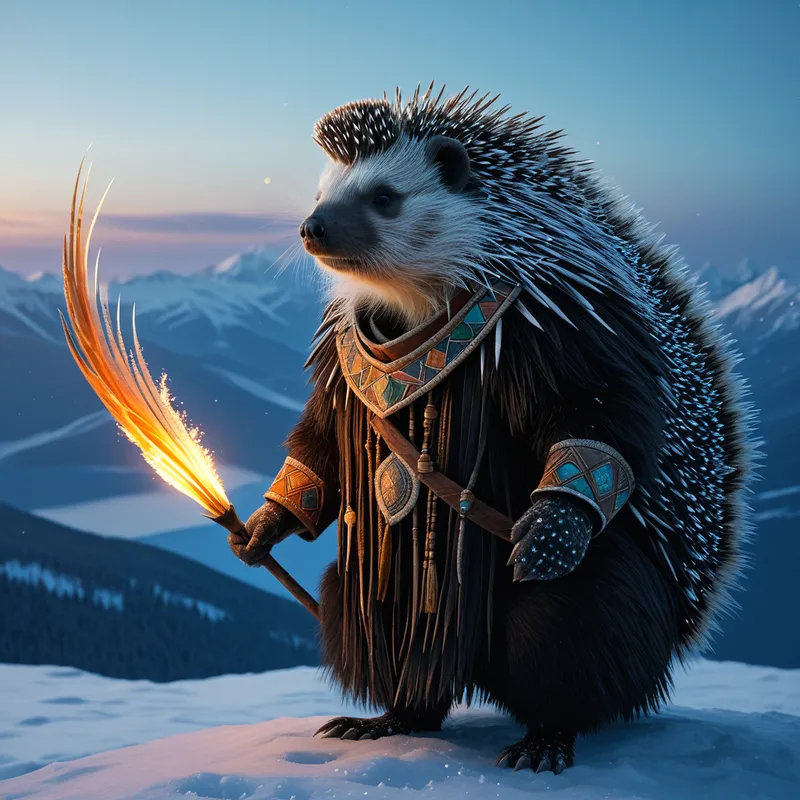
The myth of Porcupine, a small, clever hero who outwits monstrous giants to steal fire for a shivering humanity, bringing warmth, light, and culture.
The Tale of Porcupine as culture hero
In the time before time, when the world was new and raw, the People shivered. A great cold had settled upon the land, a cold that bit to the bone and stole the breath in clouds. There was no fire. No crackling warmth to gather around, no dancing light to push back the endless dark, no means to cook the tough meat of the hunt. They lived in a grey world, their songs thin and their spirits brittle with frost.
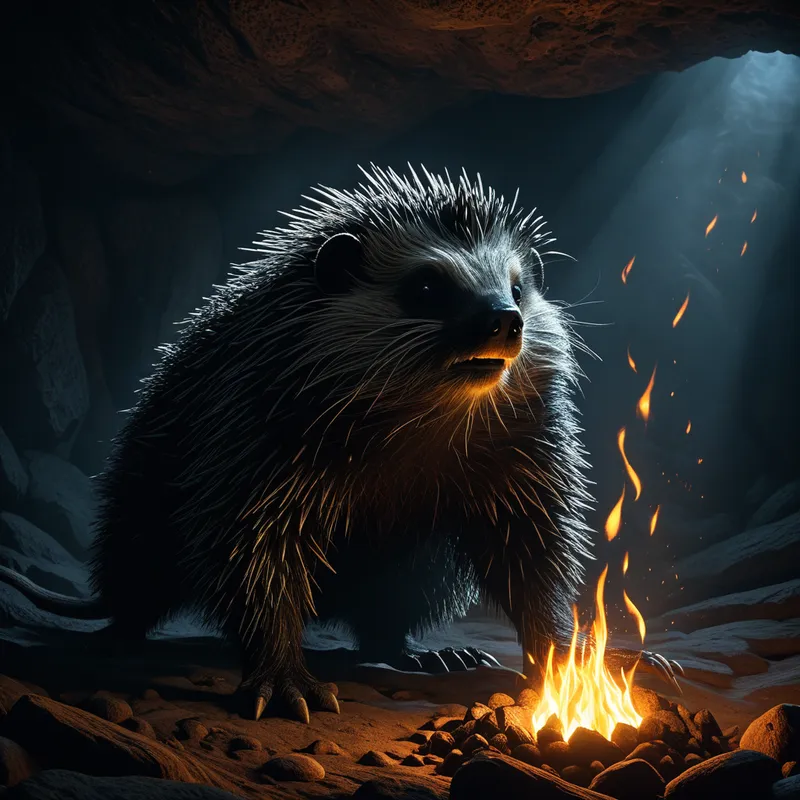
The fire was not lost. It was kept. Hoarded in the high, inaccessible mountains by the Giants. These were not the gentle giants of some tales. They were vast, crude beings of stone and storm, with voices like grinding rock and appetites as deep as gorges. In their cavernous home, a great fire roared, a heart of orange and red that they guarded with a jealous, slothful vigilance. They laughed at the shivering humans below, their laughter echoing down the slopes like distant thunder.
Among the People, despair was a second skin. But in one lodge, a different kind of warmth was kindled—not of flame, but of thought. It was Porcupine who sat, not large, not strong, but possessed of a quiet, prickly resolve. He watched his people, saw how the cold was not just chilling their bodies but extinguishing their very culture. “This cannot be,” his spirit whispered. “The fire belongs to the world, not to the hoarders.”
He announced his intent. The elders shook their heads; the warriors scoffed. To steal from the Giants was to invite annihilation. But Porcupine was not a warrior of muscle. He was a strategist of spirit. He began to prepare, not with spear and shield, but with cunning. He rolled in the ashes of their meager, sun-warmed hearths until his brown coat was dull grey. He practiced moving with infinite slowness, becoming a shadow among shadows.
The journey to the mountain was a trial of ice and wind. Finally, he found the cavern mouth, a jagged tear in the mountain’s side, pulsing with a hellish glow and reeking of smoke and old meat. Inside, the Giants lay sprawled in a stupor of gluttony, their chests rising and falling like bellows, the great fire between them. Heat washed over Porcupine, a shocking, beautiful agony after the long cold.
This was the moment. Not a charge, but a creep. He became a part of the cave itself—a smudge of soot, a trick of the light. He moved with the patience of stone, closer, closer to the fire. The Giants snorted in their sleep. One rolled over, a massive hand sweeping near Porcupine, who froze, his heart a frantic drum against his ribs. The hand passed.
Now at the fire’s edge, he faced the final test. He could not carry a burning branch; the light would betray him. He needed the essence, the seed of the flame. With a swift, desperate motion, he thrust his tail—bushy and thick—into the hottest part of the coals. The pain was instant and white-hot, a searing brand up his spine. He stifled a cry, biting down until his gums bled.
The fire caught. His tail was now a torch!
The Giants stirred, a deep rumbling beginning in their throats. The smell of burning hair and flesh—his flesh—filled the air. There was no more stealth. It was flight. Porcupine turned and ran, a living comet streaking from the cave, a trail of sparks and agony behind him.
Down the mountain he raced, a blur of pain and purpose. The Giants awoke with roars that split the sky, giving chase. But Porcupine was small, agile, driven by a mission greater than his fear. He weaved through rocks, plunged into icy streams to dampen the sparks, and finally, as the Giants’ thunderous footsteps shook the valley, he reached the edge of the People’s lands.
Exhausted, in utter agony, he collapsed before the astonished People. But from his smoldering, ruined tail, a single, perfect ember glowed. They tenderly took it, nurtured it with dry grass and whispered prayers. A small flame leapt to life. Then a larger one. Warmth, true warmth, touched human faces for the first time.
Porcupine survived, but his tail bore the scars forever—the quills now tipped with white, a permanent memory of his sacrifice. And from that single, stolen ember, all fires were lit. Culture was born. Stories could be told in the light, food transformed, communities forged in the sacred circle of the hearth. The hero was not the strongest, but the one who could bear the necessary burn.
Cultural Origins & Context
This myth originates from the rich oral traditions of the Algonquian peoples, whose territories spanned vast forests and lakes. It was not a story told for mere entertainment around the winter fire; it was a foundational narrative, a “why” story. It explained the origin of fire, humanity’s most crucial tool, and validated a worldview that prized intelligence and spiritual fortitude over brute force.
The tellers were often elders or specialized storytellers, who would narrate it during the long winter months, the very season the myth describes. In this context, the story functioned as both comfort and instruction. It reinforced key cultural values: the virtue of cleverness (cunning), the sacred duty to one’s community, and the idea that great gifts often require great sacrifice. Porcupine, as an animal, was a relatable figure—common in their environment, not traditionally fearsome, yet possessing unique defenses. His transformation into a culture hero democratized the concept of heroism, suggesting that anyone, regardless of apparent stature, could perform a world-changing deed through wit and courage.
Symbolic Architecture
At its core, this myth is a masterclass in symbolic intelligence. Porcupine represents the Trickster-Hero, a fusion of the disruptive, creative trickster and the self-sacrificing hero. His journey is the archetypal quest for the boon, which in this case is fire—the quintessential symbol of consciousness, spirit, technology, and cultural awakening.
The theft of fire is never a simple act of larceny; it is the daring translation of primal, hoarded power into structured, communal consciousness.
The Giants symbolize a stagnant, primal state of being. They possess the fire (energy, potential) but do nothing creative with it; they merely consume. They represent the unconscious forces that hoard our latent psychic energy—our talents, our vitality—keeping it in a state of useless, self-serving inflation. Porcupine’s ashen disguise signifies the necessity of humility and shadow-work; to approach the guarded treasures of the psyche, one must first become unattractive, unassuming, and blend with the “dirt” of one’s own reality.
The central, shocking image of setting his own tail on fire is profound alchemy. The tail, an extension of the spine (the central support), is sacrificed. He uses his own body, his very substance, as the vessel to carry the transformative element.
The hero does not merely take; he must become the conduit, allowing the transformative fire to alter his very form to serve its passage into the world.
The resulting white-tipped quills are a permanent emblem of this transformation—suffering translated into a new identity, a walking reminder that wisdom and culture are born from endured trials.

The Dreamer’s Resonance
When this myth pattern erupts in modern dreams, it often signals a critical phase of psychological initiation. Dreaming of being a small, vulnerable creature in the territory of giants may reflect feeling intellectually or emotionally overpowered in one’s waking life—at work, in a relationship, or by an internal complex.
The specific act of stealing fire in a dream points to a nascent, often forbidden, awakening. The dreamer may be on the cusp of “stealing” an insight, claiming a talent, or embracing a passion that they feel is “not theirs” to claim, or that is guarded by internalized “giants” of authority, doubt, or convention. The somatic sensation is often one of thrilling terror, a mix of exhilarating agency and fear of catastrophic reprisal.
If the dream involves a part of the dreamer’s body being burned or altered to contain this new energy, it indicates the process is moving from idea to incarnation. It is no longer just about wanting change; it is about the psyche understanding that real change will scar, will reconfigure the very structure of the self. The dream is preparing the conscious mind for the necessary sacrifice of an old identity to carry the new, enlivening “fire” of purpose.

Alchemical Translation
For the modern individual navigating the path of individuation, Porcupine’s myth provides a precise model for psychic transmutation. The process begins in the “great cold”—a state of depression, lethargy, or cultural/spiritual malnutrition, where one’s inner life feels barren and unsustaining.
The first alchemical stage (nigredo) is Porcupine’s ashen disguise: the confronting of one’s shadow, the humble acknowledgment of one’s smallness and sooty reality. One must see the “giants”—the inflated complexes, the inner critics, the paralyzing patterns—that hoard one’s vital energy.
The second stage (albedo) is the infiltration and the theft. This is the conscious, cunning work of therapy, reflection, or creative practice that “steals” insight from the unconscious. It requires the patience and silence of Porcupine in the cave.
The crucial, transformative stage (rubedo) is the ignition of the tail. This is where theory becomes embodied reality. The insight must be applied, at cost. To carry the fire of a new vocation, one must burn away the old career identity. To carry the fire of self-love, one must let the old wounds of rejection sear through to be healed. The energy is taken internally, and it must change the vessel that carries it.
Individuation is not a painless acquisition of light; it is the willing act of setting one’s own familiar structures ablaze to become a lantern for oneself and others.
Finally, the return with the ember is the stage of citrinitas, the yellowing or bringing of the gold into the world. The transformed individual returns to their community (inner or outer) not just with a story, but with a functional, shareable truth—a new warmth that can ignite others. The white-tipped quills are the integrated self, where the wound of transformation has become the mark of wisdom, a permanent part of one’s character and contribution. The myth teaches that the true culture hero is not the one who boasts of the flame, but the one who, scarred and humble, ensures the spark never goes out.
Associated Symbols
Explore related symbols from the CaleaDream lexicon: