Porcelain Myth Meaning & Symbolism
A myth where earth, water, and human devotion are forged in celestial fire, creating luminous beauty from sacrifice and perfecting the imperfect.
The Tale of Porcelain
Listen, and hear the story not of a thing, but of a becoming. In the time when the world was still whispering its first secrets to the mountains, there lived the people of the Middle Kingdom. They knew the language of the river mud and the song of the fine, white earth—the gaoling. They shaped it with hands that remembered the curves of gourds and the swell of hills, forming vessels to hold grain, water, and wine. But these vessels were dull. They were heavy with the sleep of the earth, mute and porous, destined to return to dust.
The potters labored, their hearts heavy with a yearning for a beauty they could feel in the wind but not capture in the clay. They prayed to the spirits of the earth and the guardians of fire. Their devotion rose like smoke, a silent plea that finally reached the ears of the Tian Gong, the heavenly artisan.
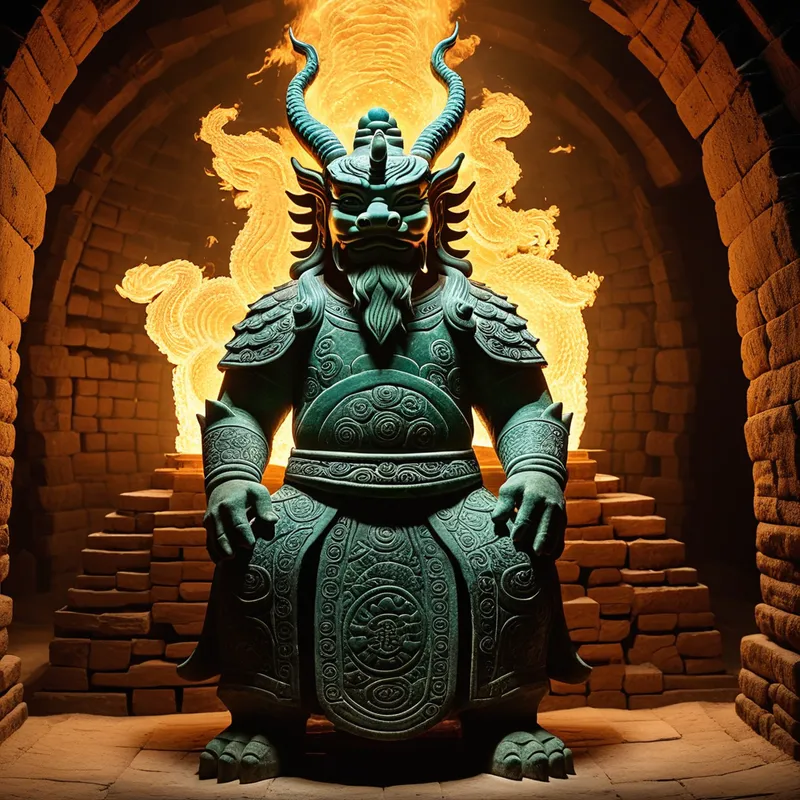
Moved by this human striving for perfection, the Tian Gong sent a vision in a dream to a master potter, an old man whose hands were maps of his craft. He saw a great dragon kiln coiled along a mountainside, not as a mere oven, but as a living throat. He saw that the clay must not merely be baked, but transformed. It required a marriage of opposites so violent it could only be a kind of death: the soft, yielding earth must willingly meet a fire so fierce it was born of stars.
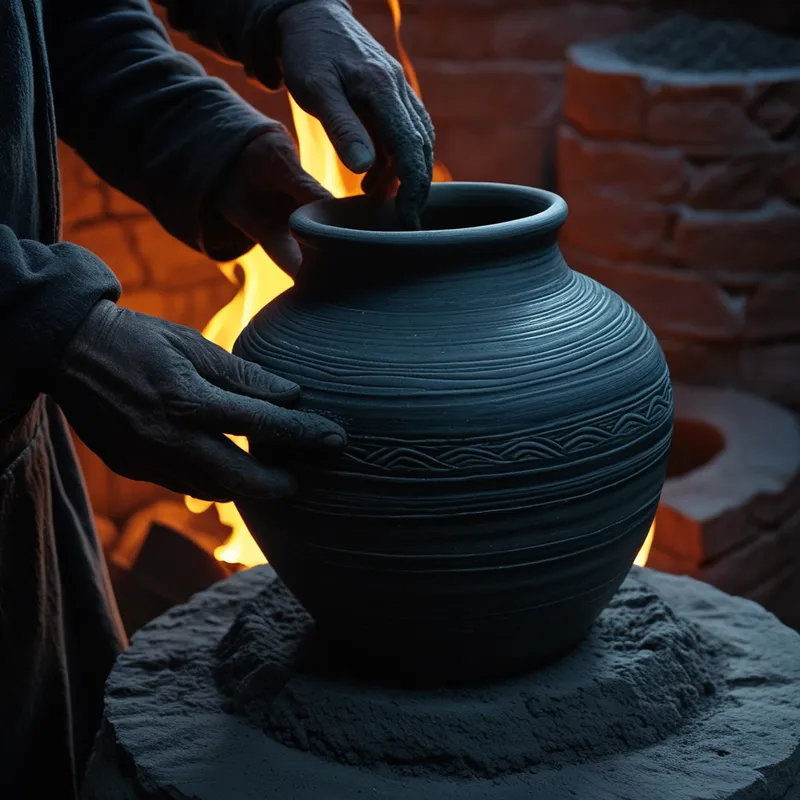
The potter awoke, his spirit alight. He gathered his disciples. “We must give it everything,” he said, his voice trembling. “Not just skill, but soul.” Together, they prepared the purest gaoling, kneading it with water so clear it held the sky. They formed a vase, its walls thin as a cicada’s wing, a vessel of impossible fragility. As they worked, they did not just shape clay; they poured their hope, their patience, their very breath into the form.
Then came the trial by fire. For days, the dragon kiln was fed until its belly glowed with a white-hot fury that melted stone. The air shimmered with heat. The potter, standing before the roaring maw, held the pale, dry vase. It was the color of bone, of surrender. With a final prayer—a sacrifice of his masterpiece to the unknown—he placed it deep into the heart of the inferno.
For three days and nights, the kiln raged. The village watched, holding its breath. They heard the groan of the earth and the shriek of the fire in their union. On the fourth dawn, as the last embers died to ash, the potter reached into the darkness. His hands, scarred by a lifetime of flame, pulled forth not the crumbled ruin they feared, but a miracle.
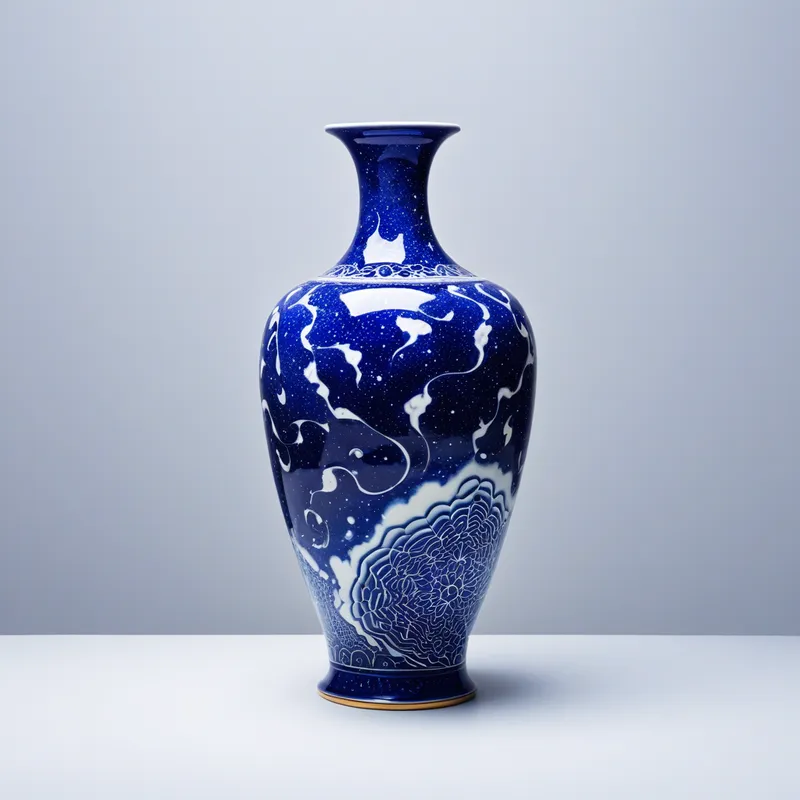
The vase had died, and been reborn. It was no longer clay. It was luminous, singing with a cool, inner light. It had become translucent, holding the dawn within its very body. It rang with a clear, pure note when struck—the sound of spirit solidified. They called it ci, porcelain: the child of earth’s sacrifice and heaven’s unforgiving grace.
Cultural Origins & Context
This is not a myth housed in a single ancient text with named gods, but a living, breathing narrative woven into the very practice and philosophy of Chinese ceramics. It emerged from the Tang and perfected in the Song dynasties, as artisans in kiln-centers like Jingdezhen achieved the technological and artistic marvel of true porcelain.
The “myth” was passed down not by bards, but by masters to apprentices at the wheel and the kiln mouth. It was told in the language of technique: the quest for the right clay (petuntse), the secret of the glaze, the precise temperature of the “dragon’s breath.” Its societal function was profound. Porcelain became more than pottery; it was a testament to human civilization’s ability to collaborate with nature’s raw forces and achieve a state of refined beauty (ya) that resonated with Daoist and Confucian ideals. It symbolized the empire itself: resilient, refined, and radiating cultural authority to the world.
Symbolic Architecture
At its core, the myth of porcelain is an alchemical drama of the psyche. The raw, formless clay represents the unrefined self—the ego with its potentials, flaws, and heaviness. The water is the fluid realm of emotion, intuition, and the unconscious, necessary to make the self pliable.
The kiln is the transformative crucible, the archetypal vessel of ordeal. It is the intense pressure of life’s crises, the heat of passion, suffering, or profound introspection.
The most beautiful song is born from the tension between the string and the void; the most enduring spirit is forged between the will to form and the fire that seeks to annihilate it.
The celestial fire is not merely heat, but the purifying, often ruthless, influence of spirit or destiny—the Tianming acting upon the individual. The transformation—from porous, fragile clay to vitrified, resonant, translucent porcelain—maps the journey from a fragile, identity-bound ego to a more integrated, resilient psychological structure. The translucence is key: it represents a state where the personal self becomes a vessel through which something transpersonal (light, spirit, meaning) can shine.
The Dreamer’s Resonance
When this myth stirs in the modern unconscious, it often manifests in dreams of intense transformation centered on fragility and heat. One might dream of holding a precious, raw clay object that must be placed into a frightening furnace. The dreamer may feel profound anxiety—the fear of annihilation, of being “fired” by a job, a relationship, or an internal truth.
Somatically, this can correlate to feelings of being “under fire,” of pressure building, or of a “purging” illness. Psychologically, the dreamer is at the threshold of an individuation step. The kiln in the dream is the psyche’s own container for a necessary death-and-rebirth process. The dream asks: What fragile, nascent part of you must be subjected to an ordeal to become strong and luminous? What raw potential are you afraid to commit to the transformative fire of lived experience?

Alchemical Translation
For the modern individual, the porcelain myth models the process of psychic transmutation with stark clarity. We all begin as “clay”—shaped by family, culture, and trauma. The first step is willingness: the conscious decision to submit this formed-but-imperfect self to a process beyond one’s control.
The alchemical stage of nigredo occurs within the kiln: the old identity cracks, illusions burn away, and one confronts the shadow in the heat of despair or conflict. This is the sacrifice.
Individuation is not about becoming hard, but about becoming resonant. The goal is not invulnerability, but the translucence that comes when the boundary between the inner self and the outer world becomes a membrane for meaning, not a wall of defense.
Then, if the “clay” is pure and the “fire” true, albedo emerges. The psyche re-forms at a higher order. What was brittle becomes strong with a new integrity. What was opaque becomes a vessel for insight. The “cracks” of our experiences, rather than being flaws, can become the unique patterns of our character, akin to the philosophy of kintsugi. We become, like porcelain, a synthesis of earth and sky, human effort and transcendent grace—a created thing that finally rings true.
Associated Symbols
Explore related symbols from the CaleaDream lexicon: