Pooka Myth Meaning & Symbolism
A shapeshifting spirit of the wild, the Pooka embodies the untamed psyche, offering chaotic gifts and demanding a reckoning with our own raw, transformative nature.
The Tale of Pooka
Listen, and let the peat-smoke carry you back. It is the hinge of the year, the night when the veil is thinnest—Samhain. The wind does not blow; it listens. In the high, lonely places where the hawthorn grows twisted, the world holds its breath.
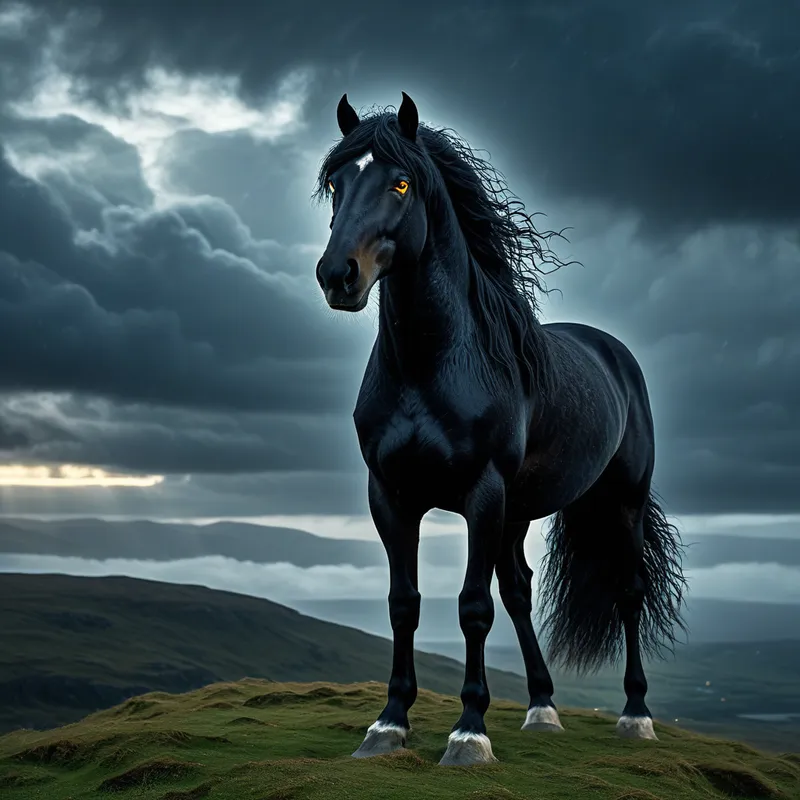
From the mist that clings to the raths and the bogs that remember everything, it comes. It is a sound first—the drum of hooves on turf, a rhythm that is not of this earth. Then, a shape coalesces from the gloom: a stallion, blacker than a starless midnight, its coat shimmering like wet slate. Its eyes are pits of molten gold, seeing through stone and soul. This is the Pooka. It is neither god nor demon, but a force as old as the land itself, a prince of chaos and prophecy.
On this night, it seeks a rider.
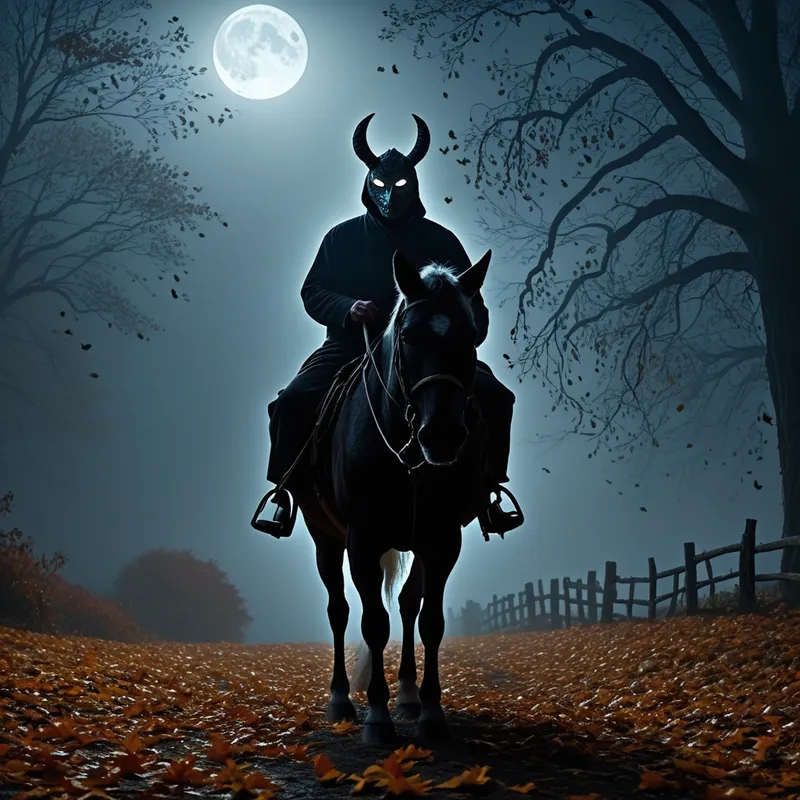
Perhaps it is a farmer, too brave or too foolish to be indoors, who feels the hot breath on his neck. Perhaps it is a young poet, wandering in search of a muse. The Pooka rears, a silhouette against the bruised sky, and its silence is an invitation more compelling than any shout. To mount is madness. To refuse is unthinkable.
The ride begins not as a gallop, but as a theft of time and sense. The world blurs into a streak of shadow and silver—standing stones whipping past like teeth, rivers crossed in a single, impossible bound. The rider is gripped by terror, yes, but also by a wild, soaring ecstasy. He is part of the storm. The Pooka speaks then, not in words, but in visions poured directly into the mind: the fate of the coming year, secrets of the neighbor’s heart, the exact spot where a lost ring lies buried in the mud. It is a torrent of truth, beautiful and brutal.
But the Pooka is a trickster. The gift is never free. The ride turns toward the cliffs, the raging sea, the treacherous bog. The ecstasy curdles into pure dread. The creature revels in the panic, in the raw, animal scream of the human clinging to its back. It is testing the very fabric of the spirit. Will it break? Will it fly?
And then, as dawn threatens the eastern edge of the world, the frenzy ceases. The Pooka deposits its shaken passenger—sometimes by a familiar gate, sometimes miles from home, often soaked and splattered with mud, always irrevocably changed. With a final, echoing whinny that sounds like laughter and lament, it vanishes into the dissolving mist. The rider is left with cold bones, a heart hammering against his ribs, and a head full of whispers that are both curse and blessing. The tale is told. The year turns.
Cultural Origins & Context
The Pooka (or Púca) is a creature of the Celtic fringe, its roots deep in the pre-Christian soil of Ireland, Wales, and the Scottish Highlands. It belongs not to the grand mythic cycles of gods and heroes, but to the folk tradition, whispered by the hearth and carried by seasonal laborers. This is significant. The Pooka was not worshipped; it was encountered. It was a narrative tool for explaining the capriciousness of nature, the sudden storms that could ruin a harvest, the inexplicable luck or madness that could befall a person.
Its primary tellers were the community itself, with seanchaí weaving its exploits into longer tales. The Pooka’s most sacred night was Samhain, the Celtic New Year, a time outside of time when order dissolved and the wild, chaotic forces of the otherworld walked freely. The myth served a societal function of enforcing cultural boundaries—stay indoors on Samhain, respect the wild places—while also providing a psychological container for the experience of the uncanny and the uncontrollable. It was a reminder that humanity was not the master of the landscape, but a participant in a living, often mischievous, and always powerful cosmos.
Symbolic Architecture
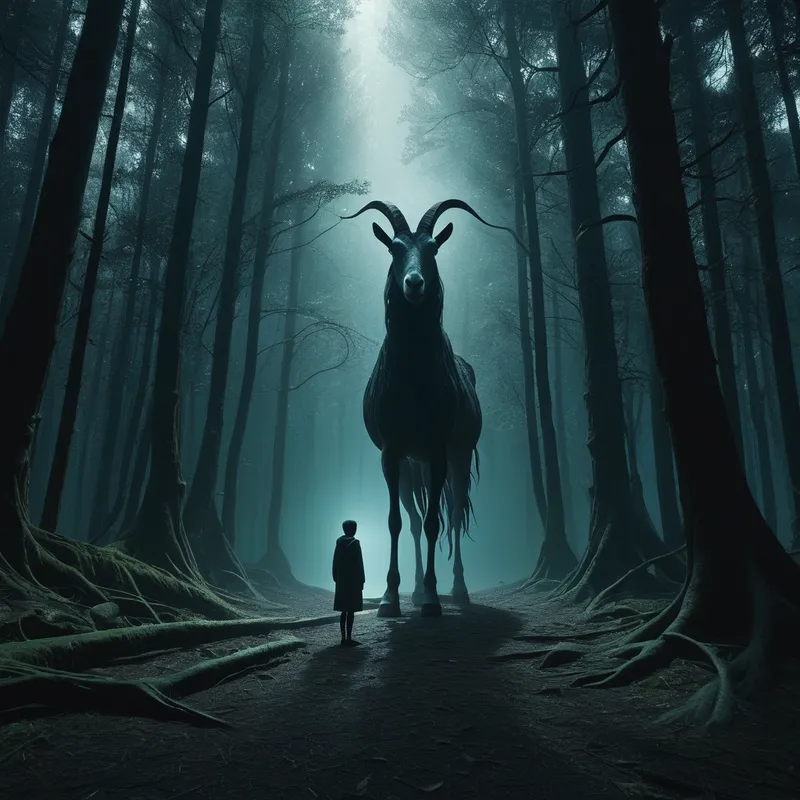
The Pooka is the ultimate symbol of the untamed, amoral aspect of nature and, by extension, the human psyche. It is not evil, but it is profoundly dangerous. Its shapeshifting—most commonly into a horse, but also a goat, dog, or even a humanoid figure—represents the fluid, unpredictable nature of primal energy. It refuses to be pinned down or categorized.
The Pooka is the psyche’s wild hinterland, the part that cannot be domesticated by reason or morality. It is the storm of inspiration that borders on madness, the prophetic intuition that feels like possession, the raw life-force that disrupts all comfortable plans.
The terrifying ride is a classic initiatory ordeal. The Pooka forcibly removes the individual from the familiar, conscious world (the farm, the village) and subjects them to the raw data of the unconscious—the prophecies, the secrets, the hidden truths. This is the gift. The subsequent peril represents the ego’s confrontation with the sheer, overwhelming power of that unconscious content. Can the conscious self integrate this chaotic wisdom without being shattered by it? The myth suggests that survival, and transformation, are possible, but never comfortable or clean.
The Dreamer’s Resonance
When the Pooka gallops into modern dreams, it heralds a forceful encounter with the Shadow. Dreaming of a wild, unrideable horse, a chaotic chase by an ambiguous animal, or finding oneself in a terrifying yet exhilarating nocturnal journey often signals that unconscious material is demanding attention. The somatic experience in the dream—the gut-clenching fear mixed with wild freedom—mirrors a psychological process where a long-repressed aspect of the self is breaking through containment.
This is not a gentle nudge from the subconscious; it is a hijacking. The dreamer is being taken for a ride by a part of their own nature they have refused to acknowledge: perhaps a fierce independence, a buried creative fury, or a raw sensuality. The Pooka-dream indicates that this energy can no longer be ignored. It will have its way, and the dreamer’s task upon waking is not to banish it, but to learn, however shakily, to hold on and listen to the chaotic truths it reveals.
Alchemical Translation
In the alchemical vessel of individuation, the Pooka represents the prima materia—the chaotic, base matter of the psyche that must be engaged for transformation to begin. The modern individual, often over-identified with order, persona, and control, must allow themselves to be “taken for a ride.” This means voluntarily engaging with the irrational: through active imagination, creative work that feels risky, or confronting a life pattern that feels out of control.
The alchemical goal is not to tame the Pooka, but to transmute the relationship with it. The rider who survives the night learns that the chaos is also a source of prophecy; the terror is intertwined with ecstasy.
The process models psychic transmutation thus: First, Submission (being taken by the force). Second, Ordeal (the chaotic confrontation with shadow content). Third, Revelation (receiving the unwanted gift of truth). Finally, Return (integrating that truth, mud-splattered and shaken, back into conscious life). The individual who undergoes this is no longer simply a farmer or a poet; they are someone who has met the wild sovereign of their own inner landscape and returned with a fragment of its dark wisdom. They have learned that the deepest growth happens not in the cultivated field, but in the haunted, hawthorn-guarded bog at the edge of everything.
Associated Symbols
Explore related symbols from the CaleaDream lexicon: