Pompeii Frescoes Myth Meaning & Symbolism
A tale of a city's hubristic artistry, a divine punishment that petrifies its beauty, and the eternal echo of life captured in a moment of ash.
The Tale of Pompeii Frescoes
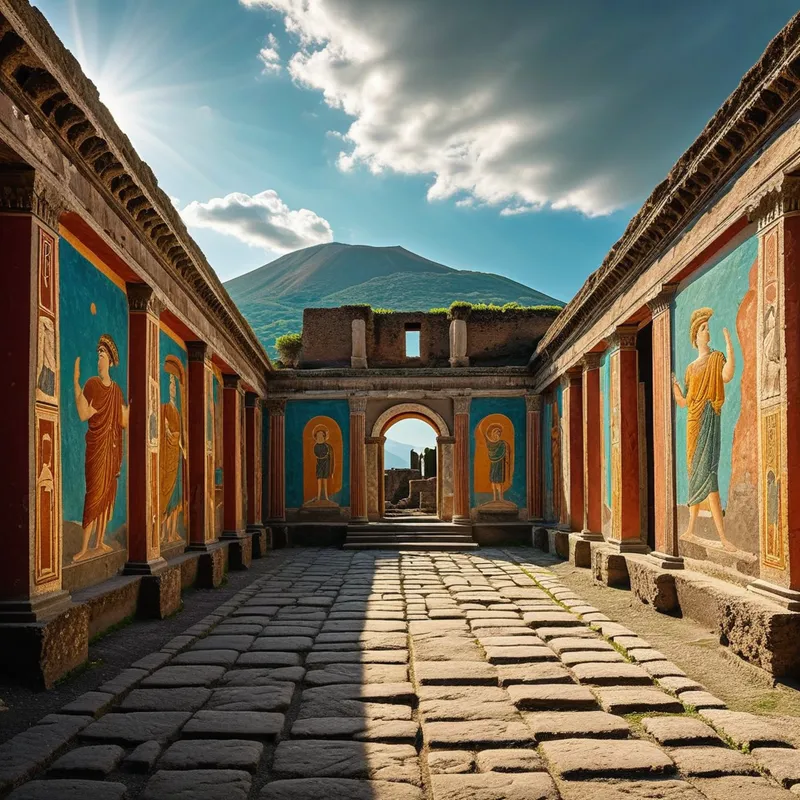
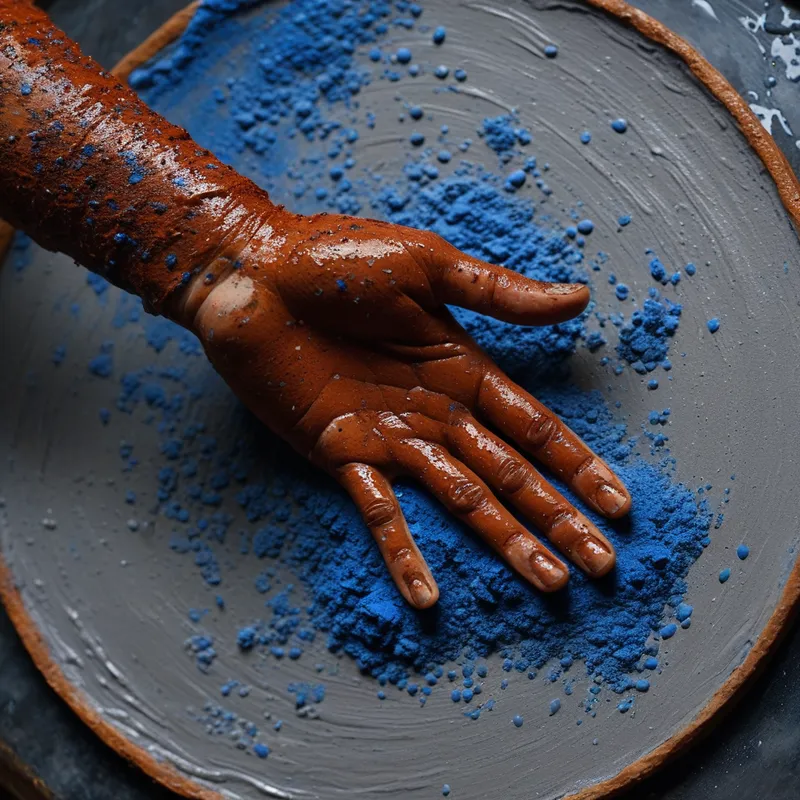
Hear now a story not of one hero, but of an entire city, a tale painted in the vibrant hues of life and sealed in the monochrome of death. It begins in the golden light of a Campanian afternoon, in Pompeii. The air is thick with the scent of baking bread, salt from the bay, and the tang of wet plaster. On the walls of villas, in the shadows of colonnades, and within the inner sanctums of homes, artists are at work. They are the silent priests of Venus and Bacchus, mixing earth and mineral into divine colors: the deep red of cinnabar, the brilliant yellow of orpiment, the celestial Egyptian blue.
They paint a world into being. Here, Theseus stands victorious over the beast in the labyrinth. There, a merchant weighs his goods with meticulous care. In another room, a couple gazes tenderly from the wall, their love made eternal in pigment. The city itself becomes a living gallery, a testament to human artistry, prosperity, and the desire to capture the fleeting moment. They paint their myths, their commerce, their lusts, and their feasts upon the very skin of their homes, believing the spectacle of their creation to be a mirror to the gods' own grandeur.
But the mountain, Vesuvius, which had been a gentle, vine-covered giant in their frescoed landscapes, held a different truth. The gods, some whispered—particularly Jupiter and the chthonic Pluto—looked upon this city of painted illusions. They saw not piety, but hubris. Not celebration, but a challenge. A city so enamored with its own reflection, it had forgotten the capricious power that slumbered beneath its feet.
The conflict was not of swords, but of elements. The rising action was a tremor, a strange drying of wells, the nervous laughter that dies in the throat. Then came the resolution, swift and absolute. The sky turned to stone. A hot, grey breath from the earth itself descended—not fire to burn, but ash to bury. It filled the streets, the gardens, the very bowls left on the table. It flowed into the open mouths of the doomed and, with a terrible, gentle finality, it flowed over the wet paint on the walls.
The artist’s brushstroke was captured mid-arc. The gaze of the painted lover was sealed under a granular shroud. The mythic hero was entombed alongside the mortal baker. The city did not die screaming; it was hushed, preserved in a single, catastrophic sigh. For centuries, it slept, a perfect memory in a stone womb, until the world turned again and a shovel struck not dirt, but a wall, and a face stared back, untouched by time, from a prison of ash.
Cultural Origins & Context
This is not a myth from a single scroll or poet, but an emergent narrative born from archaeological revelation and historical trauma. The "myth" of Pompeii’s frescoes is a modern reconstruction, a story we tell about the Romans through their final, preserved moments. In the 1st century AD, these paintings were not sacred texts but domestic and commercial art—decor. They served societal functions: demonstrating wealth and taste (public rooms had the most elaborate scenes), providing moral or heroic exemplars (mythological scenes), offering spiritual protection (household gods, or Lares), and creating illusions of expansive gardens or vistas in confined urban spaces.
The stories on the walls were the shared cultural vocabulary of the Roman world, drawn from Greek mythology, Egyptian cults, and local Italian lore. They were passed down not by bards, but by artisan workshops using pattern books. Their societal function was to reinforce identity—as Romans, as prosperous citizens, as cultured people. The cataclysm of 79 AD transformed this decor into something else entirely: a universal memento mori and a paradoxical monument to life’s vibrancy. The "myth" we perceive is our own dialogue with that transformation, a story where the Romans themselves become the tragic figures, and their art becomes the oracle speaking from the tomb.
Symbolic Architecture
The core symbol is the fresco itself: an image made of water and pigment fused into fresh plaster. It is an act of creation that must be completed before the plaster dries; it is irrevocable and immediate. Psychologically, it represents the human impulse to fix the ephemeral—a feeling, a belief, a moment of beauty—into a permanent form. It is consciousness attempting to make a lasting record of itself.
The fresco is the ego’s masterpiece, painted on the wet plaster of the present moment, forever vulnerable to the drying wind of time or the ash-fall of the unconscious.
The volcanic ash is the counterpart symbol. It is not merely destruction, but a perfect, suffocating preservation. It represents the overwhelming force of the unconscious or of fate—that which cannot be painted over, reasoned with, or escaped. It is the ultimate limit that confronts the ego’s project of self-creation. The conflict between the vibrant fresco and the engulfing ash embodies the tension between our desire for eternal significance and our mortal, fragile reality. The buried city becomes a symbol of the shadow—not as evil, but as a vast, forgotten totality of a life, perfectly preserved but unconscious.
The Dreamer's Resonance
To dream of Pompeii’s frescoes is to dream of a part of the psyche that has been suddenly—perhaps traumatically—preserved. It may manifest as discovering beautifully painted rooms in a forgotten basement of one’s dream-house, only to find the windows sealed with grey dust. Somaticly, one might feel a pressure on the chest, a literal weight of ash, or a paradoxical sense of awe amidst suffocation.
Psychologically, this dream pattern suggests a process of confronting a "frozen" complex. A vibrant period of life, a passionate identity, or a creative endeavor may have been abruptly "buried" by a crisis—a loss, a betrayal, a failure. The dream indicates this complex is not lost, but intact and waiting to be rediscovered. The dreamer is going through the initial stages of excavation: the unsettling, careful brushing away of the defensive layers (ash) that have protected—and imprisoned—a vital but painful part of the self. The emotion is often a mixture of grief for the catastrophe and wonder at the preservation.
Alchemical Translation
The myth models the alchemical process of nigredo, the blackening, which is necessary for individuation. The vibrant, conscious life of Pompeii (the ego’s identified state) is subjected to the overwhelming, darkening force of the volcano (the erupting unconscious). This is not the end, but the crucial first step.
The ash-fall is the necessary humiliation of the ego, the burial of its proud frescoes, so that the soul may be reduced to its essential, hidden forms.
The centuries of burial represent a necessary period of incubation. The old identity must be completely stilled. The modern excavation is the albedo, the whitening. As the ash is cleared, what is revealed is not the living city, but its essence—its art, its layouts, its intimate moments. This is the psychic transmutation: the conscious personality (the bustling city) dies, but the essential patterns and values (the frescoes) are salvaged, purified by the ordeal, and integrated into a new, more conscious understanding of the self.
For the modern individual, the struggle is to endure the "burial"—the depression, the crisis, the failure that seems to end a chapter of life. The triumph is the later, patient "excavation," where one discovers that what was most true and beautiful in that chapter was not destroyed, but sealed away for safekeeping, waiting to be recovered not as a living reality, but as a foundational truth to be built upon. One does not resurrect old Pompeii. One learns from its frescoes and builds a new city, conscious now of the mountain.
Associated Symbols
Explore related symbols from the CaleaDream lexicon: