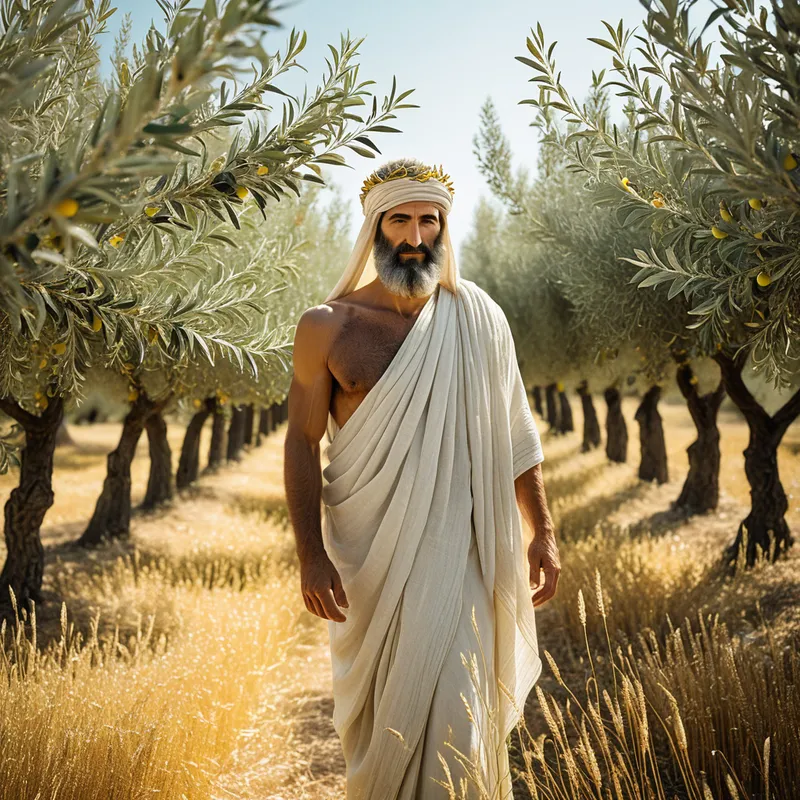
Plutus Myth Meaning & Symbolism
The myth of Plutus, the blind god of wealth, reveals that true abundance is not a random gift but a sacred trust earned through character and right relationship.
The Tale of Plutus
Listen. The story begins not in the gleaming halls of Zeus, but in the dust. In the aching back of a farmer named Chremylus, who has worked the unforgiving Attic soil until his hands are stone, yet whose granary remains as empty as his hopes. He is a good man, pious, but poor. The injustice of it gnaws at him like a winter hunger. Why do the wicked flourish, their coffers fat with ill-gotten gain, while the just shiver in want?
Driven by a despair that has curdled into resolve, Chremylus journeys to the oracle of Apollo at Delphi. He does not ask for gold. He asks for a principle. “Whom shall I raise up,” he implores the smoky dark, “to restore balance to this tilted world?” The god’s voice, thin and ancient as parchment, whispers back: “The first man you meet upon leaving this sacred place. Follow him. Make him your guest. He will lead you to your fortune.”
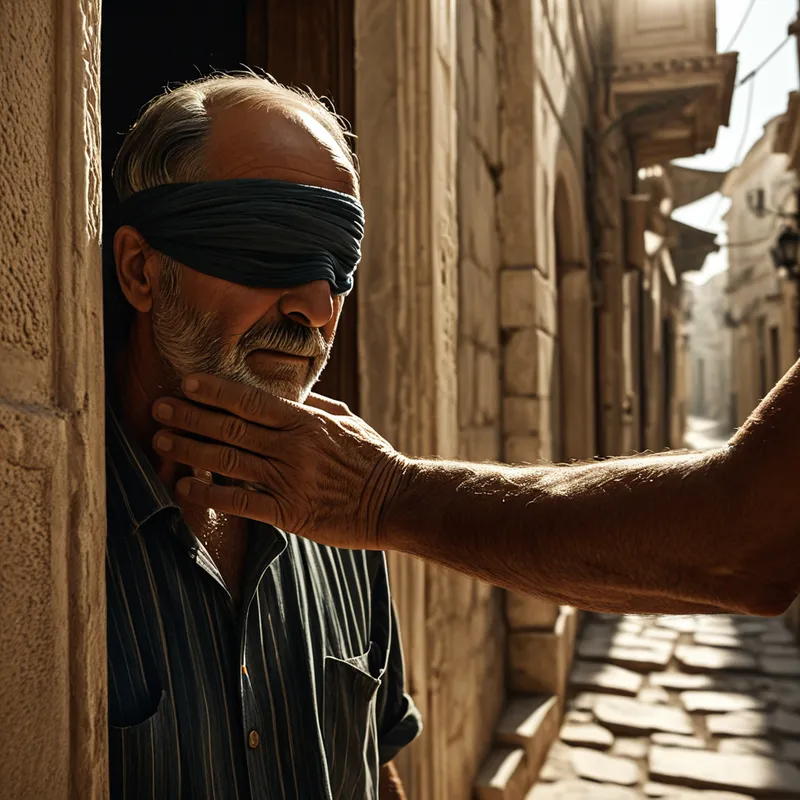
And so, exiting the temple’s shadow, Chremylus meets him. A wretched figure, clothed in rags, stumbling blindly, his eyes milky and unseeing. This is the first man. This is the one Apollo has ordained. Despair threatens to swallow Chremylus whole, but a flicker of faith remains. He takes the blind beggar’s arm. “Come,” he says, his voice softer than he expected. “You will dine with me tonight.”
At the meager hearth of Chremylus, the truth is drawn forth, not by force, but by patient hospitality. The blind man sighs, a sound like wind through a ruin. “I am Plutus,” he confesses. “God of the fertile earth, the heavy coin, the full barn. I am Wealth itself.” Chremylus reels. “But… why are you blind? Why do you wander, lost and poor?”
The god’s voice trembles with an old, divine bitterness. “Zeus did this to me. In his jealousy, he stole my sight, so that I might fall upon the wicked and the virtuous alike, without discrimination. He feared what would happen if I could see, if I could choose only the just and the wise.”
Here, in the humble home of a poor farmer, a revolution is kindled. Chremylus sees not a beggar, but a principle imprisoned. With the help of his slave Cario and the weary god Asclepius, they hatch a plan. They guide the stumbling Plutus to Asclepius’s sanctuary. In the holy silence of the temple, under the watchful serpent, a miracle of a different order occurs. The healing god touches Plutus’s eyes. The scales fall away.
Plutus opens his eyes. For the first time, he sees. He sees the honest weariness in Chremylus’s face, the simple integrity of his home. And he begins to walk. No longer stumbling, but with a god’s purposeful stride, he moves through the world. He enters the houses of the virtuous, filling their stores. He passes by the doors of the corrupt, leaving them in sudden, bewildering lack. The world, for a fleeting moment, is set right. The good are rewarded, the wicked chastised. And Chremylus, the farmer who dared to guide a blind god, finds his granary overflowing, not by chance, but by sight.
Cultural Origins & Context
This particular narrative of Plutus comes to us not from the epic cycles of Homer or the theogonies of Hesiod, but from the raucous, democratic arena of Athenian comedy. It is the central plot of Aristophanes’ play Plutus, staged in 388 BCE. In the fading light of Athens’ golden age, this myth was not a sacred hymn but a social satire, a comic thought experiment performed for the citizen body.
The function was profound. In a society grappling with inequality, the corruption of new money, and the perceived randomness of fortune, the play asked a radical question: What if wealth had a moral compass? It gave voice to the universal grievance of the hardworking poor and served as a psychic pressure valve, allowing the audience to laugh at the absurdity of a world where scoundrels prospered. By staging the “healing” of Plutus, Aristophanes was not predicting reform but exploring a deep, collective yearning for cosmic justice—for a universe where external fortune mirrored inner worth. The myth, in this form, was a civic ritual, a shared dreaming of a more equitable order.
Symbolic Architecture
Plutus is not merely a god of money. He is the ancient, chthonic spirit of abundance—of the earth’s generative power, of the harvest, of all that sustains and enriches life. His blindness, therefore, is the central, devastating symbol.
True abundance is not neutral. It is a force of nature that, when sightless, becomes chaotic and destructive, blessing and cursing at random.
His blindness represents the amoral, arbitrary distribution of wealth in the human world. It symbolizes our experience of fortune as a capricious, external event—the lottery win, the inherited windfall, the sudden ruin—devoid of connection to our character or actions. Plutus stumbling in rags is the image of wealth divorced from wisdom, of resource cut off from right use.
His healing is the restoration of relationship. To give Plutus his sight is to re-marry wealth to consciousness, to ethics, to discernment. It represents the transformation of “fortune” into “blessing.” The just person Chremylus does not find wealth; he guides it, he hosts it, he participates in its awakening. The myth insists that authentic abundance must be met with a corresponding quality of soul—a hospitality of the spirit that can receive and steward it without corruption.

The Dreamer’s Resonance
When this myth stirs in the modern unconscious, it rarely appears as a classical god. Instead, one might dream of finding a vast, neglected treasure in a basement—only to have it crumble to dust when touched. Or of being given a powerful, coveted object—a key, a gem, a document—that is somehow inert, useless, or blindingly bright, impossible to look upon directly.
These are dreams of the Blind Plutus. They signal a confrontation with one’s own relationship to “wealth” in its broadest sense: not just money, but time, energy, talent, love, creative potential. The dreamer is encountering their own belief that their desired abundance is external, random, or inherently corrupting. The somatic feeling is often one of frustration, helplessness, or tantalizing proximity without fulfillment. The psyche is wrestling with the orphan archetype—the feeling that one’s true inheritance is withheld by a cruel or indifferent world (Zeus). The dream invites the dreamer to move from passive longing to active guidance—to become a Chremylus to their own blind potential.

Alchemical Translation
The alchemical journey modeled here is the transmutation of fortuna into sapientia—blind luck into wise prosperity. The prima materia, the leaden starting state, is the experience of life as a series of random happenings, where our gifts feel blocked, our efforts unrewarded, and our worth unrecognized by the universe. This is the blind, ragged god wandering our inner landscape.
The nigredo, the blackening, is the honest confrontation with this bitterness and despair, as Chremylus experiences at the play’s start. The albedo, the whitening, is the act of faith: taking in this wretched, blind aspect of ourselves (our relationship with abundance) with hospitality, rather than contempt or desperation. We must invite it home, as Chremylus does.
The philosopher’s stone is not a secret for making gold, but the awakened faculty of discernment—the healed sight that can distinguish the fertile from the barren within and without.
The crucial rubedo, the reddening or final transformation, is the pilgrimage to the temple of Asclepius—the place of inner healing and integration. It is the conscious work of healing our sight. This means developing the discernment to see where our energy truly flows, what we truly value, and aligning our outer pursuits with that inner vision. The healed Plutus is the integrated self whose external circumstances begin to reflect inner integrity. The wealth that flows then is not a random bounty but the natural yield of a soul in right relationship with its own depths and with the world. The myth concludes not with a hoard of gold, but with a restored order—the individuated self, capable of both receiving and wisely directing the abundance that is its birthright.
Associated Symbols
Explore related symbols from the CaleaDream lexicon: