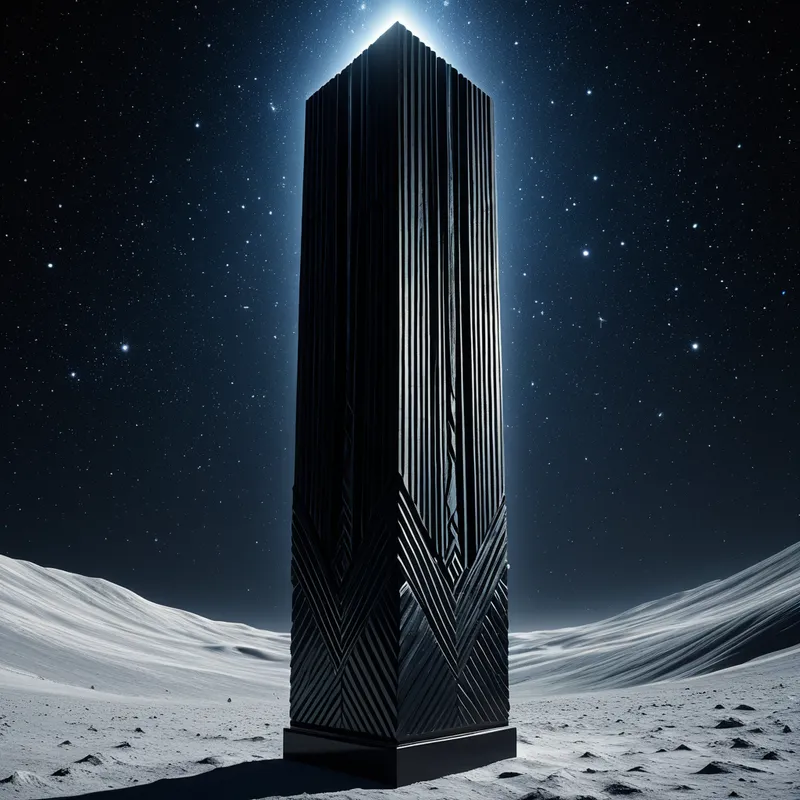
Pillar of Severity Myth Meaning & Symbolism
A myth of the left-hand pillar on the Tree of Life, representing divine judgment, necessary limitation, and the forging of consciousness through form.
The Tale of the Pillar of Severity
Before the worlds were worlds, there was the Ein Sof. From its boundless light, a vessel was formed to receive the emanation—a vessel of perfect receptivity. But the light was too pure, too fierce. The vessel, unable to contain the force of endless giving, shattered. A cosmos of fragments was born, and holy sparks fell into the depths, cloaked in shells of darkness.
From this cataclysm of light, a structure emerged. Not as a punishment, but as an act of profound compassion. Three pillars rose from the chaos. To the right, a pillar of pure, flowing mercy—white fire that sought only to give. To the left, a pillar of unyielding judgment—black fire that sought only to define. Between them, the pillar of harmony, woven from their tension.
This is the tale of the left-hand pillar, the Pillar of Severity.
Its foundation is Gevurah. Imagine not an angry god, but a divine smith in a celestial forge. His hammer is not a weapon, but a sculptor’s tool. Each strike is precise, measured, and cold. He does not create from nothing; he takes the unformed radiance from the pillar of mercy and, with blows of absolute necessity, gives it an edge. He forges the sword that cuts truth from falsehood, the boundary that separates ocean from shore, the law that gives form to love. His light is not warm, but illuminating—a searing white that reveals all flaws, all deviations, all that is not in alignment.
Above him stands Pachad, a realm of trembling. Here, the form becomes conscious of its limits. It is the chilling wind that sweeps across the soul when it stands before a vast canyon, the awe that stills the tongue before a terrible and beautiful truth. This is the fear that is the beginning of wisdom, the contraction that makes space for reverence.
And at its crown rests Binah. If Gevurah is the hammer, Binah is the mold. She is the great dark womb, the supreme mother who receives the fierce, defined light from above and comprehends it. In her profound darkness, she holds the blueprints of all that could be. She is severe not in anger, but in her infinite capacity to contain, to differentiate, to give birth to form from the formless. Her judgment is the act of profound understanding that separates potential into distinct possibility.
Together, they stand. Not as tyrants, but as the divine left hand that holds the cosmos firm. Without them, the light of mercy would be a blinding, formless flood, washing all creation back into the unity from which it came. The Pillar of Severity whispers the first and most holy word: No. It is the No that allows a Thou to exist.
Cultural Origins & Context
This “myth” is not a narrative with characters in the classical sense, but the foundational metaphysical architecture of Kabbalah, primarily crystallized in the medieval text the Zohar. It was passed down not by bards, but by initiates in tight-knit circles, often through oral teaching alongside textual study. Its societal function was dual: it was a map of the divine psyche and a mirror for the human soul.
The Tree of Life, with its three pillars, served as a contemplative technology. To study the Pillar of Severity was to engage in the most demanding spiritual work—confronting the necessity of divine judgment (Din), the role of limitation in creation, and one’s own capacity for restraint and discipline. It provided a sacred context for human experiences of law, boundary, loss, and contraction, framing them not as evils but as essential, holy forces in the structure of reality itself.
Symbolic Architecture
Psychologically, the Pillar of Severity represents the principle of differentiation. It is the psychic function that analyzes, critiques, sets boundaries, and says “this, not that.”
The ego is born from the first severance, the first act of judgment that says “I am here, and that is there.”
Gevurah symbolizes the necessary aggression of consciousness. It is the force that cuts through psychic fog, that makes decisions, that destroys outdated patterns to make way for new growth. It is “the sword of discrimination.” Pachad represents the healthy fear that guards the sanctity of the individual—the awe of the unconscious that prevents psychic inflation. Binah is the archetypal Great Mother in her transformative aspect: the container that holds suffering and experience until it can be understood and given meaningful form. She is the womb of deep insight, where raw experience is digested into wisdom.
Together, they model the psyche’s structuring principle. Without this pillar, the personality is formless, without will or definition, flooded by undifferentiated feeling and impulse. It is the internal judge, lawgiver, and strategist.
The Dreamer’s Resonance
When this mythic pattern stirs in the modern dreamer, it often manifests as encounters with severe, authoritative figures (judges, stern teachers, armored guards), immovable obstacles (walls, locked doors, chasms), or landscapes of stark geometry and chilling order (empty courthouses, stark minimalist rooms, frozen tundras).
Somatically, this may accompany dreams where one feels “frozen,” constrained, or under exacting scrutiny. This is not merely anxiety; it is the psyche initiating a process of psychic crystallization. The dream ego is being confronted with where its own boundaries are too weak or where its impulses need the discipline of form. The chilling awe of Pachad may appear as a dream of standing before something vast and incomprehensible—a towering wave, a cosmic clockwork—eliciting a visceral tremor that is both fear and reverence. This is the somatic signature of the soul encountering a limit that will ultimately define it.
Alchemical Translation
The individuation process requires not only expansion (the right pillar of Mercy) but also contraction and definition (the left pillar of Severity). The alchemical solve et coagula—dissolve and coagulate—is mirrored here. One must dissolve into the boundless waters of the unconscious, but then one must coagulate: form a distinct, resilient consciousness.
The work of the Pillar of Severity is the forging of the Philosopher’s Stone from the prima materia of the soul. Pressure, heat, and precise fracture are not cruelty, but the method of creation.
This translates to the modern journey as the courageous embrace of necessary Nos. Saying no to distractions that scatter the soul. Imposing the discipline of form on creative chaos. Accepting the painful but clarifying judgments of life—failures, endings, critiques—as the hammer-blows of Gevurah, shaping us. It is facing the awe-inspiring shadow in the mirror of Pachad and the deep, often painful, introspection in the womb of Binah where life’s experiences are slowly, severely, transformed into understanding.
To integrate the Pillar of Severity is to achieve sovereignty. It is to move from being subject to external laws and judgments to becoming the conscious author of one’s own form—to wield the sword of discrimination with wisdom and to understand that every limit is, paradoxically, the shape of one’s freedom.
Associated Symbols
Explore related symbols from the CaleaDream lexicon: