Pilate's Judgment Seat Myth Meaning & Symbolism
A Roman governor faces an impossible choice between political power and personal conscience, washing his hands of a fate he cannot control.
The Tale of Pilate’s Judgment Seat
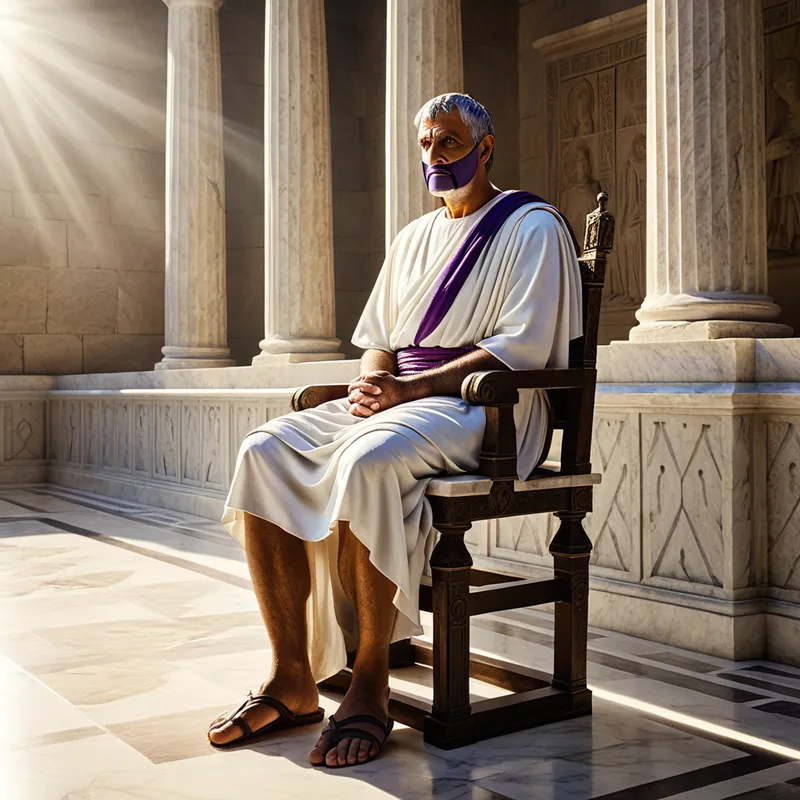
The dawn in [Jerusalem](/myths/jerusalem “Myth from Biblical culture.”/) was a blade of pale light, cutting through the dust of anticipation. In the Praetorium, the air was cool stone and cold purpose. Here sat [Pontius Pilate](/myths/pontius-pilate “Myth from Biblical culture.”/), a man carved from Roman order, upon the Bema—the judgment seat. It was not a throne, but a fulcrum upon which worlds would tilt.
Before him stood the accusation: a man from Nazareth, silent as deep [water](/myths/water “Myth from Chinese culture.”/) amidst a storm of shouted charges. “King of the Jews!” they cried, a title that was a spark in a tinderbox. Pilate’s own question hung in the space between them: “What is truth?” It was the sigh of a pragmatic soul adrift in a sea of absolutes.
He sought escape. Learning the man was a Galilean, he sent him to Herod, a puppet king in a gilded cage. But Herod, wanting only a spectacle, returned him, clad in mocking robes. The crowd swelled, a single organism of volatile will. Pilate offered a custom: the release of one prisoner at the feast. He presented the choice—Barabbas, a rebel and murderer, or the silent preacher. The roar that came back was not [justice](/myths/justice “Myth from Tarot culture.”/), but a release valve for a deeper, darker pressure. “Barabbas!”
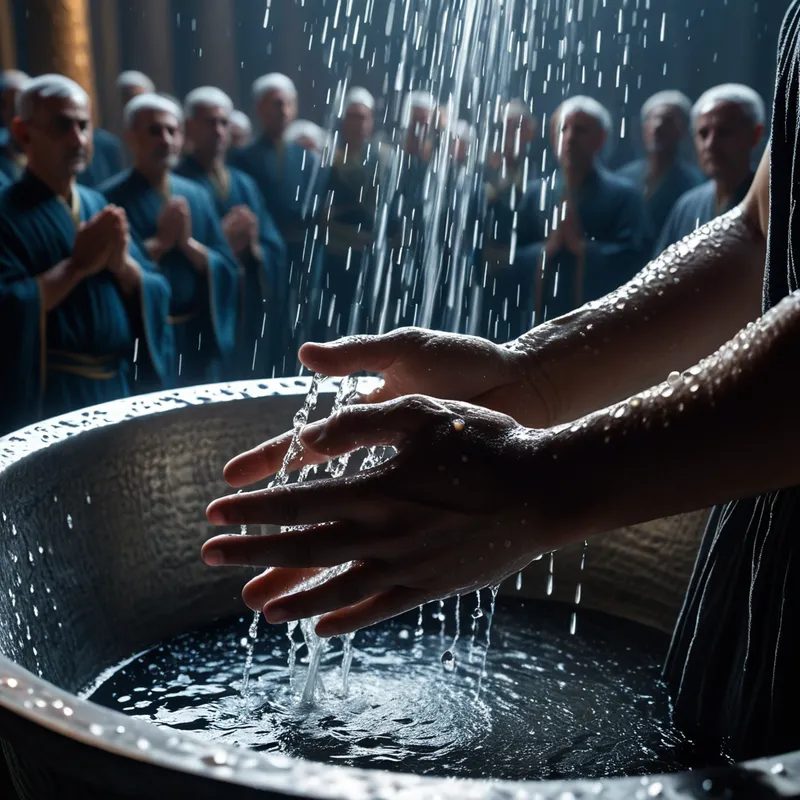
Pilate’s wife sent word, her sleep troubled by dreams of this righteous one. A shiver, not of fear but of fate, touched the governor’s spine. He took water, before them all, and washed his hands in a silver basin. “I am innocent of this man’s blood,” he declared, the water dripping like failed absolution. “See to it yourselves.” And with a gesture, he delivered the sentence, surrendering to the tide he could not stem. The judgment seat, in that moment, became not a place of verdict, but of vacancy.
Cultural Origins & Context
The story of Pilate’s judgment is embedded in the Gospel narratives, primarily those of Matthew, Luke, and John. It is not a standalone myth but a pivotal historical-mythological node within [the Passion](/myths/the-passion “Myth from Christian culture.”/) story. Its tellers were early Christian communities, for whom this moment crystallized a profound theological and political reality: the collision of the Pax Romana with the inbreaking of a kingdom “not of this world.”
Societally, it functioned on multiple levels. For Roman audiences, it portrayed a governor attempting a semblance of ius (law) amidst provincial chaos. For Jewish audiences, it highlighted the tragic complicity of their own leaders and the painful reality of colonial occupation. For the growing Christian community, it served to exonerate Roman authority to a degree (placing blame on the Jewish authorities) while simultaneously illustrating [the world](/myths/the-world “Myth from Tarot culture.”/)’s failure to recognize its own truth. The judgment seat became a symbol of worldly power’s ultimate impotence in the face of a spiritual revolution.
Symbolic Architecture
At its core, this is not a [story](/symbols/story “Symbol: The symbol of ‘Story’ represents the narrative woven through our lives, embodying experiences, lessons, and emotions that shape our identities.”/) about judging another, but about the judgment of [the self](/myths/the-self “Myth from Jungian culture.”/) that refuses to judge. Pilate represents the modern [psyche](/myths/psyche “Myth from Greek culture.”/) par excellence: the rational administrator of the [soul](/symbols/soul “Symbol: The soul represents the essence of a person, encompassing their spirit, identity, and connection to the universe.”/), tasked with managing conflicting internal and external demands.
The judgment seat is the ego’s perch, from which it surveys the chaos of the unconscious (the crowd) and the call of the Self (the silent prisoner).
Pilate’s famous hand-washing is the central, devastating [symbol](/symbols/symbol “Symbol: A symbol can represent an idea, concept, or belief, serving as a powerful tool for communication and understanding.”/). It is a [ritual](/symbols/ritual “Symbol: Rituals signify structured, meaningful actions carried out regularly, reflecting cultural beliefs and emotional needs.”/) of failed purification, an attempt at magical thinking where [action](/symbols/action “Symbol: Action in dreams represents the drive for agency, motivation, and the ability to take control of situations in waking life.”/) is replaced by [gesture](/symbols/gesture “Symbol: A non-verbal bodily movement conveying meaning, emotion, or intention, often symbolic in communication and artistic expression.”/). It symbolizes the desire to be clean of consequence, to declare neutrality in a [situation](/symbols/situation “Symbol: The ‘situation’ symbolizes the junction between the subconscious and conscious realms, often reflecting the current challenges or dynamics in the dreamer’s waking life.”/) that demands moral engagement. The [water](/symbols/water “Symbol: Water symbolizes the subconscious mind, emotions, and the flow of life, representing both cleansing and creation.”/), a universal [symbol](/symbols/symbol “Symbol: A symbol can represent an idea, concept, or belief, serving as a powerful tool for communication and understanding.”/) of the unconscious and [emotion](/symbols/emotion “Symbol: Emotion symbolizes our inner feelings and responses to experiences, often guiding our actions and choices.”/), is used not for cleansing but for distancing. The crowd, then, becomes the projected [shadow](/symbols/shadow “Symbol: The ‘shadow’ embodies the unconscious, repressed aspects of the self and often represents fears or hidden emotions.”/)—the volatile, unintegrated passions [the ego](/myths/the-ego “Myth from Jungian culture.”/) fears to own. Pilate’s tragedy is that he believes he can give the [shadow](/symbols/shadow “Symbol: The ‘shadow’ embodies the unconscious, repressed aspects of the self and often represents fears or hidden emotions.”/) what it wants (Barabbas, the untamed [impulse](/symbols/impulse “Symbol: A sudden, powerful urge or drive that arises without conscious deliberation, often linked to primal instincts or emotional surges.”/)) and remain separate. He discovers that to appease the [shadow](/symbols/shadow “Symbol: The ‘shadow’ embodies the unconscious, repressed aspects of the self and often represents fears or hidden emotions.”/) is to be consumed by it.

The Dreamer’s Resonance
When this myth stirs in the modern dreamscape, it rarely appears in biblical costume. The dreamer may find themselves in a sterile conference room, a government office, or even their own living room, forced to make a “professional” or “practical” decision that feels deeply, soul-wrong.
The somatic experience is key: a profound sense of queasy tension in the solar plexus, a feeling of being trapped between impossible options. The “crowd” in the dream may be faceless colleagues, family members, or internal voices shouting contradictory demands. The dreamer, in the Pilate role, often attempts a technicality—delegating the choice, seeking a loophole, or performing a hollow ritual (like signing a document with great reluctance). The washing of the hands manifests as a futile attempt to dissociate from the emotional weight of the choice (“It’s just business,” “I was just following orders,” “It’s not my problem”).
This dream pattern signals a critical impasse in the psyche where the ego-consciousness is being confronted with a demand from the deeper Self. It is the psychology of the bystander, the manager, the negotiator hitting its limit. The dream is showing the cost of outsourcing one’s moral and psychic authority.
Alchemical Translation
The alchemical process mirrored here is the [Nigredo](/myths/nigredo “Myth from Alchemical culture.”/), the blackening, the confrontation with the filth of one’s own compromises and cowardice. Pilate’s journey is a negative blueprint for individuation.
The first step toward the gold of the integrated self is not washing one’s hands of the leaden dilemma, but picking it up and bearing its full, dirty weight.
The true alchemical translation begins when we stop identifying with Pilate on the seat and instead identify with the tension itself—the unbearable, silent space between the crowd’s roar and the prisoner’s peace. This is the coniunctio oppositorum in its most painful form. The transmutation occurs not in the verdict, but in the internal answer to Pilate’s unanswered question: “What is truth?”
For the modern individual, the “Judgment Seat” is any role, job, or relationship where we are invited to betray our inner knowing for the sake of outer order, approval, or safety. The alchemical work is to descend from that seat. It is to refuse the false dichotomy (Barabbas or [Jesus](/myths/jesus “Myth from Christian culture.”/); career or soul; self or other) and to instead hold the tension until a third, unforeseen option—the transcendent function—emerges from the unconscious. This might look like a creative solution, a radical acceptance, or a simple, quiet “no” spoken from a place of integrated authority. We cease washing our hands and begin to get them dirty with the real work of choice, accepting that innocence is not the absence of guilt, but the wholeness of responsibility. The seat of judgment then transforms from a place of sentencing into the Self’s own inner tribunal, where all parts of the psyche are heard, and integrity, not expediency, gives the final verdict.
Associated Symbols
Explore related symbols from the CaleaDream lexicon: