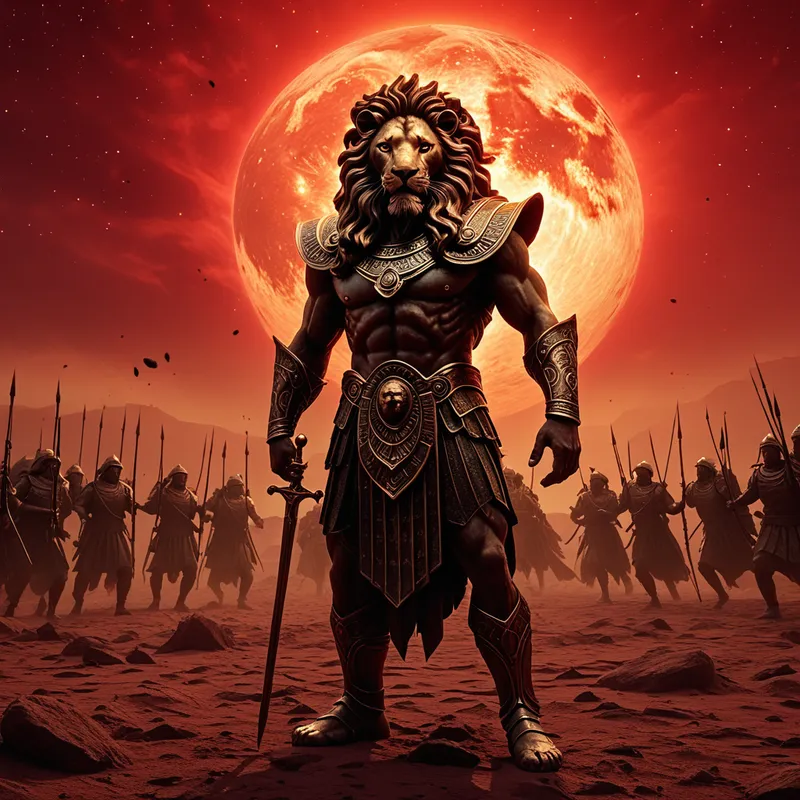
Phobos Myth Meaning & Symbolism
Phobos is the divine personification of panic and rout, born of war and love, whose terror is a sacred force to be understood, not merely vanquished.
The Tale of Phobos
Hear now of the breath that steals courage, the chill that freezes blood, the shadow that walks before the blade. This is not a tale of a hero, but of the force that unmakes them. This is the tale of Phobos.
Before the clash of spear on shield, before the war-cry dies in the throat, he arrives. He is born in the mingled sweat and ichor of the gods themselves, a child of paradox: sired by Ares, the roar of the battlefield, and sprung from the womb of Aphrodite, she of the irresistible grace. From this union of strife and attraction comes not a child of balance, but of pure, distilled dread. Phobos and his twin, Deimos, are born screaming—a sound that is the absence of all others.
He does not fight. He precedes. When the armies of men line the plain of Troy, the air grows thick and metallic. It is not the smell of rain, but of cold sweat. A hoplite’s grip, once firm on his spear, grows slick. The familiar face of the comrade beside him seems suddenly alien, a mask over a skull. The orderly ranks, so proud moments before, feel like a trap. This is Phobos walking the line. He is the tremor in the knee, the sudden, vivid memory of home, the irrational conviction that the man across the field is not a man at all, but a devouring spirit.
He rides with his father, Ares, in a chariot drawn by fire-breathing steeds, but Phobos is the true engine. When the god of war descends, it is Phobos who clears the path. Men do not see a monster; they see the friend next to them turn and run. They hear not a roar, but the sudden, deafening silence of their own fleeing army. Courage unravels like a frayed rope. The mind, that great general, is overthrown by the body’s ancient, shrieking truth: flee. This is his victory—not conquest, but dissolution. He is the god of the rout, the patron saint of the breaking line, and his temple is the hollow, pounding chest of every soldier who has ever known the name of his fear.
Cultural Origins & Context
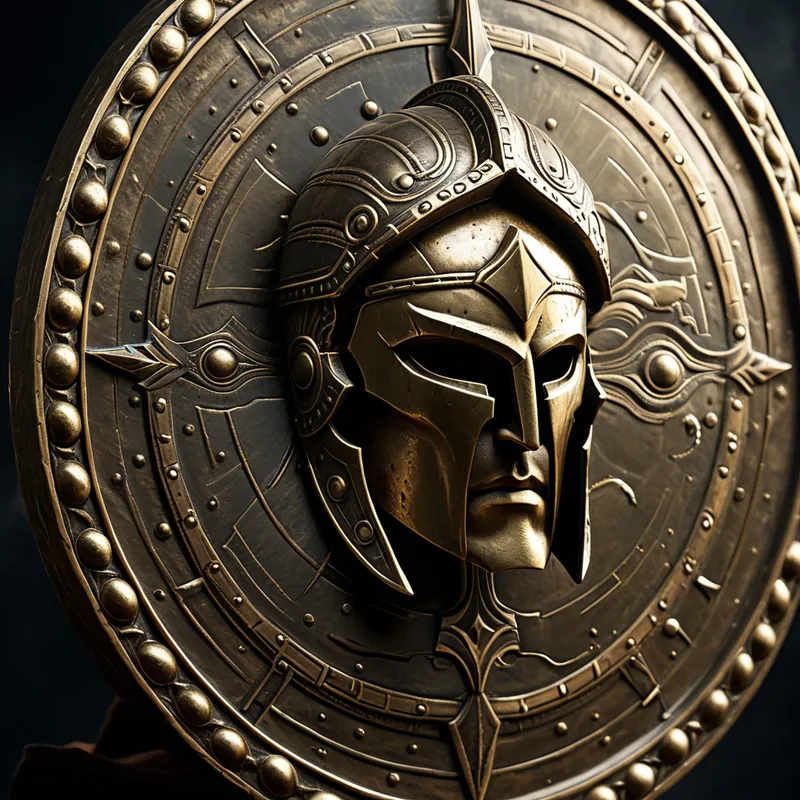
Phobos was not worshipped in grand temples with serene statues. His cult was visceral and practical, embedded in the very machinery of polis survival. His primary shrine was the battlefield, and his priests were the warriors themselves. In the fiercely martial society of Sparta, statues of Phobos were placed near the mustering grounds. Soldiers would make offerings to him before combat—not to banish fear, but to propitiate it, to acknowledge its divine power and, perhaps, to harness a sliver of it for themselves.
The myth was passed down not as a standalone epic, but woven into the fabric of others. He appears in the shield of Achilles, as described by Homer, and in the genealogies of gods recounted by Hesiod. His story was told in the tense moments before battle, in the veterans’ tales, and in the collective memory of cities that knew the cost of panic. The societal function was clear: to name and ritualize the most destabilizing force in communal life. By making Phobos a god, the Greeks did not dismiss fear as a weakness; they elevated it to a cosmic principle. To ignore him was not bravery, but hubris. His myth served as a constant reminder that courage exists only in dialogue with terror, and that the community’s strength relied on managing the panic that could shatter it in an instant.
Symbolic Architecture
Phobos represents the raw, autonomic power of fear before it is shaped by story or reason. He is not the fear of something specific, but fear as a primary, existential state. His parentage is the first key to his symbolism.
Phobos is the child where Love and Strife embrace—the terrifying truth that our deepest attachments are the very roots of our most profound fears.
Born of Ares (conflict, aggression, the will to dominate) and Aphrodite (union, attraction, the will to connect), Phobos embodies the panic that arises when these two fundamental drives collide. We fear the destruction of what we love (Ares threatening Aphrodite’s domain), and we fear the vulnerability required to engage in conflict or competition (Aphrodite’s openness threatening Ares’s domain). He is the psychic shock at this intersection.
He is also a daimon, a personified spiritual force, rather than a full Olympian. This places him closer to the human experience—an ambient influence, a mood, a climate of the soul. He symbolizes the moment the conscious ego is bypassed, and the older, reptilian brain takes command. In psychological terms, Phobos represents the flood of the autonomic nervous system—the fight, flight, or freeze response—in its pure, undiluted form. He is the symbol of the psyche’s own capacity to paralyze and dismantle itself from within.
The Dreamer's Resonance
When Phobos visits the modern dreamscape, he rarely wears a lion’s head. His manifestation is more subtle, more environmental. To dream of Phobos is to dream the sensation of panic.
This may appear as a dream where you are being pursued, but the pursuer is never seen—only the overwhelming, suffocating need to run, coupled with legs that move through syrup. It may be a dream of being utterly, catastrophically unprepared for a crucial exam or presentation, a scenario where the social self feels annihilated. It can be the dream of a loved one transforming into a stranger or a threat, echoing his parents’ paradoxical union. The setting is often liminal: empty parking garages at night, endless hallways with shifting doors, or vast, empty landscapes under a sickly sky.
Somatically, the dreamer is often experiencing a process of psychic disintegration. The conscious persona, the “I” that navigates the day, is being confronted by a surge from the deeper, instinctual layers of the psyche. The dream is not merely showing fear; it is allowing the dreamer to experience the physiological reality of panic in a safe container. The process is one of involuntary confrontation. The ego is being shown its own fragility, its dependence on a body and a nervous system that have their own ancient sovereignty. The dream of Phobos asks the dreamer to feel this terror fully, to locate it in the body upon waking—the tight chest, the cold sweat—and to begin the slow work of recognizing it not as an enemy to be destroyed, but as a powerful, if terrifying, part of the total self.

Alchemical Translation
The individuation process, the journey toward psychic wholeness, does not involve slaying Phobos. That is the hero’s hubris, and it only makes the god stronger by denying his reality. The alchemical work is one of transmutation, and Phobos provides the essential, volatile ingredient: raw, unmediated fear.
The first step in transmuting lead into gold is to acknowledge the lead. The first step in transmuting panic into presence is to bow to the god of panic.
The myth models this by showing Phobos as divine. The modern translation begins with this same sacred acknowledgment. When panic arises—be it social anxiety, a phobia, or existential dread—the alchemical approach is to stop fighting it. Instead, one must, like the Spartan before his statue, make an offering. This offering is conscious attention. “I see you, Phobos. I feel your chill in my veins. You are here.”
This act of naming and holding the somatic experience without narrative (the “why” of the fear) begins to separate the pure energy of Phobos from the personal story it has attached to. The terror is de-personalized, seen as a universal, archetypal force passing through the individual. In this space, a miraculous shift can occur. The energy of panic, when fully felt and not resisted, contains immense vitality—it is, after all, the energy meant for survival. The alchemical fire is in the full, conscious immersion in the sensation.
From this crucible, Phobos can be integrated. His energy, once a force of rout and disintegration, can become the acute sensitivity of the warrior who senses danger before others, the vibrant alertness of the artist on the edge of creation, or the sacred awe of one who stands before the immense and unknown. The twin born of War and Love becomes, through this conscious process, a guardian of the threshold. He no longer scatters the self; he signals that the self is being called to encounter something vast. The panic is transmuted into a profound respect for the power of life itself, and the individual no longer flees from the shadow, but learns to see by its dark, revealing light.
Associated Symbols
Explore related symbols from the CaleaDream lexicon: