Pharaoh's empty throne Myth Meaning & Symbolism
A myth of divine absence where the empty throne becomes a vessel for potential, awaiting the return of the true king from the underworld's trials.
The Tale of Pharaoh’s empty throne
Hear now, and let your ka listen, a tale woven from the silence between heartbeats, from the space between the stars. In the time when the gods walked with men, and the Two Lands were one under the sun’s golden eye, a shadow fell upon the palace of white limestone. It was not a shadow of night, nor of storm cloud, but a shadow of absence.
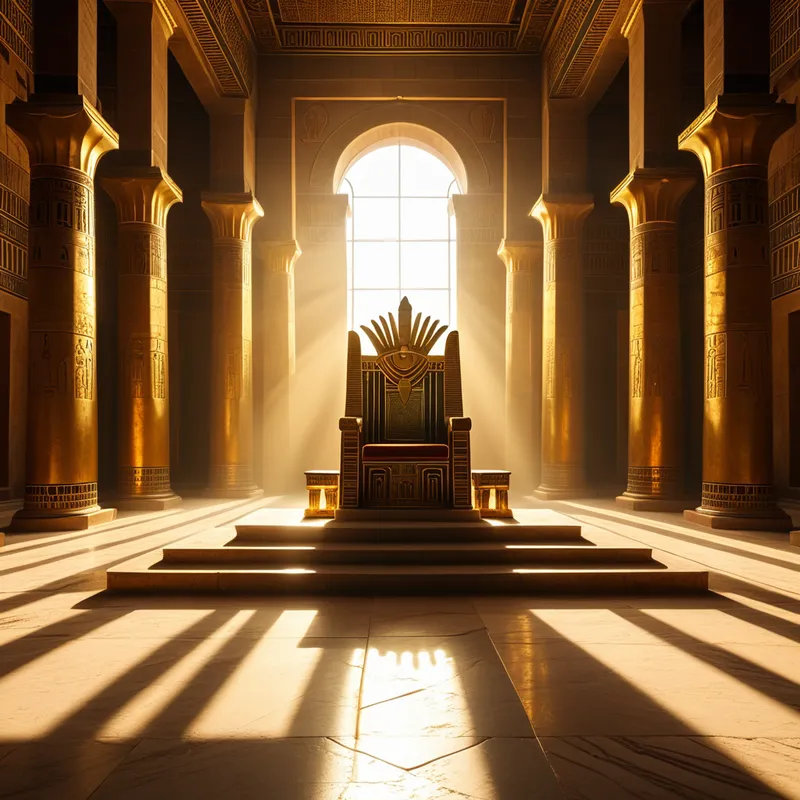
The Great House, the Per-aa, stood hushed. The scent of [lotus](/myths/lotus “Myth from Hindu culture.”/) oil and baked earth hung still in the air. The throne of the Living [Horus](/myths/horus “Myth from Egyptian culture.”/), carved from cedar inlaid with lapis lazuli and gold, the seat that anchored Maat to [the earth](/myths/the-earth “Myth from Hindu culture.”/), sat empty. Not for an hour, not for a day, but for a season that stretched like [the desert](/myths/the-desert “Myth from Biblical culture.”/) horizon. [The Pharaoh](/myths/the-pharaoh “Myth from Egyptian culture.”/), the embodiment of Ra’s will and [Osiris](/myths/osiris “Myth from Global/Universal culture.”/)’s legacy, was gone. He had descended [the winding path](/myths/the-winding-path “Myth from Taoist culture.”/) into the Duat, to face the coils of Apep and the judgment of the forty-two assessors. His body, [the vessel](/myths/the-vessel “Myth from Alchemical culture.”/) of the land, was prepared and sealed in the hidden tomb, but his office, his divine function, remained… suspended.
In the hall of columns shaped like [papyrus](/myths/papyrus “Myth from Egyptian culture.”/) stalks, the courtiers whispered like reeds in a vanished breeze. The generals’ swords grew heavy without a command to follow. The scribes’ ink dried upon their palettes. The land itself seemed to hold its breath. The Nile did not rise in rebellion, nor did the sun fail to rise, but a profound stillness settled, a waiting. The throne was not abandoned; it was expectant. It was a sacred vessel of pure potential, a geometric locus of power that demanded a king to complete its meaning.
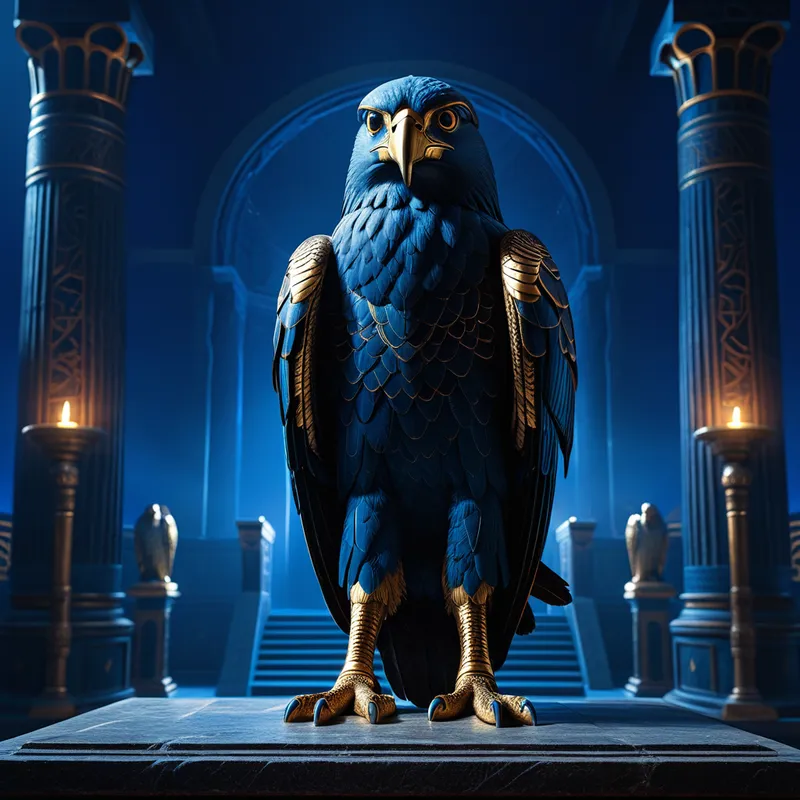
Then, in the deepest hour of the night, a figure approached the dais. It was Horus, son of Osiris, his feathers the color of the storm-tinged sky. He did not sit. He stood before the empty seat, his falcon’s eyes seeing not gold and stone, but the invisible architecture of duty. He saw the ghost-impression of every [Pharaoh](/myths/pharaoh “Myth from Egyptian culture.”/) past, the weight of the white and red crowns, the echo of the crook and flail. He felt the pull of the seat, the magnetic call of sovereignty, but he knew the throne was not his to claim by presence alone. It was his to earn through the restoration of what was missing.
His vigil was the first act of filling [the void](/myths/the-void “Myth from Buddhist culture.”/). His presence was a bridge between [the world](/myths/the-world “Myth from Tarot culture.”/) of the living and the journey of the king in [the Duat](/myths/the-duat “Myth from Egyptian culture.”/). He was the promise of return. And as the first hint of dawn gilded [the horizon](/myths/the-horizon “Myth from Various culture.”/), a change, subtle as a shift in [the wind](/myths/the-wind “Myth from Various culture.”/), moved through the palace. The emptiness of the throne was no longer a mark of loss, but a sacred space in the process of becoming. It was the silent, potent interval between the setting and the rising sun, holding within its hollow form the entire destiny of the Two Lands. The myth ends not with a coronation, but with this pregnant silence, teaching that true authority resides in the capacity of the space to call forth its rightful occupant from the trials of transformation.
Cultural Origins & Context
The motif of the empty throne is not a single, codified myth from one papyrus, but a profound thematic current running through Egyptian royal ideology, temple ritual, and funerary practice. It finds expression in the interregnum—the dangerous, sacred period between the death of one Pharaoh and the coronation of his successor. During this time, the state existed in a liminal state. Rituals of succession, detailed in texts like the Amduat, were not mere formalities; they were cosmological necessities to ensure the sun (Ra) would continue its journey and the Nile would flood.
The throne itself, often associated with the goddess Isis (whose name means “throne”), was more than furniture. It was an active participant in kingship, a divine feminine entity that literally “bore” the king. Its emptiness, therefore, was a temporary dissolution of the union between the divine seat and the mortal god, a crack in the cosmic order that needed urgent ritual mending. This concept was enacted by priests in temple dramas and was a core psychological reality for the Egyptian state, embedding the understanding that order (Maat) is not a permanent possession, but a dynamic balance constantly threatened by chaos (Isfet) and requiring active, rightful authority to maintain.
Symbolic Architecture
At its [heart](/symbols/heart “Symbol: The heart symbolizes love, emotion, and the core of one’s existence, representing deep connections with others and self.”/), the empty [throne](/symbols/throne “Symbol: A seat of authority, power, and sovereignty, representing leadership, divine right, or social hierarchy.”/) symbolizes the [vessel](/symbols/vessel “Symbol: A container or structure that holds, transports, or protects something essential, representing the self, emotions, or life journey.”/) of potential. It represents a center of power that is defined not by [the ego](/myths/the-ego “Myth from Jungian culture.”/) who occupies it, but by the archetypal function it serves. The [emptiness](/symbols/emptiness “Symbol: Emptiness signifies a profound sense of void or lack in one’s life, often related to existential fears, loss, or spiritual quest.”/) is not a vacuum, but a charged field.
The most potent center is not the one that is always filled, but the one that can be authentically, rightfully filled from within.
Psychologically, the throne corresponds to the Self in Jungian terms—the [archetype](/symbols/archetype “Symbol: A universal, primordial pattern or prototype in the collective unconscious that shapes human experience, behavior, and creative expression.”/) of wholeness and the regulating center of the [psyche](/myths/psyche “Myth from Greek culture.”/). The Pharaoh represents the conscious ego, tasked with the nearly impossible job of embodying this Self. His descent into the Duat is the ego’s necessary [dissolution](/symbols/dissolution “Symbol: The process of breaking down, dispersing, or losing form, often representing transformation, release, or the end of a state of being.”/), its confrontation with [shadow](/symbols/shadow “Symbol: The ‘shadow’ embodies the unconscious, repressed aspects of the self and often represents fears or hidden emotions.”/), [mortality](/symbols/mortality “Symbol: The awareness of life’s finitude, often representing transitions, impermanence, or existential reflection in dreams.”/), and the unconscious (the forty-two assessors, the [serpent](/symbols/serpent “Symbol: A powerful symbol of transformation, wisdom, and primal energy, often representing hidden knowledge, healing, or temptation.”/) Apep). The empty throne [period](/symbols/period “Symbol: Periods in dreams can symbolize cyclical patterns, renewal, and the associated emotions of loss or change throughout life.”/) is thus the [psyche](/myths/psyche “Myth from Greek culture.”/) in a state of transitional [disintegration](/symbols/disintegration “Symbol: A symbol of breakdown, loss of form, or fragmentation, often reflecting anxiety about personal identity, control, or stability.”/). The old, identified way of being (the dead [king](/symbols/king “Symbol: A symbol of ultimate authority, leadership, and societal order, often representing the dreamer’s inner power or external control figures.”/)) is gone, but the new, integrated [consciousness](/symbols/consciousness “Symbol: Consciousness represents the state of awareness and perception, encompassing thoughts, feelings, and experiences.”/) (the justified [king](/symbols/king “Symbol: A symbol of ultimate authority, leadership, and societal order, often representing the dreamer’s inner power or external control figures.”/) returned) has not yet emerged. The throne—the seat of [the Self](/myths/the-self “Myth from Jungian culture.”/)—waits, intact, a promise of order and centrality that pulls the struggling ego through its ordeal.
The Dreamer’s Resonance
When this mythic pattern stirs in the modern dreamer, it often manifests as dreams of empty chairs of authority: a vacant CEO’s desk, an unoccupied driver’s seat in a moving car, a teacher’s empty podium. The somatic feeling is one of anxiety mixed with awe—a “weight of the empty.” This is the psyche signaling a crisis or transition in personal sovereignty.
The dreamer may be experiencing a profound loss of identity (a job, a role, a relationship) that has dismantled their conscious sense of self. The empty throne dream does not merely reflect this loss; it maps the process. It shows that the central organizing principle of their life (the Pharaoh/ego) is undergoing its necessary journey through [the underworld](/myths/the-underworld “Myth from Greek culture.”/) of the unconscious. The dream’s emotional tone—whether of dread, quiet anticipation, or solemn peace—indicates the dreamer’s relationship to this void. Is it a terrifying abandonment, or a sacred space of becoming? The dream invites the dreamer to do as Horus did: to stand vigil before their own emptiness, to acknowledge the function that must be filled, and to begin the inner work of preparing for a more authentic return.

Alchemical Translation
The alchemical process mirrored here is the [Nigredo](/myths/nigredo “Myth from Alchemical culture.”/), the blackening, the descent into the massa confusa. The Pharaoh’s death and journey is the dissolution of the old, inflated, or rigidified personality. The empty throne represents the vas, the sealed alchemical vessel, within which this transformation occurs. It is the protected, sacred space of the therapeutic container or the committed inner practice where the old self can fall apart without the world collapsing.
Individuation is not about claiming the throne prematurely, but about enduring the throne’s emptiness until the true king is forged in the underworld.
The [triumph](/myths/triumph “Myth from Roman culture.”/) is not simply in returning and sitting down. The alchemical gold, the [Lapis Philosophorum](/myths/lapis-philosophorum “Myth from Alchemical culture.”/), is the renewed relationship between the ego and the Self. The returned Pharaoh does not just rule; he rules as one who has faced the judges of the Duat and been justified. He rules with the humility of mortality and the authority of transformation. For the modern individual, this translates to the hard-earned ability to occupy one’s own center—one’s vocation, relationships, and life—not out of hubris or borrowed identity, but from a place of integrated consciousness that has acknowledged and incorporated [the shadow](/myths/the-shadow “Myth from Jungian culture.”/). The empty throne teaches that before we can rule our world, we must first honor the sacred, silent void from which our true authority is reborn.
Associated Symbols
Explore related symbols from the CaleaDream lexicon: