Phaeacian Harbor Myth Meaning & Symbolism
A magical island kingdom offers Odysseus perfect rest and passage home, representing the psyche's necessary sanctuary before reintegration.
The Tale of Phaeacian Harbor
Hear now of a place not found on any mortal map, a kingdom woven from the loom of dreams and the shuttle of [the sea](/myths/the-sea “Myth from Greek culture.”/). After nine years of war and ten more of wandering, after facing the Cyclops’ rage and [the Sirens](/myths/the-sirens “Myth from Greek culture.”/)’ song, after descending to the very House of [Hades](/myths/hades “Myth from Greek culture.”/) and losing every last companion, a man was broken upon the waves. His name was [Odysseus](/myths/odysseus “Myth from Greek culture.”/), and [the sea](/myths/the-sea “Myth from Greek culture.”/), his old adversary, had claimed his raft and his strength, leaving him naked and salt-crusted, clinging to a splintered beam.
For two nights and two days he was battered in the wine-dark sea, until on the third dawn, through stinging eyes, he saw a line of dark against [the horizon](/myths/the-horizon “Myth from Various culture.”/). Not the jagged teeth of rocks he knew, but a smooth, forested coast. With the last of his god-given will, he swam toward a river’s mouth, crawling onto the sweet, soft earth beneath a sheltering thicket. There, in the hollow of two olive trees, he fell into a sleep deeper than death, covered by a blanket of leaves shed by the goddess Athena herself.
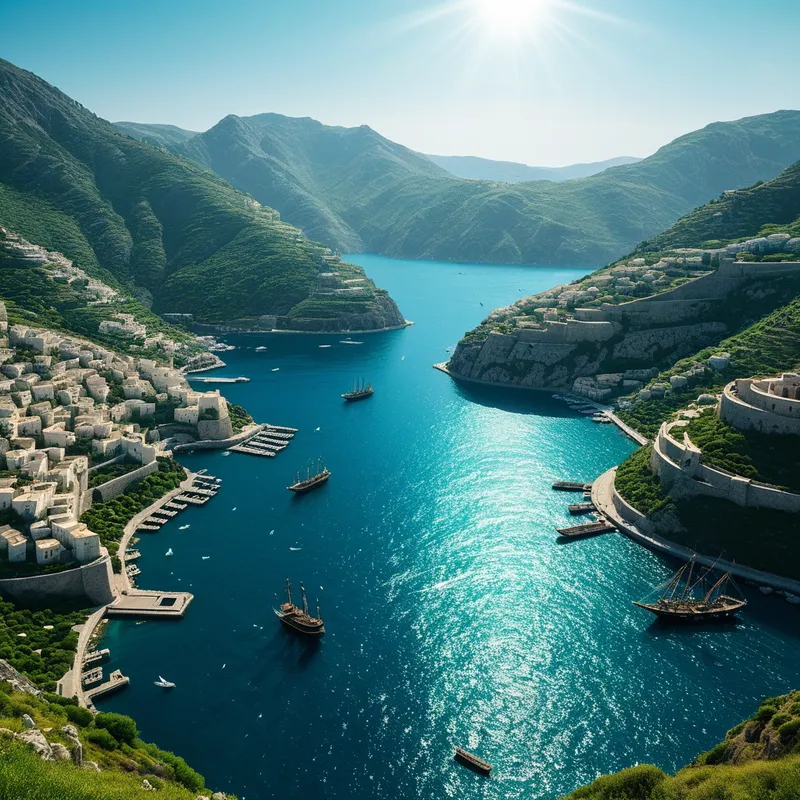
He did not know he had come to Scheria, the land of the Phaeacians. A people apart, closer to the gods than to men. Their ships were not mere wood and pitch, but conscious beings, swift as thought, needing no helm or oar, knowing the mind of the captain. Their harbor was a perfect circle, a stone embrace where these sleek vessels slept. Their king, the wise Alcinous, and his queen, Arete, whose counsel was heeded above all, ruled a city of abundance and peace, untouched by famine or strife.
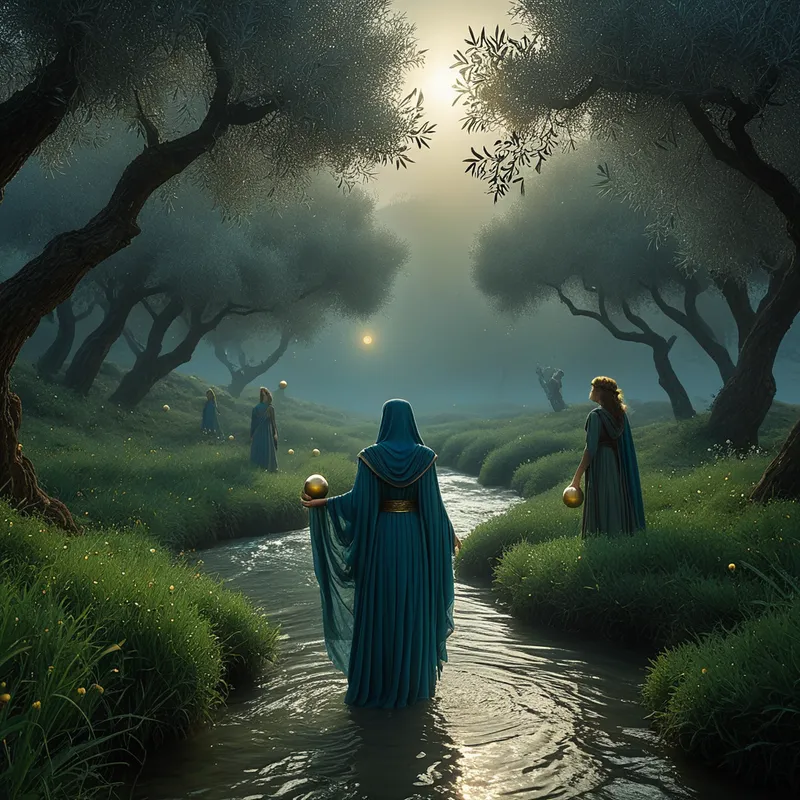
Awoken not by danger, but by the laughter of girls, Odysseus crept from his thicket. Athena veiled him in a mist, and he beheld the princess Nausicaa, radiant as a young goddess, playing at ball with her handmaidens by [the river](/myths/the-river “Myth from Buddhist culture.”/). When the game ended and the laundry was done, he emerged—a terrifying, salt-encrusted specter. Yet Nausicaa, with a courage and grace beyond her years, did not flee. She clothed him, fed him, and guided him to the towering walls of her father’s palace.
And what a palace it was! Walls of bronze, doors of gold, guarded by immortal dogs of silver and gold crafted by [Hephaestus](/myths/hephaestus “Myth from Global/Universal culture.”/). Within, the lords of the Phaeacians feasted. Odysseus, still shrouded in mist, walked through the hall untouched, until he knelt at [the hearth](/myths/the-hearth “Myth from Norse culture.”/), the sacred place of the suppliant, and clasped the knees of Queen Arete. [The mist](/myths/the-mist “Myth from Celtic culture.”/) dissolved. Silence fell.
Here, in this perfect realm, [the law](/myths/the-law “Myth from Biblical culture.”/) was hospitality. No question of his name, his origin, his plight was asked until he was bathed, anointed with oil, clothed in fine robes, and seated at the table, his cup overflowing. Only when his mortal frame remembered what it was to be human did King Alcinous gently inquire. And then, under the firelight, to the sound of [the bard](/myths/the-bard “Myth from Celtic culture.”/)’s lyre, Odysseus unspooled his tale. He told them everything—the war, the [Lotus-Eaters](/myths/lotus-eaters “Myth from Greek culture.”/), the Cyclops, Circe, the dead, the monsters, the losses. For the first time in twenty years, he was heard. He was witnessed.
In return, the Phaeacians gave him the final gift: a passage beyond sailing. They loaded their enchanted ship with more treasure than he had won at Troy, and as he slept a deep, dreamless sleep on a purple rug upon [the deck](/myths/the-deck “Myth from Tarot culture.”/), the ship flew across the sea, faster than a falcon flies, and laid him, still sleeping, on the familiar shore of his own Ithaca. The Phaeacian Harbor was not a destination, but a threshold. A place of perfect telling, so that the man who arrived broken could be the king who returned home.
Cultural Origins & Context
The tale of the Phaeacians is the radiant, still center of [Homer](/myths/homer “Myth from Greek culture.”/)’s Odyssey, an epic that served as the foundational narrative of Greek identity, recited at festivals and in royal halls for centuries before being codified in writing. This episode functions as a narrative and emotional pivot. For the original audiences, the Phaeacian kingdom represented an idealized “other”—a utopian society that embodied the highest Greek virtues of [xenia](/myths/xenia “Myth from Greek culture.”/) (the sacred guest-friendship), artistic mastery (their sublime dancers and bard, Demodocus), and technological harmony with nature, all while existing just beyond the known world.
Its societal function was multifaceted. It provided a narrative breather, a moment of safety and reflection amidst the epic’s relentless trials. It modeled the proper, divinely-sanctioned treatment of a stranger, reinforcing a critical social code. Furthermore, it positioned Odysseus not just as a warrior, but as a storyteller. His recitation of his adventures to the Phaeacians is the mechanism by which the epic itself is framed; we, the audience, are like the Phaeacian court, bearing witness to the tale. The myth was passed down by oral bards, for whom Scheria represented the ideal audience: receptive, generous, and capable of appreciating the transformative power of a story well-told.
Symbolic Architecture
Psychologically, Phaeacian [Harbor](/symbols/harbor “Symbol: A harbor symbolizes safety, rest, and the arrival at a destination, representing a place of shelter and emotional refuge.”/) is the archetypal Sanctuary. It is not the homecoming itself, but the essential, liminal [space](/symbols/space “Symbol: Dreaming of ‘Space’ often symbolizes the vastness of potential, personal freedom, or feelings of isolation and exploration in one’s life.”/) that makes homecoming possible. It represents the [psyche](/myths/psyche “Myth from Greek culture.”/)’s need for a complete cessation of struggle, a place where one is not required to fight, strategize, or endure.
The harbor is not the journey’s end, but the soul’s antechamber, where the scars of traversal are witnessed and named before one crosses the final threshold.
Odysseus arrives as a raw, reactive bundle of instincts—the survivor. The Phaeacians, through their unwavering protocol of care (bathing, clothing, feeding, listening), help re-constitute his civilized, social self. The [palace](/symbols/palace “Symbol: A palace symbolizes grandeur, authority, and the pursuit of one’s ambitions or dreams, often embodying a desire for stability and wealth.”/), with its miraculous, self-navigating ships and immortal guardians, symbolizes a [realm](/symbols/realm “Symbol: The symbol of ‘Realm’ often signifies the boundaries of one’s consciousness, experiences, or emotional states, suggesting aspects of reality that are either explored or ignored.”/) where the conscious ego is not in charge; a higher, more harmonious order operates. Here, the [hero](/symbols/hero “Symbol: A hero embodies strength, courage, and the ability to overcome significant challenges.”/)’s [task](/symbols/task “Symbol: A task represents responsibilities, duties, or challenges one faces.”/) is not to act, but to receive and to recount. This is the critical symbolic act: the [integration](/symbols/integration “Symbol: The process of unifying disparate parts of the self or experience into a cohesive whole, often representing psychological wholeness or resolution of internal conflict.”/) of experience through narrative. By telling his [story](/symbols/story “Symbol: The symbol of ‘Story’ represents the narrative woven through our lives, embodying experiences, lessons, and emotions that shape our identities.”/), Odysseus transforms chaotic, traumatic events into a structured epic, reclaiming his [identity](/symbols/identity “Symbol: Identity represents the sense of self, encompassing personal beliefs, cultural background, and social roles.”/) from the clutches of his ordeals.
The Dreamer’s Resonance
When this mythic pattern surfaces in modern dreams, it often manifests as finding an inexplicably peaceful, beautiful, or technologically serene place amidst a landscape of chaos or a life of relentless striving. One might dream of a silent, empty library with infinitely soft chairs; a hotel where every need is anticipated; a friend’s home that feels more like home than one’s own.
Somatically, this dream points to a nervous system that is utterly depleted, seeking a pharmacological level of rest—rest that is deeper than sleep. Psychologically, it signals a transition point. The dreamer has been through a long, arduous “voyage” (a period of loss, career change, illness, or spiritual crisis) and is on the cusp of a return to a new normalcy, but cannot make that final step without first being utterly held. The dream is the psyche’s creation of its own Scheria, insisting, “You must stop. You must be cared for. You must tell your story, if only to yourself, before you can go on.”

Alchemical Translation
The alchemical process mirrored here is Solution—not in the sense of solving a problem, but in the ancient sense of [solutio](/myths/solutio “Myth from Alchemical culture.”/): dissolution, washing, and return to a fluid state. The rigid, calcified identity of “the survivor” or “[the wanderer](/myths/the-wanderer “Myth from Taoist culture.”/)” must be dissolved in the waters of compassion and witness so that the essential gold of the true self can be reconstituted.
The Phaeacians perform the alchemical operation: they receive the materia prima of the battered hero and, through the fire of their hearth and the water of their bath, begin its purification.
For the modern individual, the “Phaeacian Harbor” stage of individuation is the often-overlooked step between the ordeal and the return. We are adept at facing trials and we long for the [triumph](/myths/triumph “Myth from Roman culture.”/) of homecoming, but we scorn the vulnerable, receptive middle. This myth teaches that integration requires a sacred pause. One must find or create a “harbor”—whether therapy, a retreat, a trusted community, or a period of solitary reflection—where the battles are laid down. In this space, [the ego](/myths/the-ego “Myth from Jungian culture.”/)’s relentless doing is replaced by the soul’s receptive being. The stories we tell there, the witnessing we receive, become the psychic ship that carries us, not back to who we were, but forward to who we must become: the ruler returned, whole at last, because we allowed ourselves to be, for a time, the perfect guest.
Associated Symbols
Explore related symbols from the CaleaDream lexicon: