Peter's Boat Myth Meaning & Symbolism
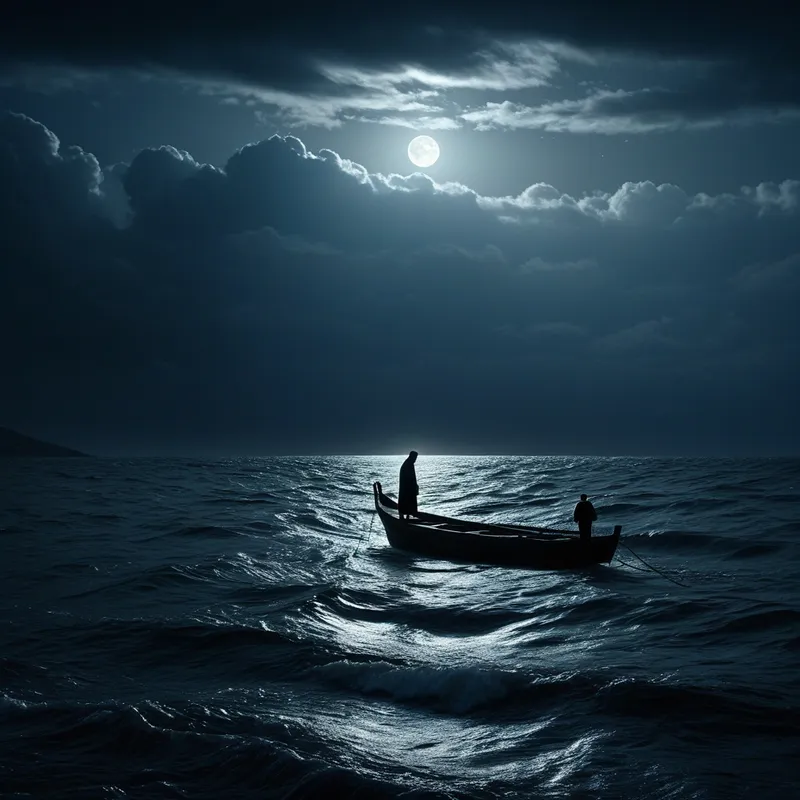
A disciple steps from a storm-tossed boat onto the churning sea, his faith tested between the abyss and the divine call.
The Tale of Peter’s Boat
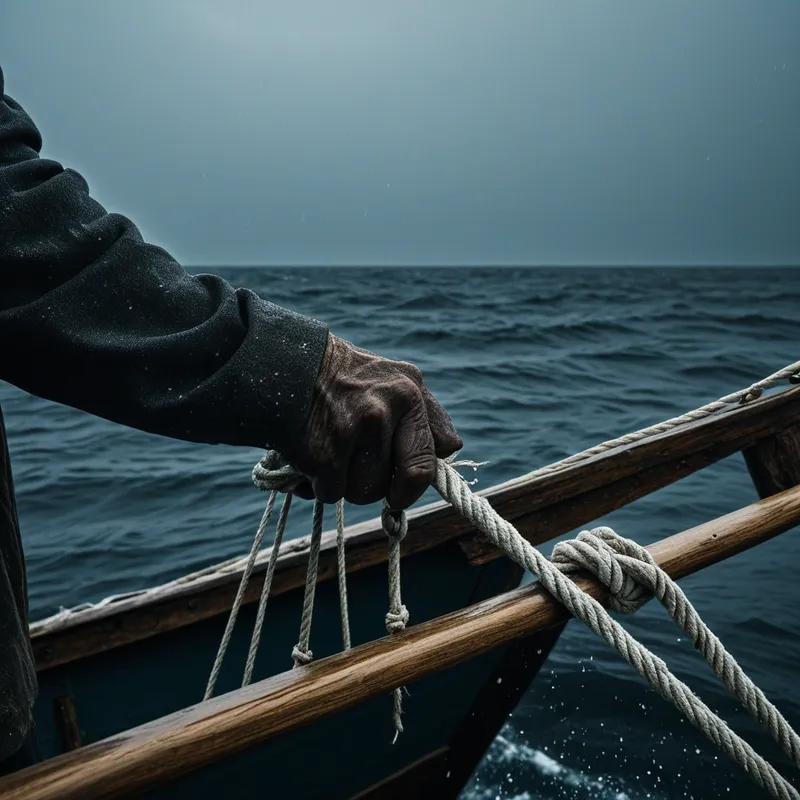
The night was a living thing, a beast of wind and water. The Sea of Galilee, usually a placid mirror, had been roused from its slumber by a shrieking gale. The boat—a humble fishing vessel, all creaking timber and taut rope—was a speck of defiance in the vast, heaving dark. The men aboard were not sailors of the deep, but fishermen, their courage born of familiar shores, now utterly undone by the chaos of the open water.
They strained at the oars, muscles burning, but the waves threw them back as if they were toys. Salt stung their eyes, fear clenched their hearts. And in the fourth watch of the night, in that deepest hour before the dawn when hope seems a forgotten dream, they saw a shape upon the waters. A figure, walking toward them upon the crests of the waves as if strolling on a paved road. A collective cry of terror went up—“It is a phantasm!” For what else could walk upon the abyss?
But a voice cut through the storm’s roar, familiar and calm: “Take heart; it is I. Do not be afraid.”
From among the terrified men, one stirred. Peter, whose spirit was often a tumult mirroring this very sea, called out into the gale. “Lord, if it is you, command me to come to you on the water.”
“Come,” said the voice.
And Peter moved. He swung his legs over the side of the groaning boat, away from the fragile solidity of wood, and placed his foot onto the liquid chaos. And it held. The impossible became his ground. Step by step, he walked on the water, his eyes locked on the figure ahead, the howling wind now a symphony to his faith. He was doing it. He was crossing the uncrossable.
Then, a shift. The wind, which had been a roar, became a personal shriek in his ear. A wave, larger than the rest, loomed like a black wall. His gaze flickered for a single heartbeat—away from the Lord, down to the furious, hungry deep beneath his feet. And in that glance, the spell of the miraculous shattered. The solidity vanished. The law of the world rushed back in with a vengeance. He felt the cold suck of the abyss, and he began to sink.
“Lord, save me!” he cried, the words ripped from him, half prayer, half drowning gasp.
Immediately, a hand grasped his. It was firm, real, pulling him from the clutch of the deep. As he was hauled back, first onto the surface and then toward the boat, the voice held a sorrow deeper than the sea. “O you of little faith, why did you doubt?”
The moment they boarded the boat, the wind ceased. A great calm settled over the water and the men. In the sudden, profound silence, huddled in the dripping boat, they could only bow and whisper, “Truly you are the Son of God.”
Cultural Origins & Context
This narrative is recorded in the Gospel of Matthew (14:22-33), a text composed in the latter half of the first century CE. It emerges from a community defining itself in the wake of Jesus’s death and resurrection, grappling with the nature of discipleship in a world often hostile to their faith. The story is not a detached fable but a paradigm, a teaching tool for early believers facing their own storms—persecution, doubt, and existential fear.
Told and retold in house churches and communal gatherings, it served multiple functions. It was a theophany, showcasing divine authority over chaotic nature. It was a diagnosis of the human condition, perfectly capturing the pendulum swing between bold confession and crippling doubt. Most importantly, it was an etiology of faith. It answered the pressing question: How do we follow when the way is impossible, and we are already sinking? The answer was not in the disciple’s strength but in the immediacy of the cry for help and the grace that meets it. The story validated the reality of failure within the journey of faith, making it a profoundly human and enduring anchor for a community often at sea in a turbulent world.
Symbolic Architecture
The myth is a masterclass in symbolic density. Every element is a facet of the psyche’s encounter with the numinous and the unknown.
The Boat represents collective consciousness, tradition, and the fragile vessel of the ego that contains our identity. It is the known world, our shared reality, and while it is battered, it remains a point of return.
The Storm is the outer crisis that mirrors inner turmoil—unexpected suffering, moral chaos, the upheaval of meaning. It is the nigredo of the alchemists, the chaotic prima materia necessary for transformation.
The Walking on Water is the archetypal image of transcending the natural law of the psyche. Water is the unconscious, deep, potent, and potentially devouring. To walk on it is to operate from a principle beyond the ego, to be sustained by faith in something that re-orders reality itself.
The moment of sinking is not the failure of the myth, but its heart. It is the necessary confrontation with the Law of Gravity, both physical and psychological.
Peter is the archetypal Everyman, the heroic impulse flawed by human perception. His stepping out is the audacity of the soul that says, “There must be more than this boat.” His doubt is the inevitable recalibration when the soul realizes the sheer magnitude of what it has undertaken. He embodies the tension between the idealized self (walking confidently) and the shadow (the fear that pulls us under).
The Lord’s Hand is the saving symbol of the Self reaching for the drowning ego. It signifies that the connection to the transpersonal center, once authentically sought, is unbreakable, even in—especially in—the moment of failure.

The Dreamer’s Resonance
When this myth stirs in the modern unconscious, it manifests in dreams of profound transition and existential testing. To dream of being in a small boat on a vast, stormy sea speaks to a feeling of being overwhelmed by life circumstances, where familiar coping mechanisms (the boat) are no longer sufficient.
The critical dream motif is the attempt to cross an impossible surface. This could be dreaming of walking on a fragile glass floor over an abyss, trying to run across the surface of a swimming pool, or stepping from a solid path onto a raging river that suddenly holds your weight. The somatic experience is one of exhilarating, terrifying freedom, followed often by a visceral plunge.
This dream sequence maps directly onto a psychological process: the individual is attempting to integrate a new level of awareness or responsibility. The “walking” phase reflects a temporary, grace-filled alignment with a deeper Self. The “sinking” is the ego’s inevitable recoil, its terror at the dissolution of its old structures. The dream is not a verdict of failure, but a depiction of the soul’s natural rhythm in growth—expansion and contraction, faith and doubt. The healing is implied in the very structure: the cry for help is always the next, and most crucial, step.

Alchemical Translation
The alchemy of Peter’s Boat is a perfect model for individuation. The process begins with separatio: the conscious decision to leave the collective vessel (the boat), to differentiate oneself from mass opinion or comfortable dogma.
The walking on water is the sublimatio—the spirit attempting to rise above the overwhelming waters of the unconscious, to gain a transcendent perspective. But pure sublimatio is unsustainable for the human psyche; it risks inflation, a spiritual pride that says, “See what I can do.”
Therefore, the sinking is the essential mortificatio—the humbling, the drowning of the inflated ego. It is the dark night that makes the dawn visible.
This drowning is not an end, but a return to the primal waters for rebirth. The cry, “Lord, save me,” is the conjunctio, the sacred marriage of human limitation and divine grace. It is the ego surrendering its solo project and consciously linking with the guiding Self.
Finally, the return to the calm boat is the coagulatio—the new, solidified state of being. The individual returns to the world of ordinary consciousness, but is no longer the same. They have been tempered. The storm without may cease, but the true calm is within, forged in the crucible of having dared, having doubted, and having been retrieved. The boat is no longer just a shelter from the storm, but a vessel now carrying the memory of the abyss and the hand that pulls one from it, ready to sail into deeper waters.
Associated Symbols
Explore related symbols from the CaleaDream lexicon: