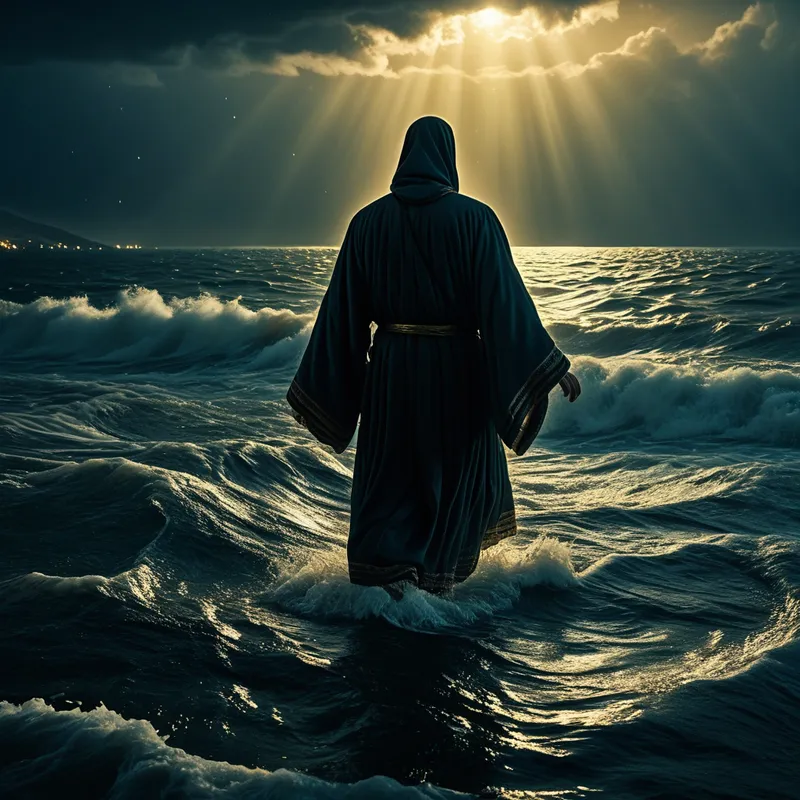
Peter walking on water Myth Meaning & Symbolism
A disciple steps from a storm-tossed boat onto the churning sea, walking toward a divine figure, until his own doubt pulls him under the waves.
The Tale of Peter walking on water
The night was a living [thing](/myths/thing “Myth from Norse culture.”/), a beast of wind and [water](/myths/water “Myth from Chinese culture.”/). The boat, a tiny shell of wood, was seized by the Sea of Galilee’s sudden fury. It pitched and groaned, each wave a black mountain intent on swallowing it whole. The men aboard, seasoned fishermen all, fought with ropes and oars, their muscles burning, their hearts hammering against their ribs. The familiar lake had become an abyss, and the shore was a memory lost in the spray.
Then, through [the veil](/myths/the-veil “Myth from Various culture.”/) of rain and darkness, a shape. Not a shape of the storm, but against it. A figure moving on the face of the deep, walking upon the chaos as if it were solid ground. A collective gasp was torn from their throats, swallowed by [the wind](/myths/the-wind “Myth from Various culture.”/). A ghost, they whispered, a spirit of [the drowned](/myths/the-drowned “Myth from Norse culture.”/). Terror, colder than the lake water, gripped them tighter than the storm.
But a voice cut through the roar, a sound that did not shout yet was heard in the marrow of their bones. “Take heart; it is I. Do not be afraid.”
It was the voice of their Rabbi. And one man, Simon called [Peter](/myths/peter “Myth from Biblical culture.”/), felt a wild, impossible hope ignite in his chest. The storm was real. The sinking boat was real. But so was that voice, and the figure standing in the impossible place.
“Lord,” Peter cried out, [the word](/myths/the-word “Myth from Biblical culture.”/) a lifeline thrown into the gale, “if it is you, command me to come to you on the water.”
The command came back, simple and direct. “Come.”
And Peter moved. He did not think. He swung his legs over the gunwale, his eyes locked on the one who called him. His foot found not liquid void, but solidity. Then the other. He was standing on [the sea](/myths/the-sea “Myth from Greek culture.”/). The wind still screamed, the waves still heaved, but beneath his feet was a path of unwavering certainty. Step by step, he walked toward the light, toward the calm at the center of the storm. He was doing the impossible, drawn by faith alone.
But then, a shift. His gaze, fixed on the Rabbi, flickered downward. He saw the wind. He felt its power anew. He remembered the depth, the cold, the drowning. The reality of [the world](/myths/the-world “Myth from Tarot culture.”/)—the world of storms and sinking—rushed back in with terrifying clarity. The path of certainty vanished. The water remembered it was water, and his body remembered it was flesh.
He began to sink.
A cry, raw and stripped of all bravado, erupted from him as the dark water clutched his legs. “Lord, save me!”
Immediately, a hand grasped his. It was firm, real, pulling him from the consuming deep. As he was hauled back onto the surface he could no longer walk upon, the voice held a question softer than the fading wind. “O you of little faith, why did you doubt?”
Then, together, they walked back to the boat. And as they climbed in, the wind ceased its howling, and the sea lay down like a spent beast. In the sudden, profound quiet, the men in the boat could only bow and whisper, “Truly you are the Son of God.”

Cultural Origins & Context
This narrative is embedded within the Gospel tradition, specifically in the Gospel of Matthew. It emerges from a first-century Jewish milieu, a culture steeped in the symbolism of the Torah and [the prophets](/myths/the-prophets “Myth from Biblical culture.”/). The sea, in this tradition, was not merely a geographical feature but a primordial symbol of chaos, disorder, and [the abyss](/myths/the-abyss “Myth from Kabbalistic culture.”/)—Tehom. For a rabbi to command the sea was to echo the creative power of God at the dawn of time.
The story was likely passed down orally within early Christian communities before being codified in written form. It functioned as a parabolic teaching, less about documenting a physical miracle and more about illustrating a spiritual crisis and truth for a community facing persecution and doubt. Peter, the impulsive leader, served as an everyman. His journey on the water was a dramatic metaphor for the life of discipleship: called into terrifying uncertainty, sustained by faith, and perilously vulnerable to the human propensity for doubt. The story affirmed the presence of the divine in the storm and served as a potent reminder that faith was not a permanent state but a moment-by-moment orientation.
Symbolic Architecture
At its core, this is a myth of [the threshold](/myths/the-threshold “Myth from Folklore culture.”/). The boat symbolizes the known world, the consensus [reality](/symbols/reality “Symbol: Reality signifies the state of existence and perception, often reflecting one’s understanding of truth and life experiences.”/), [the ego](/myths/the-ego “Myth from Jungian culture.”/)‘s fragile [structure](/symbols/structure “Symbol: Structure in dreams often symbolizes stability, organization, and the framework of one’s life, reflecting how one perceives their environment and personal life.”/). The storm is the unconscious upheaval, the [crisis](/symbols/crisis “Symbol: A crisis symbolizes turmoil, urgent challenges, and the need for immediate resolution or change.”/) that shatters old securities. The figure on the [water](/symbols/water “Symbol: Water symbolizes the subconscious mind, emotions, and the flow of life, representing both cleansing and creation.”/) represents [the Self](/myths/the-self “Myth from Jungian culture.”/)—the [archetypal image](/symbols/archetypal-image “Symbol: A universal, primordial symbol from the collective unconscious that transcends individual experience and carries profound spiritual or mythic meaning.”/) of wholeness and [guidance](/symbols/guidance “Symbol: The act of receiving or seeking direction, advice, or leadership in a dream, often representing a need for clarity, support, or a higher purpose on one’s life path.”/) that emerges from beyond [the ego](/myths/the-ego “Myth from Jungian culture.”/)‘s control.
To step onto the water is to consent to live by a different law than the law of gravity. It is the ultimate act of psychological courage: to trust the reality of the inner image more than the overwhelming evidence of the outer world.
The water itself is the quintessential [symbol](/symbols/symbol “Symbol: A symbol can represent an idea, concept, or belief, serving as a powerful tool for communication and understanding.”/) of the unconscious—[life](/symbols/life “Symbol: The symbol of ‘Life’ represents a journey of growth, interconnectedness, and existential meaning, encompassing both the joys and challenges that define human experience.”/)-giving yet dangerous, reflective yet depthless. Walking upon it signifies a miraculous [integration](/symbols/integration “Symbol: The process of unifying disparate parts of the self or experience into a cohesive whole, often representing psychological wholeness or resolution of internal conflict.”/), where [consciousness](/symbols/consciousness “Symbol: Consciousness represents the state of awareness and perception, encompassing thoughts, feelings, and experiences.”/) (the [ability](/symbols/ability “Symbol: In dreams, ‘ability’ often denotes a recognition of skills or potential that one possesses, whether acknowledged or suppressed.”/) to stand and move) engages directly with the unconscious (the medium) without being swallowed by it. Peter’s success is brief because this state is inherently liminal; it is a [glimpse](/symbols/glimpse “Symbol: A fleeting, partial view or moment of insight that suggests more lies beyond immediate perception, often hinting at hidden truths or future possibilities.”/) of potential, not a permanent residence.
His doubt is not a moral failure, but the inevitable reassertion of the ego’s primary function: self-preservation. To “see the wind” is to re-identify with the separate, fearful self. The sinking is the experience of being reclaimed by the unintegrated unconscious—[the flood](/myths/the-flood “Myth from Biblical culture.”/) of [anxiety](/symbols/anxiety “Symbol: Anxiety in dreams reflects internal conflicts, fears of the unknown, or stress from waking life, often demonstrating the subconscious mind’s struggle for peace.”/), depression, or old patterns. The saving hand, however, reveals the myth’s deepest [truth](/symbols/truth “Symbol: Truth represents authenticity, honesty, and the quest for knowledge beyond mere appearances.”/): failure within the [journey](/symbols/journey “Symbol: A journey in dreams typically signifies adventure, growth, or a significant life transition.”/) of [faith](/symbols/faith “Symbol: A profound trust or belief in something beyond empirical proof, often tied to spiritual conviction or deep-seated confidence in people, ideas, or outcomes.”/) is not fatal. The Self reaches back for the drowning ego.

The Dreamer’s Resonance
When this myth appears in the modern [psyche](/myths/psyche “Myth from Greek culture.”/), it manifests in dreams of precarious traversal. The dreamer may find themselves walking across a bridge that becomes gossamer, a floor that turns to water, or a narrow path over a terrifying drop. The somatic feeling is one of thrilling possibility instantly hijacked by visceral dread.
This dream pattern signals a critical passage in the dreamer’s life. They have heard an inner call (a new vocation, a necessary ending, a creative impulse) and have courageously stepped out of the “boat” of their former life structure. The initial steps feel empowered, aligned. The dream captures the euphoria of this psychological expansion. The subsequent faltering and fear mirror the inevitable onslaught of doubt: “Who am I to do this? What if I fail? This is impossible.” The dream is not a condemnation, but a mapping of the process. It shows the dreamer the precise moment where their identification shifted from the calling (the figure on the water) back to the problem (the wind and waves). It is an invitation to recognize that the sinking feeling is part of the journey, not its end, and that the call itself contains the grace for retrieval.

Alchemical Translation
The alchemical process mirrored here is the Mortificatio and Sublimatio. The old, earth-bound identity (the Peter who only trusts the boat) must undergo a symbolic death by drowning in the chaotic waters of the unconscious. This is not a literal death, but the death of an old way of being—the ego that believes it is separate and solely in control.
The miracle is not that water becomes stone, but that the human spirit, for a moment, learns to dance with the law of its own depth.
The triumphant walk is the Sublimatio—the spirit rising above the overwhelming matter of fear and circumstance. But in true alchemical fashion, the work is not complete with the sublime elevation. [The fall](/myths/the-fall “Myth from Biblical culture.”/) back into the [prima materia](/myths/prima-materia “Myth from Alchemical culture.”/) of doubt is necessary. The gold is not made in the walking, but in the grasping of the hand that pulls one out. This is the Coniunctio—the integration of the divine impulse (the calling Self) with the humble, failing human ego.
For the modern individual, the myth models the path of individuation. We are all called out of our secure, conventional boats into storms of meaning and change. We will have moments of transcendent confidence where we move in harmony with a deeper purpose. And we will, inevitably, look down at the howling wind of our insecurities and begin to sink. The alchemical translation is this: the goal is not to walk on water forever without faltering. The goal is to learn the rhythm of the journey—the stepping out, the sinking, and the saving grasp—until we realize that the hand that pulls us up is, and has always been, a part of our own deepest nature, reaching back for itself.
Associated Symbols
Explore related symbols from the CaleaDream lexicon: