Perun and Veles Myth Meaning & Symbolism
The eternal mythic battle between the thunder god Perun and the serpentine god Veles, a foundational Slavic story of cosmic order and underworldly transformation.
The Tale of Perun and Veles
Listen, and hear the tale that shakes the foundations of the world.
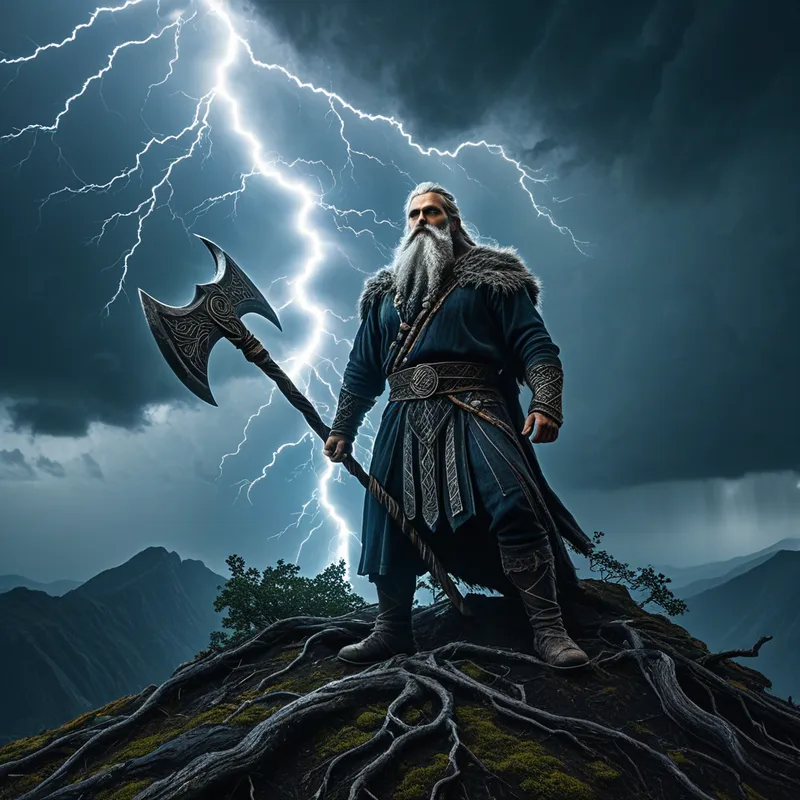
In the time before time, when the World Tree was young, the realms were divided. Above, in the vault of Prav, ruled [Perun](/myths/perun “Myth from Slavic culture.”/). His beard was the storm cloud, his voice the crack that splits the sky. In his hand, he held an axe of living stone that thirsted for justice, and he rode the winds in a chariot drawn by goats of thunder. His domain was the mountain peak, the high place where the air is clean and the law is clear.
Below, in the rich, dark realm of Nav, coiled [Veles](/myths/veles “Myth from Slavic culture.”/). He was the horned one, the serpent of the deep earth, the master of tangled roots and hidden springs. His form shifted—a great, black bull one moment, a man with the horns of a mighty ram the next, a serpent of impossible length the last. His wealth was not of gold but of the dark, fertile soil, the memory of ancestors, and the chaotic potential of all beginnings. His domain was the marsh, the cave mouth, the deep forest where paths are lost.
And between them stretched Yav, the world of the living, sustained by the tension between the two.
The conflict was eternal, written into the bones of creation. For Veles, in his chthonic wisdom and trickster nature, would stir. He would slither up the great trunk of the World Tree, past the roots of Nav, through the trunk of Yav, aiming for the high branches of Prav. He sought to steal what was Perun’s—his celestial cattle, the storm clouds, the very light of order. He was chaos, testing the bounds.
Then would Perun awaken. The sky would darken, not with night, but with his fury. The first thunderclap was his roar. The wind screamed as his chariot descended. The chase was on—a cataclysm made manifest. Veles, now a great serpent or a horned beast, would flee through the middle world, Yav. He would dive into rivers, shatter trees, hide among the herds of cattle he protected. Perun’s lightning would strike, searing the earth, splitting oaks, boiling water. The world trembled. Rain fell in torrents, a deluge born of their strife.
The climax was always the same, yet always new. Cornered at the edge of the world, by a great river or at the foot of the sacred oak, Veles would be struck. Perun’s axe or lightning bolt would find its mark. The serpent-god would fall, his form dissolving, not into death, but into the waters, into the earth, back to the depths of Nav.
And there, in the darkness, he would heal. He would gather his strength from the wet clay and the memories of the dead. And in time, when the world grew too rigid, when the law became a prison, he would feel the urge to climb again. For the battle was never won, only paused. The rain that fell from their fight watered the crops of Yav. The shattered oak gave new shoots. Their eternal conflict was the engine of the world’s renewal, a sacred, terrifying dance of destruction and creation.

Cultural Origins & Context
This myth was the cornerstone of the pre-Christian Slavic cosmovision, particularly among the Eastern Slavs. It was not a single story in a book, but a living, breathing narrative pattern woven into the very fabric of seasonal and agricultural life. It was told and retold in the symbolic language of ritual, not just words.
The primary custodians of this mythic framework were likely the volkhvs, the priestly class who acted as intermediaries between the three worlds. The myth was enacted during thunderstorms, which were seen as the literal, visible battle playing out in the sky. It was ceremonially recalled in seasonal festivals, particularly those marking the end of dry spells or the tumultuous transitions of spring and autumn, when the boundaries between worlds were thin.
Its societal function was profound. It explained the natural world—why it storms, why rivers flood, why the earth is fertile. More importantly, it provided a cosmic model for social order. Perun, later associated with the ruling princely class (the knyaz), represented the necessary, protective, but sometimes harsh force of law, sovereignty, and communal defense. Veles, patron of cattle, wealth, and the common folk, represented the fertile, unpredictable, and vital forces of the earth, trade, and magic. The myth validated a world in tension, where both the king’s justice and the people’s prosperity, both clear skies and life-giving rain, were dependent on this sacred, cyclical struggle.
Symbolic Architecture
At its [heart](/symbols/heart “Symbol: The heart symbolizes love, emotion, and the core of one’s existence, representing deep connections with others and self.”/), this is not a [story](/symbols/story “Symbol: The symbol of ‘Story’ represents the narrative woven through our lives, embodying experiences, lessons, and emotions that shape our identities.”/) of good versus evil. It is a story of complementary opposites locked in a dynamic, creative [tension](/symbols/tension “Symbol: A state of mental or emotional strain, often manifesting physically as tightness, pressure, or unease, signaling unresolved conflict or anticipation.”/) that sustains [reality](/symbols/reality “Symbol: Reality signifies the state of existence and perception, often reflecting one’s understanding of truth and life experiences.”/) itself.
The sky cannot know itself without the abyss to define its height; the tree cannot grow without the dark soil to resist its roots.
Perun symbolizes [the principle](/symbols/the-principle “Symbol: A fundamental truth, law, or doctrine that serves as a foundation for a system of belief, behavior, or reasoning, often representing moral or ethical standards.”/) of [Differentiation](/symbols/differentiation “Symbol: The process of distinguishing or separating parts of the self, emotions, or identity from a whole, often marking a developmental or psychological milestone.”/). He is [consciousness](/symbols/consciousness “Symbol: Consciousness represents the state of awareness and perception, encompassing thoughts, feelings, and experiences.”/), the ego, the force that says “I am” and “this is [the law](/symbols/the-law “Symbol: Represents external rules, societal order, moral boundaries, and the tension between personal freedom and collective structure.”/).” He represents verticality, [clarity](/symbols/clarity “Symbol: A state of mental transparency and sharp focus, often representing resolution of confusion or attainment of insight.”/), [structure](/symbols/structure “Symbol: Structure in dreams often symbolizes stability, organization, and the framework of one’s life, reflecting how one perceives their environment and personal life.”/), and the active, penetrating will that cuts through [ambiguity](/symbols/ambiguity “Symbol: A state of uncertainty or multiple possible meanings, often found in abstract art and atonal music where clear interpretation is intentionally elusive.”/). His [lightning](/symbols/lightning “Symbol: Lightning symbolizes sudden insights or revelations, often accompanied by powerful emotions or disruptive change.”/) is sudden [insight](/symbols/insight “Symbol: A sudden, deep understanding of a complex situation or truth, often arriving unexpectedly and illuminating hidden connections.”/), decisive [action](/symbols/action “Symbol: Action in dreams represents the drive for agency, motivation, and the ability to take control of situations in waking life.”/), and the terrifying, cleansing power of [truth](/symbols/truth “Symbol: Truth represents authenticity, honesty, and the quest for knowledge beyond mere appearances.”/).
Veles symbolizes the principle of The Undifferentiated. He is the unconscious, the [shadow](/symbols/shadow “Symbol: The ‘shadow’ embodies the unconscious, repressed aspects of the self and often represents fears or hidden emotions.”/), the fertile [chaos](/symbols/chaos “Symbol: In Arts & Music, chaos represents raw creative potential, uncontrolled expression, and the breakdown of order to forge new artistic forms.”/) of potential, the [realm](/symbols/realm “Symbol: The symbol of ‘Realm’ often signifies the boundaries of one’s consciousness, experiences, or emotional states, suggesting aspects of reality that are either explored or ignored.”/) of instinct, [memory](/symbols/memory “Symbol: Memory symbolizes the past, lessons learned, and the narratives we construct about our identities.”/), and [wealth](/symbols/wealth “Symbol: Wealth in dreams often represents abundance, security, or inner resources, but can also symbolize burdens, anxieties, or moral/spiritual values.”/) that is not yet coined. He represents horizontality, fluidity, cunning, and the passive, enveloping power of the [womb](/symbols/womb “Symbol: A symbol of origin, potential, and profound transformation, representing the beginning of life’s journey and the unconscious source of creation.”/) of all things. His serpentine form is the primal [life](/symbols/life “Symbol: The symbol of ‘Life’ represents a journey of growth, interconnectedness, and existential meaning, encompassing both the joys and challenges that define human experience.”/) force, the wisdom of the [body](/symbols/body “Symbol: The body in dreams often symbolizes the dreamer’s self-identity, personal health, and the relationship they have with their physical existence.”/), and the [trickster energy](/symbols/trickster-energy “Symbol: A chaotic, transformative force that disrupts order, reveals hidden truths, and catalyzes change through humor, deception, or mischief.”/) that undermines rigidity.
Their battle across the Yav represents the [drama](/symbols/drama “Symbol: Drama signifies narratives, emotional expression, and the exploration of human experiences.”/) of life itself, played out in the [human](/symbols/human “Symbol: The symbol of a human represents individuality, complexity of emotions, and social relationships.”/) [soul](/symbols/soul “Symbol: The soul represents the essence of a person, encompassing their spirit, identity, and connection to the universe.”/) and in society. The [chase](/symbols/chase “Symbol: Dreaming of a chase often symbolizes avoidance of anxiety or confrontation, manifesting as fleeing from something threatening or overwhelming in one’s waking life.”/) is the process by which consciousness (Perun) pursues and attempts to integrate or subdue the contents of the unconscious (Veles). The lightning strike is a [moment](/symbols/moment “Symbol: The symbol of a ‘moment’ embodies the significance of transient experiences that encapsulate emotional depth or pivotal transformations in life.”/) of [integration](/symbols/integration “Symbol: The process of unifying disparate parts of the self or experience into a cohesive whole, often representing psychological wholeness or resolution of internal conflict.”/), where a hidden complex is brought to light. Veles’s retreat is not defeat, but the necessary return of those forces to the [depths](/symbols/depths “Symbol: Represents the subconscious, hidden emotions, or foundational aspects of the self, often linked to primal fears or profound truths.”/) to ferment and transform, ensuring they are not destroyed but cyclically renewed.
The Dreamer’s Resonance
When this mythic pattern stirs in the modern dreamer, it signals a profound somatic and psychological process: the ego’s confrontation with a powerful content from the personal or collective unconscious.
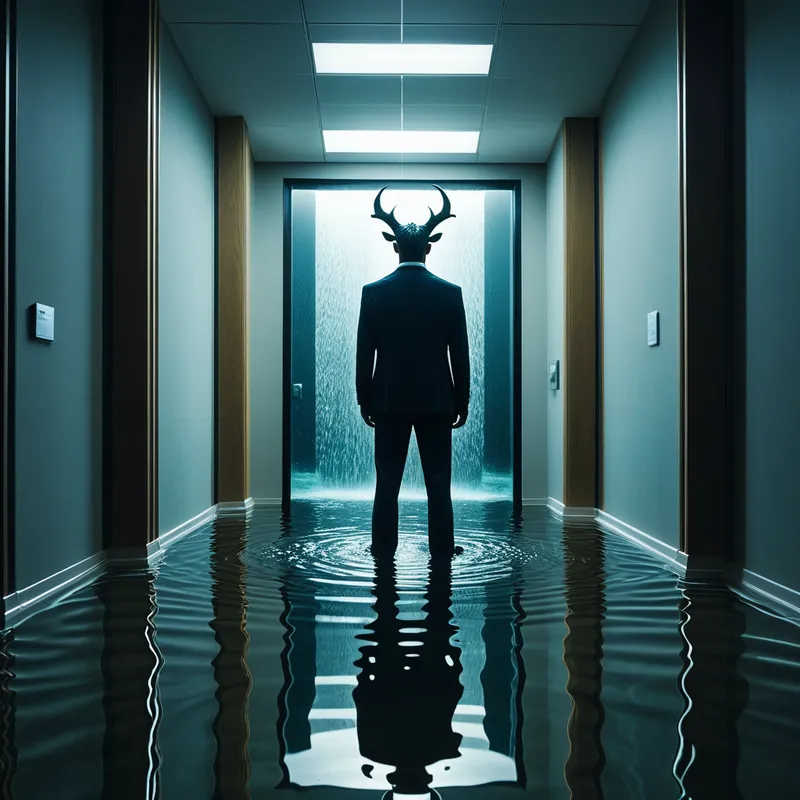
You may dream of being chased by a storm, of dark, horned figures in parking garages, or of serpents in your basement. This is the Veles energy rising—a repressed emotion (like Rage or shame), a neglected talent, a wild instinct, or a forgotten memory breaking its bonds and ascending into your psychological “middle world” of daily life. The Perun energy manifests as the pursuing force: a sense of urgent responsibility, a critical inner voice, a need for control, or a sudden, disruptive insight (the lightning) that illuminates the problem.
Somatically, this can feel like anxiety—the tightening in the chest before a storm. It is the body sensing the psychic tension, the build-up of charge between what is consciously acknowledged and what is pressing from below. The dream is the arena where this battle is safely enacted. The resolution in the dream—whether you are struck by lightning, drown in floodwaters, or witness a great tree split—indicates the current state of this inner alchemy. Is the unconscious content being violently rejected? Is it overwhelming the ego? Or is there a sacred, world-watering release?
Alchemical Translation
For the modern individual seeking wholeness or individuation, the myth of Perun and Veles is a master blueprint for psychic transmutation. It models not a final victory, but the art of sacred conflict.
The first step is to recognize the deities within. To identify one’s inner Veles—the chaotic, creative, shadowy, instinctual self that holds our unlived life and primal wealth. And to recognize one’s inner Perun—the structuring, moral, conscious will that seeks order and purpose.
The alchemical work is not to have Perun slay Veles, but to build a sacred Bridge between the mountain and the underworld, so the lightning of insight may fertilize the dark waters, and the wealth of the depths may be brought up to build in the world of light.
The “chase” is the conscious effort to engage with the shadow, to pursue the meaning of our symptoms, dreams, and projections. The “lightning strike” is the moment of integration—a painful but liberating realization where we see, “This rage, this creativity, this fear, is also me.” This is the Sacrifice of our one-sided self-image.
Crucially, we must also learn the wisdom of Veles’ retreat. Not every integrated content becomes a permanent resident of the conscious ego. Some wisdom must return to the depths to mature. The cycle is eternal because the self is not a static achievement but a living process. We are the Yav, the middle world, forever nourished by the rain born of our own inner sky and inner earth doing battle. To individuate is to become the fertile ground where this divine, stormy marriage takes place, season after season, ensuring continual Rebirth.
Associated Symbols
Explore related symbols from the CaleaDream lexicon:
- Thunder — The voice and weapon of Perun, representing divine judgment, sudden awakening, and the terrifying, cleansing power of truth that breaks through stagnation.
- Serpent — The primary form of Veles, symbolizing the chthonic life force, primal wisdom, cyclical time, and the unconscious mind in its potent, ambivalent totality.
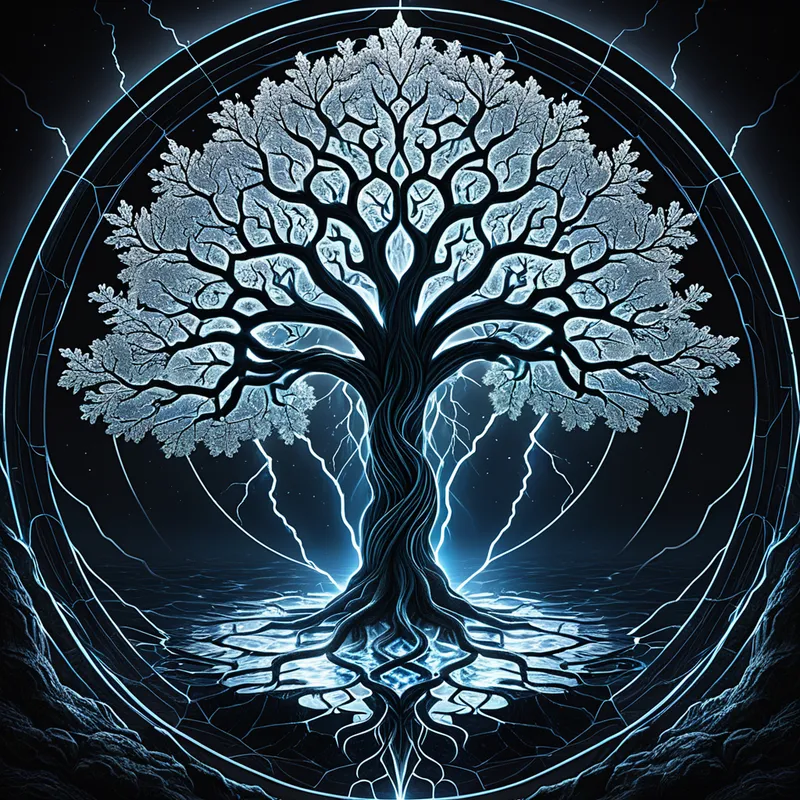
- Tree — The World Tree or sacred oak, representing the axis of reality itself, the connecting structure between the celestial, earthly, and underworld realms where the battle is staged.
- Water — The domain and essence of Veles, symbolizing the unconscious, the emotional body, fertility, memory, and the fluid, shape-shifting nature of the soul’s depths.
- Lightning — The piercing strike of Perun, symbolizing instantaneous insight, decisive action, spiritual illumination, and the moment of integration between conscious and unconscious.
- Mountain — The throne of Perun, representing the heights of consciousness, clarity of vision, spiritual aspiration, and the domain of law and order.
- Cave — An entrance to the realm of Veles, symbolizing the descent into the unconscious, the womb of transformation, hidden knowledge, and the birthplace of instinct.
- Cattle — The wealth of Veles, representing earthly prosperity, instinctual drives, the “herd” of unconscious contents, and the fertile resources of the underworld.
- Rain — The direct result of the cosmic battle, symbolizing the blessing that follows conflict, the fertilization of consciousness by the unconscious, and emotional release.
- Bridge — The implied connection necessary for wholeness, representing the ego’s function in mediating between the heights and depths, creating a passage for energy and meaning.
- Shadow — The psychological counterpart of Veles, representing the repressed, denied, or unlived aspects of the personality that must be confronted and integrated.
- Chaos — The fundamental quality of Veles’s realm, representing the fertile void, unlimited potential, and the necessary dissolution that precedes any new creation.