Persona Myth Meaning & Symbolism
The story of the mask that reveals the soul, a divine gift from the gods to navigate the world while protecting the sacred inner self.
The Tale of Persona
Listen, and hear the tale not of a hero, but of a vessel. A story whispered not in epics of war, but in the quiet spaces between breath and speech.
In the time when gods walked just beyond the edge of sight, humanity was raw and exposed. Every thought shone plain upon the brow, every feeling churned like a visible storm in the chest. To meet another was to be laid utterly bare, soul to soul, a communion that was as terrifying as it was true. There was no commerce but the exchange of essence, no society but the chaotic chorus of unfiltered selves. [The world](/myths/the-world “Myth from Tarot culture.”/) was a cacophony of pure being.
The gods watched from their sun-drenched heights. Zeus, whose will shaped the cosmos, saw both the beauty and the brutality of this naked existence. He saw the poet driven mad by the beauty of a sunset he could not contain, and the warrior felled not by spear, but by the unveiled hatred in his enemy’s eyes. He saw the delicate, luminous core of the human spirit—the [psyche](/myths/psyche “Myth from Greek culture.”/)—bruised and battered by the relentless weather of the world.
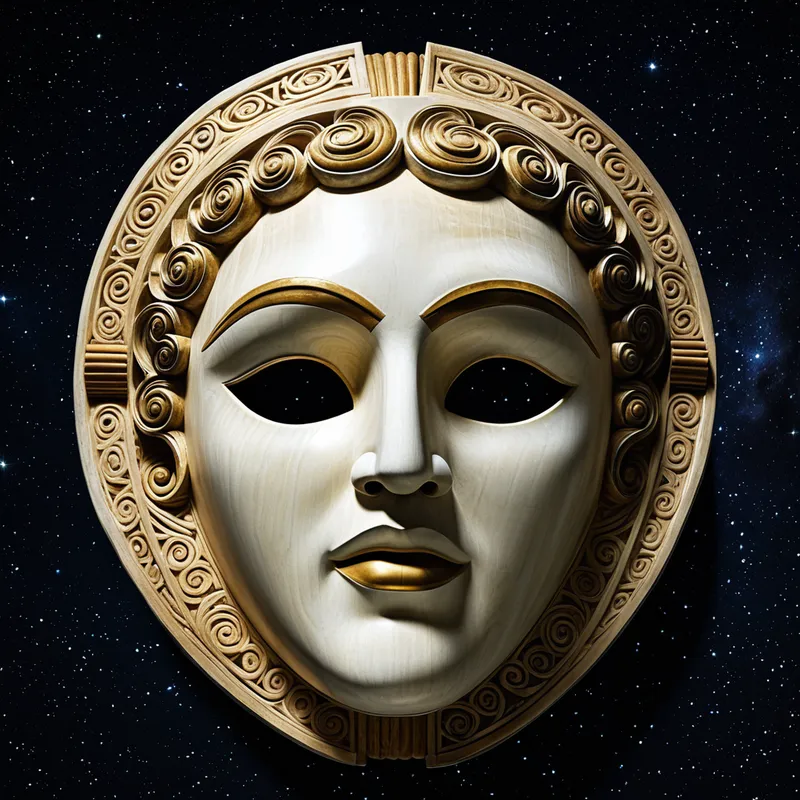
In the forges of [Hephaestus](/myths/hephaestus “Myth from Global/Universal culture.”/), deep within the volcanic heart of Lemnos, a solution was wrought. Not a weapon, not a tool, but an interface. From the breath of Athena came the design: a [thing](/myths/thing “Myth from Norse culture.”/) of carved olive wood or molded clay, smoothed by [the river](/myths/the-river “Myth from Buddhist culture.”/) sands of time. It was hollow, a shell, yet imbued with a divine paradox. They called it the prosopon, the face-for-others.
[Hermes](/myths/hermes “Myth from Global/Universal culture.”/), [the psychopomp](/myths/the-psychopomp “Myth from Various culture.”/), the guide of boundaries, was tasked to deliver this gift. He descended to a gathering of humans at a crossroads, their inner turmoils painting the air around them in visible hues of anguish and joy. He did not speak. Instead, he held the object aloft. It was a mask, serene and ambiguous in expression.
“Take this,” his silence seemed to say. “Place it before your face.”
The first to dare was a shepherd, whose heart was perpetually heavy with a private grief. He lifted [the mask](/myths/the-mask “Myth from Various culture.”/). As it settled, the world shifted. The crushing weight of the others’ pity did not strike him directly. It met the mask first. He found he could speak of the weather, of the flock, without his sorrow being the only topic. A space opened within him, a protected chamber where his grief could simply be, unassailed.
Another, a woman of fiery temper, tried it. The mask absorbed the first flash of her rage, allowing a moment’s pause. In that pause, she found choice.
The gift was not one, but many. Hephaestus forged a multitude: the mask of the wise elder, the mask of the joyful reveler, the mask of the stern judge, the mask of the supplicant. They were tools for the theater of life, allowing humans to play their parts in the city, [the market](/myths/the-market “Myth from Various culture.”/), the ritual. The raw, howling self was not gone; it was sheltered. The mask became the persona, the sound-through-which, the necessary filter between the inner sanctum of the soul and the outer forum of the world.
Cultural Origins & Context
The myth of the persona is not found in a single, canonical text like the tales of Achilles or [Odysseus](/myths/odysseus “Myth from Greek culture.”/). It is a foundational concept woven into the very fabric of Greek social and religious life, emerging most vividly in the ritual of theater. [The word](/myths/the-word “Myth from Biblical culture.”/) itself, prosopon, meant both “face” and “mask,” and later, “person.” Identity was inherently understood as a role one wore.
This myth was enacted, not just recited. In the orchestra of the Dionysian theatre, actors donned large, exaggerated masks that transformed them entirely. The mask allowed a single man to become [Oedipus](/myths/oedipus “Myth from Greek culture.”/), then Dionysus, then a chorus elder. It was a sacred technology. The mask protected the actor from being wholly consumed by the divine or tragic forces he channeled, while also amplifying his voice and creating a universal, archetypal figure for the audience. The myth served a crucial societal function: it legitimized the necessary performance of social roles. To be a citizen, a parent, a priest, was to wear a prosopon appropriate to the occasion. It was a civic duty, a way to maintain the delicate kosmos of [the polis](/myths/the-polis “Myth from Greek culture.”/).
Symbolic Architecture
At its core, the myth of the [Persona](/symbols/persona “Symbol: The social mask or outward identity one presents to the world, often concealing the true self.”/) is about the [birth](/symbols/birth “Symbol: Birth symbolizes new beginnings, transformation, and the potential for growth and development.”/) of the [boundary](/symbols/boundary “Symbol: A conceptual or physical limit defining separation, protection, or identity between entities, spaces, or states of being.”/)—the sacred [separation](/symbols/separation “Symbol: A spiritual or mythic division between realms, states of being, or consciousness, often marking a transition or loss of connection.”/) between the inner and outer worlds. The raw, pre-[persona](/symbols/persona “Symbol: The social mask or outward identity one presents to the world, often concealing the true self.”/) state represents a primordial, undifferentiated [consciousness](/symbols/consciousness “Symbol: Consciousness represents the state of awareness and perception, encompassing thoughts, feelings, and experiences.”/), where subject and object are merged. It is psychic [infancy](/symbols/infancy “Symbol: A symbol of beginnings, vulnerability, and foundational development, often representing a return to origins or a state of pure potential.”/). The gift of the mask is the gift of form, of distinction.
The persona is not a lie, but a vessel. It is the shaped clay that allows the formless water of the soul to be carried from the well of the self to the community of others.
The mask symbolizes the necessary fiction of a coherent [identity](/symbols/identity “Symbol: Identity represents the sense of self, encompassing personal beliefs, cultural background, and social roles.”/). The gods, in their wisdom, did not give humanity a rigid, single face, but a collection of masks. This reveals a profound [truth](/symbols/truth “Symbol: Truth represents authenticity, honesty, and the quest for knowledge beyond mere appearances.”/): [the self](/myths/the-self “Myth from Jungian culture.”/) is not singular, but plural. We contain multitudes, and different situations call forth different aspects of our being. The wise elder and the joyful reveler both reside within. The persona is the selector, the face chosen for the [moment](/symbols/moment “Symbol: The symbol of a ‘moment’ embodies the significance of transient experiences that encapsulate emotional depth or pivotal transformations in life.”/).
Psychologically, the persona represents the adaptive complex of [the ego](/myths/the-ego “Myth from Jungian culture.”/). It is the “I” we present to the world, forged from familial expectations, cultural norms, and professional demands. Its function is vital—it facilitates [adaptation](/symbols/adaptation “Symbol: The process of adjusting to new conditions, often involving psychological or physical change to survive or thrive.”/), communication, and survival within the collective. However, the myth carries a latent warning. The [danger](/symbols/danger “Symbol: The symbol of ‘Danger’ often indicates a sense of threat or instability, calling for caution and awareness.”/) is identification. One can forget to remove the mask, can believe the carved [wood](/symbols/wood “Symbol: Wood symbolizes strength, growth, and the connection to nature and the environment.”/) is one’s true face. The [shepherd](/symbols/shepherd “Symbol: A shepherd symbolizes guidance, protection, and the nurturing aspects of leadership, often reflecting the dreamer’s desire for direction or support.”/) who never removes his “stoic” mask may find his [grief](/symbols/grief “Symbol: A profound emotional response to loss, often manifesting as deep sorrow, yearning, and a sense of emptiness.”/) has festered into [despair](/symbols/despair “Symbol: A profound emotional state of hopelessness and loss, often signaling a need for transformation or surrender to deeper truths.”/) in the dark [chamber](/symbols/chamber “Symbol: A private, enclosed space representing the inner self, hidden aspects, or a specific stage in life’s journey.”/) of his [soul](/symbols/soul “Symbol: The soul represents the essence of a person, encompassing their spirit, identity, and connection to the universe.”/).
The Dreamer’s Resonance
When the myth of the Persona stirs in the modern unconscious, it often manifests in dreams of masks, faces, and interfaces. To dream of frantically trying on different masks, none of which fit, speaks to a crisis of identity. The dreamer is trying on societal roles (the professional, the partner, the parent) but feels no authentic connection to them. The somatic sensation is often one of constriction, of suffocation—the mask is too tight.
Dreams of a mask cracking or shattering can be terrifying, but they are profound moments of initiation. This signifies a rupture in the over-identified persona. The adapted self has become too rigid, too brittle, and the pressure of the neglected inner life (the shadow, the authentic feelings) is breaking through. The psychological process here is one of disintegration for the purpose of reintegration. The dream ego is being shown that its current “face” is not the whole truth.
Conversely, a dream where one discovers a beautiful, comfortable mask that feels “just right” may indicate the healthy formation of a new persona—perhaps a new career identity or social role that genuinely aligns with deeper aspects of the self. The dream celebrates a successful adaptation.

Alchemical Translation
The alchemical journey modeled by the Persona myth is the process of relation. It begins with the [prima materia](/myths/prima-materia “Myth from Alchemical culture.”/) of the undifferentiated, exposed self. The first operation is coagulatio—giving form, creating the mask. This is the necessary stage of entering the world, of building an ego-structure.
The peril, and the next stage of the work, is in [separatio](/myths/separatio “Myth from Alchemical culture.”/). One must learn to distinguish the mask from the wearer. This is the essence of psychological liberation: “I am not my job. I am not my social role. I am not the face I show to placate my parents.” This separation requires conscious reflection and often, a descent into [the shadow](/myths/the-shadow “Myth from Jungian culture.”/) material that the persona was designed to hide.
The ultimate alchemy is not in destroying the persona, but in becoming its conscious author. To wear the mask knowingly is to transform it from a prison of identification into a tool of sacred play.
The final translation is coniunctio—not a rejection of the mask, but a redeemed relationship with it. The individuated person can don the mask of the healer, the teacher, or the leader with full awareness, skill, and compassion, then remove it and return to the silent, unmasked core of being. The persona becomes a flexible, expressive instrument of the self, rather than its master. One moves from being an unwitting actor on the world’s stage to becoming the playwright and director of one’s own necessary performances, always in service to the mystery of the soul within. The sound that passes through the mask is no longer merely an echo of expectation, but the unique music of an individual life, filtered into forms the world can hear.
Associated Symbols
Explore related symbols from the CaleaDream lexicon: