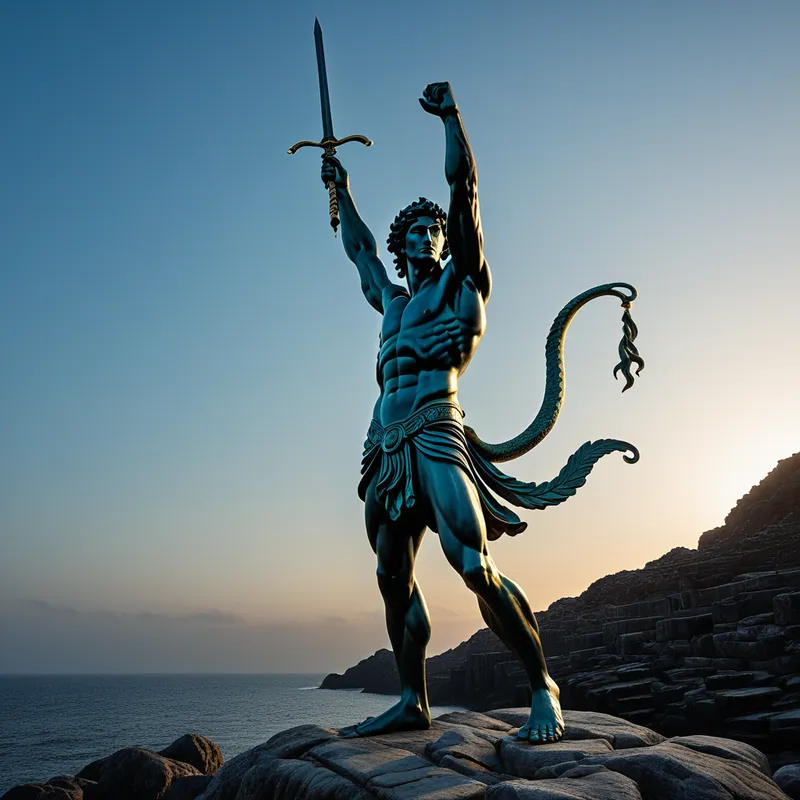
Perseus' Sword Myth Meaning & Symbolism
A hero, armed with gifts from the gods, uses a mirrored shield to confront the Gorgon Medusa, turning her petrifying gaze into a tool of liberation.
The Tale of Perseus’ Sword
Hear now the tale of the blade that was not forged by mortal hands, a tale born from the storm of divine will and mortal fear. It begins with a king, Polydectes, whose heart was a trap of polished stone, and a youth, [Perseus](/myths/perseus “Myth from Greek culture.”/), son of Zeus, whose very existence was a threat. The king, desiring the youth’s mother and seeking the boy’s death, set a seemingly impossible price for his mother’s freedom: the head of the Gorgon [Medusa](/myths/medusa “Myth from Greek culture.”/), whose gaze turned flesh and blood and hope into cold, silent stone.
Cast adrift by this cruel decree, Perseus stood on a lonely shore, the salt wind his only companion. It was here the gods intervened, not with an army, but with tools. From the swift-footed [Hermes](/myths/hermes “Myth from Global/Universal culture.”/) came two gifts: first, the [talaria](/myths/talaria “Myth from Greek culture.”/) to chase [the wind](/myths/the-wind “Myth from Various culture.”/), and second, a weapon. This was no ordinary sword. It was an adamantine harpe, its curve like a crescent moon captured in metal, its edge honed by divine craft to a sharpness that could part spirit from form. It was the sword of decisive separation.
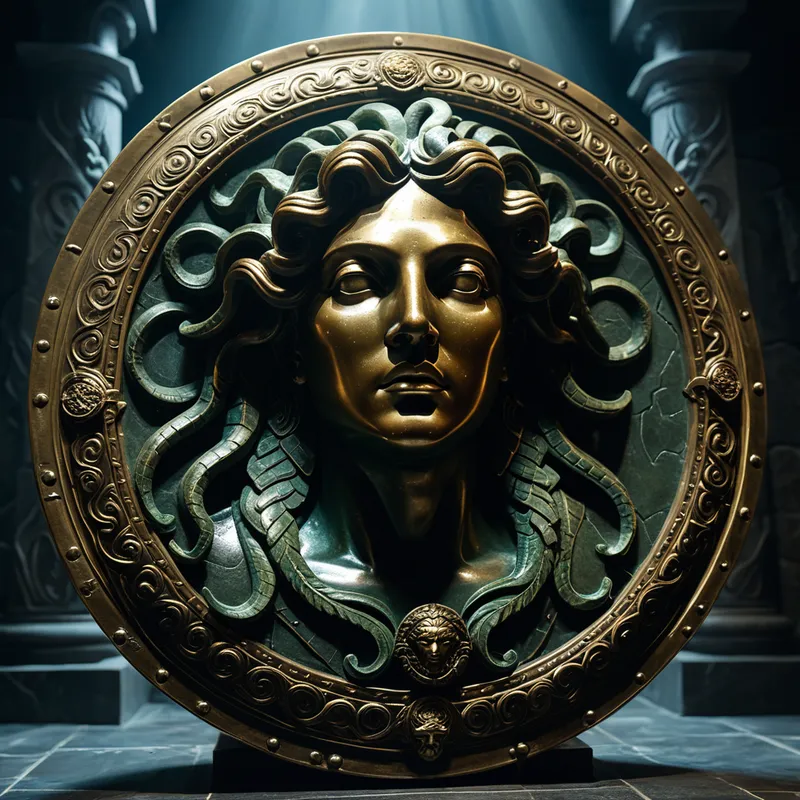
But a sword alone is a blind instrument. From the grey-eyed Athena came wisdom’s own tool: a shield of polished bronze, brighter than any mirror. “Look not upon her directly,” the goddess warned, her voice the sound of owl wings in the dark. “Let your shield be your eye. See only the reflection.”
Guided by the Graeae and armed with these divine implements, Perseus flew to the end of [the world](/myths/the-world “Myth from Tarot culture.”/), to the Gorgons’ lair—a place of unspeakable stillness, littered with the statues of those who had dared and failed. The air was thick with the silence of captured screams. There, among her stony sisters, slept Medusa.
Perseus descended, his heart a drum against his ribs. He fixed his eyes not on the horror before him, but on the horror reflected in the shining bronze. In that circular world of metal, he saw the coiled serpents, the face that was a monument to divine wrath. Holding the image steady in the shield, he became a surgeon of fate. He did not charge; he calculated. He did not rage; he focused. With the adamantine harpe granted by Hermes, a tool of divine intervention, he struck not in blind fury, but with the precise, backward arc of one who trusts the reflection. The blade, singing with celestial sharpness, cleaved through sinew and spell. From the severed neck sprang the winged horse [Pegasus](/myths/pegasus “Myth from Global/Universal culture.”/) and the giant Chrysaor, new life born from the cut. The hero, swift as the god who armed him, seized the head, using the very shield that showed him [the way](/myths/the-way “Myth from Taoist culture.”/) as a vessel to contain the petrifying power he had now mastered.
Cultural Origins & Context
This myth, as we know it, was crystallized in the Epic Cycle and later sculpted into canonical form by poets like Hesiod and the Roman Ovid. It was not mere entertainment; it was a foundational narrative told in symposiums, recited at festivals, and depicted on temple metopes and everyday amphorae. It functioned as a cultural blueprint for the Hellenic ideal of the hero.
Perseus is a unique hero—often less brutish than [Heracles](/myths/heracles “Myth from Greek culture.”/), more strategic and divinely favored. His story reinforced crucial societal values: the importance of [metis](/myths/metis “Myth from Greek culture.”/) (cunning intelligence) over brute force, the necessity of piety to receive the gods’ favor ([xenia](/myths/xenia “Myth from Greek culture.”/)), and the ultimate [triumph](/myths/triumph “Myth from Roman culture.”/) of civilized order (represented by the gods’ gifts) over primordial, chaotic monstrosity. The sword, a direct gift from Hermes, underscored that true heroism was a collaboration between mortal courage and divine grace. It was a myth that assured its audience that even the most terrifying obstacles could be overcome with the right tools, the right guidance, and the right—the reflective—approach.
Symbolic Architecture
The myth of Perseus’ Sword is a masterclass in symbolic [psychology](/symbols/psychology “Symbol: Psychology in dreams often represents the exploration of the self, the subconscious mind, and emotional conflicts.”/). Each element is an [aspect](/symbols/aspect “Symbol: A distinct feature, quality, or perspective of something, often representing a partial view of a larger whole.”/) of the [psyche](/myths/psyche “Myth from Greek culture.”/) navigating its own transformation.
The Sword of Adamant is not merely a [weapon](/symbols/weapon “Symbol: A weapon in dreams often symbolizes power, aggression, and the need for protection or defense.”/); it is [the principle](/symbols/the-principle “Symbol: A fundamental truth, law, or doctrine that serves as a foundation for a system of belief, behavior, or reasoning, often representing moral or ethical standards.”/) of discrimination and decisive [action](/symbols/action “Symbol: Action in dreams represents the drive for agency, motivation, and the ability to take control of situations in waking life.”/). It represents the conscious will, honed and gifted from a higher [source](/symbols/source “Symbol: The origin point of something, often representing beginnings, nourishment, or the fundamental cause behind phenomena.”/) ([the Self](/myths/the-self “Myth from Jungian culture.”/), or transcendent function), capable of making the clean, necessary cut that separates one state of being from another. It is the act of saying “no,” of setting a [boundary](/symbols/boundary “Symbol: A conceptual or physical limit defining separation, protection, or identity between entities, spaces, or states of being.”/), of severing an identification.
The sword is the clarity of consciousness that must cut through the tangled, petrifying narratives of the unconscious to liberate new potential.
Athena’s [Shield](/symbols/shield “Symbol: A symbol of protection, defense, and boundaries, representing personal security, resilience, and the need to guard against external threats or emotional harm.”/) is the complementary principle: [reflection](/symbols/reflection “Symbol: Reflection signifies self-examination, awareness, and the search for truth within oneself.”/) and indirect [perception](/symbols/perception “Symbol: The process of becoming aware of something through the senses. In dreams, it often represents how one interprets reality or internal states.”/). It is the [capacity](/symbols/capacity “Symbol: A measure of one’s potential, limits, or ability to contain, process, or achieve something, often reflecting self-assessment or external demands.”/) for self-observation, for seeing the terrifying aspects of our own psyche (the [Shadow](/symbols/shadow “Symbol: The ‘shadow’ embodies the unconscious, repressed aspects of the self and often represents fears or hidden emotions.”/), in the form of Medusa) not head-on, where they paralyze us, but indirectly, through the mediating [vessel](/symbols/vessel “Symbol: A container or structure that holds, transports, or protects something essential, representing the self, emotions, or life journey.”/) of art, dream [analysis](/symbols/analysis “Symbol: The process of examining something methodically to understand its components or meaning. In dreams, it represents the mind’s attempt to break down complex experiences.”/), or therapeutic [dialogue](/symbols/dialogue “Symbol: Conversation or exchange between characters, representing communication, relationships, and narrative flow in games and leisure activities.”/). We do not confront the complex directly; we analyze its reflection. Medusa herself is the ultimate [symbol](/symbols/symbol “Symbol: A symbol can represent an idea, concept, or belief, serving as a powerful tool for communication and understanding.”/) of the petrifying, traumatic complex—the face that turns one to [stone](/symbols/stone “Symbol: In dreams, a stone often symbolizes strength, stability, and permanence, but it may also represent emotional burdens or obstacles that need to be acknowledged and processed.”/) is the [memory](/symbols/memory “Symbol: Memory symbolizes the past, lessons learned, and the narratives we construct about our identities.”/) or fear that freezes us in [trauma](/symbols/trauma “Symbol: A deeply distressing or disturbing experience that overwhelms the psyche, often manifesting in dreams as unresolved emotional wounds or psychological injury.”/), the [shame](/symbols/shame “Symbol: A painful emotion arising from perceived failure or violation of social norms, often involving exposure of vulnerability or wrongdoing.”/) that paralyzes growth. Perseus’s entire [operation](/symbols/operation “Symbol: An operation signifies a process of change or transformation that often requires deliberate effort and planning.”/)—using the [shield](/symbols/shield “Symbol: A symbol of protection, defense, and boundaries, representing personal security, resilience, and the need to guard against external threats or emotional harm.”/) to see, and the sword to cut—models the therapeutic process: we must first safely observe the [pattern](/symbols/pattern “Symbol: A ‘Pattern’ in dreams often signifies the underlying structure of experiences and thoughts, representing both order and the repetitiveness of life’s situations.”/) (reflect) before we can consciously intervene to change it (cut).
The Dreamer’s Resonance
When this myth stirs in the modern dreamer, it signals a profound crossroads in the psyche. To dream of a shining, impossibly sharp sword often accompanies a somatic feeling of readiness, a gathering of personal will and resolve. It appears when a difficult, clean break is psychically imminent—leaving a toxic situation, ending a self-destructive habit, cutting ties with an old identity.
Conversely, to dream of a mirrored shield, or to find oneself in a dream avoiding a direct gaze, points to an encounter with one’s own “Medusa.” This is the somatic experience of freezing, of dread rooted in a complex not yet integrated. The dream may present a terrifying figure, a monstrous reflection, or simply an overwhelming force that cannot be faced directly. The psyche, in its wisdom, is insisting on an indirect approach. It is calling for reflection, for the dreamer to turn their attention to the image of the problem—through journaling, active imagination, or somatic awareness—rather than being consumed by the problem itself. The appearance of both sword and shield together is a powerful indicator that the dreamer is assembling the inner resources necessary for a transformative act of psychic surgery.

Alchemical Translation
The journey of Perseus is a precise allegory for the alchemical process of individuation. The initial state is one of oppression (Polydectes) and imposition of an impossible task. This is the [nigredo](/myths/nigredo “Myth from Alchemical culture.”/), the darkening, the leaden feeling of being trapped by an external or internal tyrant.
The gifts from the gods represent the arrival of transcendent resources from the Self. Hermes’ sword is the Mercurial spirit—the penetrating insight and communicative function that can make distinctions. Athena’s shield is the Solar principle of consciousness and wisdom—the light of awareness that allows for reflection without being consumed. The flight to the lair is the journey into the unconscious (descensus ad inferos).
The confrontation is the core operation. The petrifying Medusa is the [prima materia](/myths/prima-materia “Myth from Alchemical culture.”/), the chaotic, terrifying raw material of the psyche, often our deepest wound or most gripping complex. To stare at it directly is to be identified with it, to be paralyzed by it. The alchemical instruction is clear: use the speculum ([the mirror](/myths/the-mirror “Myth from Various culture.”/)). Observe the complex in [the vessel](/myths/the-vessel “Myth from Alchemical culture.”/) of reflection. This is the stage of [separatio](/myths/separatio “Myth from Alchemical culture.”/), where consciousness differentiates itself from the unconscious content.
The cut of the sword is the moment of integration, where the conscious ego, acting as the hero, severs the autonomous, monstrous power of the complex, transforming it into a usable resource.
The act of beheading is not destruction, but transformation. From the wound springs Pegasus (the soaring spirit, inspiration) and Chrysaor (the golden-wielded power). The severed head, now contained in the shield-bag, becomes the Gorgoneion, a protective amulet. This is the ultimate alchemical truth: what once paralyzed us, when faced with reflection and decisively integrated, becomes our greatest source of power and protection. The liberated hero returns, not just with a trophy, but with the petrifying gaze now under his command—a symbol of the individual who has faced their deepest shadow and emerged not merely unscathed, but empowered, capable of “freezing” malignant forces in their own life. The sword’s cut completes the cycle, turning leaden paralysis into golden, winged potential.
Associated Symbols
Explore related symbols from the CaleaDream lexicon: