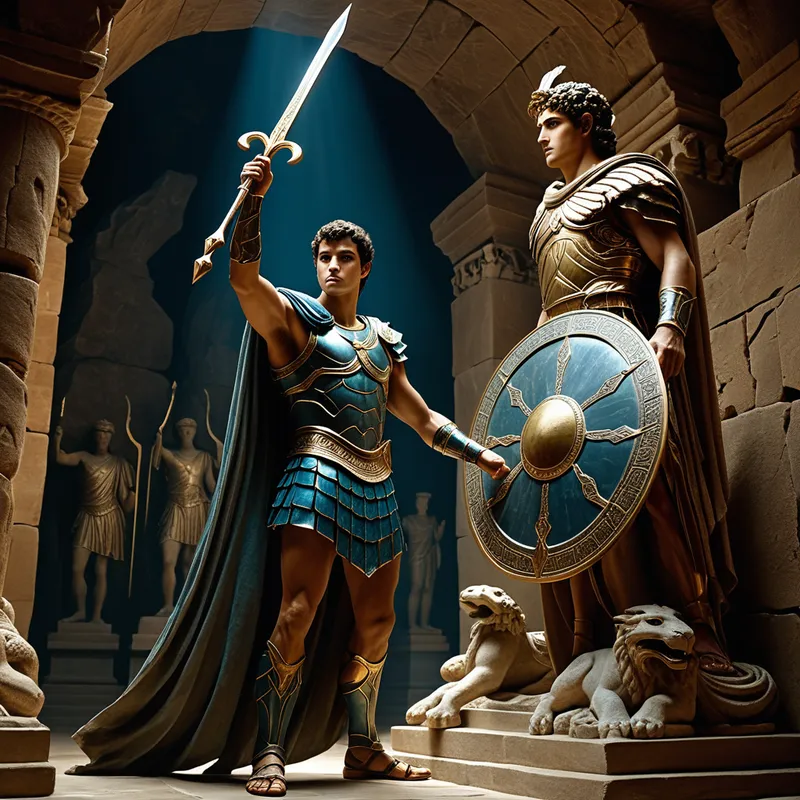
Perseus and the Harpe Myth Meaning & Symbolism
A hero, armed with a divine sickle-sword, confronts the petrifying gaze of the Gorgon, severing the monstrous to liberate the sacred.
The Tale of Perseus and the Harpe
Listen, and hear a tale spun on the loom of fate, a story of a son cast into [the sea](/myths/the-sea “Myth from Greek culture.”/) at birth, who would rise to meet the gaze of the unseeable. His name was [Perseus](/myths/perseus “Myth from Greek culture.”/), and his path was etched by the cruelty of a king. The tyrant Polydectes, seeking to be rid of the youth, set a deadly bride-price: the head of the Gorgon [Medusa](/myths/medusa “Myth from Greek culture.”/).
A man alone would be but another statue in her lair. But Perseus was not alone. The whispers of the gods stirred the air. Athena, whose shield was a mirror to truth, appeared to him. Her grey eyes were cool, her voice the sound of strategy. [Hermes](/myths/hermes “Myth from Global/Universal culture.”/), the swift one, came on winged sandals, a smile playing on his lips. They were the guides in the unseen world.
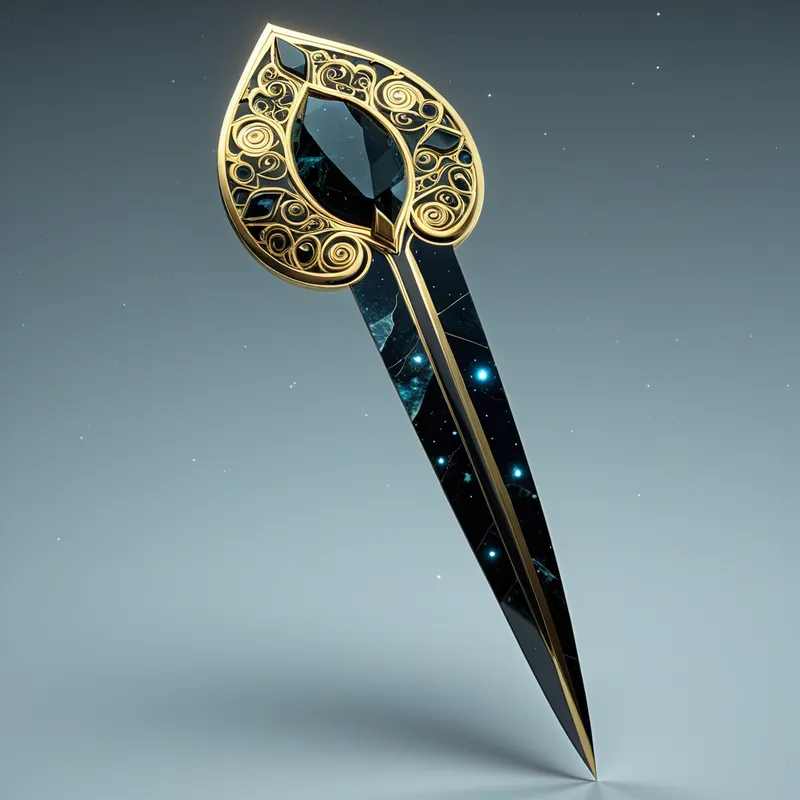
To Hermes, they gave the weapon. Not a common sword of bronze, but the Harpe. Its blade was of adamantine, a metal fallen from the stars, unbreakable and keen enough to cut shadow from substance. Its shape was a crescent, a sharpened moon, a tool that had once severed the very heavens from [the earth](/myths/the-earth “Myth from Hindu culture.”/). Into Perseus’s hand it was placed, its weight both physical and prophetic.
But a blade alone is a blind man’s stick. From the Graeae, the grey witches, he stole their single seeing eye. From the [Nymphs](/myths/nymphs “Myth from Greek culture.”/) of the North, he received gifts that made him a ghost: the helmet of [Hades](/myths/hades “Myth from Greek culture.”/) that shrouded him in darkness, winged sandals to dance on [the wind](/myths/the-wind “Myth from Various culture.”/), and the kibisis to safely hold his terrible prize. And from Athena, the final key: a shield of bronze, polished to a mirror’s sheen.
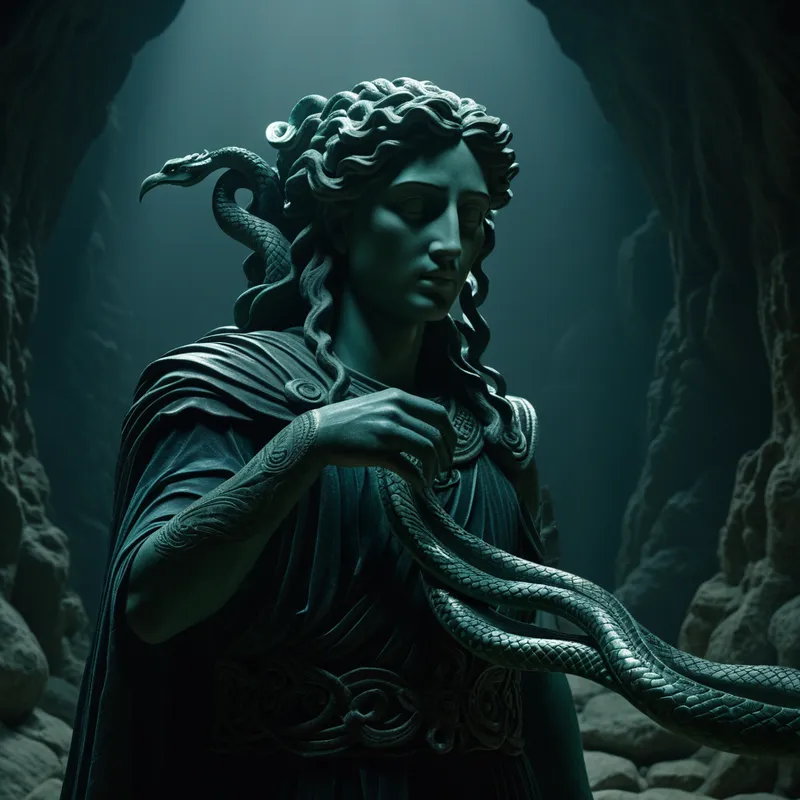
Then he flew, a silent thought on the wind, to the end of [the world](/myths/the-world “Myth from Tarot culture.”/), where the Gorgons dwelt in a garden of stone men. The air was thick with the silence of halted breath. There she lay, Medusa, asleep amidst her stone-faced victims, her hair a nest of living, hissing serpents. Perseus did not look upon her. He moved by the guidance of the goddess, his eyes fixed only on the reflection in the shield. He saw the monster not as she was, but as she was mirrored—a distorted truth he could bear to witness.
The Harpe descended. It was not a strike of anger, but a cut of divine necessity, a clean, crescent arc through the neck. From the severed wound sprang [Pegasus](/myths/pegasus “Myth from Global/Universal culture.”/), the winged horse, and the giant Chrysaor—life and violence born from death. With a motion swift as thought, he plunged the head into the kibisis, its petrifying power now contained, a weapon turned to ward.
Cultural Origins & Context
This myth echoes from the Bronze Age, a foundational story for the city-states of Argos and Mycenae, whose kings traced their lineage directly to Perseus. It was not a singular text but a living narrative, sung by bards like [Homer](/myths/homer “Myth from Greek culture.”/) and later sculpted into epic cycles by poets such as Hesiod. Its function was multifaceted: it established heroic genealogy, explained the origins of mythical creatures like Pegasus, and served as a paradigm for the young warrior.
The tale was a societal instruction manual for navigating a world perceived as deeply interconnected with the divine. It taught that raw courage was insufficient; success required [metis](/myths/metis “Myth from Greek culture.”/) (cunning intelligence), divine favor (theia moira), and the proper use of magical tools (keimēlia). Perseus’s journey, from being cast adrift to returning as a sovereign, modeled the ideal passage from vulnerable youth to authoritative adulthood, a journey every aristocratic Greek youth was expected to undertake in spirit.
Symbolic Architecture
The myth is a perfect diagram of the [psyche](/myths/psyche “Myth from Greek culture.”/) confronting its own annihilating [depths](/symbols/depths “Symbol: Represents the subconscious, hidden emotions, or foundational aspects of the self, often linked to primal fears or profound truths.”/). Perseus represents the nascent [consciousness](/symbols/consciousness “Symbol: Consciousness represents the state of awareness and perception, encompassing thoughts, feelings, and experiences.”/), [the ego](/myths/the-ego “Myth from Jungian culture.”/) tasked with an impossible [mission](/symbols/mission “Symbol: A mission in dreams represents one’s aspirations and goals, often linked to a sense of purpose or commitment.”/) from a tyrannical [father](/symbols/father “Symbol: The father figure in dreams often symbolizes authority, protection, guidance, and the quest for approval or validation.”/)-figure (Polydectes). The mission itself is the call to confront the ultimate [shadow](/symbols/shadow “Symbol: The ‘shadow’ embodies the unconscious, repressed aspects of the self and often represents fears or hidden emotions.”/): Medusa.
Medusa is not mere monster; she is the face of the unbearable, the traumatic memory, the repressed rage or shame that, if looked at directly, petrifies the soul into rigid patterns, neuroses, and emotional paralysis.
The gods who aid Perseus are the guiding archetypes of [the Self](/myths/the-self “Myth from Jungian culture.”/): Athena, the discerning wisdom that allows us to see indirectly (the mirrored [shield](/symbols/shield “Symbol: A symbol of protection, defense, and boundaries, representing personal security, resilience, and the need to guard against external threats or emotional harm.”/)); Hermes, [the psychopomp](/myths/the-psychopomp “Myth from Various culture.”/) who provides the means of transition and the tool of decisive [separation](/symbols/separation “Symbol: A spiritual or mythic division between realms, states of being, or consciousness, often marking a transition or loss of connection.”/) (the Harpe). The magical gifts are the internal resources we must integrate: invisibility (the [capacity](/symbols/capacity “Symbol: A measure of one’s potential, limits, or ability to contain, process, or achieve something, often reflecting self-assessment or external demands.”/) to observe the unconscious without being overwhelmed by it), [flight](/symbols/flight “Symbol: Flight symbolizes freedom, escape, and the pursuit of one’s aspirations, reflecting a desire to transcend limitations.”/) (transcendent [perspective](/symbols/perspective “Symbol: Perspective in dreams reflects one’s viewpoints, attitudes, and how one interprets experiences.”/)), and containment (the kibisis, the [ability](/symbols/ability “Symbol: In dreams, ‘ability’ often denotes a recognition of skills or potential that one possesses, whether acknowledged or suppressed.”/) to hold powerful psychic content without being destroyed by it).
The Harpe itself is the supreme [symbol](/symbols/symbol “Symbol: A symbol can represent an idea, concept, or belief, serving as a powerful tool for communication and understanding.”/). As a [sickle](/symbols/sickle “Symbol: The sickle symbolizes the cyclical nature of life, harvest, and the labor involved in reaping rewards from hard work.”/), it is the tool of [Kronos](/myths/kronos “Myth from Greek culture.”/), who severed [Heaven](/symbols/heaven “Symbol: A symbolic journey toward ultimate fulfillment, spiritual transcendence, or connection with the divine, often representing life’s highest aspirations.”/) from [Earth](/symbols/earth “Symbol: The symbol of Earth often represents grounding, stability, and the physical realm, embodying a connection to nature and the innate support it provides.”/). Here, it is the [instrument](/symbols/instrument “Symbol: An instrument symbolizes creativity, communication, and the means by which one expresses oneself or influences the world.”/) of psychic [differentiation](/symbols/differentiation “Symbol: The process of distinguishing or separating parts of the self, emotions, or identity from a whole, often marking a developmental or psychological milestone.”/).
To wield the Harpe is to make the conscious, courageous cut that separates the paralyzing image of a trauma (the monstrous head) from the living, creative potential that was bound within it (Pegasus).
The Dreamer’s Resonance
When this myth stirs in modern dreams, the dreamer is at a threshold. They may dream of facing a terrifying, hidden figure, of holding a strange, curved blade, or of using a mirror to see something behind them. The somatic sensation is often one of frozen dread—the petrification—mixed with a thrilling, anxious clarity.
This dream pattern signals that a deeply rooted, archaic complex—often related to a primal fear, a maternal wound, or a core shame—is rising to the surface of awareness. The psyche is assembling its own “nymph-given gifts”: perhaps a newfound intellectual detachment (Athena’s shield), a sudden insight or “messenger” thought (Hermes), or a protective boundary (Hades’ helmet). The dreamer is in the process of gathering the internal resources required to “behead” a pattern that has held them in stasis. The act is not one of violence, but of sacred severance, of cutting the identification with a story that has turned their own life to stone.
Alchemical Translation
The alchemy of Perseus is the transmutation of the [prima materia](/myths/prima-materia “Myth from Alchemical culture.”/) of trauma into the gold of sovereignty. The journey models the individuation process perfectly. First, the [nigredo](/myths/nigredo “Myth from Alchemical culture.”/): the dark, chaotic sea of the infant’s exile, the oppressive demand of the tyrant (the unresolved parental complex). Then, the guiding symbols from the Self arrive (divine aid), prompting the albedo: the purification and preparation, the gathering of tools and the adoption of reflective consciousness.
The confrontation in [the Gorgon](/myths/the-gorgon “Myth from Various culture.”/)’s cave is the [rubedo](/myths/rubedo “Myth from Alchemical culture.”/), the fiery crucible of transformation. Here, the conscious ego, guided by the Self (the gods), does not fight [the shadow](/myths/the-shadow “Myth from Jungian culture.”/) on its own terms but uses reflection to approach it safely. The stroke of the Harpe is the moment of integration—not by embracing the monster, but by severing its autonomous, terrifying power from the psyche’s substance.
The liberated head, placed in the kibisis, becomes the telos of the work: the once-paralyzing content is now a contained power that can petrify external threats (as Perseus later uses it against his enemies). The born Pegasus is the new, liberated creative spirit.
For the modern individual, this means that the work of healing is not to become one with our deepest wound, but to separate its eternal, frightening form from our living being. We behead the Gorgon not to kill a part of ourselves, but to free the winged life trapped within the stone. We reclaim the Harpe—the power of conscious discrimination—and in doing so, cease to be victims of what we cannot bear to see, becoming instead sovereigns of our own reflected gaze.
Associated Symbols
Explore related symbols from the CaleaDream lexicon: