Peplos of Athena Myth Meaning & Symbolism
The sacred ritual of weaving and presenting a new robe to the statue of Athena, embodying the city's soul, fate, and cyclical rebirth.
The Tale of Peplos of Athena
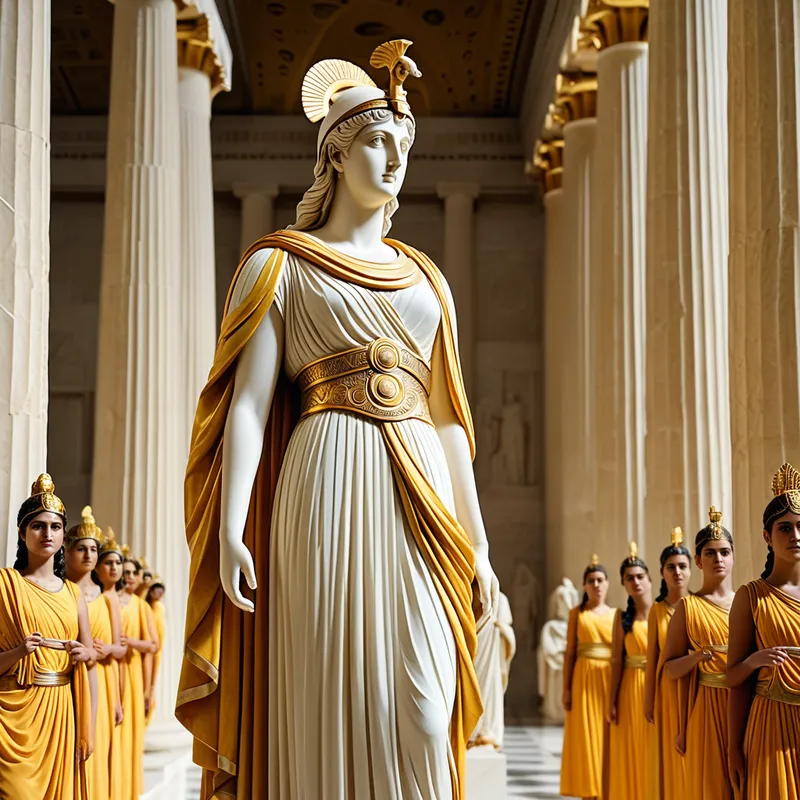
Hear now the tale of the city’s breath, the rhythm of its heart. It begins not with a roar, but with the soft, persistent whisper of the shuttle through the warp. In the high citadel of [the Acropolis](/myths/the-acropolis “Myth from Greek culture.”/), under the watchful eyes of the olive trees that were her first gift, the presence of Athena was a cool, clear pressure in the air. Her great statue, the Athena Parthenos, stood in the dimness of [the Parthenon](/myths/the-parthenon “Myth from Greek culture.”/), a giantess of ivory and gold, her spear a promise, her outstretched hand a blessing.
But her woven garment, the [peplos](/myths/peplos “Myth from Greek culture.”/), grew weary with the passing year. It held the dust of prayers, the faint scent of incense and oil, the memory of a thousand gazes. It was time for the old to be folded away and for the new to be born.
This was no common task. In a sacred chamber, chosen from the noble houses of Athens, the Arrephoroi and the Ergastinai began their silent, solemn work. Their hands, young and diligent, selected the finest wool, dyed it with precious saffron until it glowed like captured sunlight. The loom became an altar. As they wove, they did not weave mere patterns. They wove the story of the gods themselves—the [triumph](/myths/triumph “Myth from Roman culture.”/) of Zeus over [the Titans](/myths/the-titans “Myth from Greek culture.”/), the victory of divine order over primal chaos. With each pass of the thread, they bound the fate of the city into the fabric.
The climax came with the Panathenaia. The city held its breath. A grand procession unspooled from the Dipylon Gate, snaking through the Agora, climbing the sacred way. Musicians, sacrificial animals, elders, and warriors—all moved toward the towering rock. At the heart of this river of people was the new peplos, displayed like a sail on the mast of a sacred ship-cart. It billowed in the Aegean wind, a banner of saffron light.
The procession reached the [Parthenon](/myths/parthenon “Myth from Greek culture.”/)’s feet. In a moment of profound intimacy amidst the public spectacle, the old peplos was tenderly removed from the ancient wooden statue of Athena Polias. Then, the new one was draped upon her. The goddess was re-clothed. The city, through the hands of its daughters and the devotion of its citizens, had re-made its covenant with the divine intelligence that protected it. The old robe, now a sacred relic, was stored away, holding the past year’s trials and blessings. The new one, bright and potent, faced the year to come. The cycle was complete. The city had breathed in, and breathed out.
Cultural Origins & Context
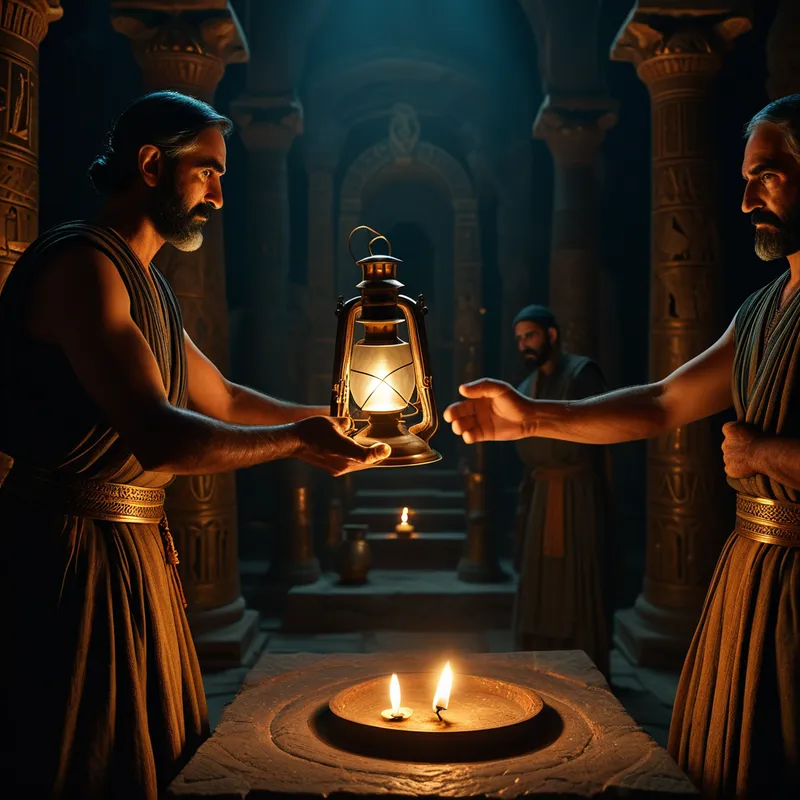
The ritual of the Peplos was not merely a story; it was the lived, annual heartbeat of Athenian civic and religious identity. Its origins are lost in the deep time of Mycenaean and Minoan traditions of goddess worship and sacred cloth, but by the Classical period, it was the centerpiece of the Panathenaic Festival. This was Athens’ most important event, held annually with a much grander version, the Great Panathenaia, every four years.
The myth was not “told” in a single epic but performed. It was enacted by the entire polis. The select young women who wove the peplos lived a liminal life on the Acropolis for nine months, their labor a form of civic service and religious initiation. The procession was a living map of Athenian society, from metics (resident foreigners) to cavalry, all in their assigned place, moving in harmony toward the divine center. The function was multifaceted: it honored the city’s patron deity, reinforced social hierarchy and cohesion, and performed a crucial act of sympathetic magic. By clothing the goddess, the city symbolically renewed its own strength, order, and fortune. It was an act of collective maintenance for the soul of the state.
Symbolic Architecture
At its core, the Peplos is a [symbol](/symbols/symbol “Symbol: A symbol can represent an idea, concept, or belief, serving as a powerful tool for communication and understanding.”/) of the [veil](/symbols/veil “Symbol: A veil typically symbolizes concealment, protection, and transformation, representing both mystery and femininity across cultures.”/)—not as something that hides, but as something that contains, defines, and mediates. It is the [skin](/symbols/skin “Symbol: Skin symbolizes the boundary between the self and the world, representing identity, protection, and vulnerability.”/) between the divine and the [human](/symbols/human “Symbol: The symbol of a human represents individuality, complexity of emotions, and social relationships.”/), the ideal and the manifest.
The sacred garment is the visible form of the invisible covenant. To weave it is to participate in the creation of the world-order one inhabits.
The loom represents cosmic order, the kosmos. The vertical warp threads are the fixed, divine principles; the horizontal weft threads are the human actions and events of time. The finished peplos is the beautiful, ordered [reality](/symbols/reality “Symbol: Reality signifies the state of existence and perception, often reflecting one’s understanding of truth and life experiences.”/) produced from this [intersection](/symbols/intersection “Symbol: An intersection symbolizes the crossroads of decision-making, presenting choices and the potential for change.”/). The act of weaving the Gigantomachy (battle with the Giants) into the fabric is profoundly psychological: it is the eternal human [task](/symbols/task “Symbol: A task represents responsibilities, duties, or challenges one faces.”/) of consciously integrating our chaotic, titanic impulses (anger, fear, greed) into a coherent narrative of self-mastery and civilized [life](/symbols/life “Symbol: The symbol of ‘Life’ represents a journey of growth, interconnectedness, and existential meaning, encompassing both the joys and challenges that define human experience.”/), under the [aegis](/symbols/aegis “Symbol: A divine shield or protective mantle, often associated with Zeus or Athena in Greek mythology, representing supernatural protection, authority, and divine power.”/) of wisdom (Athena).
The [ritual](/symbols/ritual “Symbol: Rituals signify structured, meaningful actions carried out regularly, reflecting cultural beliefs and emotional needs.”/) replacement—removing the old, draping the new—is a master symbol of renewal. It acknowledges that all forms grow worn, all institutions stale, all personal identities rigid. [Health](/symbols/health “Symbol: Health embodies well-being, vitality, and the balance between physical, mental, and spiritual states.”/) lies not in permanence, but in the sacred, cyclical act of conscious renewal.
The Dreamer’s Resonance
When this myth stirs in the modern unconscious, it often manifests in dreams of clothing, weaving, or preparing for a significant ceremony. To dream of frantically searching for the right garment for a pivotal event mirrors the anxiety of presenting one’s crafted self to [the world](/myths/the-world “Myth from Tarot culture.”/) or to one’s own inner authority. To dream of weaving a tapestry whose pattern keeps changing or unraveling speaks to the struggle to create a coherent identity or life-narrative from disparate threads of experience, relationships, and aspirations.
The somatic sensation is often one of pressure or solemn responsibility—a “weight of the robe.” This is the [psyche](/myths/psyche “Myth from Greek culture.”/) signaling a transition point where an old “skin” or way of being (a job, a relationship, a self-concept) has served its purpose and grown heavy with accumulated history. The dream process is the psyche’s workshop, where the new garment—the next iteration of [the Self](/myths/the-self “Myth from Jungian culture.”/)—is being silently assembled. The conflict in such dreams is rarely about external monsters, but about the precision, dedication, and patience required for this inner craftsmanship.
Alchemical Translation
The alchemical process mirrored here is circulatio—the cyclical distillation and refinement of the spirit. The individual’s journey of individuation is not a linear path to a fixed goal, but an ongoing ritual of renewal.
Individuation is the Panathenaic procession of the soul, regularly returning to its own Acropolis to reclothe its central image of meaning.
The “old peplos” is the outworn [persona](/myths/persona “Myth from Greek culture.”/), the defensive identity, the narrative we’ve told ourselves that has grown stiff and no longer fits our lived reality. The “weaving chamber” is the introverted, protected space of reflection, therapy, or creative incubation where we examine the raw materials of our life—our memories, talents, and wounds—and begin to work them into a new pattern. Choosing the “saffron” dye is the act of committing to value, to making our life’s work something of worth and beauty.
The procession is the courageous act of bringing this newly woven self back into the world—the Agora of our relationships and responsibilities—and offering it up to our own inner Athena, the archetype of conscious discernment and strategic wisdom. Draping the new garment is the moment of integration, where we fully inhabit the renewed identity. The stored old robe is not discarded; it is honored as part of our history, its threads still part of the larger tapestry of the Self. Thus, the psyche achieves its own Great Panathenaia, a festival of becoming, repeated in cycles throughout a lifetime.
Associated Symbols
Explore related symbols from the CaleaDream lexicon: