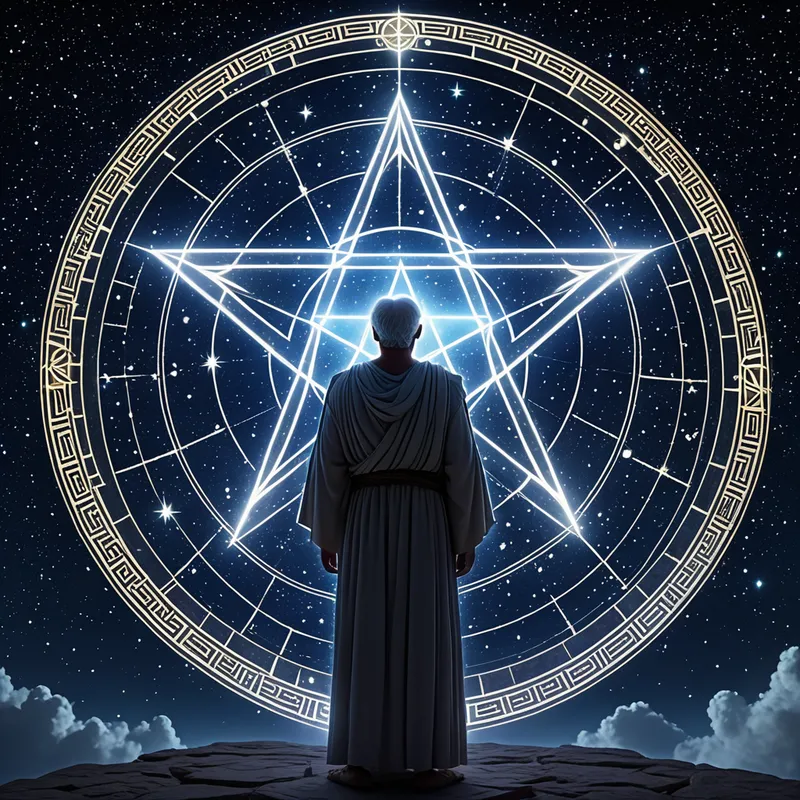
Pentagram Myth Meaning & Symbolism
A sacred symbol of health, harmony, and the soul's hidden journey, discovered in the silent language of mathematics and the cosmos.
The Tale of Pentagram
Listen, and hear the tale not of a hero, but of a secret. It was born not in the clash of swords, but in the silent, humming space between a thought and its truth. In the white-washed city of Croton, where the sea whispered secrets to the shore, there lived a man who listened to the music of the world itself. His name was Pythagoras, and he walked not on earth, but on a lattice of numbers.
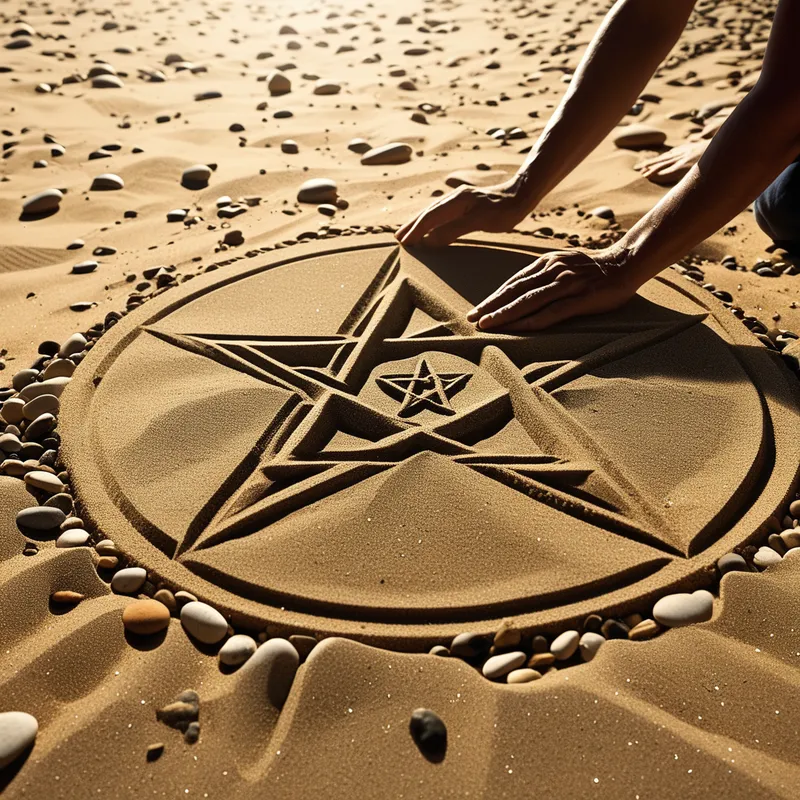
One evening, as the sun bled into the Ionian Sea, casting long shadows across the courtyard of his school, a profound stillness fell. The disciples had departed, and only the whisper of the cypress trees remained. Pythagoras sat, his fingers tracing idle patterns in the fine dust. He was pondering the eternal triangle, the harmony of the spheres, the divine proportion that sang in the shell of a snail and the orbit of a star.
His stick moved, not by conscious will, but by a deeper pull. One line, then another, crossing, intersecting. He was seeking the perfect division, the golden mean, the point where a line sings in perfect ratio to itself. Five strokes. A simple, closed path. But as he stepped back, the dust seemed to ignite with an inner fire. There it was—a five-pointed star, cradled within a five-sided house.
The air grew thick, charged with the scent of ozone and crushed thyme. In the heart of the star, he saw another, smaller star, and within that, another, an infinite regression into a core of pure, blinding light. He heard it then—not a sound, but a vibration. It was the same chord he had discovered in the blacksmith’s hammers, the same mathematical harmony that governed the lyre. This shape sounded. It was the visual echo of the Music of the Spheres.
He saw the dance of the elements: earth, air, fire, water, and the quintessence—aether—all held in dynamic, perfect tension. He saw the human form, arms and legs outstretched, the navel as the center. This was no mere drawing. It was a map. A map of the cosmos, a map of the microcosm, a map of the soul’s journey from the gross elements to the divine spark. The Pentagram had spoken its first, silent word. The secret was revealed, not through battle, but through contemplation; its conflict was the chaos of the unmeasured world, and its resolution was the eternal, silent shout of perfect proportion.
Cultural Origins & Context
This was not a myth of gods on Olympus, but a mystery born in the Pythagorean Brotherhood. The tale of the Pentagram’s discovery was an esoteric teaching, passed in hushed tones within the inner sanctum of the school. It functioned as a foundational symbol, a core piece of their symbolic language that blended mathematics, music, cosmology, and theology into a unified worldview.
For the Pythagoreans, reality was number. To discover a geometric form of such profound perfection—where every line segment relates to others by the Golden Ratio (φ)—was to glimpse the very architecture of the divine mind. The Pentagram, or “Pentalpha”, served as a badge of recognition for initiates and a powerful emblem of their central doctrine: “All is number.” Its societal function was to bind the community together through shared, secret knowledge, setting them apart as those who could see the hidden order behind the visible world.
Symbolic Architecture
The Pentagram is a symbol of dynamic, living harmony, not static perfection. Its five points are in constant, balanced tension, each reliant on the others. Psychologically, it represents the totality of the human psyche striving for integration.
The star is the soul stretched between the five corners of its own experience, seeking the center where contradiction becomes chorus.
The four lower elements—earth (body), air (mind), fire (passion), water (emotion)—are surmounted by the fifth point, aether or spirit. This represents the ultimate goal of Pythagorean practice: the ascent of the soul from the bondage of material concerns and chaotic passions toward intellectual and spiritual purity. The endless recursion of smaller stars within the larger figure symbolizes the fractal nature of the cosmos and the psyche—the macrocosm reflected in the microcosm. The struggle depicted is the internal struggle for balance, proportion, and the subjugation of the irrational (represented by the shocking discovery of irrational numbers like √2) within a framework of perfect order.
The Dreamer’s Resonance
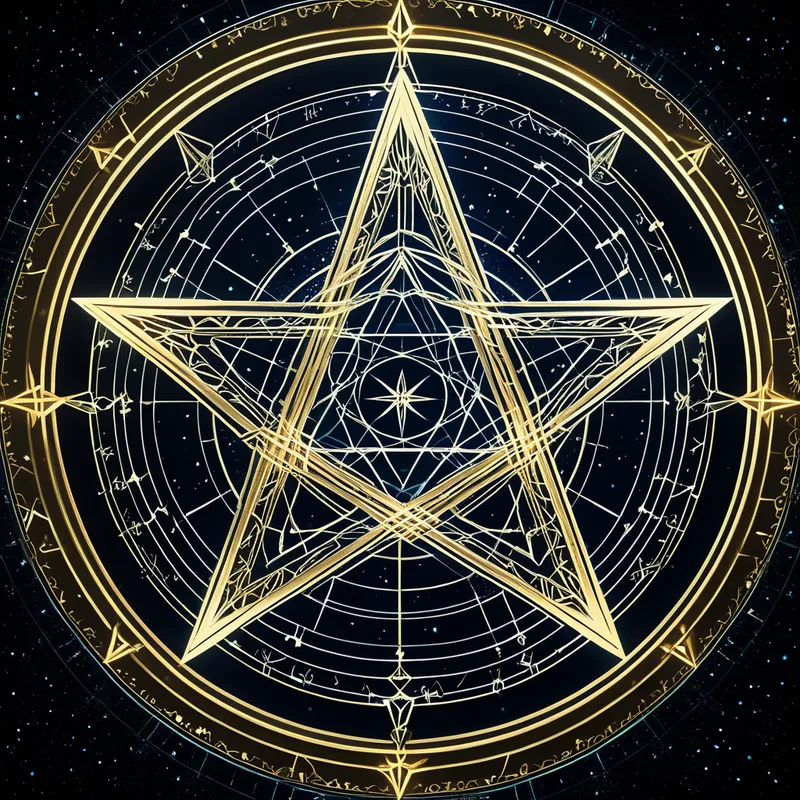
When the Pentagram appears in a modern dream, it is rarely as a static, drawn symbol. It manifests as a process. One might dream of walking a five-pointed path in a labyrinth, of arranging five crucial objects into a specific pattern, or of a relationship dynamic between five people that feels cosmically significant. Somatically, this can accompany feelings of tension, pulling, or a need for rebalancing.
Psychologically, this dream motif signals a phase of synthesis. The dreamer is likely grappling with disparate, often conflicting, aspects of their life or self (career, family, creativity, relationships, personal spirit) that feel disjointed. The Pentagram emerges from the unconscious as an archetypal blueprint for integration. It is the Self’s instruction to find the hidden harmonic ratio between these parts. The anxiety in the dream often mirrors the Pythagorean crisis of the irrational—the frightening, messy, unquantifiable aspects of life that must be acknowledged and incorporated, not denied, to achieve a higher, more complex wholeness.
Alchemical Translation
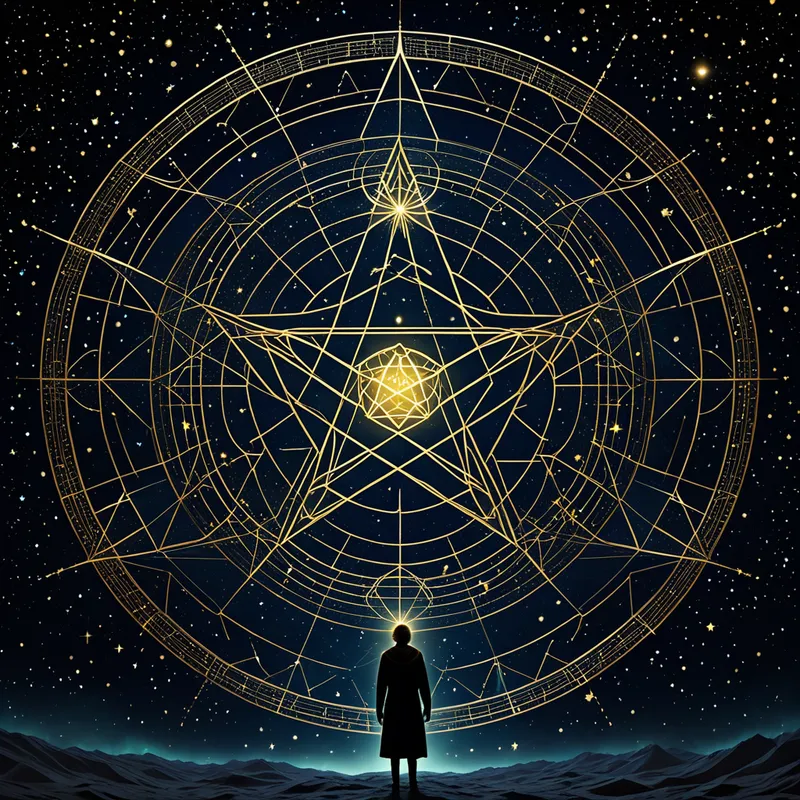
The myth of the Pentagram models the alchemical process of individuation as a geometric and harmonic operation. The initial state is the “unmeasured dust”—the prima materia of the scattered, unexamined life.
The first act of transmutation is to draw the first line: to define a boundary, to make a conscious distinction.
The process of drawing the star is the arduous work of self-observation and differentiation: identifying the five core elements of one’s psyche. The conflict is the discovery of the intersecting lines, the points where these aspects conflict and cause friction (the “irrational” internal contradictions). The resolution is not the elimination of these points of tension, but the realization that they are necessary to create the stable, star-shaped structure of the whole personality.
The final, alchemical stage is the realization of the infinite regression—seeing the same pattern repeating at every scale of one’s being. The personal struggle (microcosm) is recognized as a reflection of a universal principle (macrocosm). The individual achieves the quintessence, not by escaping the four elements of earthly life, but by arranging them in perfect, dynamic proportion around the central, guiding light of the Self. One becomes, like the Pentagram itself, a living emblem of hidden order revealed—a sanctuary of harmony built from the very lines of one’s own contradictions.
Associated Symbols
Explore related symbols from the CaleaDream lexicon: