Penelope's Weaving Myth Meaning & Symbolism
A queen uses a weaving trick to delay suitors, weaving by day and unraveling by night, holding space for her husband's return and her own sovereignty.
The Tale of Penelope’s Weaving
The halls of Ithaca echoed with a silence that was not peace, but a held breath. Twenty years. For twenty years, the great hall, once warmed by the laughter of Odysseus, had grown cold with his absence. In his place swarmed a plague of suitors, men who drank his wine, slaughtered his cattle, and clamored for his throne—and for his wife.
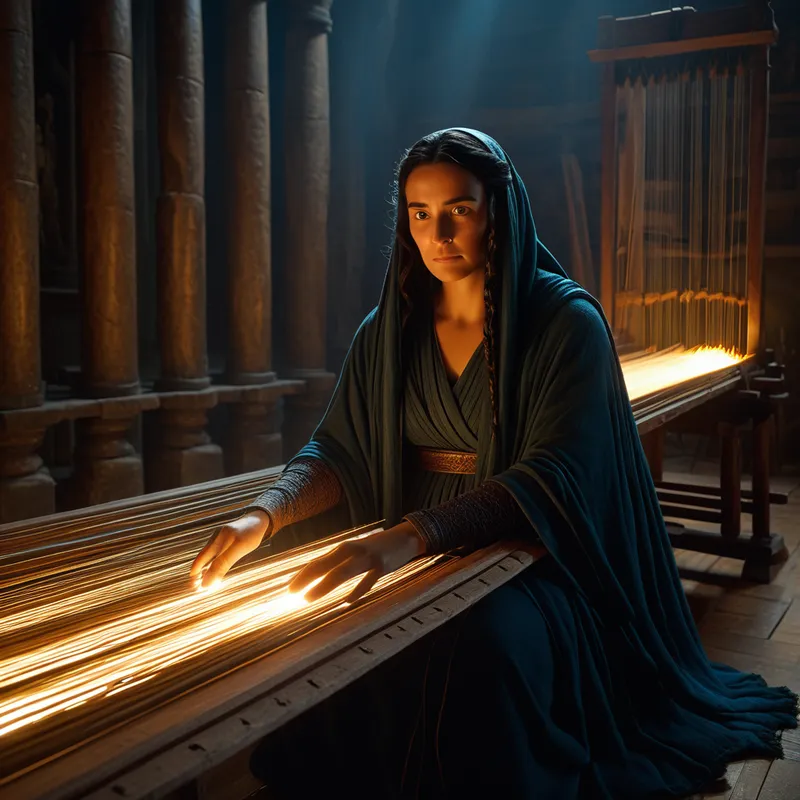
Penelope, the queen, was an island within an island. Grief was her constant companion, but it was a quiet, cunning grief. It sat with her at the massive loom erected in the heart of the palace. To the clamoring men, she appeared a model of pious duty. “My lords,” she announced, her voice clear yet weary, “you press me for an answer. But first, I must discharge a sacred obligation. I am weaving a funeral shroud for Laertes, my husband’s father. It would be a disgrace to let him go to his rest without this final honor. When this shroud is complete, I shall choose a new husband.”
The suitors, bloated with entitlement, agreed. They saw only a woman’s chore, a delay of mere weeks. Each day, they would see her there, in the streaming sunlight from the high windows, her fingers flying across the warp and weft. The shroud grew, a magnificent tapestry of deep purple and brilliant white, a testament to her skill and her supposed resignation.
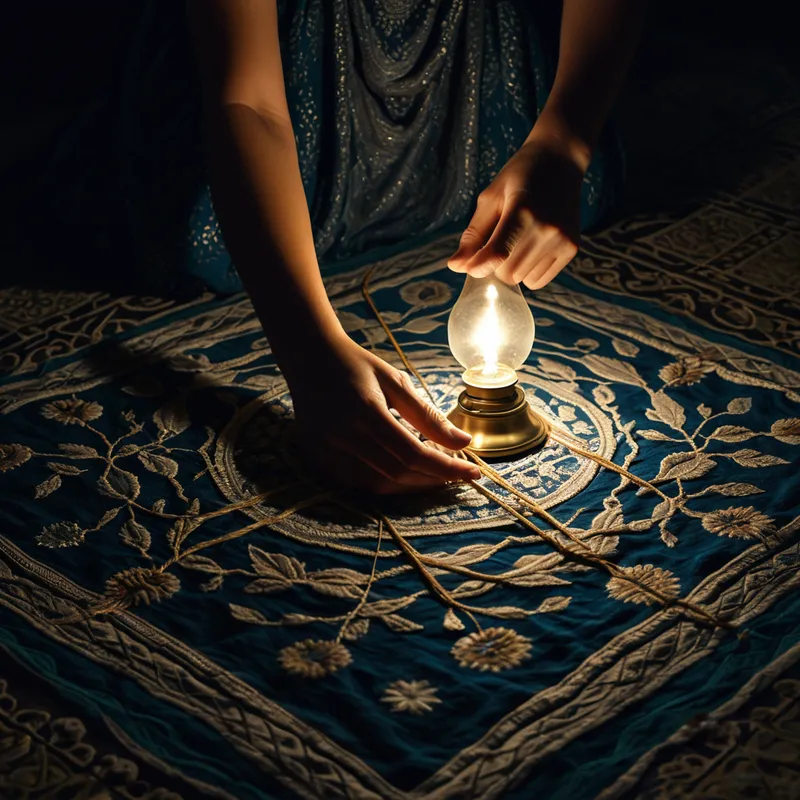
But what they witnessed by day was only half the truth. For when the last drunken song faded and the palace fell into the deep silence of the Nyx-cloaked hours, Penelope would rise. By the guttering light of a single lamp, she would return to the loom. Not to weave, but to unweave. With meticulous, desperate care, she would pull apart the threads she had labored over all day. The growing tapestry would shrink back into a formless heap of yarn. The magnificent pattern dissolved into potential once more.
This was her secret, her silent war. For three years, the day’s creation was annulled by the night’s dissolution. The shroud for Laertes, a symbol of an ending, became the very mechanism of continuance. Her fidelity was not a passive waiting; it was an active, creative defiance. She wove time itself into a circle, holding the linear, demanding world of the suitors at bay. The tension was a live wire in her soul—the fear of discovery, the ache for her lost husband, the crushing weight of a kingdom on her shoulders. Yet, her hands never faltered in their dual rhythm: the steadfast click-clack of the shuttle by day, and the soft, whispering shush of unraveling threads by night. Her cunning was her loom, and upon it, she wove the fragile fabric of hope.
Cultural Origins & Context
This core strand of the Odyssey originates in the oral tradition of Archaic Greece, a world where a woman’s worth and security were intrinsically tied to her husband. Penelope’s story would have been sung by bards alongside the bloody exploits of her husband, offering a crucial, interior counterpoint to the epic’s external adventures. Her narrative functioned as a societal anchor, embodying the ideal of the parthenos (married woman) who maintains the oikos (household) against all threats.
Homer, compiling these tales, presents her not merely as a plot device but as a figure of immense intelligence (metis), a quality highly valued but often depicted as masculine. Her weaving ruse is a masterclass in this cunning intelligence. In a culture with rigid gender roles, her power operates within the domestic sphere—the loom—transforming it into a site of profound strategy and resistance. The myth reassured a patriarchal society of the loyal wife while simultaneously, and subversively, showcasing a model of female agency and intellectual triumph where physical force was impossible.
Symbolic Architecture
Penelope’s loom is the axis mundi of her psyche, the still point around which chaos swirls. The act of weaving and unweaving is a perfect symbolic paradox, containing the entire tension of her—and our—human condition.
The work of the soul is often not completion, but the sacred maintenance of the threshold, the active holding of a space for what must one day return.
The Daytime Weaving represents the persona, the face shown to the world. It is duty, social contract, and visible progress. It is the construction of a plausible reality to appease external demands—the “shroud” of acceptable behavior that covers our true intentions.
The Nighttime Unraveling is the work of the shadow and the true self. It is the preservation of inner truth, the private vow, the secret hope that refuses to be finalized by external pressure. This dissolution is not destruction, but a return to potential. It negates the false endings imposed by others.
The Suitors symbolize the relentless pressures of the outer world—social expectations, deadlines, compromises, and the temptations of easier, more conventional paths that demand we sacrifice our deeper commitments.
The never-finished Shroud itself is the central symbol. It is the work-in-progress of the self, a tangible manifestation of a liminal state between endings and beginnings. It is the physical form of patience, a patience that is not passive waiting, but a dynamic, creative, and deeply strategic state of being.
The Dreamer’s Resonance
When this myth stirs in the modern unconscious, it often manifests in dreams of futile labor or protective deception. You may dream of building a sandcastle as the tide comes in, writing a document that erases itself, or rehearsing a speech in a mirror that cracks. The somatic feeling is one of exquisite tension—a muscle held just shy of cramping, a breath held too long.
Psychologically, this signals a period where the dreamer is engaged in a “holding pattern.” This is not stagnation. It is a critical, active process of maintaining integrity against internal or external forces demanding a premature decision, closure, or commitment. The psyche is saying, “The time is not right. The true partner—be it a person, a project, or a part of yourself—has not returned. You must creatively delay, using the materials at hand.” The dream acknowledges the exhaustion of this dual life (the public weave, the private unravel) but validates its necessity as a soul-survival strategy.
Alchemical Translation
In the alchemy of individuation, Penelope’s ordeal models the opus contra naturam—the work against nature, or more precisely, against the apparent natural course of events. The “natural” response to her situation would be despair, surrender, or pragmatic acceptance of a new husband. Instead, she engages in a psychic alchemy that transmutes linear, oppressive time into cyclical, soul-time.
The prima materia for transformation is often the unbearable tension of opposites. The soul’ gold is forged in the space between weaving and unraveling, between yes and no.
The first stage is Negatio (Negation). Her nightly unraveling is not nihilism; it is the conscious refusal to let the external world dictate her inner reality. It is the “no” that protects the fragile “yes” burning within.
The second is Mortificatio (Mortification). This is the suffering of the tension itself—the loneliness, the fear of discovery, the sheer fatigue of the double life. This suffering “kills” the naive hope and forges it into a resilient, cunning faith.
The final, implicit stage is Solutio (Dissolution) leading not to death, but to Coagulatio (Coagulation). When Odysseus finally returns and the suitors are defeated, the need for the ruse dissolves. The energy bound in the endless cycle is released. The threads of her cunning, her patience, and her fidelity can finally be woven into a new, authentic fabric—not a shroud for an ending, but the tapestry of a reunited life, created on her own terms. For the modern individual, the myth teaches that the creative act of holding space—for a calling, a relationship, or a true self to emerge—is itself the heroic journey. The triumph is not in the final product, but in the wisdom and integrity sustained through every treacherous day and every unraveling night.
Associated Symbols
Explore related symbols from the CaleaDream lexicon: