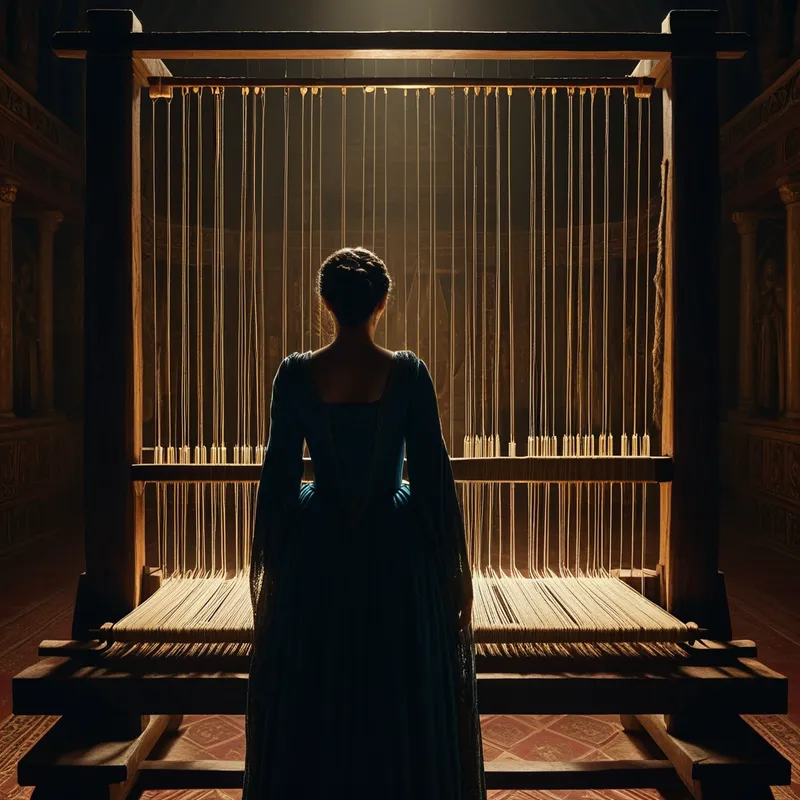
Penelope's Loom Myth Meaning & Symbolism
A queen weaves and unravels a shroud to hold chaos at bay, using time and craft to preserve a sacred space for a lost king's return.
The Tale of Penelope’s Loom
Hear now the story woven not in wool, but in the marrow of the soul, a tale from the age when gods walked in men’s shadows and a woman’s wit was the only shield against the dark.
For twenty years, the great hall of Ithaca has groaned under a wrongness. Its king, the cunning [Odysseus](/myths/odysseus “Myth from Greek culture.”/), is lost to the wine-dark sea, and vultures have gathered in his place. A hundred princes from neighboring isles—the suitors—have descended like a plague of locusts. They devour the kingdom’s wealth, slaughter its flocks, and fill the air with their drunken boasts. Their demand is a single, corrosive note: the queen must choose a new husband. The kingdom, they say, cannot remain in this suspended breath. It must have a king.
But the queen, [Penelope](/myths/penelope “Myth from Greek culture.”/), is a woman whose love is a geography more vast than [the sea](/myths/the-sea “Myth from Greek culture.”/). In the center of the besieged palace, she has erected her fortress: a great, upright loom of aged oak. Upon it, she has begun a shroud for Laertes, her father-in-law, an old man wrapped in the cloak of his grief. “Honor demands I complete this funeral cloth,” she tells the clamoring suitors, her voice a calm lake over a deep current. “When it is done, I will give you my answer.”
And so, by day, they see her. In the slanting light from the high windows, her figure is a study in devotion. The click-clack of the heddle, the whisper of the shuttle, the growing tapestry of rich purple and somber black—it is a performance of perfect piety. The suitors, mollified by this visible progress, return to their feasting. They can afford to wait a little longer.
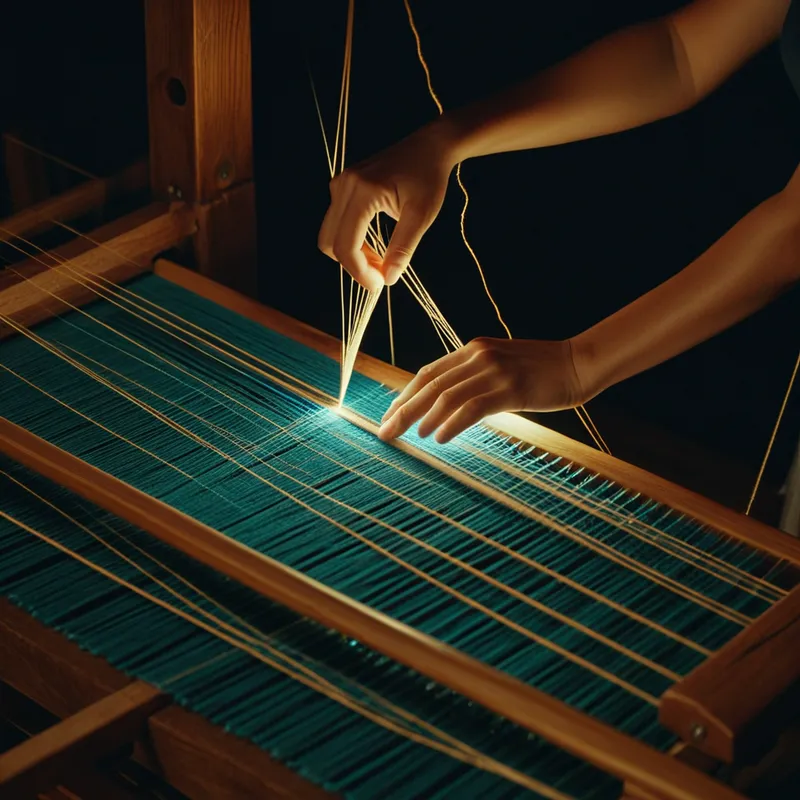
But night is a different country. When the last drunkard has stumbled to his pallet and the great hall echoes only with the sighs of [the hearth](/myths/the-hearth “Myth from Norse culture.”/), Penelope returns. Not to weave, but to unravel. By the guttering light of a single oil lamp, her strong, slender fingers—the same that guided the shuttle—now work in reverse. She seeks a single thread, pulls it gently, and watches the day’s labor dissolve. Stitch by careful stitch, the pattern she built unwinds. The shroud that grew by sunlight shrinks by moonlight. It is an act of silent, breathtaking sabotage. A day woven, a night undone. A promise kept by being perpetually broken.
For three years, this is the rhythm of the palace: the daily promise of an ending, the nightly return to the beginning. It is a spell cast with thread, a binding of time itself. The suitors are trapped not by walls, but by the visible, credible progress of a task that never completes. They are pacified by a future that never arrives. Then, a maidservant, bought with trinkets and whispers, betrays the nocturnal truth. The suitors’ rage is a sudden storm. The deception is over.
Yet, in that moment of exposure, the true weaving is revealed. The shroud was never for Laertes. It was a net to snare time, a sacred space woven to keep a home and a hope intact. It bought the hours in which a ragged beggar, newly arrived on the shore, could string a great bow and reclaim his kingdom. The loom’s work was done. The king was home.
Cultural Origins & Context
This story reaches us from the heart of the Odyssey, composed in the 8th century BCE but singing of a legendary Bronze Age past. It was not read, but heard. A bard, a rhapsode, would chant these verses to the accompaniment of a lyre in the halls of aristocrats or at public festivals. Penelope’s stratagem was not a minor subplot, but a central pillar of the epic’s tension, a mirror in Ithaca to Odysseus’s own cunning ([metis](/myths/metis “Myth from Greek culture.”/)) on his travels.
In a society where a woman’s primary cultural currency was fidelity (pistis) and domestic management, Penelope’s story functioned as the ultimate exemplar. But it transcended mere morality tale. It showcased the legitimate, potent power available to a woman within the strict confines of the oikos (the household). She could not wield a sword like Odysseus, but she could wield time, custom, and craft. Her loom became the symbolic center of the kingdom in the king’s absence, and her act of unraveling was a profound, subversive form of political resistance, using the very tools of her domestic role to defy the demands of a hostile world.
Symbolic Architecture
The loom is the [axis](/symbols/axis “Symbol: A central line or principle around which things revolve, representing stability, orientation, and the fundamental structure of reality or consciousness.”/) of this myth, a world-[tree](/symbols/tree “Symbol: In dreams, the tree often symbolizes growth, stability, and the interconnectedness of life.”/) in miniature. On its frame, the fundamental tensions of existence are stretched: order and [chaos](/symbols/chaos “Symbol: In Arts & Music, chaos represents raw creative potential, uncontrolled expression, and the breakdown of order to forge new artistic forms.”/), creation and [dissolution](/symbols/dissolution “Symbol: The process of breaking down, dispersing, or losing form, often representing transformation, release, or the end of a state of being.”/), time and [eternity](/symbols/eternity “Symbol: The infinite, timeless state beyond human life and measurement, often representing the ultimate or divine.”/).
The true fabric Penelope weaves is not a shroud, but a vessel of potential—a womb of time in which a future can still be born.
The [Daytime](/symbols/daytime “Symbol: Daytime often symbolizes clarity, awareness, and the active aspects of life, contrasting with night, which represents the unconscious.”/) Weaving represents the [persona](/symbols/persona “Symbol: The social mask or outward identity one presents to the world, often concealing the true self.”/), the necessary face shown to [the world](/myths/the-world “Myth from Tarot culture.”/). It is compliance, social duty, and visible progress. It is the [construction](/symbols/construction “Symbol: Construction symbolizes creation, building, and the process of change, often reflecting personal growth and the need to build a solid foundation.”/) of a credible [reality](/symbols/reality “Symbol: Reality signifies the state of existence and perception, often reflecting one’s understanding of truth and life experiences.”/) that pacifies external pressures—the suitors, the demands of society to “move on,” to resolve the unresolved.
The Nocturnal Unraveling is the work of the [soul](/symbols/soul “Symbol: The soul represents the essence of a person, encompassing their spirit, identity, and connection to the universe.”/). It is the sacred, hidden labor of preservation. This is not destruction, but a profound, active [resistance](/symbols/resistance “Symbol: An object or tool representing opposition, struggle, or the act of pushing back against external forces or internal changes.”/) to closure. It is [the ego](/myths/the-ego “Myth from Jungian culture.”/)’s refusal to let the [story](/symbols/story “Symbol: The symbol of ‘Story’ represents the narrative woven through our lives, embodying experiences, lessons, and emotions that shape our identities.”/) be finished on others’ terms, to declare hope dead and sanctify [loss](/symbols/loss “Symbol: Loss often symbolizes change, grief, and transformation in dreams, representing the emotional or psychological detachment from something or someone significant.”/). Each pulled thread is a defiance of [linear](/symbols/linear “Symbol: Represents order, predictability, and a direct, step-by-step progression. It symbolizes a clear path from cause to effect.”/), consumptive time.
The Suitors symbolize the relentless pressures of the outer world that seek to force a premature [resolution](/symbols/resolution “Symbol: In arts and music, resolution refers to the movement from dissonance to consonance, creating a sense of completion, release, or finality in a composition.”/)—the rush to remarry, to replace, to fill a void with [noise](/symbols/noise “Symbol: Noise in dreams signifies distraction, confusion, and the need for clarity amidst chaos.”/) and substance before the true essence has had its [chance](/symbols/chance “Symbol: A representation of opportunities and unpredictability in life, illustrating how fate can influence one’s journey.”/) to return. They are the collective [shadow](/symbols/shadow “Symbol: The ‘shadow’ embodies the unconscious, repressed aspects of the self and often represents fears or hidden emotions.”/), the temptation of [despair](/symbols/despair “Symbol: A profound emotional state of hopelessness and loss, often signaling a need for transformation or surrender to deeper truths.”/) masquerading as pragmatic necessity.
The ultimate [Betrayal](/symbols/betrayal “Symbol: A profound violation of trust in artistic or musical contexts, often representing broken creative partnerships or artistic integrity compromised.”/) by the Maid signifies the inevitable [moment](/symbols/moment “Symbol: The symbol of a ‘moment’ embodies the significance of transient experiences that encapsulate emotional depth or pivotal transformations in life.”/) when the inner compromise can no longer be hidden. The [psyche](/myths/psyche “Myth from Greek culture.”/)’s delicate, secret holding [pattern](/symbols/pattern “Symbol: A ‘Pattern’ in dreams often signifies the underlying structure of experiences and thoughts, representing both order and the repetitiveness of life’s situations.”/) is exposed to the harsh light of reality. Yet, crucially, the unraveling lasted just long enough. The myth tells us that this creative resistance is not about eternal delay, but about buying the necessary time for the deep, transformative process—the [hero](/symbols/hero “Symbol: A hero embodies strength, courage, and the ability to overcome significant challenges.”/)’s [journey](/symbols/journey “Symbol: A journey in dreams typically signifies adventure, growth, or a significant life transition.”/) of the soul—to reach its [culmination](/symbols/culmination “Symbol: A point of completion or climax in a process, often marking the end of a cycle and the achievement of a goal.”/).
The Dreamer’s Resonance
When this myth stirs in the modern dreamer, it often manifests as dreams of futile labor or suspended animation. You may dream of endlessly preparing a meal that is never eaten, writing a document that deletes as you type, or building a structure that collapses at dawn. The somatic feeling is one of profound, wearying tension—a sense of running in place, yet with a core of absolute necessity.
Psychologically, this is [the Self](/myths/the-self “Myth from Jungian culture.”/)’s enactment of a Penelope process. You are in a life situation where an ending is being demanded of you—to leave a relationship, to finalize a grief, to abandon a long-held creative project—but your soul knows the time is not ripe. The conscious mind (the daytime weaving) may be going through the motions of “moving on,” but the unconscious (the nocturnal unraveling) is actively deconstructing that closure. This dream pattern signals a psyche holding a liminal space against the internal and external “suitors” of premature judgment, closure, or despair. It is not stagnation, but active, soul-level endurance.

Alchemical Translation
The alchemical journey of individuation is not a straight path to a goal, but a circulatio—a cycling through stages of dissolution and coagulation. Penelope’s loom models this exact operation.
Individuation requires the courage to unravel the day’s certainties, to hold the tension of the unfinished thing, for it is in that pregnant pause that the gold is formed.
First, we must Weave the [Persona](/myths/persona “Myth from Greek culture.”/) (Coagulatio). We take the raw materials of our social selves, our duties, and the expectations upon us, and we craft a credible life. This is necessary; it holds our place in the world.
Then, we must engage in the Sacred Unraveling ([Solutio](/myths/solutio “Myth from Alchemical culture.”/)). This is the introspective, often painful, work of questioning that very construction. We pull the thread of a belief we held dear, a identity we assumed, a path we declared finished. We dissolve the day’s work not out of nihilism, but to return to the raw material, to the potential. This prevents the persona from becoming a sarcophagus, a finished shroud for a living soul.
The suitors within us—our inner critic, our impatience, our desire for the comfort of any answer over the anxiety of mystery—clamor for us to stop this “futile” cycle. To choose, to finish, to bury the hope for the return of what is lost or not yet found (the lost king, the true Self).
Penelope’s genius is her Willed Suspension. She masters the tension between the opposites—weaving and unraveling, promise and delay, hope and despair—without collapsing into either pole. She becomes [the vessel](/myths/the-vessel “Myth from Alchemical culture.”/) for the coniunctio, [the sacred marriage](/myths/the-sacred-marriage “Myth from Various culture.”/), which in the psyche is the reunion of the conscious ego with the long-absent, transformative power of the Self (Odysseus). Her work ensures that when the true king finally arrives, ragged and unrecognizable from his journey, there is still a home, a coherent psyche, to which he can return and be recognized. Her loom teaches that the highest creativity is sometimes the fierce, patient, cyclical preservation of the space where wholeness can one day land.
Associated Symbols
Explore related symbols from the CaleaDream lexicon: