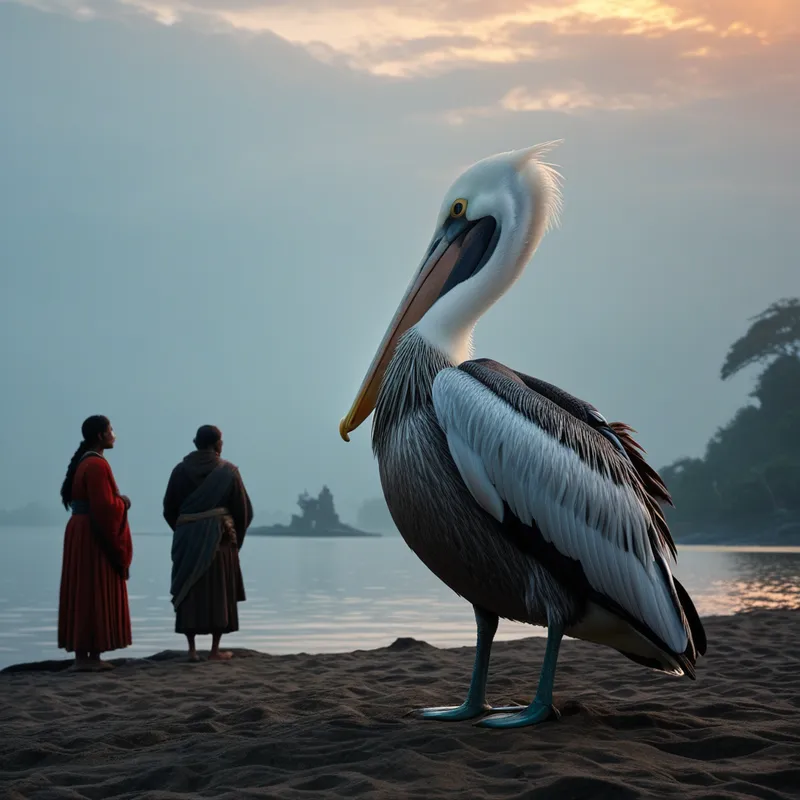
Pelican Clan Myth Meaning & Symbolism
A myth of a clan's transformation through self-sacrifice, where a great bird tears its own breast to feed its people, birthing a new covenant with life.
The Tale of Pelican Clan
Listen. In the time before time, when the world was still soft from the dreaming, there was a people. They were the People of the Reeds, living where the water whispered to the land. Life was a cycle of sun and fish, of birth and passing. But the cycle broke.
A great silence fell. The sun became a relentless eye, the earth cracked like old pottery, and the waters shrank back, hiding their life. The fish vanished into the deep, cold mud. The reeds browned and whispered only of thirst. The people grew thin, their spirits drying like the creek beds. The children’s cries were the only music, a sharp, aching song of emptiness. The elders looked to the sky, but the sky was a bowl of hard, blue stone.
In their despair, they gathered one last time at the edge of the grey water. They had no more prayers, only a shared silence of ending. It was then that a shadow fell upon them—a shadow vast and cool as a cloud. They looked up.
There, against the sun, was Pelican. Not as we know it now, but as it was in the First World: a being of immense grace, with wings that held the memory of rain and eyes that were deep, still pools. It did not speak with a human tongue, but its presence was a language felt in the bone. It saw their hollow cheeks, their eyes like dried berries, the life leaching from them.
And Pelican’s heart, which beat with the rhythm of the lake’s deepest springs, broke open. Not with sorrow alone, but with a knowing. A terrible, beautiful knowing.
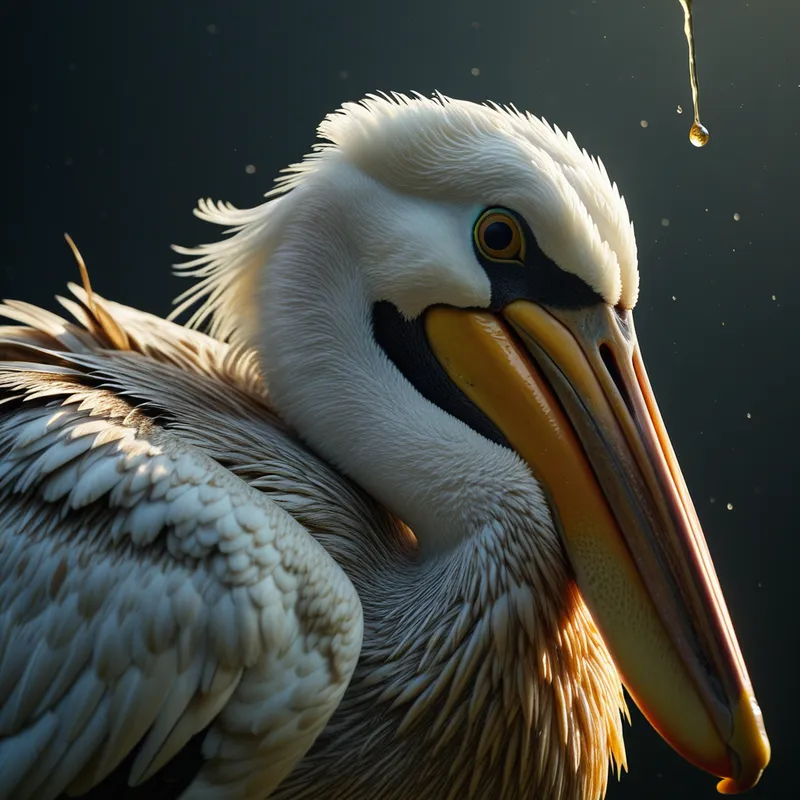
With a sound that was not a cry but a tearing of the very air, Pelican raised its great, hooked beak. Not to the empty sky. Not to the barren water. It turned its gaze upon its own breast, the place of its life-warmth. And there, with a act of will that shook the watching world, it struck.
It tore open its own flesh.
But from the wound did not flow only blood. There flowed a substance of light and life—thick, rich, shimmering with the essence of all that was and could be. It was nourishment beyond food, a liquid sunrise, a sacrifice made substance. This radiant flow poured forth, not onto the ground, but directly into the waiting mouths of the people, onto the parched earth, into the very roots of the reeds.
The people drank. And as they drank, strength returned not just to their bodies, but to their souls. The colour returned to the world. The waters, tasting the sacrifice, began to rise. The fish returned. But the people were no longer the People of the Reeds. They were changed, marked by the covenant of that moment. They were the Pelican Clan, forever children of the one who fed them from its own heart.
And Pelican? It did not die. It became a new kind of being. Its breast bore forever the mark, the sacred hollow, from which life had been given. It flew on, a living testament, and where it fished, it would store the catch in the pouch that was once a wound—a perpetual reminder that the vessel of giving is shaped by its own sacrifice.
Cultural Origins & Context
The narrative of the Pelican Clan finds its roots among various Indigenous peoples of the North American wetlands and coastal regions, particularly within the cultural tapestry of the Pacific Northwest and Southeastern tribes. This is not a single, monolithic story, but a powerful motif that surfaces in clan origins, ethics, and cosmology. It was traditionally passed down not as mere entertainment, but as adaawx or teaching narrative, often by elders and storytellers during the long winter nights or in rites of passage.
Its societal function was multifaceted. Primarily, it served as a foundational charter for the Pelican Clan itself, explaining their unique identity, responsibilities, and their symbiotic relationship with the bird that was their totem. Ethically, it encoded the supreme law of generosity and leadership: that true authority is born of self-sacrifice for the community’s survival. The chief or matriarch was to embody this pelican-heartedness, putting the people’s needs before their own. Ecologically, it wove the human community into the web of life with a sacred duty, reminding them that their sustenance was part of a profound, sometimes painful, cycle of gift and reciprocity.
Symbolic Architecture
At its core, the myth is an archetypal drama of the nourishing depths confronting the barren surface. The pelican is not a distant god, but a proximate, embodied spirit of the life-source itself—the lake, the tribe’s womb—turning its generative power inward to address a crisis of lack.
The wound that feeds is the paradox at the heart of creation. To give from surplus is charity; to give from essence is transformation.
Psychologically, the pelican represents the Self in its aspect as the ultimate caregiver. The drought symbolizes a psychic state of aridity, depression, or spiritual famine, where the ego-consciousness (the people) is cut off from its inner wellspring. The pelican’s auto-sacrifice is the shocking, autonomous act of the unconscious psyche to break its own boundaries and flood the conscious mind with life-giving content—insight, emotion, libido—even at great cost to its own prior form.
The resulting “clan” symbolizes a new psychic structure. The individual is no longer merely a collection of personal desires (People of the Reeds) but is now organized around a central, nourishing mystery (the Pelican Clan). The mark on the pelican’s breast, transformed into a pouch, signifies that the wound of sacrifice becomes the permanent vessel for future sustenance; trauma, integrated, becomes capacity.
The Dreamer’s Resonance
When this myth stirs in the modern dreamer, it often manifests in periods of profound emotional or spiritual depletion. You may dream of a giant, silent bird visiting you in a desolate landscape. You may find yourself desperately hungry, and then discover a mysterious, radiant food source that seems to come from your own body or a loved one’s. A dream of a heart glowing with a soft, golden light, or of feeding others from your own hands in a way that feels both painful and necessary, echoes this pattern.
Somatically, this can correlate with sensations in the chest—tightness, warmth, or a feeling of “opening.” Psychologically, you are likely undergoing a process where an old way of being (a job, identity, relationship) has become a psychic desert. The dream signals that the solution will not come from searching outside, but from a shocking, inward-turning generosity from a deep part of yourself you may have neglected or wounded. It is the Self’s intervention, tearing open its own resources to save the conscious personality from starvation. The process feels like a crisis because it is—it is the crisis that precedes rebirth.

Alchemical Translation
The alchemical journey mirrored here is the nigredo giving way to the albedo through the shocking rubedo—the blackness of despair, the whitening of purification via the red act of sacrifice. For the modern individual on the path of individuation, the Pelican Clan myth models a critical phase.
First, one must acknowledge the drought: the feeling of meaninglessness, the burnout, the creative block. This is the honest confrontation with the nigredo. The ego, like the people, is helpless. Then comes the pivotal, terrifying turn: not an effortful striving, but a receptive suffering that allows a deeper authority to act. The pelican’s strike is the moment of rubedo—the passionate, bloody, sacrificial act where a part of the psyche (a cherished ideal, a comfort, a long-held pain) is willingly offered up.
Individuation demands not that we become pelicans, but that we acknowledge the Pelican within—the inner other who loves us enough to wound itself for our growth.
The nourishment that flows is the new consciousness. It might be the birth of compassion from acknowledged suffering, creativity from endured emptiness, or genuine self-love from the act of self-giving. You are transformed into a member of your own “Pelican Clan”—your identity is now structured around this central, sacrificial mystery. You carry the pouch, the hollow that is also a source. Your life’s work becomes the gathering and distributing of what you once received in your time of famine, not from a place of pristine wholeness, but from the sacred hollow that proves you have loved, lost, and chosen to feed the world anyway.
Associated Symbols
Explore related symbols from the CaleaDream lexicon: