
Pele Myth Meaning & Symbolism
The myth of Pele, the volcanic goddess, is a profound saga of creation through destruction, exile, passion, and the forging of new land from primal fire.
The Tale of Pele
Listen. The story begins not in the green valleys, but in the cold, distant dark. In the homeland of Kāhiki, where the sea is a memory of separation, a family of gods chafed under a sky that felt like a lid. Among them was Pele, whose spirit was not of water or calm earth, but of the fire that sleeps in stone. Her very breath steamed, and her dreams were of landscapes born in cataclysm.
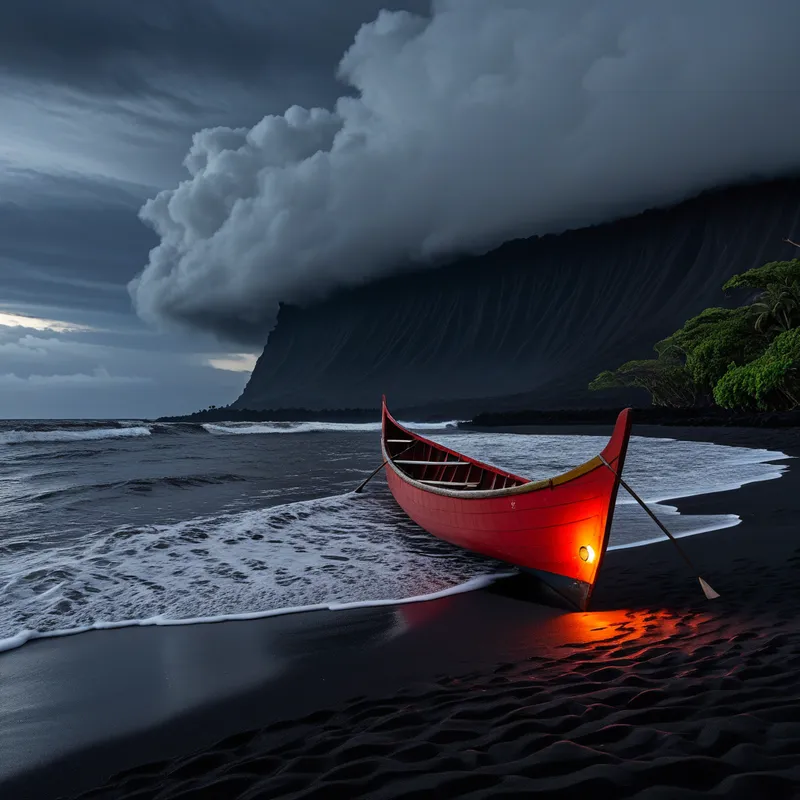
Her elder sister, Nāmakaokahaʻi, whose domain was the vast, crushing deep, saw Pele’s restless fire as a threat to the ancestral order. A great conflict erupted, a war of elemental natures. Pele, with her faithful younger sister Hiʻiaka—who she carried as an egg in her armpit—fled. They fled in a great canoe, chased by Nāmaka’s tidal wrath.
Their voyage was a genesis of islands. Wherever Pele thrust her magical digging stick, the Pāoa, into the seabed, fire would erupt, building land from the ocean floor. But each time, Nāmaka’s waves would rise and quench the fledgling fires, drowning the newborn earth. From Niʻihau to Kauaʻi, to Oʻahu, each island was a temporary haven, then a tomb, as the sea goddess pursued her fiery sister with relentless fury.
Finally, exhausted and cornered on the island of Maui, a final, cataclysmic battle ensued. Nāmakaokahaʻi, in her full oceanic might, struck Pele down, tearing her body apart and scattering her bones across the land. It was a seeming end. But Pele’s spirit was not so easily extinguished. Her essence fled south, to the youngest, largest island. There, at the summit of Kīlauea, she rose again, reborn in the heart of the caldera. Here, the sea could not reach her. Here, her fires found a permanent home. The Big Island of Hawaiʻi was her ultimate creation, still growing, still breathing with her molten breath.
Yet, the story of creation is also a story of passion. Pele, in the form of a beautiful young woman, would often walk among mortals. She once fell deeply for a chief named Lohiʻau on Kauaʻi. She sent her most beloved sister, Hiʻiaka, on a perilous journey to fetch him, promising not to stir the fires of her home in Hiʻiaka’s absence. The journey took far longer than forty days; faced with demons and trials, Hiʻiaka was delayed. Pele, consumed by jealous fire and assuming betrayal, erupted in fury, scorching the lush forests of Puna and destroying Hiʻiaka’s sacred lehua groves and her dearest friend, the maiden Hopoe. When Hiʻiaka finally returned with Lohiʻau, she found her world in ashes. In a climax of tragic passion, Hiʻiaka embraced the mortal chief before Pele’s very eyes, and Pele’s wrath consumed him. The sisters were forever estranged, their bond shattered by the very fire that forged their home. Pele remained, a goddess of sublime, terrifying creativity and lonely, immortal passion, her home both a womb and a forge, her heart a chamber of endless, conflicted flame.
Cultural Origins & Context
The myth of Pele is not a relic of a dead past but the living breath of the Hawaiian people. These stories, or moʻolelo, were the vessels of history, genealogy, and cosmic understanding. They were chanted by kahuna and skilled storytellers, passed down through moʻokūʻauhau with precise cadence and language to preserve their mana.
Pele’s function was multifaceted. She explained the terrifying, awe-inspiring geology of the islands—the lava flows that destroyed forests and villages yet created new, fertile land. She was a spiritual reality; offerings of ʻōhelo berries, mokihana, and strands of hair are still given to her at the crater’s edge. Her myth enforced profound ecological and social lessons: the respect for elemental power, the understanding that creation and destruction are inseparable, and the consequences of broken promises and unchecked jealousy. She was the ultimate ʻaumakua for some families, a ancestor whose fierce nature demanded and deserved reverence.
Symbolic Architecture
Pele is not merely a goddess of volcanoes; she is the archetypal embodiment of the creative-destructive impulse that exists at the core of all profound change. Her myth maps the psyche’s journey from exiled fragmentation to empowered, albeit isolated, embodiment.
The primal self must often be shattered by the old order (the sea) to be reborn in its true, elemental form (the fire).
Her flight from Kāhiki represents the soul’s exile from a state of unconscious belonging that can no longer contain its burgeoning, disruptive potential. The failed islands are tentative selves, partial identities that could not withstand the pressure of the deep, conformist unconscious (Nāmakaokahaʻi). Only in the final, total confrontation—the symbolic death and dismemberment—is the old identity structure彻底 destroyed, allowing for a rebirth into a more authentic, central, and powerful form at Kīlauea.
The saga with Hiʻiaka and Lohiʻau reveals the shadow of this creative fire: its capacity for consuming jealousy and its tragic isolation. Pele’s passion is absolute, but it cannot tolerate the independent life of others. Her fire, which builds land, also burns the gardens of relationship. She is the ultimate creator, but her creation demands a sacrifice of the soft, growing, interconnected world represented by Hiʻiaka and the lehua forests.
The Dreamer’s Resonance
To dream of Pele’s pattern is to feel the ground of your psyche becoming seismically active. It speaks to a period of intense, often disruptive, emotional or creative upheaval. Somaticly, one might feel a rising heat, restlessness, or pressure—a sense that something must erupt or be released.
Psychologically, this dream motif appears when long-suppressed passions, rages, or creative drives can no longer be contained by the “watery” defenses of adaptation, calm, and compromise (Nāmakaokahaʻi). The dreamer may be on the verge of a life-altering decision that feels both destructive to their current situation and necessary for their growth. The scorched forests in the dream are not mere destruction; they are the clearing of old, outgrown psychic structures to make way for new, more authentic ground. The dream is a summons from the deep self to stop building temporary islands and to claim your central, volcanic power, with all its terrifying and glorious consequences.
Alchemical Translation
The individuation process modeled by Pele is the opus contra naturam—the work against the prevailing nature—of transforming a latent, fiery potential into a conscious, creative force. It is the alchemy of the nigredo, where the old self is burned away.
The psyche’s most fertile land is always forged in the flows of its own deepest eruptions.
The modern individual begins in their personal Kāhiki: a state of adapted, perhaps comfortable, but ultimately restrictive identity. The stirring of Pele is the awakening of a vocation, a passion, or a truth so potent it threatens to destroy current relationships, careers, or self-concepts (the flight, the battle with the sister-sea). The failed islands are half-measures: the new job that isn’t quite right, the relationship that dulls the fire, the art form that doesn’t fully express the vision.
The alchemical crucible is the confrontation at Maui—the necessary, often painful, dissolution of the ego’s current form. This is the dark night, the depression, the crisis that feels like an end. But it is the prerequisite for the rebirth at Kīlauea: the establishment of a life centered on that primal, creative fire. This new center is powerful and authentic, but the myth warns it comes with a cost: the potential for isolation and the burning of certain “gardens” of softer, relational joys (the rift with Hiʻiaka). The individuated self, like Pele, learns to rule its fire, to direct its flows of creation, and to respect the sacred offerings of the world it both destroys and renews. It understands that to create is, in some essential way, to destroy what was, and to accept that responsibility is the price of a soul made of primordial flame.
Associated Symbols
Explore related symbols from the CaleaDream lexicon: